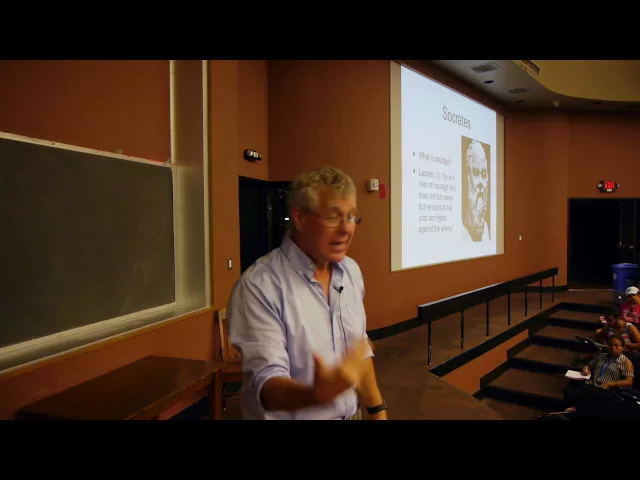
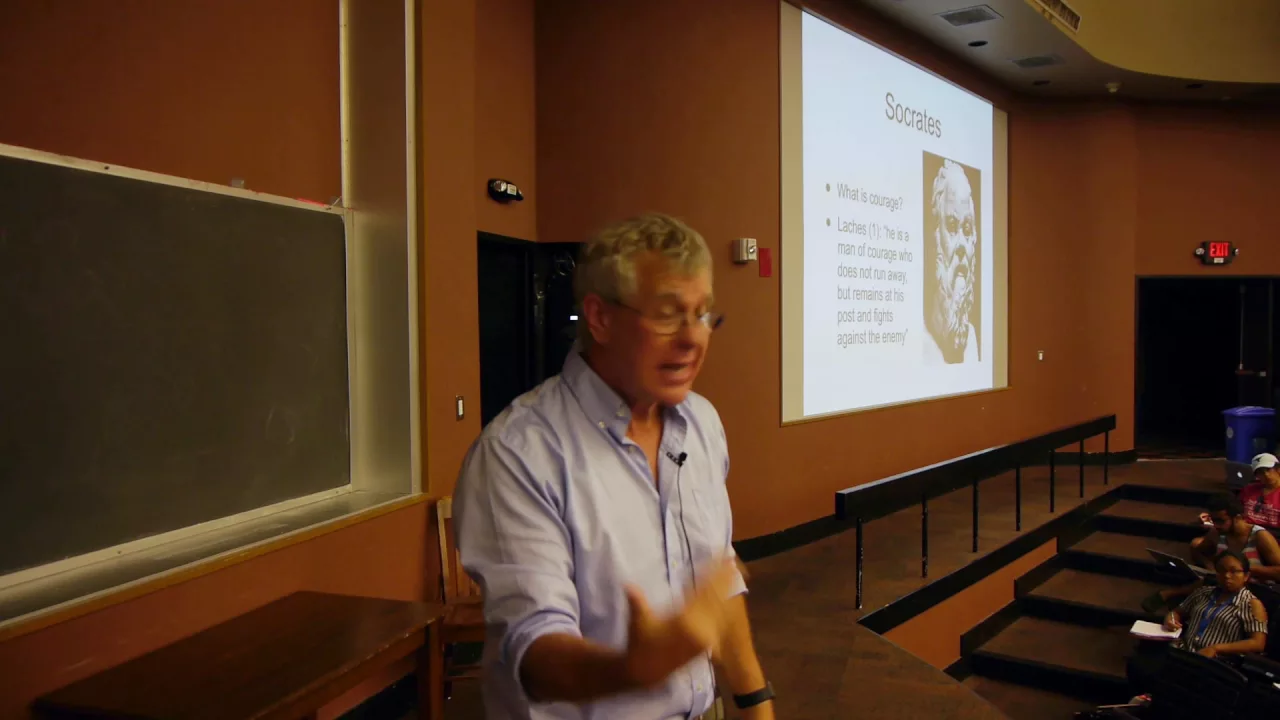
okay good well then we are going to talk today beginning the second major part of the course on classical rationalism about the ethics we find in Socrates and in order to talk about this I have to remind you of a few things we discussed right at the beginning of the course Socrates was in a certain sense the first Greek philosopher to raise questions raise objections Advan arguments criticize people's views there were earlier philosophers who held positions like th claimed that everything in the end is water or uh heraclitus has claimed that everything constantly changes and
there's nothing constant or parmen view that nothing ever changes but Socrates is really the first one to say well wait wait a minute why should I think that's true and begin to examine things ask for definitions of terms and in short supply the Critical examination part that we had talked about being an essential component of philosophy at the outset and so earlier people in advance views but they hadn't really subjected them to this kind of Critical examination well Socrates himself never writes anything down he does not take any official positions and we know about his
views primarily by way of the dialogues of Plato Plato's dialogues come in three sections you might say three General uh categories of dialogues the early dialogues feature Socrates as a major character and people think they are fairly close to the historical Socrates that's not to say that Plato was sitting there as a scribe writing down actual conversations these are literary Creations but on the other hand they are things that are pretty faithful to the way Socrates actually talked and also pretty faithful to the Views that Socrates actually held now I think we can determine from
some of these dialogues what socrates's underlying views were both because of hints in the dialogues but also because Aristotle at a certain point later says these were Socrates views and so we can check the interpretation of these dialogues against the positions of Socrates as reported by Aristotle well Socrates taught Plato who in turn taught Aristotle so there's a direct connection there and Plato writes these dialogues eventually developing his own view now today I'm going to talk about the views that emerge in the early dialogues as representing the views of the historical Socrates I think that's
Jus aile next time we'll move on to the middle category of dialogues where Socrates continues to be a major character but where Socrates does something he never does in the earlier dialogues he actually starts answering some questions and giving you philosophical views and in the middle period I think those are really Plato's views those are the views he's adopting and often they are contrary to the Views that seem to emerge in those early dialogues then in the later dialogues radically different things happen and Socrates either isn't there or he's there only as a minor character
and a lot of those views the middle period then get critiqued well let's talk about socrates's views on ethics as they emerge in these early dialogues here you see a painting of The Death of Socrates Socrates was actually sentenced to death and died by drinking Hemlock um his friends had urged him to flee but he said no I owe the state Allegiance in much the way that a child owes a parent Allegiance and I have to carry out the sentence we've talked about ocratic method and I want to just remind you of a few elements
of it Socrates goes in these early dialogues by asking somebody what a certain term is what virtue is courage is justice is well that's actually in the middle dialoges friendship is love is and so on and he analyzes the proposed definitions and we've talked about that um we've talked about for example chairs and attempting to Define chairs we can talk about the things that really are chairs and the things that satisfy our definition and Fin out whether they really overlap exactly which is what we want or whether there are problems whether we've got false negatives
or false positives whether this definition is too broad or too narrow and so let's take a look at how this actually works in a philosophical dialogue where Socrates is examining some of these views and trying to apply the method the dialogue called the loes named after one of the main figures in there the general Lois is is Raising this question how do we raise our children to not only be successful people but good people how do we raise them to be virtuous and so it's a question about education it's a question about virtue about in
general how we want our children to be educated how we want them brought up and Socrates says look if we're trying to understand how to educate people to become good people we better know what a good person is in other words if an outcome of education is not just knowledge or skill but virtue we need to understand what virtue is in order to know how to do that just as if I'm trying to train somebody to be a carpenter I need to know what good carpentry is in order to know how to educate them as
a carpenter well what is virtue now Socrates says that's a very hard question we try to say what in general it is to be a good person that's tough I mean suppose I ask you what is it to be a good person what are some characteristics of good people if you're thinking about your own children's at some point in the future what char istics what you want those children to have yeah respectful you want okay you want them to be respectful what else honest honest what else kind kind yeah compassionate disciplined disciplined brave brave good
good yes and that turns out to be the topic of this particular dialogue yeah curious curious ous ambitious okay good all of these are things you might want your children to exhibit qualities you might want them to have and describing what a good person is amounts to well listing things like this things that the Greeks call virtues traits of character that we ought to strive to have now Socrates says look it's complicated and one dimension of Education they were in particular debating was military education should you train someone to fight and he says well let's
focus Fus just on that one question not on this broad question of what virtue is but instead on the more specific question something it's just a part of virtue presumably what is courage what is it to be brave now this turns out to be sort of tricky ly the general says well of course I I I fought the War I'm a general I know what courage is and Socrates says well please tell me give me a definition of courage and his answer is this a man of Courage is one who stands and fights and does
not run away and indeed that's not an entirely implausible thought a man of Courage doesn't run away but remains at his post and fights against the enemy so imagine yourself there you're there in the mountain pass you've got your position and the enemy starts drinking toward you okay if you don't have any personal experience of anything like this think of the movie Mulan okay or something like that there you are trying to defend your post and there come the Mongol hordes storming at you okay the idea is that the man of Courage doesn't run away
but stands and fights against the enemy okay now it's not an implausible thought but what do you think of that as a definition of courage it impes that that courageous thing that do um in battle at least o okay it seems to suggest that's the only way of being courageous right the only courageous thing you can do so even if we stop and think just about battle are there other ways of being courageous in battle other than this yeah oh good putting your own life at risk to save somebody else in fact the movie what
does Mulan do she charges the enemy right she doesn't stand that her post she charges but are there other ways of doing this too yeah o all right might be times when it's courageous not to fight and for different reasons right it could be that you think wait a minute there's something horribly wrong going on here maybe if you think you're fighting for the wrong reasons or that this is a wrong sort of cause maybe the good thing to do is not to fight at all or maybe there are other ways of actually not fighting
and being courageous Socrates gives an example like that says remember what we did in the war at one point where we actually retreated when the enemy attacked and we swung around and then attacked them from the flanks that retreat was a sort of strategic Retreat so that we could regroup and attack in a way that would be more advantageous for us that doesn't seem like cowardice and so their courage involved actually not not standing there in fighting but abandoning our posts and regrouping and attacking and so there might be ways even in a military context
of being C courageous that aren't like this so if we think about this definition we can say well all right good are there cases of Courage that are not covered by this definition and we've already seen several even in the context of the military of what are false negatives these would the definition would predict that these aren't cases of Courage but they do seem to be courage are there other cases like that move outside the military context cases of Courage that don't consist of standing and fighting and not running away yeah running into running building
o running into a burning building to save somebody that might take great courage but it's not a matter of standing and fighting against an enemy yeah having a disting opinion say it again having a dissenting opinion oh good having a dissenting opinion and being able to give voice to that you're in a meeting and everybody else agrees and it can be scary to actually voice your own opinion in fact it turns out not many people can do it there are these psychological experiments that are once you learn about them deeply disturbing um and they go
like this somebody draws for example lines on a Blackboard so is this line and that line labels of a and b and everybody in the room except you is a Confederate of the experimenter so the experimenter says well tell me which line is longer line a or line B and goes around the room and everybody else says oh line a is longer okay and so it's like line a oh yeah line a line a line a and finally gets to you which line is longer what percentage of people do you think say line a along
with everybody else something like 90% it's very threatful okay the overwhelming majority of people say um yeah okay line a okay and it's very rare that somebody has the courage to say you're all crazy it's line B and that's something really obvious right there's no ambiguity about this it's not like well it's sort of hard to tell you know it's not like some color patch where you say is this blue or orange sorry that's not really sorry I bet say blue or green and it's kind of turquoisey and it's in between and you think well
I think it's no it's like that's really clear and so if that sort of thing takes real courage and most people can't do it imagine a case where there really is some ambiguity and there is disagreements and so on and so to voice an unpopular opinion in that context can take real courage other examples of Courage that aren't covered by this definition yeah okay yeah public speaking there are probably things that you would be afraid of a lot of people are afraid of public speaking in fact it's interesting I'm I'm very strongly introverted um which
is something you probably wouldn't guess by what I do profession but if I'm talking to a big group like this or um even an even larger group I'm fine but talking to people in small groups or oneon-one I find that very frightening so like going to a party I find that terrifying I hate that I'd much rather just sit at home and read okay than go to a party um and about gosh a year and a half ago I was interviewed at the Chancellor's council meeting this was like 3 to 5,000 of UT's top donors
um and I was up there on stage being interviewed by the editor of the Texas Mon and I found that if I they had set up with these chairs I was just talking to him uh one-on-one and I found that if I looked at him and answered I was Terri thought but if I turned and faced the thousands of people and talked I was totally relaxed okay now that's weird and the opposite of the way most people are most people would be like I can talk to one person but talking to 3,000 people and I'm
just sort of odd and the reverse of that but anyway yeah for a lot of people public speaking would be a phobia are there things like that that you will also be afraid of and would take real courage to do yeah going against Authority go going against Authority yeah somebody says okay do this and to directly defy them that can take real courage other things that are sort of phobia of yours yeah I hate the sensation of falling ooh the sensation of falling okay yeah so for a lot of people getting on a roller coaster
might be something that takes real courage um I I'm fine with roller coasters but there are other sort of things that I wouldn't do in an amusement park uh because they give that sensation of falling or actually the scariest coaster I've ever been on was also one of the mildest it was like a mouse coaster I don't know if you've ever seen these but it's like you're sitting in a mouse a big mouse and it just goes around this tiny track and there's nothing around you and it swings suddenly and you just feel as if
you're about to fall now in fact I mean in a few places goes like this but it's nothing like the serious posters at Six Flags or something but nevertheless it is terrify because you just have this Sensation that you're completely unprotected in this wobbly little thing um so yeah all of us probably have some sort of phobia like that um it might be like putting your hand in a box full of snakes or spiders or whatever but anyway there are things like that that can take real courage but don't involve standing and fighting against an
enemy now what about the other side are there cases of standing and fighting and not running away that you think would count would sorry would not count as courage are there times when somebody might stand and fight and not run away but you'd say that's not courage yeah okay good you could be standing there and fighting for the wrong reason so for example suppose it's just to follow ERS somebody says s there and when those people come with the hill shoot them just say okay is that courage I mean if it's just like following orders
let's say this person doesn't even feel any fear just like shoot those people okay uh that would you look at that and say yeah that's not really courage are there other scenarios where You' say that's not courage that's something else yeah um fighting for the seg fighting like fighting Authority con stubbornness O Okay somebody who's immensely stubborn somebody who is fighting really out of something other than courage so she gives the example of defying Authority what about somebody who defies Authority just to be different uh you know the person says what uh maybe yeah what
are some things that an authority might say that are perfectly reasonable things to follow let's say the fire alarm goes off and somebody says all right we better leave the building the person says no I won't do it standing here you might yeah that's not the kind of standing up to Authority that's really courageous um I mean if there's some reason to do it like no it's our job to guard the valuables I'll stay here and guard them no matter what but if it's just like no I don't do what I'm told screw the man
well that's not c um so this comes to mind by the way because I was supposed to have a meeting last week and we were interrupted twice by a fire alarm that went off and finally we gave up a Jour um and nobody can figure out why it was going off I mean we just kept having to move acuate the building and uh there was well anyway um other things that would be like that yeah uh a one-sided fight all right a really one-sided fight there you are at your post you're waiting for the the
uh Mongol hord storm through the mountain pass and then you see a Kindergarten class and the kind garders come through and they're trudging through the snow with rubber bands and you say let's get them boys well that's not really courage either that just seems awful um other cases where you would not be willing to call this courage yeah someone who's killing just because they enjoy killing or something like that oh good somebody who just is enjoying killing there come the enemy soldiers like finally I joined the army to kill and the last to get my
chance yeah that I mean that doesn't seem like courage either that's something else and so it's not I mean here's one way of looking at this you could say number one it's too narrow there are other kinds of Courage that's the first thing we talked about there are too many false negatives here there are other ways of being courageous but also there are all sorts of examples where you can do this kind of thing and not be courageous and why because you're doing it for the wrong reason right you're not doing it for a because
despite your fear maybe you're not afraid at all maybe you're just following orders maybe you're just bloodthirsty maybe you're just defying Authority whatever it is it turns out you're doing it for the wrong reason yeah that also courageous was also same could you be courageous and cowardly at the same time that's an interesting possibility what did you have in mind um maybe you're fighting for something that you don't believe in but put for but at the same time you don't believe in it and you're only doing it because you're being to oh there's a cause
you don't believe in is that right um or POS like maybe you don't believe in the cause but you believe in protecting your country or something like that okay something that I was of oh I see what you're saying yeah yeah okay right I mean here's the thing you can have mixed you can have mixed motivations right so maybe you're there and somebody says actually why are you fighting and you say well listen it's partly to defend my country though I don't know if this war were involved in is a just War not I'm not
sure so I don't know if I believed in this cause but but I'm doing it to defend my country and these guys in the troop are my buddies and I'm doing this to defend them um and yeah I'm partly doing this for some but you know actually I've always loved guns and shooting things and shooting people sounds kind of cool to me and and you know and and besides this seems like all my friends joined up and so I think actually my my own children lost a lot of respect for their grandfather when they found
out he or at least when he said I don't know if he was honest he was old then but he was sort of saying you know I I joined the Navy in World War II why to defend my country because they had been attacked no just because my buddies were doing it seem cool and they were like gosh I always looked up to you because you served in the Navy now you were just doing it to oppress the girls and you know so they were so suddenly not but here's the third thing somebody might have
lots of motivations right and some of those are noble and some of those are not very Noble and so in those cases what do we say there are some good reasons and some bad reasons why the person is there doing this and in that case do we say it's both courageous and cowardly do we say well it's sort of courageous what do we say about those kinds of cases what about the case where the person doesn't even know why they're doing it and it might be very hard for us to then assess this so I
think you're raising a good problem here which is look if in part this depends not just on what you're doing D externally but why you're doing it that can be a really complicated matter and there can be all sorts of things it's not transparent why we do things people often don't know why they themselves are acting and there might be this mixture of motivations some of which are good and some of which are bad well in any event Lu aband this attempt to Define things and instead says Ah Yeah I see what you mean and
notice what's going on here he realized that it's not just a matter of your external Behavior it's not just a matter of acting in a certain way it's dependent in part on why you're doing it and so he says ah I see it's something internal he says it's a kind of endurance of the Soul now Socrates right away says oh it's a sort of endurance of the Soul well what sort of endurance that's pretty unclear it's kind of like saying oh yeah chair is like some kind of furniture like yeah yeah we kind okay here
it's some kind of endurance well yeah what kind of endurance and he says well I mean a wise endurance this now how is that as a definition of courage a wise endurance of the soul and let's not get hung up on the question of what the soul is here it's just sort of some sort of wise psychological endurance he has in mind some kind of mental endurance so we can ask the same questions right are there kinds of wise mental endurance that are not courageous are there cases of Courage that don't involve a wise endurance
yeah there could be cases where it's courageous but you're sort ofing doing it automatically ah good okay so sometimes people do things courageously but it's just automatic there's no kind of endurance involved it involves a quick sort of immediate thought immediate action so what are some cases like that yeah mother's inct good a mother's instinct to protect her children maybe the child to take an example from menus is about to fall into the well and Mom said no and she doesn't endure right she doesn't think and then think oh I could just go have a
cup of tea no no uh no it's just an immediate thing right where the soldier who seizes a grenade and throws himself on top of it to save his comrades those are immediate responses they don't involve somebody enduring and so already there we've got cases where we've got courage but not a wise endurance of the soul that indicates that this is really too narrow a definition are there cases on the other side where you've got a wise endurance but it is not courageous are there cases where you yes say maybe like running from Battle something
like that it's ultimately wise to R but it's notar theous you know what I'm say oh okay yes the enemy is coming and you realize they vastly outnumber us we're cooked we can stand here and fight but we're all going to be killed and there's no point to that so let's run so you start running but the enemy starts chasing you so you keep running and you keep running and you know you you endure greatly and it's tough cuz you know you're in danger but you after days of trying to escape finally get away you've
wisely endured but do we say w that was so brave uh it might have been the Wis to do we're not really criticizing you in fact if if you really were overwhelmed and had no chance of Victory maybe we say that's what you should have done so we don't call you a coward but on the other hand it doesn't seem like an act of Courage either other cases like that you had one in mind beinge good being in school and trying to get a degree notice I said trying she just said get one but you're
not there yet anyway um that that's something that involves a lot of endurance and it's a wise endurance right there may be a moment here where at some point you doubt whether you can actually do this and at that moment it's going to take real psychological persistence to get through and get to the other side now maybe not but a lot of people I've known they come to this point where it's like I just feel overwhelmed and and first of all let me just say you're here because we're convinced you can do it so have
that faith in yourself but secondly it really is going to take a kind of virtue to press on despite that seeming adversity and do it but is it Courage well it could be but often times you know you don't say ah man I've got that philosophy exam I got to go study and somebody say whoa It's so courageous it's not ordinarily bravery it's persistence it's a kind of endurance um it's something that is admirable but it's not really ordinarily courageous now could be suppose somebody announces that you know they're going to try to beat up
philosophy Majors they maybe just study for that philosophy exam takes real courage because if somebody catches you with copy of ploh in your hand they're going to beat the pulp out of you well that I mean that's bad but ordinarily it's not something that takes courage so we might say look there are lots of cases of Courage that don't involve a wise endurance these cases of immed mediate action these cases of the mother saving the child by instinct or somebody sacrificing himself to save his comrades in battle but o all right even if it's a
stupid reason isn't doing that in some sense Brave yeah I mean here's what I think Plato has in mind the person who could go down there and is pretty confident they could actually get to the other side it takes real courage because there's a risk but suppose you think it's very unlikely you'll get to the other side it takes more bravery doesn't it rather than less or you go into battle thinking you're like you know your side is likely to win you think you'll survive you could be killed in the battle but you think you're
going to make it okay well it still takes courage to go in and risk your life in that battle but suppose you're talking about a battle where you think the odds are overwhelmingly against you you're very likely to die it seems as if actually you're braver right even though in some sense it's less wise to risk yourself in that way and so you might think well wait a minute actually something very is going on here because it looks like the wiser the decision the less bravery is really required the more unwise the decision and at
Homer here certainly unwise about this well the more bravery it takes so in a sense is Bart the guy who's confidently can make it across is he braver than Homer or is Homer saying I'm going to do it just to teach you a lesson even though I know I won't make it which one is braver and Socrates says actually I think Homer is brave I think the person who's doing it more foolishly is braver and that suggests that it's not a question of wise endurance of the Soul after all if bravery is a matter of
wise endurance it should be the case that the wiser the endurance the more bravery and it looks like it's exactly the reverse the more wisdom involved the less bravery so at this point we might think yeah a foolish endurance often seems braver than a wise endurance so there's something going wrong well at this point actually liy gives up nissus comes along and says well maybe I can do better nissus offers this definition the knowledge of that which inspires fear or confidence we might put it this way courage is a matter of knowing what to fear
and what not to fear now how is that as a definition of Courage by the way nus here says I think I've heard something like this before and he's heard it from Socrates that's the kind of hidden joke behind this part of the dialogue okay so Socrates has said something like this and he's reporting it second hand back to Socrates well what do you think of that definition knowing what to fear and what not to fear yeah good knowing something doesn't necessarily involve doing it right it doesn't necessarily involve action so if we think of
this definition knowing what to fear and what not to fear our first reaction is likely to be wait a minute I might know what to fear and what not to fear but nevertheless not do it couldn't I be there seeing the enemy coming saying I know I should stay here I know I should not really fear death I should fear dishonor about death but think yeah I know that but and run away okay that doesn't look like courage it's not a question in other words of just knowing but doing and next time we're going to
look at that in much more detail this is perhaps the main reason what certainly one of the main reasons that Plato rejects this view in the end and says Socrates couldn't be right about this but we could say okay look um if we say it's a matter of knowing what to fear and what not to fear we've got to think about cases of Courage that don't involve knowing and then cases of knowing that aren't courageous so knowing without acting that looks like a case of not being courageous it's a false positive but what about the
other side false negatives could we have cases of Courage that don't involve knowing what to fear and what not to fear yeah um maybe going into simp not knowing the risks but still risking it and not going out okay good going into a situation and risking things even though you don't know what the risk is you don't you sense this is dangerous but you don't really understand what the risk is what the likelihood of harm is but nevertheless you do this that can take courage even though you might say you don't really know what to
fear and not to fear you don't understand the grounds of fear and confidence here you just feel this sense of for boing and you overcome it anyway that feels corageous even though you don't really have this knowledge of the grounds of fear and confidence yeah uh yeah what about like fear of the unknown or like uncertainty good uncertainty fear of the unknown that seems to be a case where well I mean could we say yeah you do know what to fear namely the unkknown but it feels strange right it feels like wait a minute but
I don't know I mean by definition unkn so we'd have to be very careful in dealing with that but it's certainly the case that sometimes it's just the uncertainty that makes you feel afraid it's certainly not knowing what's at stake that you might have it's just that you would know gosh I'm not sure what I'm doing here you walk into uh an exam in a course and you haven't taken an exam in that subject before you feel a fear and it's based on the uncertainty you don't know what kinds of questions are going to be
asked you don't know what's going to count as a good answer um that can be scary well the other cases cases of knowing that aren't cases of knowing the gr sorry cases of knowing that aren't cases of Courage we've already talked about that a bit now interestingly Socrates raises this question about the courage of animals he says what about the mama bear who defends the Cub without thinking the mama bear doesn't know the grounds of fear and confidence let's say the hunter comes and she defends the Cub but not because she thinks huh that Hunter
has a that following rifle I'm I'm in danger or something no it's just Instinct and the response here is well look we've got to distinguish courage from fearlessness it's not just fearlessness it's something else but then Socrates gives an objection and it has nothing to do with this problem of knowing and not doing interestingly it's a different one he says look if we take this seriously it turns out that courage is all of virtue why because hope and fear are directed at the future knowing what to fear and know knowing what not to fear knowing
the grounds of fear and confidence involves knowing the future but there is no knowing the future apart from knowing the past and the present everything we know about the future we know on the basis of the past and the present so he says since there's no division between our knowledge of the past our knowledge of the present and our knowledge of the future to know the grounds of fear and confidence is just to know good and evil it is just to know what to do and what not to do so in the end he says
look if this is right courage involves knowing the grounds of fear and confidence knowing what to fear and what not to fear but that means you have to know what's better than what what to do and what not to do that's just knowing good and evil and that comes down to Virtue as a whole so Socrates says and here I mean he doesn't lay this out exactly but here's the position in the background wisdom is a matter of knowing what to do and what not to do wisdom is a matter of knowing Good and Evil
but it turns out that if we Define courage this way it is just the same as wisdom and that's the same as just being virtuous just knowing what to do and what not to do so in the end Socrates says look if this is right then it turns out that courage is just all of virtue instead of being this part of virtue that we thought was easy more easily defined it turns out it's everything it's really just knowing what's better than what what to do and what not to do but wait a minute that's just
virtue as a whole and yet that's seems wrong it seems like courage is just a part of virtue so he says this can't be a good definition and so they all say yeah I guess we don't know what courage is and they all leave sort of dejected now what about that objection knowing what to fear and what not to fear comes down to just knowing what to do and what not to do knowing good and evil actually Socrates in the end thinks it does okay he doesn't lay this out in the dialogue but Aristotle makes
it clear this is socrates's position he thinks that in the end yes every virtue really is just wisdom courage is just a matter of knowing what to do and what not to do so is wisdom in fact that's the definition of wisdom that he gives but it's not just that so is self-control so is generosity so is kindness so is Justice etc etc all of those in the end are really just a matter of knowing good and evil knowing what to do and what not to do so in the end all the virtues are the
same courage is the same as piety which is the same as Justice which is the same as self-control which is the same as generosity and so on because in the end it's all just knowing what to do now yeah what do we say about that well gosh are all those virtues really the same one position is that they are but here's an alternative you might think no no no they're all different they might overlap in some ways but surely you could have courage without generosity for example or without self-control could someone be courageous but not
self-control intuitively you might think sure so here's what's going on in in in some sense here we could say look that first definition standing and fighting and not running away that was purely about Behavior had nothing to do with your state of mind which is why it ran into trouble endurance of the Soul or now knowledge that seems to have just an internal Dimension to it just a matter of your mental state has nothing to do with what you do surely both are required so in our final minute can anybody give me a better definition
of courage presumably it has to have something about behavior in it but it also has to have something about your state of mind so what is courage any suggestions yeah doing something you o doing something you fear because you know it's the right thing to do now notice that the components of that doing so she's got the doing part in there something you fear and good cuz that goes to the state of mind and if you don't feel fear it's hard to describe you as courageous but then for the sake of something right for the
sake of some good and that seems like an important component too if you're doing it just for some crazy reason or selfish reason it doesn't seem courageous next time we'll come back to that and think more about it and think about play's definition