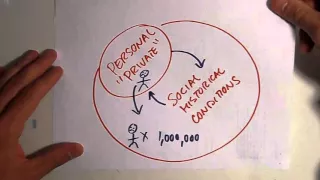
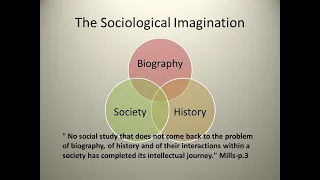
one interpretation of the sociological imagination is it's just about telling us that we're not really free that we're entirely determined by the society around us but this is an overly simplified way of putting it and it's useful to get a more nuanced sense of the concepts most frequently used in sociology it is true that the idea that we all as individuals control and steer our own lives in a purely individual way is an illusion our sense of who we are comes from the people around us we always have to operate within existing social institutions like
a university or an organization and the opportunities that we have to shape the social world are actually quite limited my own view has always been that the only way social change ever takes place is on a collective basis if you get a social movement where lots of people get together to argue for a particular kind of change that's when you get social change but not if it's only a selection of IND individuals no matter how supposedly powerful and influential they are in reality no individual exists in a vacuum people are always part of a group
or a social institution an example of a social institution would be the family there a range of rules and principles running through family life that have a continuity to them they exist over time people acquire them from their parents and pass them on to their own children even if they change those rules and principles there's still a degree of stability and continuity to the way in which family life is organized now the concept being applied here is that of social structure but it's important to keep in mind another concept that you need to use alongside
that of agency or action despite the arguments against Freedom sociologists do still see human beings as active even if they are socially shaped and formed the response to the arguments against freedom is to say well it might be an illusion to think that we're all absolutely free or that we can change world events single-handedly but that doesn't mean that we don't play some kind of active role in society so instead of the word Freedom sociologists will talk about agency and work out the relationship between that agency and the constraints of social structure now this is
one account of how the problem should be approached by Peter Burger a more adequate representation of social reality would be the Puppet Theater with the curtain Rising on the little puppets jumping about on the end of their invisible strings cheerfully out the little parts that have been assigned to them in the tragedy comedy to be enacted we see the puppets dancing on their miniature stage moving up and down as the strings pull them around following the prescribed course of their various little parts we learn to understand the logic of this theater and we find ourselves
in its motions we locate ourselves in society and thus recognize our own position as we hang from its subtle strings for a moment we see ourselves as puppets indeed but then we grasp a decisive difference between the Puppet Theater and our own drama unlike the the puppets we have the possibility of stopping in our movements looking up and perceiving the Machinery by which we've been moved in this act lies the first step towards Freedom the important part here is a bit after but then we grasp the first part of the quote is describing a very
structuralist approach and then adds but the fact that we can see how the Puppet Theater Works how the strings are attached is important it has the effect of softening the idea that we're simply a product of the world around us gives us an active relationship to that world there are some points in history where it becomes possible for people to cut those strings or to change Puppet Masters for sociologists the most interesting case studies involve looking at points where Society changes a lot where there's a break in that continuity and people start thinking and acting
in quite different ways the word culture is also very important it draws your attention to the role that beliefs values and Norms play in social life life it's an aspect of what makes sociology different from economics because economists tend to think of people as behaving in entirely rational ways they have a certain model of human behavior that assumes that everyone makes rational choices in their lives what sociologists and anthropologists will emphasize is that often people's reasons for doing things are much more complicated than a rational calculation of what the costs and benefits are people will
often be have on the basis of their commitments to certain kinds of values that aren't necessarily rational people do things because they think they're important not just because they've worked out that the benefits outweigh the costs an extreme counter example is the argument that it might be a good idea to buy and sell children on the market because then being a parent would be linked to your wealth and what that implies for your ability to provide the best upbringing for a child if you ask what's wrong with that idea it's only possible to answer the
question question in terms of non-economic non-rational ideas we think it's a bad idea just because we think it's a bad idea because we think there's something important about the relationship between a parent and a child that shouldn't be subjected to the mechanisms of the market that shouldn't be influenced by money another important concept is socialization which fleshes out the idea of structure when you start by observing that we're not really free the next step is to notice that there's a process we all go through from infancy onwards that we aren't born social beings we're born
as a bundle of instincts with very few social capacities the most important ones When You observe young infants appear to be crying and smiling it's the process by which we learn to become members of society that's important to understand and that's what the term socialization refers to the concept of modernity is also Central to the way sociologists analyze social life particularly in the sense that modernity is contrasted with tradition the development of the society we live in today is understood as having gone through a process of transformation from traditional social forms to increasingly modern ones
this is partly because sociology as a discipline emerged in the period around the 18th and 19th centuries when rapid social changes were taking place and the concept of society was useful in understanding those changes and their impact on people those changes were understood as a process of modernization of living behind an old world in order to enter an unknown new one for example the impact of the Industrial Revolution and the introduction of new types of Machinery on people's social relationships with each other on family life on the way work was organized was an important aspect
of the emergence of modern as distinct from traditional Society there were a range of processes at play at the same time there was a transformation of economic structure from feudalism to capitalism at the same time you can see a process of democratization where the ability to influence the direction of politics gradually spread from Rich male land owners to the rest of the population that process wasn't uncontested there were many arguments against the spread of democracy and today there are parts of the world where it's argued that democracy as we know it in Western countries isn't
in fact the best way to organize political and economic life indeed when you look at the United States stes today it's clear that as a political system there are many aspects that don't function very well such as the conflict between the president and a Congress and Senate dominated by the opposing political party urbanization was also very important you see a massive movement of population from the country to the city and rapidly increasing population size in the larger cities throughout Western Europe this meant a very significant change in people's everyday Lifestyles and in many senses a
modern society is precisely an urban one the role of religion changed significantly too for a long time sociologists thought that what one could observe was a consistent Trend towards secularization and in many respects that was equated with modernization church attendance gradually dropped the church's influence on society appeared to become weaker and weaker now that secularization thesis has been proved spectacularly wrong since the 1980s because religion's role in society has in fact been reinvigorated and it's become a apparent that the relationship between religion and modernity is much more complex the mechanisms of government have also changed
enormously the organization of people into units like Australia or the United States with a corresponding machinery for administering those units let's call it the state has constantly grown in size and its impact on social life it's hard to speak of modernization with also mentioning the process of rationalization and one useful way to capture what that's about is the American sociologist George Ritz's theory of mcdonaldization he uses McDonald's as a key example of how the process of rationalization operates and the way in which certain kind of logic to the way we do our work the way
we relate to each other the way in which any workplace is organized follows particular kinds of principles that are then translatable into other quite different contexts he shows how the principles governing the organization of McDonald's calculability predictability efficiency and control align with how the rest of society is organized you could also look at the spread of Ikea stores or Starbucks as another example of this kind of process a process of individualization is another important aspect of the emergence of modern society there's a shift from a more Collective sense of your identity and who you are
as a member of a family a kin Network or a village to a much more strongly individualized one people often say that developments like Facebook are simply the latest stage in that process because it creates a whole new space where you can express your very distinctive individuality The Genius of Mark Zuckerberg was to work out that this technology would tap into that inclination into that sense of people being driven towards constructing themselves as Unique Individuals this can be seen as demonstrating what I was saying before about how we're actually shaped by social forces it's precisely
when we sense how unfree we actually are that we seek out opportunities for expressing our distinctiveness and our fre Freedom by assembling collections of photos that nobody else has and so on finally the concept of colonialism is important to keep in view if one is speaking of a process of State formation or modernization it's crucial to remember that it involved the exercise of force and Power by some parts of the world some groups of people over others not everyone will see modernization in this way indeed most accounts won't but here at the University of Sydney
we make a point of arguing that the concept of colonialism and its variations like settler colonialism and postcolonialism is Central to an accurate understanding of modernization understanding how colonialism has shaped the modern world will hopefully be one of the more interesting aspects of your studies in sociology in summary I spoke about how the idea that humans are socially formed needs to be balanced with a sense of their active relationship to their social context second I talked about the importance of a number of Concepts culture modernity democratization urbanization religion State formation rationalization and colonialism third I
indicated that although colonialism isn't usually placed centrally in the analysis of modernity here at the University of Sydney we do emphasize its significance in sociological thought