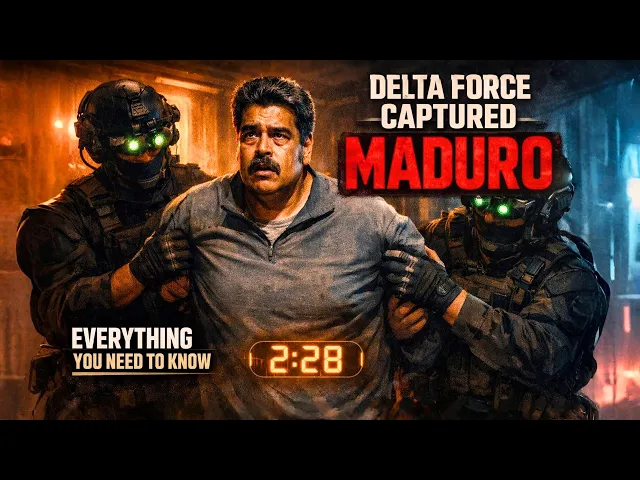
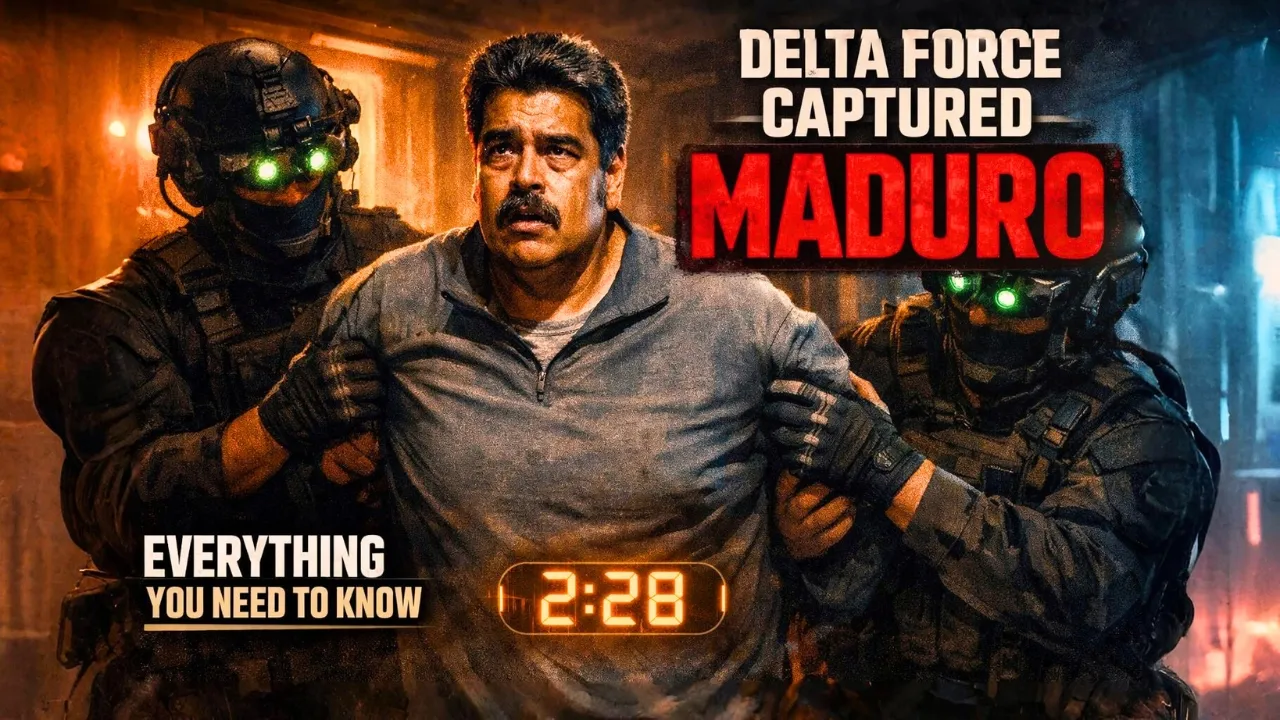
January 3rd, 2026, at exactly 2:01 a. m. local time, American helicopters descended through the darkness over Caracus, Venezuela, carrying the world's most elite soldiers on an impossible mission.
Inside one of those helicopters sat members of Delta Force, the United States Army's premier counterterrorism unit. Their night vision goggles illuminating a heavily fortified military compound below. Their target was Nicholas Maduro, the authoritarian president of Venezuela, a man protected by thousands of troops, Russian air defense systems, and Cuban intelligence operatives.
In exactly 2 hours and 28 minutes, Maduro would be in American custody, blindfolded aboard the USS Ewima, facing narot terrorism charges in New York. But this operation did not begin on January 3rd. and the story of how America pulled off the impossible starts 5 months earlier in the shadows of Langley, Virginia.
Before we break down every phase of this operation, understand that what you are about to hear represents the largest and most complex special operations mission since the raid that killed Osama bin Laden. This is the complete story of Operation Absolute Resolve, told with precision, accuracy, and unprecedented detail about how the most powerful military on Earth captured a sitting head of state. Before we dive in, why not hit subscribe and drop a like?
It really helps out. All right, let's keep going. In August 2025, newly confirmed CIA Director John Ratcliffe received authorization from President Donald Trump to conduct covert operations inside Venezuela.
Within weeks, a small team of CIA operatives slipped across the Venezuelan border, beginning what would become the most significant intelligence penetration in Latin American history. Their mission was singular and precise. Track Nicholas Maduro's every movement, map his security apparatus, and identify vulnerabilities in his protective cocoon.
The CIA team established surveillance operations across Caracus, monitoring Maduro's pattern of life with the patience of predators stalking their prey through the jungle. They documented where he slept each night, what routes his motorcade traveled, which restaurants he frequented, and even the habits of his pets. General Dan Kaine, chairman of the Joint Chiefs of Staff, would later reveal that American intelligence knew intimate details about Maduro's daily routine down to his meal preferences.
But the CIA's most valuable asset was not electronic surveillance or satellite imagery. It was a human source embedded within Maduro's own inner circle. This source, whose identity remains classified, had penetrated the highest levels of Venezuelan power and was feeding realtime intelligence directly to American handlers.
The source provided critical information about Maduro's security protocols, the rotation schedules of his guards, and most importantly, where he would be sleeping on any given night. According to officials briefed on the operation, this human intelligence asset made the difference between a theoretical operation and one that could actually succeed. The CIA was not working alone in this effort as Secretary of State Marco Rubio and CIA Director Ratcliffe became the principal advocates for decisive action against the Maduro regime.
Throughout the fall of 2025, the intelligence picture became increasingly clear, revealing a dictator who rotated between safe houses but maintained a primary residence at Fort Tuna. Fort Tuna, officially known as Fuerte Tuna, is Venezuela's largest military complex, a sprawling installation in the heart of Caracus that serves as headquarters for the Venezuelan army. Within this fortress, Maduro had constructed a heavily reinforced residence featuring steel reinforced doors, a panic room, and multiple escape routes designed to thwart exactly this type of operation.
While CIA operatives gathered intelligence inside Venezuela, the United States began the largest military buildup in the Caribbean since the 1962 Cuban missile crisis. In September 2025, the Pentagon deployed the USS Gerald R. Ford, the world's largest and most advanced aircraft carrier, to waters north of Venezuela.
The Ford carrier strike group brought with it a complement of FA18 Super Hornets, EA18G Growler electronic warfare aircraft, and E2D Hawkeye early warning planes. Simultaneously, the United States Southern Command began positioning destroyers, cruisers, and amphibious assault ships throughout the Caribbean Sea and Eastern Pacific Ocean. By late December, American forces in the region numbered approximately 15,000 personnel, a force far exceeding what would be necessary for the stated mission of counter narcotics operations.
The 161st Special Operations Aviation Regiment known as the Nightstalkers quietly deployed their specialized helicopters to forward operating bases in the Caribbean. These elite aviators based at Fort Campbell, Kentucky, are considered the finest helicopter pilots in the world. trained specifically for high-risk special operations insertions.
Their aircraft included MH60 Blackhawk variants modified for special operations, MH47 Chinuk heavy lift helicopters and MH6 Little Bird attack helicopters. The Nightstalkers had flown the missions that captured Saddam Hussein and killed Osama bin Laden. And now they prepared for their most politically sensitive operation ever.
Meanwhile, F-22 Raptor stealth fighters deployed to Joint Base Langley Eustace began rotating through Puerto Rico, establishing a forward presence within striking distance of Caracus. F-35 Lightning 2 stealth fighters from the Marine Corps also arrived in Puerto Rico with 10 aircraft setting up operations at the former Roosevelt Roads Naval Station. B1B Lancer bombers from DAS Air Force Base in Texas began flying missions over the Caribbean.
Their presence detected by civilian flight trackers monitoring military movements. The official justification for this massive buildup was Operation Southern Spear, a counter narcotics campaign targeting drug smuggling vessels traveling from Venezuela to the United States. Since September, American forces had struck at least 35 suspected drug boats, killing more than 114 people in what the administration described as attacks on narco terrorists.
But military analysts and foreign governments understood the true purpose, recognizing that the assembled firepower far exceeded anything required for interdicting drug shipments. On November 21st, 2025, President Donald Trump picked up a secure telephone and placed a direct call to Nicolas Maduro, initiating the final diplomatic phase before military action. During a 15-minute conversation, Trump delivered an ultimatum that left no room for misinterpretation.
Resign immediately, leave Venezuela with your family, or face the consequences. Trump offered Maduro safe passage out of the country, suggesting exile in Russia or China, and reportedly offered to allow him to retain up to $200 million of personal assets. According to sources familiar with the call, Maduro seemed to waver, coming close to accepting the offer before making demands that would prove unacceptable to Washington.
Maduro demanded blanket amnesty for himself, his wife Celia Flores, and approximately 100 top officials accused of drug trafficking, corruption, and human rights violations. He also insisted on maintaining some control over Venezuela's armed forces during any transition, a condition reminiscent of the 1991 Nicaraguan transition under Voleta Chamorro. Trump rejected these conditions, reportedly giving Maduro one week to leave Venezuela voluntarily before military options would be executed.
That deadline expired on Friday, November 28th, and Maduro responded not with surrender, but with defiance, holding rallies and denouncing American imperialism before cheering crowds. Speaking at Miraafra Flores Palace on December 1st, Maduro told thousands of supporters that Venezuela wanted peace, but only peace with sovereignty, equality, and freedom. He declared that his country would never accept what he called a slave's peace.
rejecting any suggestion of capitulation to American pressure despite the Armada off his shores. Trump later recalled that Maduro came close to surrendering, adding that after the capture, the Venezuelan dictator surely wished he had taken the deal when it was offered. With diplomatic options exhausted, the Pentagon shifted into final preparation mode, activating the most intensive mission rehearsal cycle since Operation Neptune Spear killed Bin Laden.
At a classified facility in the United States, Delta Force operators practiced their assault on a full-scale replica of Maduro's residence constructed based on CIA intelligence. This mockup included the steel reinforced doors, the layout of hallways and rooms, and the exact dimensions of the panic room that Maduro would attempt to reach during the raid. President Trump would later describe this replica to Fox News, noting that it featured all the same steel everywhere, replicating the fortress-like protection Maduro believed would save him.
The operators rehearsed breach techniques, room clearing procedures, and extraction protocols dozens of times until every movement became muscle memory, requiring zero conscious thought. General Kaine explained the preparation philosophy in a press conference, stating that they trained not to get it right, but to ensure they could not possibly get it wrong. Special equipment was prepared for the mission, including what Trump described as massive blowtorrches capable of cutting through the reinforced steel doors protecting Maduro's safe room.
The FBI's hostage rescue team was integrated into the operation to provide the legal authority for formally arresting Maduro once Delta Force secured him. This arrangement allowed the administration to characterize the mission as a law enforcement operation with military support rather than a purely military action. By Christmas 2025, President Trump approved the operation in principle, though the exact execution date would depend on weather conditions and final intelligence confirmation.
The original plan called for execution on New Year's Eve, but meteorological conditions over the Caribbean and the mountains surrounding Karacus forced a postponement. Throughout the holiday week, Delta Force operators and nightstalker pilots remained on standby aboard ships and at forward bases, waiting for the order that would launch them into history. Operation Absolute Resolve represented the largest synchronized special operations mission in American history, coordinating assets across every domain of modern warfare.
The United States Air Force contributed F-22 Raptor Stealth Fighters, the world's most advanced air superiority aircraft capable of evading the most sophisticated radar systems. F35 Lightning 2 stealth fighters from both the Air Force and Marine Corps provided additional strike capability. Combining airto ground attack power with advanced electronic warfare.
B1B Lancer bombers flying from bases in Texas would deliver precisiong guided munitions against Venezuelan military infrastructure and air defense installations. The Navy's contribution included carrierbased FA18 Super Hornets and EA18G Growlers. The latter specifically designed to jam and suppress enemy radar and communications.
Surveillance and reconnaissance assets included E2D Hawkeye airborne early warning aircraft and what appeared to be the classified RQ170 Sentinel stealth drone spotted over Caracus. United States Cyber Command activated its most sophisticated capabilities, preparing to penetrate Venezuelan military networks and disable critical communications infrastructure. The Army's Delta Force provided the ground assault element with operators trained specifically for direct action missions and the capture of high value targets.
The 161st Special Operations Aviation Regiment would fly the helicopters carrying the assault force, navigating at extremely low altitude to avoid radar detection. Navy destroyers positioned offshore stood ready to launch Tomahawk cruise missiles against diversionary targets, creating chaos to mask the true objective of the operation. In total, more than 150 aircraft would participate in the operation, launching from 20 different bases across land and sea throughout the Western Hemisphere.
The Venezuelan air defense network that American forces would have to penetrate represented billions of dollars of Russian and Chinese military technology layered across the country. The backbone of Venezuela's groundbased air defense was the S300VM system known by NATO as the SA23 Gladiator. Purchased from Russia for approximately $1 billion.
This mobile anti-aircraft and anti-bballistic missile system could theoretically engage targets at ranges up to 200 km and altitudes up to 30 km. Supporting the S300VM were Book M2e medium-range surfaceto-air missile systems mounted on wheeled chassis for rapid relocation and independent operation. Short-range defense was provided by Pancia S1 systems, which Russia had delivered as recently as October 2025, combining 30 mm cannons with radar guided missiles.
Older S125, Pachura 2M systems, upgraded versions of a Soviet era design provided additional lowaltitude coverage around critical installations. Chinese technology formed the nervous system of this defense network with JY27 early warning radars and JY1 surveillance radars theoretically capable of detecting stealth aircraft. The Venezuelan Air Force operated 21 SU30 MK2 Vflanker fighters advanced Russian jets capable of carrying KH31 anti-ship missiles that posed a significant threat to American vessels.
Cuban intelligence operatives and military advisers were embedded throughout Maduro's security apparatus, providing additional layers of protection and surveillance capability. On paper, Venezuela possessed one of the most formidable air defense networks in Latin America, a shield that Maduro believed would make any American attack impossibly costly. On the evening of January 2nd, 2026, President Trump gathered with his national security team at Mara Lago, Florida, to monitor what would become his most consequential military decision.
At 10:46 p. m. Eastern time, Trump gave the final execute order, saying simply to his commanders, "Good luck and Godspeed.
" Within minutes, aircraft began lifting off from 20 bases scattered across the Western Hemisphere, converging toward Venezuelan airspace in carefully choreographed waves. The first wave consisted of electronic warfare aircraft and stealthy platforms designed to blind Venezuelan radar systems before the main assault could be detected. United States Cyber Command launched coordinated attacks against Venezuelan military networks, reportedly causing widespread disruptions to communications and power systems.
President Trump later suggested that the United States had blacked out Caracus using what he called a certain expertise that we have, referring to cyber capabilities. EA 18G growlers and F-35s began flooding Venezuelan airwaves with electronic noise, forcing radar operators to increase power output to see through the digital static. The moment those radars powered up to full strength, they became beacons for American AGM88 HRM anti-radiation missiles designed specifically to home in on radar emissions.
Within minutes, 12 major radar installations across northern Venezuela went dark. Their operators either killed or forced to shut down to avoid destruction. F22 Raptors established air superiority over Caracus.
Their stealth characteristics, making them virtually invisible to any surviving Venezuelan detection systems. Venezuelan sue 30 pilots who attempted to scramble from Valencia air base received radio warnings in Spanish. Return to base immediately or you will be destroyed.
Facing the reality of American fifth generation fighters already dominating their airspace, the Venezuelan pilots wisely chose discretion over Valor and returned to their hangers. At 2:00 a. m.
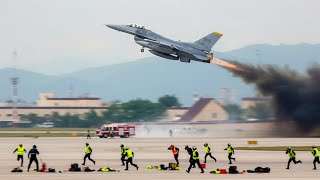
local time, Tomahawk cruise missiles launched from Navy destroyers began impacting targets across northern Venezuela, creating spectacular explosions visible for miles. Ammunition depots at Fuerte Tuna military base erupted in secondary explosions. The night sky illuminated by cascading fireballs that convinced many civilians an invasion had begun.
Fuel storage facilities at Laguayra Port were struck, sending columns of black smoke rising into the pre-dawn darkness and drawing military response teams toward the coast. General Isimo Francisco De Miranda Air Base located in eastern Caracus received precision strikes that cratered runways and destroyed aircraft maintenance facilities. These strikes were not designed to cause mass casualties, but to create maximum confusion, drawing Venezuelan military attention away from the true objective.
Air raid sirens wailed across Caracus as panicked civilians fled to shelters, basements, and subway tunnels. Convinced that a full-scale American invasion was underway, Venezuelan military units rushed toward the explosions on the city's periphery, exactly as American planners had intended, leaving Maduro's compound with reduced protection. Defense Minister Vladimir Padrino Lopez later reported that American combat helicopters fired rockets and missiles in urban areas during these diversionary operations.
While explosions rocked the outskirts of Caracus, helicopters from the 161st Special Operations Aviation Regiment crossed the Venezuelan coastline, flying at barely 100 ft above the waves. The pilots navigated through mountain passes using terrain following techniques using the very geography that Venezuela believed would protect its capital as concealment. At 2:00 a.
m. local time, the lead helicopter carrying Delta Force operators reached the perimeter of Maduro's compound within the Fort Tuna military complex. Venezuelan ground forces opened fire on the approaching helicopters, striking one aircraft, but failing to bring it down as the armored machine continued its mission.
The American helicopters returned fire with overwhelming force. Their door gunners and accompanying attack helicopters suppressing defensive positions around the compound. Fast ropes dropped from hovering helicopters as Delta Force operators descended onto the compound grounds.
Their movements rehearsed to perfection over months of preparation. Inside his residence, Maduro awoke to the sound of explosions and gunfire, immediately understanding that the moment he had feared for years had finally arrived. He attempted to reach his steel reinforced safe room, the panic room designed specifically to protect him until rescue forces could arrive.
But Delta Force operators moved with speed that Maduro could not match, breaching doors with explosive charges and flooding rooms with overwhelming tactical precision. They intercepted Maduro before he could reach the safe room door, tackling the Venezuelan president and securing him with flex cuffs in seconds. His wife, Selia Flores, was secured separately as FBI agents accompanying the assault force formally placed both under arrest on charges of narotism conspiracy.
By 2:16 a. m. , just 16 minutes after the first helicopters arrived, Maduro and Flores were aboard an extraction helicopter lifting off from the compound.
Cuban security personnel who attempted to resist were killed in the firefight with the Cuban government later confirming that 32 of its citizens died during the operation. The extraction helicopters raced north across the Caribbean escorted by fighter jets and attack helicopters providing continuous protective coverage. By 3:29 a.
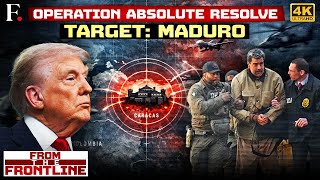
m. Eastern time, General Ka confirmed that the helicopters carrying Maduro had crossed into international waters beyond the reach of Venezuelan retaliation. Maduro was transferred to the USS Eoima, an amphibious assault ship positioned in the Caribbean where he was photographed blindfolded wearing a gray Nike sweatsuit.
President Trump posted that photograph to Truth Social, showing the former Venezuelan president holding a plastic water bottle, his face covered with soundproof headphones. At 5:21 a. m.
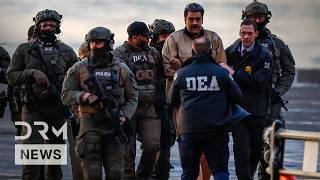
Venezuelan time, Trump officially announced that Maduro and Flores had been captured and flown out of the country following the large-scale strike. Later that day, a C17 Globe Master 3 transport aircraft carried Maduro to Steuart Air National Guard base in New York, where federal agents waited to process him. He was helicoptered to Manhattan, transported through the city in an armored motorcade, and processed at a Drg Enforcement Administration field office before being jailed.
On January 5th, 2026, Nicholas Maduro stood in a Manhattan federal courtroom wearing an orange jumpsuit, facing charges of narot terrorism, conspiracy, and cocaine importation. Before entering his plea, Maduro declared, "I am the president of Venezuela. I consider myself a prisoner of war.
I was captured at my home in Caracus. " Both Maduro and his wife pleaded not guilty to all charges with the judge ordering them held without bail pending trial scheduled for later in 2026. The Russian-made air defense systems that were supposed to protect Venezuela had failed completely, unable to stop a single American aircraft during the entire operation.
Military analysts noted that the S300VM systems were designed for a different era of warfare. Incapable of countering theworked electronic warfare heavy American assault. The success of Operation Absolute Resolve demonstrated the overwhelming superiority of American military technology and the irreplaceable value of human intelligence on the ground.
President Trump declared that no nation in the world could achieve what America achieved that night, calling it one of the most stunning displays of military power in history. The operation that captured Nicholas Maduro lasted just 2 hours and 28 minutes from first strike to extraction confirmation, rewriting the rules of modern special operations. It proved that with sufficient intelligence, adequate preparation, and overwhelming force, even the most protected targets in the most defended locations could be reached.
And it sent an unmistakable message to dictators, terrorists, and narot traffickers everywhere. American justice, when it finally comes, arrives without warning and without mercy. If you found this perspective valuable, consider subscribing.
Let me know your thoughts in the comments. I read every one of them. Thank you for watching.