- So it's not really true to say, "I am aware of the awareness in me. " No, the awareness in you is aware of itself. (bell dinging) When the person and the deeper eye, the person that I call the surface eye, and the deep eye don't exist as separate, so one day you're, and then one moment you're, (sighs) but the two can come together.
And so then you're able to function in this world as a person, but always with an additional dimension that operates now through that person. In other words, the way in which you deal with difficulties and situations and people changes, it's no longer an egoic way of dealing with things, but dealing with things consciously. This greater intelligence can now operate and use your flow into your mind, and then your mind comes up with the right solution suddenly or spontaneously, you take the right action.
Whereas before, you would've been reactive out of the egoic conditioning, which usually is wrong, it just makes things worse. So that's, then the two, you can have, I sometimes put it like this, you can have one foot in this dimension where you are a person and you have the other foot in the transcendent dimension. So you, and then you don't lose yourself anymore in your, ultimately in your mind.
And that means you don't lose yourself in the world anymore, because ultimately the so-called world and your mind are one in the same thing. So you don't lose yourself anymore. You operate within this limited realm, but you are no longer looking for yourself or for some kind of ultimate completion or fulfillment in this limited realm of the horizontal dimension, which means you can now pursue a goal still, because the surface eyes still operates here, you pursue a goal, but you do not make the mistake of over-emphasizing what this goal can do for you once you reach it.
Yes, you might be very dedicated to what you're doing, but there is not an excessive projection into where you are feeling you need to get to. "I need to get there. I need to have, achieve the success that will make me, that will make me feel complete and fulfilled and then I will have made it.
" "Made what? " "The ego. " That goes, you pursue a goal, but your attention is in the doing rather than where you want to get to.
You know where you want to get to, but your main attention is in the quality of the doing now. Whatever action you take now, you're able to be present with it rather than always devaluing everything you do now. Now in the surface of this greater goal in the future that will never ultimately satisfy you anyway.
And that is a very dysfunctional way to live. Whenever stress arises, you have, there's something has happened. You don't want to be where you are and ultimately you don't want to be doing what you're doing now.
Stress means there is a projection to some future point where you want to be rather than here, you want to be there. So the quality of the doing diminishes. There's no, the consciousness doesn't flow into the doing.
The doing is a means to an end. It goes like, "I want to be there," and here I'm doing instead of yes, peripherally, you know where you want to get to, but that's not where your main focus is, your peripheral, but your main focus is the doing itself. So the doing is no longer in the service of the future.
It is self-fulfilling, and then it becomes actually much more empowered. In other words, you enjoy the doing no matter what it is, there is an enjoyment of the energy that flows into the doing, and that's enlightened or conscious action as I call it, conscious action. It's not reduced just to a means to an end.
Yes, it is also a means to an end, but it is not only a means to an end, it is fundamentally an end in itself, the doing itself. That's already, this teaching has already, the ancient scripts of the "Bhagavad Gita", which if you haven't read it, you should, nobody knows how old it is, maybe 2,000 years or more. Again, one of the main lessons in the "Bhagavad Gita" is it is possible to perform an action without losing yourself in the desired goal, which in the "Bhagavad Gita" is called the fruit of the action.
"Don't give," it says, "Don't give excessive attention to the fruit of the action, but just be conscious of the action itself. " And this is regarded as a spiritual practice. And this is the, it's called karma yoga.
The yoga in the sense of yoga here means spiritual practice, not necessarily body movement, but that's fine too. Karma yoga, karma means action, karma action and reaction. Karma as, so karma yoga is the practice, the action as spiritual practice.
And that's a very, very powerful teaching that's been around a long, long time. Any activity that you perform as a person, by performing it in this way becomes actually empowered. And then you have a foot in both worlds.
You have the unconditioned consciousness acting through you, giving your attention, your fullest attention to the doing in the moment, in this moment, whatever you do in this moment. And if it's not just doing, it might be something else. One isn't, you're not always doing, you're always walking around this world perceiving things and talking and perceiving and so on.
You may be familiar, I'm sure you are, with the term that's mentioned a lot these days as in new age teachings and others, gratefulness or gratitude. And again, that is related to this, what does it mean gratitude? Well, people say, "Well, you say thank you for," okay, it sounds a little weird.
"Thank you. " I was, somebody asked me, I think it was a Buddhist, because Buddhists don't believe in God as such. It's not that they're atheists, but they don't believe, it's a complicated thing, but don't need to talk about this, (laughs) but the Buddhist said, "Well, who am I thanking if I don't think of a God that has just given me something.
So why do I say thank you? What, I don't understand, who am I thanking? " Gratitude is really appreciation.
It's an alternative term you could use. And what is appreciation? It is, again, it's related to be present with a sense perceptions, for example.
You can appreciate, have appreciation for anything by giving it attention and to give attention, your mind needs to be free of the conditioned naming and labeling. So awareness again, presence. You give attention to this flower, for example.
You give it attention. And so this is visual in this case, and you appreciate its beauty, but without mentally saying, you may, yes, the thought may come into your mind, "It's beautiful," but you don't stay stuck in that thought. Then the thought disappears and you continue to be aware of that flower and you appreciate its, just if you one had to use words, incredible presence and aliveness, and then it's as if a kind of thank you arises that is not necessarily verbal, it's a deep appreciation, but you can even do it with any even so-called inanimate objects.
There's a glass of water here and I can see the reflections of the light in the water. It's really beautiful. And for a moment, the mind stops, and simply perceive the incredible beauty of this without even calling it beauty.
Wow. And then you feel this, everything is a gift, there is a aliveness all around you. Some people make a mistake with a gratitude practice, which is a way of being in the present moment.
The mistake is they associate gratitude with a story in their mind. And the story would go like this. "I really should be grateful for what I have, because look at all these people who have less than me.
" Okay, well, this may be true, but it's not, that is not the past to true gratitude. Because if you can only be appreciative and have gratitude by comparing yourself to others who are worse off than you, that is not true gratitude. You're dependent on others to be worser than you, to feel a bit more grateful, "I should be more grateful.
" It's just don't look for gratitude on the level of narratives in your mind, but the immediate thing, sense perception, hearing birdsong, clouds, sky, whatever. Even how light gets reflected off a surface. Just this moment of pure appreciation of the aliveness of things.
And there's always another factor that comes in and is important whenever you are aware of these things, whether you are performing an action or you're simply contemplating something and feel this gratitude or acknowledgement of the being of whatever it is, there's a very subtle thing here. Again, let's make it experiential right here now. We can, we take in the, the totality of this room and the lights and a man on the chair talking and perhaps you're aware that you're breathing while you are contemplating all this.
And now we come to the perhaps the most important point of realization, as you're aware of all this and to appreciate it, are you also aware of yourself at the same time? But not the person. As you are aware of all this and you're, inside, you're still, are you aware of that still?
Let's say what words do we use? Are you aware of that still presence that is aware of all this? Are you aware of yourself as that awareness?
And that's a very subtle thing, but it's very important. So you have here the outer world of the senses, which ultimately is only the surface reality, but beautiful too. But you're also aware of yourself as consciousness, as the stillness, which is the conscious, the unconditioned consciousness?
Now when I put it like that in words, a little error arises, which is created by language, because I'm asking, "Are you aware of yourself? " That seems to imply that there's a duality there and that but it arises because we're using language. When you say, "I am aware of myself," that looks like a duality.
There's I and there's that which I am aware of, but that's not how it is. It only appears like that when you begin to talk about it. But when you don't talk about it, there is just the awareness itself, because you are not separate from the awareness.
So it's not really true to say, "I am aware of the awareness in me. " No, the awareness in you is aware of itself, which perhaps a better way of putting it. And that is, so that's the secret of not losing yourself in the world and in your mind.
While you are operating in this world, can you be aware of yourself as now I'm using another term now, but it's all the same. Are you aware of yourself as the space, which is the presence, the awareness. Are you aware of yourself as the space for whatever it is that arises in your awareness, the forms that arise, your physical body, even your thoughts and sense perceptions?
All these things arise in the awareness that you are. The awareness is the space for it. So to be aware of that space is ultimately to be aware of yourself at the deepest level where you, that far transcends who or what you are as a person, so you're aware of.
And that space of awareness is actually the true meaning of the present moment, that is the power of the present moment, the power itself, of consciousness itself, of life itself. And that power is the power of now. The, then you are aware of yourself as that.
And there's the world and there this is the, in some spiritual traditions called the I am, the beings of you, the essence of you. That is the I am that in the Old Testament, God replies when I can't remember who, Abraham or Moses asks, meets God, so to speak. It's a story.
I mean you can't meet God like that, but there's a story there. There's a deep truth in it. "God, what's your name?
," he asked God and God said, "My name is I am. The I am that I am. " And he's very surprised.
"Oh, I am is the name of God. Wow. That's very strange.
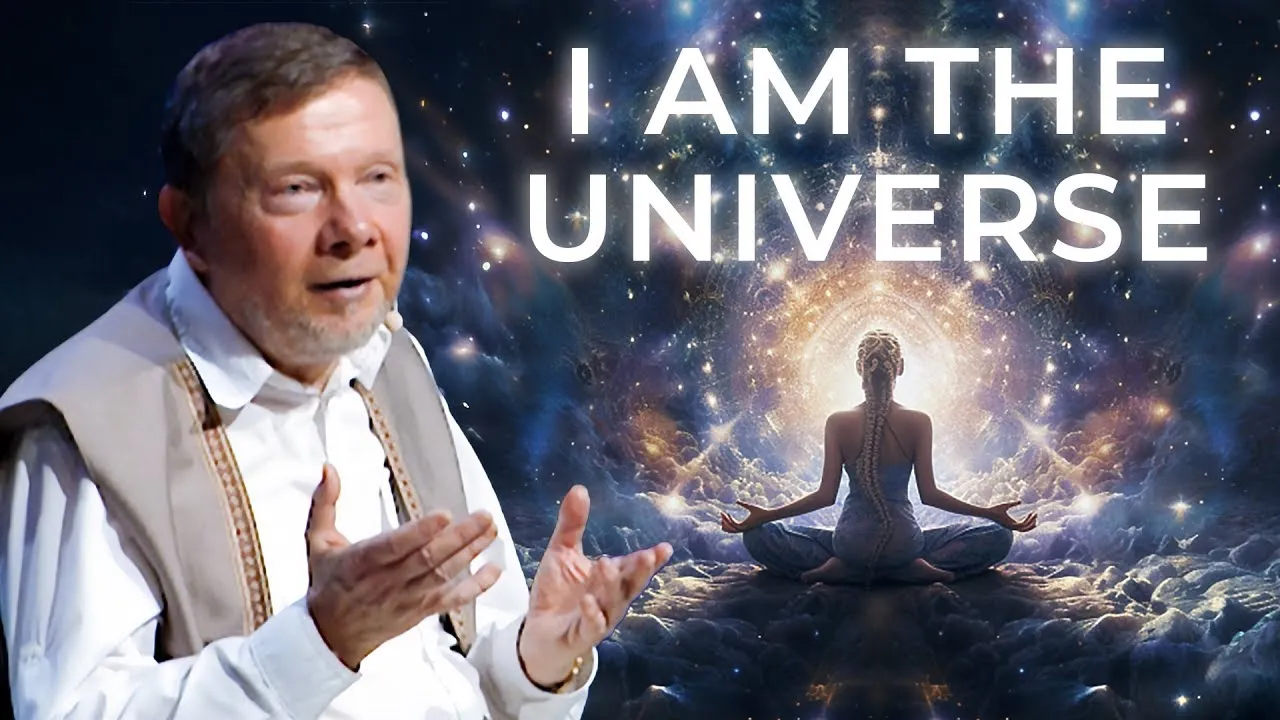
" I'm sure that's what he said. It's not in the Bible, but that's, that is so weird. And perhaps he realized something when the essence I am is it's not just your I, it is the I am of the universe.
It is the being itself, the beingness of the universe itself. You can realize that within as your essence and that connects you to the one, the God, if you are, have to be very careful with words like that, because they have been misused a lot and misunderstood. But the way I see it or perceive it or sense it is that the consciousness that is the hidden essence behind all the phenomenal universe that we see with our, perceive with our senses, behind it, there is a vast intelligence operating that is not part of this dimension, but somehow flows into this dimension and gradually creates more and more complex forms.
It gradually expresses itself more fully in this dimension. And this, it flows into this dimension from the transcendent one that we call God. But we cannot, of course, understand at all.
God does not exist in space or time, but is transcendent to all that. But just as the sun emanates light and creates life here by the energy that it emanates continuously, and that could be used as an analogy in the same way. This is my perception, and perhaps it makes, perhaps you can sense the truth of it too.
Maybe not, maybe yes, the God's, the emanation of God into this dimension is like the emanation of light that comes from the sun. And this emanation is consciousness, and this consciousness is behind every form that arises here. It's an intelligence that operates, you could also call it the soul of the world.
The ancients had a term for it that in Latin it's called anima mundi, the soul of the world. That everything ultimately is a manifestation of that deeper transcendent aliveness. And so the what you sense in yourself as yourself, as the consciousness is the light of God in you and as you, it is the light of God in you.
That's how I sense it somehow. And so just as the light of the sun is not separate from the sun, it's somehow, it's an extension of the sun, one could say. In the same way, the consciousness that flows that is the essence of what you are is an extension of God, is an emanation of the one source of all life.
And that is you. That is the essence, but that is the transcendent self, which the Buddhists call no self. That is the essence.
So in essence, you are the light of God in this world one could say, the light of consciousness. You are the light of the world as consciousness. And that's exactly what Jesus said to his disciples.
"You are the light of the world.