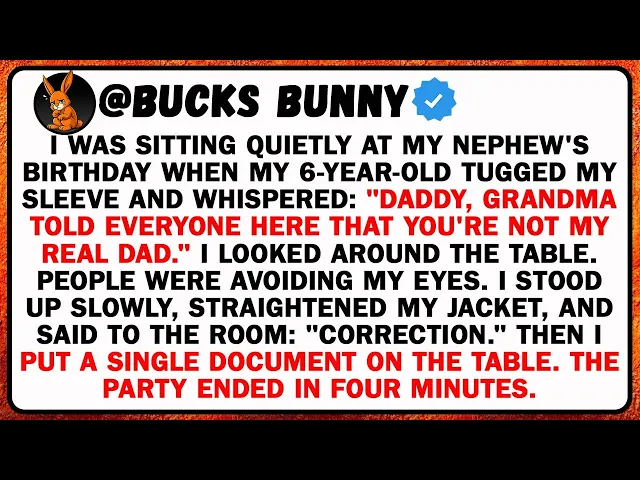
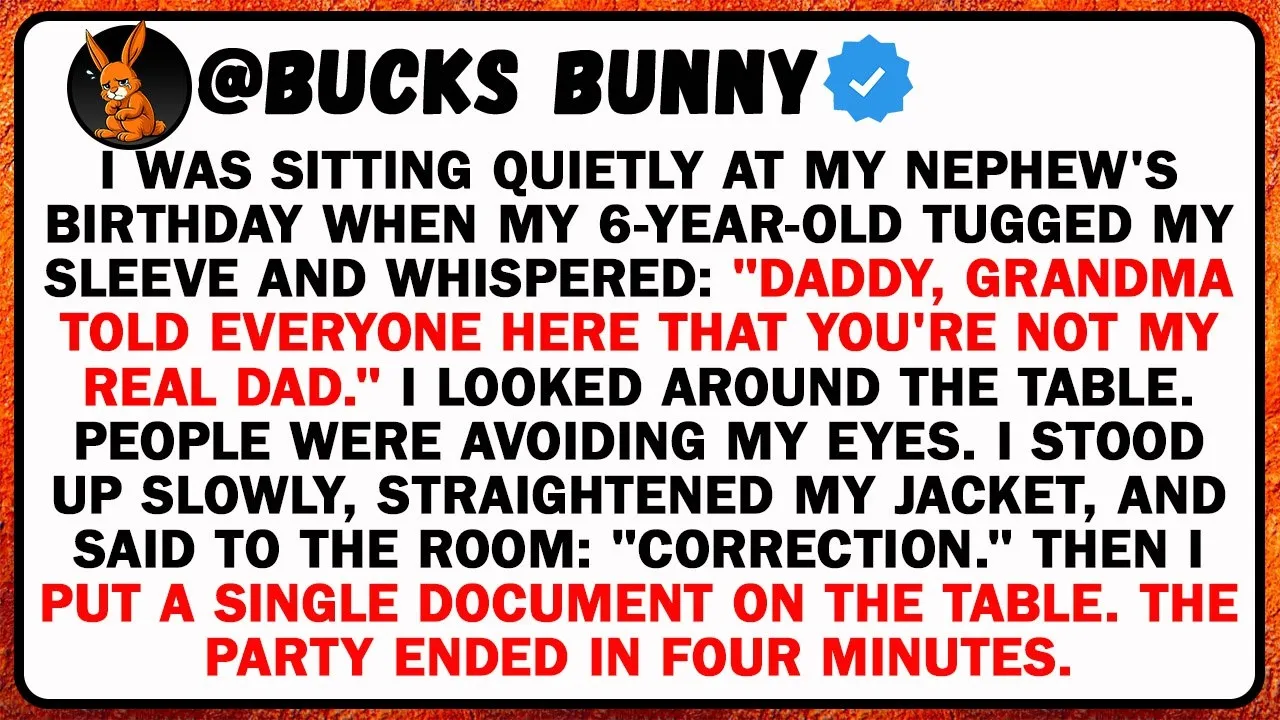
I was sitting quietly at my nephew's birthday when my six-year-old tugged my sleeve and whispered, "Daddy, grandma told everyone here that you're not my real dad. " For a second, I honestly thought I misheard him. The backyard was full of those cheap paper streamers that curl at the ends when the heat gets to them.
My sister had rented one of those bright inflatable slides that never stop hissing. Kids were screaming. Plastic plates were bending under too much cake.
Somebody had a Bluetooth speaker playing old pop songs too loud near the fence. And right in the middle of all that noise, my son somehow made the world go completely still. I looked down at him.
Eli had chocolate frosting on his top lip and one sneaker half untied. He was holding a little paper favor bag with dinosaurs on it. His eyes were wide in that careful way kids get when they already know something is wrong and they're trying not to make it worse.
I bent down and asked very quietly, "What did grandma say exactly? " He swallowed. He kept his eyes on the grass when he answered.
She said, "You only became my dad on paper. " She told Aunt Brenda that everybody was pretending so I wouldn't feel bad. My throat tightened so fast it hurt.
I looked around the table. My mother was near the drinks cooler, fanning herself with a napkin like she didn't have a care in the world. My sister Kendra was cutting the second cake, laughing too hard at something her husband said.
My father was in his usual folding chair under the maple tree, saying almost nothing and watching everything. Aunt Brenda suddenly got very interested in rearranging gift bags. No one met my eyes.
That told me everything. I stood up slowly. I straightened my jacket.
I had come straight from the matinea, still in the dark linen blazer I wore because theater people are always either overdressed or carrying garment bags. I could feel the old instinct rise in me. That actor's instinct to control the room with voice and posture.
But this didn't feel theatrical. It felt cold. Clean, I said.
Correction. A few conversations died mids sentence. I reached into the leather folder I'd brought in from the car and put a single document on the patio table between the sweating lemonade picture and the unopened stack of napkins.
The party ended in 4 minutes. That wasn't the dramatic part, though. The dramatic part had happened 6 years earlier the day I sat on the floor of a pediatric recovery room holding a feverish 3-month-old baby while his biological father signed away more than responsibility.
He signed away presents. He signed away memory. He signed away the right to ever confuse love with blood again.
My name was Joshua Mercer. I was 38 and I lived in Cincinnati where I worked as a theater actor and occasional teaching artist when stage work thinned out between runs. I wasn't famous, which my family never let me forget, but I did well enough.
Regional theater paid the mortgage when combined with voice work, commercial gigs, and the private movement classes I taught twice a week at a conservatory downtown. My wife Nora had died when Eli was two. That sentence still looked wrong even in my head.
Before Norah died, Eli had already started calling me dad. I had been there from the time he was an infant through ear infections, sleep regressions, speech therapy, dinosaur pajamas, and the weird phase where he ate only beige food. His biological father had drifted in and out just enough to make paperwork annoying and hope dangerous.
After Norah died, he disappeared completely until it was time to sign documents that meant he never had to be asked for anything again. I adopted Eli three months after her funeral. My mother sent flowers to the courthouse.
The card said, "We support whatever makes this easier. " Easier. Not right.
Not beautiful, not family, just easier. I should have taken that as the first honest thing she ever said about it. But I kept trying.
That was my pattern. I kept trying when my parents forgot to add Eli's school photo to the grandkids collage above their piano. I kept trying when my sister labeled Christmas stockings and wrote Joshua on mine, Mia and Troy on her kids, and nothing at all for Eli until I noticed and she said laughing, "Oh my god, I thought we were doing adults first.
" I kept trying when my mother introduced him at church as Joshua's little guy, never my grandson. I kept trying because that is what people like me do. We rehearse hope until it sounds real.
And while I kept trying, I kept paying. That was the uglier pattern. Three years ago, when my parents refinanced their house and came up short on closing fees, I wired $4,800 because my father said if they lost that rate, they might never recover financially.
Two years ago, when Kendra and her husband decided to expand their kitchen, I co-signed for the cabinetry delivery because they were between bonuses and the contractor needed proof the balance would clear. Every month for almost 18 months, I sent my mother $600 for what she called medication and incidentals. Though somehow those incidentals always lined up with monogrammed baby gifts for Kendra's friends and boutique candles she displayed but never lit.
I paid for my parents' anniversary dinner at a steakhouse they posted all over Facebook as if my father had planned it. I covered half the deposit on the beach house for our last family reunion because Kendra called crying about how embarrassed she'd be if they had to back out. I paid to keep everyone comfortable inside a family that never made my son comfortable at all.
That was the part I hated admitting. It wasn't only that they used me. It was that I made it easy.
I was the reliable one. The one with online banking. The one who answered his phone.
The one who knew how to speak to customer service reps and loan officers and insurance people without losing patience. The one who could transfer money before dessert and still bring a good bottle of wine. And because I did theater, because my work looked soft to them, they never respected it, even while they spent what it earned.
My father liked to say, "Well, at least the little plays are good for something. " My sister once laughed and told her husband right in front of me, "Josh is basically our family arts grant. " I laughed then, too.
Eli was four and sitting on my lap with Goldfish crackers in his pocket. He didn't understand the joke. I did.
I ignored it anyway. The last 6 months had been worse. My parents had started talking openly about converting their detached garage into a little guest studio.
Then guest studio became rental unit. Then rental unit became income property, which my father pronounced like he'd invented real estate. They didn't have the money, so naturally they came to me.
Not for a gift. They were too proud to call it that. They wanted me to front the contractor retainer and float the first materials order through my business line because according to my mother, you know how to move money around.
I said no the first two times. The third time my mother cried. She said they were getting older.
She said they had done so much for me. She said Kendra couldn't help because of the boy's school tuition. She said if I loved this family, I would stop making everything so transactional.
That word stuck with me, transactional. As if I was the one who had turned love into invoices. I did not agree to fund the whole project.
But I made the mistake of doing what I always did. I solved it halfway. I helped them open a renovation escrow account at my bank branch because the contractor wanted a dedicated place for scheduled draws.
My father didn't understand online access. My mother forgot passwords on purpose because she liked making other people reset them. So, my name went on the account as an authorized manager until the build started.
The balance in that account by the time of my nephew's birthday was $21,400. Not all my money. Enough of it was, and more importantly, it was an account that could not conveniently operate without me.
I should have stepped off it earlier. I know that now. But then came the birthday.
I hadn't wanted to go. Eli had a cough the week before, and I almost used that as an excuse, but he loved his cousins, especially Mason, the birthday boy. He spent all morning making him a card with a handdrawn dragon wearing a party hat.
He used my good markers without asking and then apologized by lining them back up in color order. So, we went. We brought a Lego set that cost more than I could comfortably spend that month.
We brought the card. We brought ourselves like offerings again. At first, it looked normal.
Kendra hugged me with one arm and kissed the air near my cheek. My mother called from the deck. Joshua, the ice is melting.
Can you grab more from inside? Not hello, not let me see, Eli. Ice.
My father nodded at me from his chair. Eli ran toward the other kids with that hopeful little bounce he got whenever he thought today might be the day he got folded in naturally instead of tolerated politely. For about an hour, I let myself believe maybe I was being paranoid.
Then I noticed small things. Goodie bags had names on them. Eli's did not.
The kids were being lined up for a cousin photo. Kendra moved Eli aside twice without even looking at him like he was part of the furniture someone needed to step around. My mother handed out juice boxes and told the boys one each for the grandchildren first.
Then she gave one to the neighbor kid before she handed one to Eli. I saw it all. I did what I always did.
I swallowed it. Then Eli came to me with that whisper. Daddy, Grandma told everyone here that you're not my real dad.
I put my hand on the table to steady myself, not because I was afraid I'd yell, because I was afraid I wouldn't. There is a specific kind of fury that goes cold before it goes loud. I felt that.
So I asked him one more question. Did she say it where you could hear? He nodded.
She thought I was coloring. Of course she did. Of course, the child was in the room but not considered fully present.
That was exactly how they treated him all the time. Present enough to watch, not present enough to matter. I kissed the top of his head and told him to go stand by Uncle Darren's grill for one minute.
Darren was Kendra's father-in-law, decent in that quiet Midwestern way, and he looked at my face once and straightened up immediately. I stood I straightened my jacket and I said, "Correction. " My mother's hand froze midair with the napkin.
Kendra looked up first, then my father, then the rest in pieces. Those little flickers of social panic people get when they sense a scene and want desperately not to be assigned a role in it. I set the document down flat on the table.
It was Eli's amended birth certificate and final adoption order, copied and certified, both sealed together because I had been carrying them to register him for a summer program that wanted every possible piece of family paperwork under the sun. I hadn't planned to bring them into a birthday party. life had planned that part for me.
I looked directly at my mother. I am his real dad, I said legally, practically, publicly, and every other way that matters. No one spoke.
I went on because after 6 years of politeness, I was not going to waste the silence. You don't have to like how we became a family. You don't get to insult my son because of it.
And you definitely don't get to take money from me while telling people he isn't mine. That last line landed harder than the first. Kendra put the knife down.
My father sat forward. My mother said very softly. Joshua, this is not the place.
I laughed once. It didn't sound nice. No, I said the place would have been any one of the hundreds of moments before this when you could have chosen not to humiliate a six-year-old.
My sister jumped in then because of course she did. Oh my god. Mom didn't humiliate him.
You're turning one private conversation into theater. There it was. The family insult shaped exactly for me.
theater pretending performance. I looked at her. You had no problem accepting my money when your boys needed camp deposits.
She opened her mouth and shut it. My father stood up too fast, his chair scraping against the patio stones. Don't start with money.
I nodded. Fine, I'll finish with it. Then I pulled out my phone.
I had already made the decision in my body before my mind caught up. That was the strange part. Sometimes the boundary exists before the sentence does.
Right there at the patio table, while three children still wore paper crowns and somebody's halfeaten hot dog was sliding off a plate, I opened the banking app. My hands were perfectly steady. I signed into the renovation escrow account.
My father saw the screen and went pale. Joshua, he said, I didn't answer him. There are moments in stage acting where the room changes before a line is spoken.
You feel the audience lean. That happened there, except no one was an audience anymore. They were involved whether they wanted to be or not.
I tapped the balance. I tapped transfer. I moved every dollar I had personally deposited into that account back to my own holding account.
Then I removed myself as authorized manager. Then I hit confirm. A green screen came up with that clean, bloodless word banks use after something irreversible.
Completed. I set the phone face up on the table next to the adoption papers. My mother made a sound in her throat I had heard only twice before.
Once when my grandfather died and once when she thought Kendra's water broke in a target. What did you do? I looked at her and said it calmly.
I took my money out of a project I am no longer funding. Kendra actually laughed but it cracked in the middle. At a child's birthday party.
Seriously? I nodded toward Eli, still standing by the grill, small and silent and watching all of us. You brought a child's humiliation to a child's birthday party first.
My father took one step toward me. Darren stepped between us without making a fuss. That was the first sign the party was done.
The second sign was Mason starting to cry because children can feel adult collapse before adults admit it's happening. The third sign was Kendra's mother quietly collecting purses from under chairs. My mother hissed.
You can't just destroy a family project. I said I won't fund a family my child is not part of. Then I picked up the certified papers, slid them back into the folder, and held out my hand for Eli.
He came immediately. His little hand felt damp and trembling in mine. On the way out, he remembered Mason's card.
He turned back, walked to the gift table, and set the dragon card down carefully on top of the presents. That almost broke me more than anything else. He still had manners for people who had none for him.
We got to the car. I buckled him in. He asked only one question.
Are you still my dad? I shut the door, leaned one forearm against the roof of the car, and breathed through the kind of pain that feels old and new at the same time. Then I got in, turned to face him, and said, "Eli, I was your dad when I learned how to warm bottles without making a mess.
I was your dad when you threw up on my only tuxedo shirt before a fundraiser. I was your dad when you had pneumonia. I was your dad when you learned to read.
A judge signed papers because the law needed catching up. I didn't. He looked at me for a second, then he nodded like that made complete sense.
Kids understand truth faster than adults do. By the time I got home, I had 11 missed calls. By bedtime, 23.
My mother left a voicemail saying I was unstable. My father left one saying I had stolen from them. Kendra sent six texts in a row, each one trying a different angle.
First outrage, then guilt, then logistics, then blame, then that old favorite, you're letting grief make you irrational. That one sat on my screen a long time. People always try to drag your dead into an argument when they are losing.
I did not reply that night. I made Eli macaroni because he wouldn't touch the leftover pasta salad we brought home. We sat at the kitchen table in our socks.
He asked if grandma was mad. I told him yes. He asked if he had done something bad.
I told him absolutely not. Then he pushed his bowl away halfway through and said, "I don't want to go there anymore. " So simple, so clear.
The sentence I had been circling for years came out of a six-year-old without effort. I tucked him into bed with three stuffed animals and the glow-in-the-dark stars Nora had stuck on his ceiling before she got sick. After he fell asleep, I went downstairs and did the rest properly.
One move cleanly finished. I drafted a short email to the contractor and copied my father. I wrote that as of today, I was no longer participating in or guaranteeing any part of the garage conversion project and all future questions, access requests, and payment issues should be directed solely to the property owners.
Then I attached the bank confirmation. Then I sent it. That was the boundary.
No threats, no screaming, no speech, just records. At 7:12 the next morning, my parents were on my porch. My mother still wore her hair set from the party, flattened on one side from sleep.
My father had on yesterday's polo under a zip-up sweatshirt like he dressed in the dark and chose anger over buttons. I opened the door but didn't invite them in. My mother started immediately.
How could you do that publicly? I said, you can speak to me or leave. You cannot do both.
That startled her into silence. My father tried next. We had material scheduled.
You should have thought about that before insulting my son. My mother snapped. I did not insult him.
I told the truth. There it was. Finally, the clean ugly thing.
I held the door frame a little tighter and said, "Then hear mine. Eli is my son. I am not your backup bank.
You are off my accounts and you are out of my business. " My father looked past me into the hall. Where is he?
Inside. We need to explain this to him. I almost smiled.
No, you need to explain yourselves to yourselves. My mother changed tactics. She always did when brute force didn't work.
Tears came fast. Neat as stage rain. We are your parents, Joshua.
I said, "Yes, and for years I paid like I owed interest on that fact. " My father muttered. Unbelievable.
I nodded. That's one word for it. Then I closed the door.
They stood there another minute. I know because I watched the frosted side panel darken and brighten with their shapes before they finally left. The texts got uglier after that.
Aunt Brenda told me I was overreacting. Kendra said the boy's school year was starting and now the garage apartment wouldn't be done in time for the tenant they were counting on. My mother wrote, "Blood should matter to you more than paperwork.
" I stared at that one for a while, then I blocked her. My father used a new number two hours later. blocked.
Kendra emailed me from work. Archived. The only message I answered came from Darren of all people.
He wrote, "For what it's worth, what your mother said was cruel. " Mason was asking why Eli left. We telling him the truth in an age appropriate way.
I wrote back, "Thank you. " That was all, but it mattered. 3 days later, my cousin Lena called, not to pry, to say, "I've been waiting for someone to stop this.
" Then she told me something I should have guessed but didn't want confirmed. At Thanksgiving, when I was in the kitchen helping wash dishes, my mother had told two relatives that Eli was sweet enough but not truly one of ours. Lena said she didn't repeat it then because she was ashamed and thought maybe she had heard wrong.
I told her she hadn't. Silence sat between us for a second. Then she said, "Bring Eli to my place next Saturday.
The kids are doing pizza and a movie in the yard. No weirdness. " I nearly cried at that, not because it was grand, because it was normal.
Normal was all I had wanted. The practical consequences rolled in quickly after that. Without my contribution, the garage project stalled.
The contractor put them back at the end of the schedule because partial funding is less exciting than complete funding. The lumber package was delayed. The plumber, who had been holding a date as a favor, took another job.
My father called three different relatives to complain that I had sabotaged their retirement plan. Kendra apparently told people I was punishing the whole family over a misunderstanding. Funny how often cruelty gets renamed when the money stops.
For my part, I got quieter. I changed every shared password my parents had ever borrowed. I redirected my monthly giving into a college savings account for Eli and a small emergency fund under my own name.
I did not announce that to anyone. It was not a performance. It was maintenance.
A week after the party, I found Eli sitting at the dining room table with crayons spread everywhere. He was drawing our house, not my parents house. Ours small blue house front steps.
Marolds in the planter. Norah loved me in a ridiculous green sweater because he said I wore that one too much. Him on the porch holding a paper crown.
No grandparents, no cousins, just us. I asked what he was making. He said, "A real family picture.
" I had to turn away for a second under the excuse of checking the kettle. That Saturday, we went to Lena's. Her backyard had string lights and folding chairs and one of those cheap projectors that makes every movie look a little haunted around the edges.
The kids ate too much pizza. Someone spilled orange soda. Eli laughed so hard at a dog in the movie that he snorted and then covered his mouth in embarrassment.
Lena's teenage daughter handed him a blanket without making it a big deal. At one point, I looked across the yard and realized no one there was performing kindness. They were just doing it.
I had forgotten the difference. September turned into October. My parents kept trying side doors after I closed the front one.
Cards in the mail with no apology inside. A church friend calling to say my mother was heartbroken. An uncle suggesting family counseling as if this had happened in a vacuum and not as the natural result of years of choices.
Every time I gave the same answer, I won't fund a family my child isn't part of. The sentence stayed useful because it was true. That was the thing I learned too late and then all at once.
Boundaries do not need variety. They need repetition. In November, I got one last message from my father.
Not angry this time, just brief. The garage project is suspended. Your mother is taking it hard.
I read it twice. Then I put the phone down. I did not answer.
There are some losses people need to sit beside without being rescued from them. By December, we make new plans. No big family Christmas.
No trying again. No strategic optimism. Just our house.
Lena and her girls came over Christmas Eve with lasagna in foil pans and a paper bag full of cookies that looked storebought but weren't. Darren dropped off a dragon puzzle from Mason, which was his quiet way of saying children can do better when adults let them. I hung Eli's ornaments a little lower on the tree so he could place them himself.
He made hot chocolate too sweet. We watched a black and white holiday movie I loved and he claimed to hate until halfway through when I caught him paying attention. Before bed, he handed me a folded piece of construction paper.
Inside was a drawing. Me on stage in one of my old costumes, curtain behind me, him in the front row above us. he had written in huge careful letters.
My real dad. I sat on the edge of the couch for a long time holding that card. The house was quiet except for the little hum our old radiator made in winter.
Outside, someone down the block was dragging trash bins to the curb. Inside, the tree lights reflected in the window and made the room look fuller than it was. I didn't feel triumphant.
That wasn't it. I felt accurate. That was new.
The next morning, there were two empty chairs at my dining table that no one would fill. I left them there on purpose for exactly one hour while the cinnamon rolls baked. Not as an invitation, not as a punishment, just as a way to look straight at what was gone.
Then I folded the chairs up, carried them to the basement, and came back upstairs to my son laughing at whipped cream he had sprayed directly into his own hot chocolate like he had invented joy. I kept his drawing. I framed it in a cheap black frame from the drugstore.
It's on the hallway table now where everyone sees it when they come in. Not the court papers, not the bank confirmation, not the messages, just the drawing. That was the only document that ever really mattered.