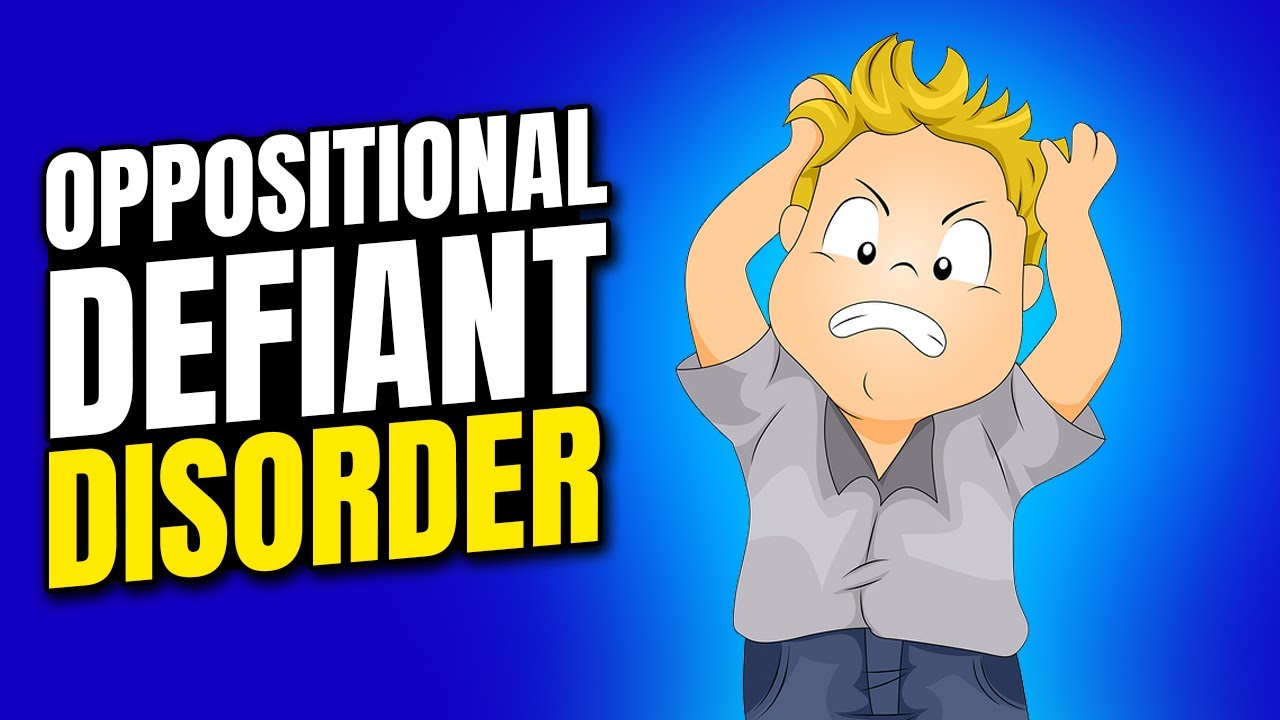
Hey, everybody. Today, I’m gonna with you about Oppositional Defiant Disorder, what is it, and how does it relate to other disorders we may struggle with. So like I said, today, I’m gonna with you about Oppositional Defiant Disorder, and because I’m talking about a disorder, like always, I got my DSM handy.
And I’m going to read you the description of what they say— I’m gonna call it ODD from now on, but we’ll know that means Oppositional Defiant Disorder but ODD what it really is. And they say it’s a pattern of angry/irritable mood or argumentative/defiant behavior or vindictiveness lasting at least six months as evidenced by at least four symptoms from any of the following categories. So the way that I remembered when I was studying for my license and exam, you all remember when I was doing that, and the way that I remember the difference because there are two of these types of—it’s a young person’s disorder— usually ODD and Conduct Disorder, or CD, happen to people when they’re in, you know, late-adolescence–early-teen years.
That’s usually when these come about. And the difference—what I always remember between Oppositional Defiant Disorder, ODD, and Conduct Disorder, CD— was that ODD, the “O” stands for obnoxious: These people are very irritable. They get very angry and frustrated.
And they lash out. But the people with Conduct Disorder commit crimes. The “C” in Conduct was for committing crime.
So that is how I always differentiated these. Conduct Disorder is what—if you remember my Antisocial Personality Disorder video, I bring it up because that is a precursor to that. So that’s how these differentiate, just so that you know.
Now, ODD. The symptoms that people may experience are things like often losing their temper, really touchy, they get annoyed easily. They’re angry and resentful a lot of the time.
They can argue with authority figures. For children, they tend to do with their teachers, and adults tend do more with their loved or their boss, even. They often deliberately annoy other people.
And they often blame others for his or her mistakes or misbehavior. And they can also, a part of this, is like being vindictive. And that says they’ve been spiteful or vindictive at least twice in the past six months.
And that’s just the diagnostic criteria, and we know that that doesn’t show us the whole picture. So I made some notes about what it is, what causes it, why do we have this, how does it relate to other disorders we may have. And you can see already, as I talk about the different symptoms that may show, and you may feel, how these can relate.
I know a lot of you who struggle with Bipolar Disorder. We experience a mixed state, a mixed state being, I may be kind of hypomanic, but I also feel very depressed. See, we have that inner tension, irritability, uncomfortable feeling, and we may exhibit these types of symptoms.
I may have ADD or ADHD, and in school, it’s really difficult for me to pay attention. I get bored easily. I don’t want to listen to the teacher.
And I get really annoyed. And I’m irritable about it. You can see how these may look the same, how they may overlap.
And so it’s important if you worry that you struggle with this or someone’s told you that you’ve been diagnosed with this, that you ask questions about these other issues you may have because we want to make sure you are getting diagnosed properly, okay? So what causes it? Like everything [sighs] in psychology, we don’t actually know, because we can’t look at the brain while it’s working and be like, Why is this happening?
When did this happen? What caused it? But we do know—I have all my notes.
It’s what I’m looking at— that they believe that there’s most likely a genetic component because they find people who have somebody in their family who also struggles with some kind of Conduct Disorder or ODD that they are two times more likely to struggle. And it’s also environmental factors. In my experience, with the— I used to see children that were forced to see me because they had just gotten out of juvenile detention and had been in trouble with the law that a lot of those kids had environmental factors that played a role.
And a lot of that talk about environment is prone to parenting, lack of supervision, or inconsistency in parenting. And a lot of the people that I saw had an intensely hard discipline, like they would get beat with a belt or a wooden spoon or even punched or slapped for doing something wrong. And so extremely harsh discipline or abuse or neglect, they find, can lead to ODD.
And as far as genetics, we don’t really know. They talk about the different nerves and the way that the brain functions and that there’s a disconnect, and so people really struggle. So, what do we do?
We know we have it. We have a lot of the symptoms, or we’ve been told we have it. And it may be something that we just got diagnosed with on top of something else that we already have.
I looked up different treatments, and obviously, medication is something that they always put in there as an option. But the ones that I want to highlight are more things that we can do as families, because we know that environmental factors play such a big role, that we can put in motion and we start doing that can actually help us in the long run. And a lot of it has to do with parents, parent-child interaction, parent training.
They talk about how you can do what they call parent-child interaction therapy, PCIT. You can look it up. I hadn’t heard about this, because I have never worked with a family and a child with ODD.
But it really helps them interact with their children in a way, communicate in a way, set boundaries in a way that allows the person with ODD to become less irritable, to feel safer, to be able to communicate their frustrations in a healthier way, and if they don’t, then there’s time outs and different rules and things that they follow that don’t involve any kind of abuse or extreme discipline. You can see how we’re trying to change the way family functions. And another is obviously individual and family therapy, because it can give you a place if you’re the person who’s really feeling frustrated all the time and just want to lash out, it can give you a place to express the anger, to express your frustration with a situation, to talk about how annoying this whole thing is and what’s going on at school or at work or whatever.
It gives you a place to vent, and we know that that’s part of the reason why therapy works so well, am I right? And the last thing that they talk about— there are a lot of options, by the way, but these are just the ones that show the most research and the most support— cognitive problem-solving training. Now, this helps you child just like CBT.
If you wonder about CBT, you can click here, and go to see my CBT video. But it gives the child who’s struggling with Oppositional Defiant Disorder the ability to change their thought patterns. So, if they don’t get their way, something frustrates them, it doesn’t work out, it’s okay.
They have these things that can write down, automatic thoughts, and we can give you some tools, like I do in my workbooks, right? And give you some tools to work on that, to help manage that thought, and to change the action that comes out of that thought. You know, cognitive behavioral, it’s like you have a thought-that-leads to-an-action kind of thing, a belief and a thought and an action all cycles together, and we end up doing up these things, and so this helps down that process so that we can work to not react but think about it, realize what we’re doing, and try to respond in a better way.
Now, obviously, all this takes work. All of the things that they talk about, the lifestyle and home remedies, things that we can do, like modeling behavior, picking your battles as a parent, all that parent-child interaction, it takes a lot of work. But it’s worth it, because struggling with ODD as a child can be very hard.
It means that every day is a fight. It’s a battle not only with ourselves but with other people in our lives. And from the people that I’ve worked with who struggle with it, they don’t really like feeling this way, but it’s almost like they don't know how else to react or respond.
World doesn’t feel like a very safe place, so they react out of anger a lot. They may have never felt safe, so they lash out quickly to protect themselves or kind of like pufferfish. And so doing all the work is very worth it, because it not only makes your child feel better, or the person with ODD to feel better, feel calmer, but it helps your whole household to be calmer.
And some more of the home remedies they offer is recognize and praise, like giving your child praise for the things they’ve done well and recognizing when they’re working really hard. And also setting up limits, setting up a routine. You can find a lot of these different ideas at the Mayo Clinic’s website.
They talk a lot about ODD and how to help it as a family member, how to work with your partner in assigning certain chores and responsibilities and praise them when they do them and just better structuring your household so that it’s not such an irritable, agitating place for the person with ODD. And there are also obviously some medications that they recommend, but we all know—I know that many of you don’t want to take those. A lot of them are like SSRIs and antidepressants, things that work for people with anxiety or lashing out.
They even recommend some antipsychotic medication to help kind of calm you down. So try the treatment remedies at home. Try some of the parent training and setting boundaries, because that can really help.
And we all know in general that if we have routines, we have different kinds of boundaries that we know are there, like, Well, I can't do because my mom said it's not appropriate, that’s life, and it helps us all feel calmer, stay calmer, be able to better manage what we’re feeling. And I would also encourage any of you, if you’re struggling with ODD, check out my DBT workbook. I know that’s a lot of acronyms.
I’m sorry. But DBT is a great—I have my self-harm workbook. It has a lot of DBT stuff, and there’s a DBT workbook that I recommend in my Amazon widget at the bottom of KatiMorton.
com It is great for managing that explosive-anger feeling, that buildup of tension that we get and then we feel like we explode. And that will really help you better manage those symptoms and feel like you’re more in control of your emotions versus the other way around, and wouldn’t that be nice? I love you all.
Thank you so much for checking this video out. If you like these kinds of topics and you want me to discuss more diagnoses, give it a thumbs up and like it, because like I’m always saying, it lets YouTube know how important mental health is. So let’s keep working together, let’s keep sharing videos, and sharing our experiences as we work towards a healthy mind and a healthy body.
Subtitles by the Amara.