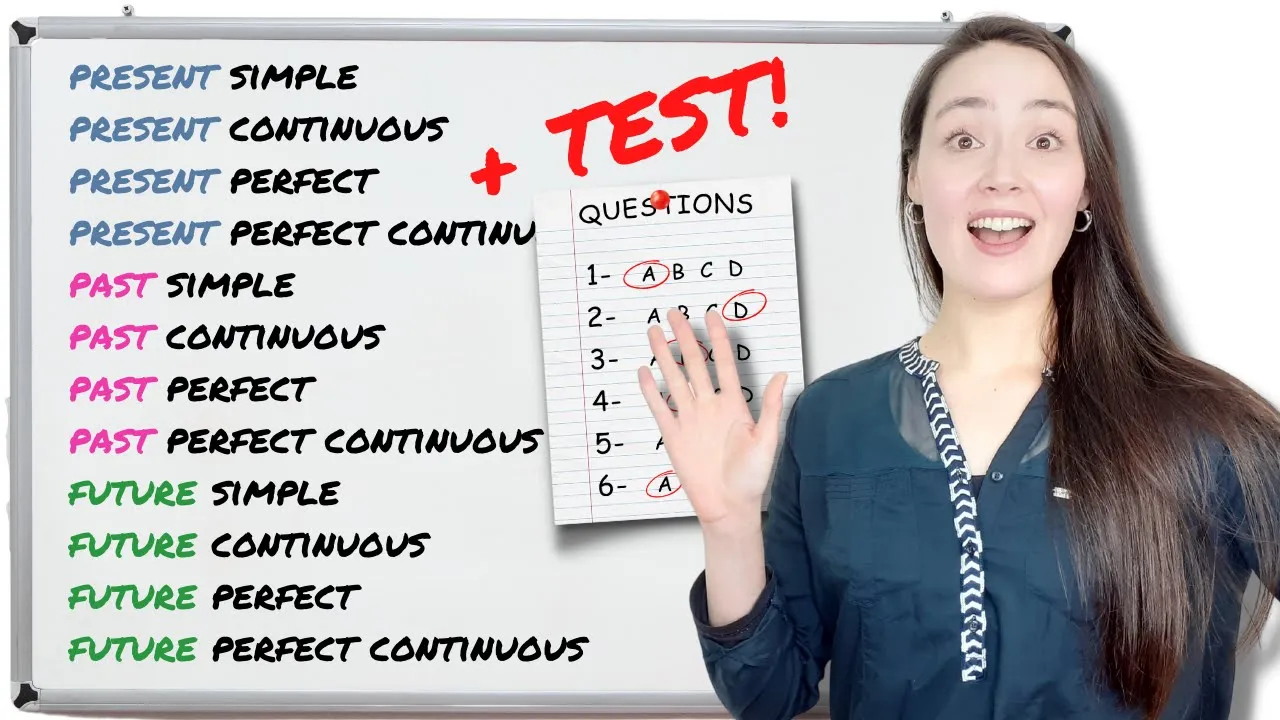
There are 12 tenses. In English in today's lesson we are going to learn and compare all of these. At the end of this lesson, at the end of this mega lesson, I have two tests for you. Yes two. My name's Arnel, are you ready? Let's start with a general overview. There are three periods: The present, the past, and the future. Simple, continuous, perfect continuous. You can see that the names are the same for each group. that makes things a little easier. Each tense has its own unique grammatical structure. Simple, continuous, perfect, perfect continuous. If this
looks confusing don't worry. I will go through all of these step by step, and you can also use the time stamps down below to help you choose the parts you want to focus on. First we are going to look at the simple tenses, then the continuous tenses, then the perfect tenses, then the perfect continuous tenses. Why? Because if you learn these groups together you Can compare them. Comparing them can show you how similar they are which makes them easier to learn. And the groups become more challenging as we continue. So if we build a really
strong foundation with the simple tenses, the more complex tenses are easier to learn. For example, if you really want to understand the present perfect, first you need to understand the present simple, and the past simple. [Music] First let's start with the grammatical structures. Present simple, past simple, future simple. Present simple. Subject plus the bare infinitive, the base verb. Remember the bear infinitive is verb number one. For example: Eat, ate, eaten. Eat is verb number one. Remember for he, she, or it, you need to add s or es to your verb. If I choose a different
verb, watch. Again, for that third person you need to add s or es. In this case he, she, or it watches. Keep that in mind. I wake up at 6am every day. The negative? I do not I, do not wake up at 6am every morning. Question: Do you wake up at 6 00 a.m every morning? Past simple. Subject plus the past simple verb. The past simple verb is verb number two. Again, Verb number two, ate. And you can see it's the same for all subjects. That makes the past simple easy. I woke up at 6am
every morning. Negative, I did not wake up at 6am every day. Question: Did you, did you wake up at six am every day? Future subject will plus base verb. We already looked at the base verb. The good news is we use will plus base verb with all subjects, that makes things easy. I will wake up at 6am every morning. I will not wake up at 6am every morning. Will you, will you wake up at 6am every morning? And it's really important to remember be is an exception. Be is the most common verb in English, so
let's take a look at a mini reminder. Be in the present: I am, you are, he/she/it is, we are, they are. Be in the past: I was, you were, he/she/it was, we were, they were. And in the future it's the same: I will be, you will be, etc... So the grammatical structures for the simple tenses are pretty simple, and of course in this lesson I will keep all the structures highlighted for you. Let's look at these tenses on a timeline: We use the simple tenses for habits, repeated actions, and for things that are always true
- like facts. Do habits change often? No. Do repeated actions change often? Not really. Do facts change often? No. A fact is a fact. Look at my timelines, the actions are the same but they are either in the present the past, or the future. Now in the present I wake up at 6am every day. This is normal for me. I woke up at 6am every day, it was normal for me. Future: I will wake up at 6am every day. Do we need to give a specific time with the simple tenses? With the present simple it's
already clear we mean now, in the present. Do we need a specific time with the past simple? In the context of the conversation or text, yes. So to make this example complete I will give you a specific time. When I was in high school I woke up at 6am every day. For the future simple, yes, we also need a specific time. It can be in the same sentence, or somewhere in the conversation or text. It needs to be clear somewhere. Starting the 15th of January I will wake up at 6am every day. Let's do another
example: Students do their homework online. They don't use pen and paper, they do their homework online. Here it's clear we're talking about now, the present period. Students did Their homework online. This would mean now, they don't. Students will do their homework online. Again for the past simple and the future simple let's give a specific time, we need a bit more detail. Students did their homework online - When? During the pandemic, but now they don't need to. Students will do their homework online beginning May. Okay, we've looked at repeated actions like waking up or doing homework,
but these tenses can also be used to describe states. What is a state? A state is a situation or an opinion, or a feeling. Do states change often? No, present simple, I have long hair. Is this a repeated action? No, it's a state, I have long hair. I had long hair until I turned 18. Past state, and I'm giving you a specific time, until I turned 18. I had long hair and now I have short hair. For example: Future simple, in a few years I will have long hair. Imagine, now I have short hair, in
a few years I will have long hair. That will be my future state. Here's another state. Doug is our team leader. Last year Doug was our team leader. Specific time, last year. Next week Doug will be our new team leader. Your turn, here's your homework, try to think of personal examples. Repeated actions, present simple. What is something you do every day, every month, every week, or every year? I cook every day. That's not a really exciting example but it's true, I cook every day. Past simple: What is something you did or didn't do every day,
every month, every year in the past? When I was a kid I never ate the crust on toast. I hated crust, yeah. Now now I eat crust. Future simple: What is something you will do? What do you think will become one of your habits in the future? I will, next year I will floss more. Okay, these are repeated actions/habits. Let's look at states. Again, think of your own personal examples. Present simple: What is something you enjoy? I enjoy pop music. Past state: What is something you had when you were a little kid? When I was
a little kid, specific time, I had a Yorkie. A Yorkie is a short name for a Yorkshire Terrier, they're cute little dogs aren't they? So I had a Yorkie. Future state: What will Earth be like in one thousand years? Earth will be different, so use these questions here to practice. If you want, give me a few examples down below. I would love to see your examples. Are we done with the simple tenses? Not yet. It's clear we use all three of these tenses again for repeated actions, habits, and states. But the past simple and the
future simple can also be used for single actions. Not repeated actions, not states. I made an omelette for breakfast. One action. The chef will prepare something nice for us. Single action. I bought a new phone yesterday. Single action. I will buy a new phone after my birthday. Do we always know what will happen in the future? No, so we often use the future simple for those single actions or promises, or predictions. Common mistake: I buy a new phone today. Can we use the present simple for a single action? No, not in this case. But, there's
always a but, this is special - we can use the present simple for a scheduled future event. Yes, future. Our train leaves at nine. The movie starts in 30 minutes. I want to show you another example, let's look at a little clip. Here we have two strangers on a train and we see a nice mix of tenses: So where are you headed? Well, back to Paris, um my class start next week. Oh, you're still in school, where do you go? Okay, where are you headed means where are you going. And here we see the present
simple used for a scheduled future event. We've looked at three scheduled future events. Are these events something you have control over? We can't control when our train leaves. We can't control when the movie starts, and we can't control when our classes start. So that present simple can be used for a single future action, but it's something that's scheduled, it's not something we can control. Simple tenses review: We can use the simple tenses for habits, repeated actions, and states. I live in an apartment, I lived in an apartment, I will live in an apartment. With the
past simple and the future simple you do want to include a specific time somewhere in the conversation or context. The past simple and the future simple can also be used for a single action. I arrived on time for the meeting, I will arrive on time for the meeting. But because we don't always know what's going to happen in the future, that future simple is often used for predictions and promises. And finally the present simple can be used for a future scheduled event. Like, my bus leaves in 10 minutes bye [Music]. Present continuous. Past continuous. Future
continuous. Present continuous. Subject: Am/are/is plus verb ing. Remember to choose am/are/is depending on your subject. Example: I am talking to you. Negative, I am not talking to you. Question, are you talking to me, or am I talking to you? Past continuous. Subject: Was or were plus verb ing. Again you need to choose was or were, depending on your subject. I was talking to you. Negative, I was not talking to you. Question, were you talking to me? Future continuous. Subject: Will be plus verb ing. The good news is we use will be for all subjects. I
will be talking to you. Negative, I will not be talking to you. Question, will you be talking to me? During this lesson I will keep all of the grammatical structures highlighted for you. Okay, so we have the grammatical structures. How do we use these tenses? We need a timeline. Present continuous. Past continuous. Future continuous. We use the continuous tenses for an action happening during a specific period. Present, let's choose now. Now I am talking to you. Past continuous. Let's choose 2 p.m. yesterday. Yesterday at 2 p.m. I was, I was talking to you. Future continuous.
Let's choose 2 p.m. again, tomorrow. Tomorrow at 2 p.m. I will be talking to you. Can you see how similar the tenses are? We just need to change the period. The present, the past, or the future. Are these actions permanent or temporary? Permanent means long term or forever. Temporary means short term. So do you think these actions are permanent or temporary? These are temporary. Continuous tenses express a temporary action or situation. They are not permanent or repeated actions like the simple tenses. Do we need a specific time with these tenses? With the present continuous it's
clear we're speaking about the present, but for the past Continuous and future continuous you do want to have a specific time. Either in the same sentence or somewhere in the context of the conversation, or texts. Here, yesterday at 2 pm. Here, tomorrow at 2 pm. Let's do another set of examples. Now. Now it's getting dark. Getting dark means becoming dark. Yeah it's getting dark, it's getting dark, now this is happening, hey you can't see me... Yesterday at 7 pm it was getting dark. In one hour (future). in one hour it will be getting dark. Permanent
or temporary? Temporary. It doesn't get dark forever. Let's do one more example. In class we are working on addition and subtraction. imagine Imagine I'm in elementary school teacher. Am I doing this right now? No, but we can also use a present continuous to speak about the general present, perhaps not this exact moment. Period: Last month. Last month we were working on addition and subtraction. Period: Next month. Next month we will be working on addition and subtraction. Your turn, here's your homework. Answer these questions and try to think of really personal examples: What are you doing
now? Well, now you are watching this lesson, but try to think of a different example. For example, now I am standing in my office. This is not permanent, it's Temporary. I really want to sit down soon. Past: What were you doing at 3 p.m. yesterday? I was picking my kids up from school. What will you be doing three hours from now? I will be making dinner probably... So we know continuous tenses are temporary. But you want to ask yourself why are you using a continuous tense, and what is important about the period? For example, let's
look at a few of my examples from earlier. I am talking to you, why would I need to say this? Maybe I'm talking to someone and they're looking at their phone, I can say: I'm talking to you, can you please stop looking at your phone? My action now is important. Did you go jogging after work? No, I didn't leave the office until 7 p.m. and it was getting dark. I don't feel comfortable jogging that late in the evening. Now it makes sense why someone would use this tense. The Continuous tenses can be the main action,
but many times they are the background action. There is another main action that happens at the same time or the main action interrupts That background action. We usually see this with the past continuous and the future continuous. What happened? I was holding a cup of coffee on the couch when my son bumped into me, so I spilled my coffee. We had that background action. That's not really the main action that's just giving us a bit of background. The main action is my son bumped into me. I really want to show you the power of the
past simple and past continuous combination. Let's take a look at a few little clips. In this interview a famous British actress, Emily Blunt, is talking about one of her movies called Quiet Place. But actually we were having a Super Bowl party and the trailer for Quiet Place came on, which is terrifying. Yes. And Hazel sort of wandered in... We were having a Super Bowl party, and the trailer for Quiet Place came on which is terrifying. Here we see the background action, we're having a Super Bowl party. And the main action, the trailer for Quiet Place
came on. And this is terrifying, looks like the present continuous, but no, terrifying here is an adjective. In the next part Emily is talking about the first time she met her future husband. I was In a restaurant, he was in the restaurant. I was sitting with a mutual friend. This is all romantic... Here we can see the two past simple states. And the past continuous is telling us what was happening in the background. Is sitting with a friend import information? No. It's just a background so we know what was happening. One more example. With you
no he just um he was actually sitting with our friend Justin Thoreau. Okay. And then uh he abandoned Justin and came over to come and talk to us, he did not eat he just... Again, background. Was sitting with a friend. Main actions. With the future continuous it's the same thing. I hope I don't see John at the event. Don't worry, you will be working in different teams. Main action, I hope I don't see John. What's that background? You will be working in different teams. Don't message me after six, I'll be having dinner with my boss.
The main action is don't message me. Why? What's going on? What will be going on? I'll be having dinner with my boss. But what if I say I'm hungry, I'm wanting some breakfast. The students were knowing all of the answers. I know Kira will be loving the party. Want? Know? Love? These are stative verbs. Stative verbs, what are stative verbs? Stative verbs describe states. These can be our feelings, our thoughts, and our emotions. They are the opposite of dynamic verbs. Dynamic verbs like eat, play, run, work. Lets take a look at a list of stative
verbs. You can see you want, know, and love here. Again, just like the present simple, stative verbs describes states which don't change often. These are not used in continuous tenses. So here, nope, these sentences are not correct. We need to use the simple tenses, here. This is so important to remember in this lesson, and I will continuously remind you of this. Yes, some verbs can be stative and dynamic, but there aren't very many of those. Let me show you a mini clip. This is a clip of a young lady and a vampire dancing. At one
point the vampire says this: They're loving it. Okay, the vampire is using the present continuous because the action is happening now. This is not correct grammar because love is a stative verb. However, sometimes in very casual English you might hear stative verbs being used in a continuous tense. But for English exams you don't want to do that. Are we done with the continuous Tenses? Not quite. Let's focus on the present continuous because that one's pretty special. Tomorrow we are flying to Rome. I'm meeting Jake and Ellen for dinner tonight. What are you doing this weekend?
We can use the present continuous for a future plan. Yes, a future plan. It's very natural. Common mistake: Tomorrow we will fly to Rome. I will meet Jake and Ellen for dinner tonight. What will you do this weekend? Wait, wait, wait, wait, wait, wait, wait. In this lesson you said we could use, will, for a single future action. Yeah I said that. So why is tomorrow we will fly to Rome wrong? It's a single future action. Am I talking about a future habit? No. Am I talking about a future state? Nope. Am I making a
promise? Maybe. Right, we don't use the future simple will for a future plan. The present continuous is the better and more natural choice. But what about be going to? We can also use be going to for a future plan. Okay, we need to look at present continuous and be going to for future plans. I am going to meet Jake and Ellen for dinner tonight. Present continuous, I'm meeting Jake and Ellen for dinner tonight. What's the difference? Native speakers use both of these forms interchangeably all the time, and they are both correct. But let's get really
picky, let's get super specific. Be going to plus verb one, is often used with a future intention. Present continuous is more definite. What do I mean by that? I have three days off next week, I'm gonna stay at home and watch movies all day. This is my intention. Whether I do this or not, I don't know. Teacher: I'm excited about tomorrow, I'm taking my students to a museum. Here, the present continuous is more definite. I have my lesson planned, and I know the museum I'm going to. You might hear someone use will for a future
plan, but it's generally not the accepted form. Let's compare, finally we can start comparing tenses. I work in Tucson. I am working in Tucson. Tucson is a city in Arizona. I worked in Tucson. I was working in Tucson. I will work in Tucson. I will be working in Tucson. Which column expresses a permanent action? The simple tenses. Present simple, past simple, and future simple. These are permanent. I work in Tucson. This is my life, this is where I live, this is where my office is. I am working in Tucson. Maybe I normally work in Mesa,
a different city, but for two weeks I'm working in Tucson. This is temporary. It's the same thing for the other tenses. I worked in Tucson, that was my life, my office was there. I couldn't go to the office party because I was working in Tucson, that week. A temporary feeling. I will work in Tucson, this will be my new future life. I will be working in Tucson, temporary. I can't go to the Mesa party because I will be working in Tucson. My main office is in Mesa but here, temporarily, I'll be working in Tucson. Mini
review. The Continuous tenses express a temporary action during a specific period. I am studying now. I was studying this morning. I will be studying tonight. The continuous tenses can be the main action, but many times with the past continuous and future continuous, they express the background action. These background actions are either interrupted by a main action, or the main action happens at the same time. We were talking about Phil When he walked into the office. You can meet me after work, I'll be waiting in Starbucks. The present continuous can also be used for a future
plan. Many times this is a personal plan, we're not speaking about a prediction or a promise or a future habit or state. Next week I'm visiting my grandmother. I can also use be going to, plus bass verb. Next week I'm going to visit my grandmother. These are often used interchangeably, but if we want to be super picky, be going to often expresses an intention, the present continuous is more definite. Present perfect, past perfect, future perfect. Present perfect: subject have or has plus the past participle. Remember to choose have or has depending on your subject. And
that past participle is verb number three. For example: eat, ate, eaten. Eaten is my past participle verb number three. I have eaten at Rosario's. Imagine Rosario's is a restaurant. Negative: I have not eaten at Rosario's. Question: Have you eaten at Rosario's? Past perfect: subject had plus past participle. The good news is we use had for all subjects. I had eaten at Rosario's. Negative: I had not eaten at Rosario's. Had you eaten at Rosario's? Future perfect: subject will have plus past participle. Again, the good news is we use will have for all subjects. I will have
eaten at Rosario's. I will not have eaten at Rosario's. Will you have eaten at Rosario's? Okay, so we have the grammatical structures, and in this lesson I will keep the structures highlighted for you - of course. So how do we use these tenses? Here I have my timelines: Present, past, and future. I have eaten at Rosario's, I had eaten at Rosario's, I will have eaten at Rosario's. The perfect tenses are really special because they emphasize an action before something else. Present perfect, before now. Past perfect, before another past point. Future perfect, before another future point.
You can really see how similar these three are. [Music] I understand. Let's do these one at a time. Present perfect, I have my timeline with the past and the present. I have been to Paris. Kim has taken the TOEFL exam. My parents have seen my new house. He has finished his homework. I know what some of you are thinking, isn't this the same as the past simple? Don't worry, we will compare the past simple and the present perfect later. All of these actions happened when? Before the present. Do we know specifically when? No, but before
now is relevant. What do I mean by that before now is relevant? There is a connection between the past action and the present. So let's break this down, why would I say I have been to Paris? Maybe I'm having a coffee break at work and one of my colleagues keeps talking and talking and talking and talking about our trip to Paris. And she says to me: Arnel you have to go to Paris, you need to go to Paris. I can say: I have been there, I have been to Paris, in fact I have been there
three times. So you can stop talking about your trip now. I'm emphasizing before now I have been there. I'm telling her I have had this experience. Let's do another example, why would I say he has finished his homework? Maybe two parents are talking. Dad: Is it okay that Louis is playing video games? Mom: Yeah, he has finished his homework. Do we know specifically when? No, we don't care about when. But the present is relevant. His past action means now he can play video games. Okay, it's time for a common question: Past simple or present perfect?
I have two columns here. The present perfect is more general, we are interested in your past experience. Your past experience before now. The past simple is more specific and we need to know specifically when. So you can see in my examples here, I'm missing something. I have been to Paris, but I went to Paris in 2003. Kim has taken the TOEFL exam, but she took the TOEFL exam last week. My parents have seen my new house, they saw my new house on Monday. Louis has finished his homework, he finished his homework an hour ago. Even
though these are both completed past actions, the feeling is quite different. The Present perfect is really common in interviews. Why? Because the interviewer is interested in your experience, not specifically when things happened. Let's take a look at a mini clip. This is an interview with a famous American actress Jennifer Lawrence. I won't play the whole interview, but I want you to hear the present perfect. I'm going to do this quickly so be prepared! And what have you done for the first time recently, and what is your favorite movie of all time, that you never get
sick of? I mean, the movie I've seen the most and watch for any occasion is Father of the Bride Two. What's the craziest thing you've ever seen here? Um, the most fun I've ever had with actors on set is Josh and Liam, Hunger Games. Hi boys! They're great. All right, let's Golf. We got a mini golf here. So what's the strangest thing a journalist has ever asked you in an interview? What's the most bizarre thing that you've ever read about yourself? What's the best piece of advice you've gotten about parenting? Babies don't get bored. Okie
dokie, in all of these examples we are just interested in the action or experience. When before now, specifically when? Do. Not. Care. But earlier in the interview we hear this: So when was the last time that you played mini golf? Never or like five years ago. On Past simple, why? Because the interviewer is asking when specifically. Okay, so we've looked at single past experiences or repeated past experiences. But what happens if the action isn't finished? What happens if the actions started in the past and is still true now? We can also use the present perfect.
Jane has lived in Canada for 22 years. I have had long hair my entire life. They have known each other since kindergarten. For 22 years, my entire life, since kindergarten, all of these tell us how long. And this is really common in the present perfect. Is there a connection between the past and the present? Definitely. Are the situations still true today? Yes. Common mistake: Jane is living in Canada for 22 years. Jane lives in Canada for 22 years. Remember we do not use the present continuous or the present simple for that past to present connection.
Perfect. I'm going to use the same examples I used in the present perfect so you can really see again how similar they are. Past perfect: An action completed before another past point. Present perfect: I have been to Paris. When? Before now. Past perfect: I had been to Paris. When? Before I started University. You can see I added the past simple here to make another past point. The past perfect is always the action before another past point. Let's do another example: Present perfect. My parents have seen my new house. Past perfect. By the time I moved
all of my furniture into my new house, my parents had already seen it. Here in this example even though the past perfect comes second in the sentence, it's still clear it happened before that past simple action. Present perfect. He has finished his homework. Past perfect. Louis' Mom let him play video games (past simple) because he had finished his homework. And just like the present perfect, the past perfect can also show a past to past connection. The present perfect, remember a past to present connection? Past perfect, let's move it back past to past connection. Jane was
sad to move because she had lived in Canada for 22 years. Past to past connection. I had had long hair my entire life and it was really difficult for me to cut it. Had had? Is that possible? Yes, remember the past perfect is had plus past participle. What's the past participle of have? Had, had had. Nathan and Brian decided to open a business together. They had known each other since kindergarten and trusted each other. I want you to take a look at a little clip. This is a police interrogation. An interrogation is a police interview.
This man is the detective and this man is who the police think did the crime, he is the suspect. Police interrogations are a great place to find the past perfect, because you need to speak about the past in detail. Yeah. We didn't even know the first one had happened but uh, I understand that was reasonably close as well, but the second one was uh... We didn't even know the first one had happened. Here one means a crime, we didn't even know (past simple) that the first one had happened. Again, the past perfect describes an action
before another past action. The first crime happened before they knew about it. Learned that you told me. Okay. So I got an email, I can't remember if it was late at night early in the morning but certainly I saw it uh... I want to say first thing in the morning, because I had just come back from Ottawa. I was in Ottawa for... So he saw the email first thing in the morning. He had just come back from Ottawa. Things like fingerprints blood samples things like that? Yeah. Okay, um... The only two pieces of evidence that
police had acquired at this point in time were the tire tracks and the footprints outside the missing person's residence. At this point In time, is a pastime. Before this the police had acquired tire tracks and footprints as evidence. Right, let's compare the past simple and the past perfect. Kim had taken the TOEFL exam, Kim took the TOEFL exam. Jane had lived in Canada for 22 years, Jane lived in Canada for 22 years. I had had long hair my entire life, or I had long hair my entire life. The past perfect actions again are actions that
happened before another past action. So in these examples here a few things are missing. In the past perfect column we don't have that other past action as a reference. And what am I missing in my past simple column? The specific time. Hmm... But something doesn't feel right. I had long hair my entire life? Past simple? Am I still alive? Yes. Would I use past simple? No, in this case here you do need to look at the situation. What tense would I use to describe a past to present connection? Present perfect. I've had long hair my
entire life. I could say, I mean I could talk about someone else someone who is no longer alive. Mary Smith had long hair her entire life, that works. So whenever you Use a tense, you can't only look at the grammar, you also need to look at the logic of the situation. It's time for the future perfect, and yep, I'm going to use the same example so again you can see how similar they are. You just need to move the period to the present, the past, or the future. The future perfect, a completed action. When? Before
another Future Point. Everyone has been to more countries than me. You're going on a trip throughout Europe. By the end of the summer you will have been to France, Germany, and Spain. That's more than most people. What's my future point? By the end of the summer what will have happened before then? I will have been to France, Germany, and Spain. Kim is so stressed about her TOEFL exam, she can't sleep. In a few days she will have finished her TOEFL exam. What's my future point? In a few days. What will have been finished by then?
Kim will have taken her TOEFL exam. I wanted to surprise my parents by showing them my new house. But by the time I show them my new house (future point), they will have already seen it on Instagram. Okay, let's keep going, and you might know what's coming next. We can use the future perfect for an action that continues up to another future point. Jane has lived in Canada for a very long time. By 2025 she will have lived in Canada for 22 years. And this action can either start in the past, the present, or in
the future. We don't really know, it depends on the situation. How long has Dan been your assistant? Let me see, I hired him on my birthday, so on my next birthday he will have been with me for eight years. You can see an action that continued up to another future point. It's time to compare. Let's compare the future simple, and the future perfect. You can see my two columns here: future perfect and future simple. The future perfect emphasizes, what doesn't emphasize? A completed action before another future point, that's really important. Completed before a future point
or continued up to a future point. The future simple does not depend on anything in the future, it's just when something will happen. Your turn to practice, here is your homework: What is something you have done that you are proud of? Past perfect, what is something you had done before you turned 18? If you're not 18 yet, think of a different example. Future perfect, what is something you will have done by the time you turn 100? Use these questions to help you practice, and think of really personal examples. Perfect tenses review: The perfect tenses emphasize
a completed action before something else I have taught the present perfect many times before now. When I completed my teacher training course, I had not taught the present perfect at all. By the time I turn 40, I will have taught the present perfect many times. The perfect tenses also describe an action that continues up to another point. Present perfect, I have been a teacher for 12 years, up to now. By 2011 I had been a teacher for only one year. In nine years, I will have been a teacher for half of my life. Present perfect
continuous. Past perfect continuous. Future perfect continuous. Present perfect continuous. Subject have or has been plus verb "ing". Remember to choose have or has depending on your subject. The pie has been baking. Negative, the pie has not been baking. Question, has the pie have been baking? Past perfect continuous. Subject had been plus verb "ing". The good news is we use had been for all subjects. The pie had been baking. Negative, the pie had not been baking. Had the pie been baking? Future perfect continuous. Subject will have been plus verb "ing". We use will have been for
all subjects. The pie will have been baking. The pie will not have been baking. Will the pie have been baking? In this lesson I will keep the grammatical structures highlighted for you. Okay, so how do we use these tenses? I have my timelines and the examples we've just looked at. The pie has been baking, the pie had been baking, the pie will have been baking. The perfect continuous tenses emphasize an action that continues up to another point. And the emphasis is on duration, how long. Wait, wait, wait. Duration? How long? Remember earlier in the series
you were explaining the present perfect and you said this: For 22 years. My entire life. Since kindergarten. All of these tell us how long, and this is really common in the present perfect. Okay, if how long is important in the present perfect, and the present perfect continuous, what is the difference? I am confused! We need a grammar web [Music] Arnel's Grammar Web! I created this web to help me make a decision. Don't start with present perfect or present perfect continuous. No, use this web. First, is your verb dynamic or stative? Let's choose a simple dynamic
verb, eat. Eat is dynamic. Do I want to emphasize a completed action? Or an ongoing action? Ongoing means still continuing. Let's choose completed. If your action is completed and connected to the present, you need the present perfect simple. The guests have eaten the main course. Completed. Now it's time for dessert. Let's try with ongoing. And you can see if your action is ongoing, you need the present perfect continuous. The guests have been eating and they are still eating. Duration, all evening. You can see you need present evidence. What's the present evidence of this action? Well,
you keep putting food out for the guests and they keep eating! I mean you can literally see people chewing. And duration isn't always necessary. Sometimes in a situation the duration is obvious. Let's try another verb, be. Be is a stative verb. Can stative verbs be used in a continuous tense? No, so this makes life easy. With stative verbs continuous tenses are not an option, but you still need to choose between a completed and ongoing action. Okay, do I want to be completed or ongoing? Let's choose completed. If it's completed, it's a past experience. I've had
many jobs in my life. I have been a dog walker, a babysitter, a florist, and a nurse. Am I any of these things now? No, completed. Now let's choose ongoing. I have been a nurse, duration, since 2015. What is my evidence of this ongoing state? Well I go to the hospital every day, it's my job. So in this lesson keep my grammar web (Arnel's Grammar Web) in mind. The present perfect continuous. The pie has been baking for 20 minutes and the kitchen smells wonderful. An action started in the past, it continues up to the present,
and it is ongoing. The pie is still in the oven. What's my evidence here? Well, I can see the pie baking in the oven and the kitchen smells Wonderful. It has been raining non-stop, it's still raining! If I want I could add, for days, or for weeks. But non-stop kind of already emphasizes the duration. What evidence do I have? Well I can see it's raining and maybe outside there are large puddles everywhere. Our solar panels have been providing us energy since we put them up, and this is ongoing, they will continue to provide us energy.
What's my evidence? Well, now we have electricity. So far I've mentioned ongoing a few times. The actions are ongoing, they're continuing. However, mini note, with the present perfect continuous the action could be ongoing or the action could have stopped just before the present time. So if I say: Sorry I'm sweaty, I've been running. Maybe I'm done running, but there's still evidence of that recently finished action. What's my evidence? Well I'm all sweaty. We've looked at four examples of the present perfect continuous. What do we need to do now? We need to compare this tense to
the other tenses, are you ready? The present perfect continuous. The pie has been baking the oven for 20 minutes and the kitchen smells wonderful. An action started in the past and continues up to the present, and is ongoing. What's my evidence? The kitchen smells wonderful. Present perfect. The pie has baked, cooled, and is now ready to cut. This is a completed past action. The pie is out of the oven. When did this action happen? It doesn't matter, before now. Past simple. The pie baked beautifully yesterday and everyone enjoyed it. Completed past action. But now I
include a specific time, yesterday. And you can see I'm changing my example slightly to fit the tenses. Present continuous. The pie is baking now, don't turn off the oven. I'm focusing on the action now. Remember, we do not use a present continuous for a past to present connection. I want you to take a look at a mini clip here. In this clip we see two strangers on a train. They don't know each other but we will hear a nice combination of a few tenses. How about you, where are you going? I'm going to Vienna. Vienna,
what's there? I have no idea, Im flying out of there tomorrow. You're on holiday? Uhhhhh um I don't really know what I'm on, you know. I'm just traveling around. I've been riding the trains for the past two three weeks. You are visiting friends or just on your own... Present continuous because this is happening now. I have no idea, I'm flying out there tomorrow. This present continuous is a future plan. It's definitely happening. He will already have his plane ticket. I'm just traveling around. Present continuous because he's doing this now. I've been riding the trains for
the past two/three weeks. Yes! Now we see the present perfect continuous. Because this started in the past, continues up to the present, and now he is still on the train. This is ongoing. The verbs live and work are not stative verbs, they are dynamic verbs. But where we live and where we work are kind of like states right? They don't change often. We can use these two verbs live and work interchangeably with the present perfect and the present perfect continuous, and there is no difference in meaning. Some people may choose the present perfect continuous to
really emphasize the duration. But really you can comfortably use these, and don't worry about the difference. Past perfect continuous. When I checked on the pie it had been baking for 20 minutes. Just like the past perfect simple we need to use another past action. Why? Because the past perfect continuous emphasizes a past action that continues up to another past point and is ongoing. Was the pie still baking when I checked on it? Yes. It's actually just like the present perfect continuous but we move it to the past. The river burst its banks as it had
been pouring for days. And if a river bursts its banks - that's really hard to say, burst its banks. It means that um the river is so full the water starts to go on the land. You can see that past perfect continuous action continued up to another past point, and was probably ongoing. I want you to take a look at another mini clip. This is just a business meeting. Our risk, where's Eric Dale? He was let go today. He was let go today, and let go means fired, Eric Dale was fired. Past simple with a
specific time. Obviously today means earlier today. Apparently, Eric had been working on this for some time but he wasn't able To finish it. This morning as he left... Apparently, Eric had been working on this for some time but he wasn't able to finish it. So the past perfect continuous goes up to the moment Eric was fired. Arnel's Grammar Web! Verb, work. Work is dynamic. Was it completed or ongoing? Well, ongoing because he was still working on it when he got fired. Duration, for some time. And evidence, records, talking to Eric etc... Right, it's time to
compare the past perfect continuous with other tenses. When I checked on the pie it had been baking for 20 minutes. Past perfect. By the time I took the pie out of the oven, its crust had turned golden brown. With the past perfect I'm emphasizing a completed action before another past action. I'm not really interested in the ongoing past action, at a certain point. Past simple. The other day I was really in the mood to do some baking, so I baked a pie. Past simple, specific time, the other day. And the other day means recently, in
the past, maybe two to three days ago. The past simple is not dependent on another past point. Past continuous. The pie was baking in the oven when we had a power cut. Am I emphasizing the duration like the past perfect continuous? No, the Past continuous is giving me the background, the background action that was interrupted by another action. Okay, future perfect continuous. How are you feeling? When will the pie be ready? Um, in 10 minutes the pie will have been baking for 20 minutes, and it will need another 15 minutes after that. Can you see
how similar the future perfect continuous is to the other two perfect continuous tenses? The news says it's going to rain for another three days. [Music] Okay, so by Friday it will have been raining for eight days. Great. How are your solar panels holding up? Holding up means, surviving. How are your solar panels surviving? Great, next month they will have been providing us energy for exactly one year. Remember with the future perfect continuous this ongoing action could have started in the past, the present, or the future. It really depends on the situation. I will say the
future perfect continuous tense really is the least common tense in English. It's not really heard in spoken English, but I did find some great examples in written English. Here's an article from economist.com: At the end of July America's economy will have been growing for 121 months. There's expectation that this is ongoing. And here's one from homeserve.com: Smart Energy users will have been Using their fans throughout the winter, too, as a way to encourage warm air distribution. Let's try this again with this sentence. Grow, dynamic, ongoing. Duration, 121 months. Evidence, well whoever wrote this article just
needs to calculate from the starting point to the end of July, and count how many months there are. Your turn to practice. Here is your homework: What is something you have been doing recently and that you will probably continue to do? I've been making a lot of banana mango smoothies... so good. What is something you had been doing before the pandemic to improve your English? By the end of this year what will you have been doing to improve your English? Give me your comments down below, I would love to hear from you. Perfect continuous review.
The perfect continuous actions continue up to another point. Present perfect continuous, up to now. I have been practicing this song for days. The past perfect continuous, an action continues up to another past point. By the time I perform the song, I had been practicing for months. Future perfect continuous, the action continues up to another future point. By the time I performed the song, I will have been practicing for months. Usually these actions are ongoing or they end very close to the other point. And the perfect continuous tenses emphasize duration. You can see in my examples
four plus the period. Whew! Test number one, are you ready? Well, if you want to master the 12 tenses you need to know the grammatical structures. No structure, no tense. So what I want you to do is choose the right tense to match the sentence. Pause the video to do this. Okay, here are the answers. How did you do? Please let me know in the comments. Did you get 12 out of 12? Maybe 8 out of 12? There's no time to celebrate, we need to move on to test number two! Let's go. Test number two,
here we go. This one is a little bit more difficult. For each Sentence choose the correct option. Again, pause the video to do this. Here are the answers. Again, let me know in the comments how you did on this test. Please! I would really like to know. I know there's been a lot of information in today's lesson and . I'm actually proud of you for making it this far. Today's lesson really was a mega lesson. If today's lesson helped you just a little bit with the tenses I am happy, my job is done. I can't
wait to make another video for you, and I'll see you next time. Thank you! Bye!!! There are 12 tenses. In English in today's lesson we are going to learn and compare all of these. At the end of this lesson, at the end of this mega lesson, I have two tests for you. Yes two. My name's Arnel, are you ready? Let's start with a general overview. There are three periods: The present, the past, and the future. Simple, continuous, perfect continuous. You can see that the names are the same for each group. that makes things a little
easier. Each tense has its own unique grammatical structure. Simple, continuous, perfect, perfect continuous. If this looks confusing don't worry. I will go through All of these step by step, and you can also use the time stamps down below to help you choose the parts you want to focus on. First we are going to look at the simple tenses, then the continuous tenses, then the perfect tenses, then the perfect continuous tenses. Why? Because if you learn these groups together you can compare them. Comparing them can show you how similar they are which makes them easier to
learn. And the groups become more challenging as we continue. So if we build a really strong foundation with the simple tenses, the more complex tenses are easier to learn. For example, if you really want to understand the present perfect, first you need to understand the present simple, and the past simple. [Music] First let's start with the grammatical structures. Present simple, past simple, future simple. Present simple. Subject plus the bare infinitive, the base verb. Remember the bear infinitive is verb number one. For example: Eat, ate, eaten. Eat is verb number one. Remember for he, she, or
it, you need to add s or es to your verb. If I choose a different verb, watch. Again, for that third person you need to add s or es. In this case he, she, or it watches. Keep that in mind. I wake up at 6am every day. The negative? I do not I, do not wake up at 6am every morning. Question: Do you wake up at 6 00 a.m every morning? Past simple. Subject plus the past simple verb. The past simple verb is verb number two. Again, verb number two, ate. And you can see it's
the same for all subjects. That makes the past simple easy. I woke up at 6am every morning. Negative, I did not wake up at 6am every day. Question: Did you, did you wake up at six am every day? Future subject will plus base verb. We already looked at the base verb. The good news is we use will plus base verb with all subjects, that makes things easy. I will wake up at 6am every morning. I will not wake up at 6am every morning. Will you, will you wake up at 6am every morning? And it's really
important to remember be is an exception. Be is the most common verb in English, so let's take a look at a mini reminder. Be in the present: I am, you are, he/she/it is, we are, they are. Be in the past: I was, you were, he/she/it was, we were, they were. And in the future it's the same: I will be, you will be, etc... So the grammatical structures for the simple tenses are pretty simple, and of course in this lesson I will keep all the structures highlighted for you. Let's look at these tenses on a timeline:
We use the simple tenses for habits, repeated actions, and for things that are always true - like facts. Do habits change often? No. Do repeated actions change often? Not really. Do facts change often? No. A fact is a fact. Look at my timelines, the actions are the same but they are either in the present the past, or the future. Now in the present I wake up at 6am every day. This is normal for me. I woke up at 6am every day, it was normal for me. Future: I will wake up at 6am every day. Do
we need to give a specific time with the simple tenses? With the present simple it's already clear we mean now, in the present. Do we need a specific time with the past simple? In the context of the conversation or text, yes. So to make this example complete I will give you a specific time. When I was in high school I woke up at 6am every day. For the future simple, yes, we also Need a specific time. It can be in the same sentence, or somewhere in the conversation or text. It needs to be clear somewhere.
Starting the 15th of January I will wake up at 6am every day. Let's do another example: Students do their homework online. They don't use pen and paper, they do their homework online. Here it's clear we're talking about now, the present period. Students did their homework online. This would mean now, they don't. Students will do their homework online. Again for the past simple and the future simple let's give a specific time, we need a bit more detail. Students did their homework online - When? During the pandemic, but now they don't need to. Students will do their
homework online beginning May. Okay, we've looked at repeated actions like waking up or doing homework, but these tenses can also be used to describe states. What is a state? A state is a situation or an opinion, or a feeling. Do states change often? No, present simple, I have long hair. Is this a repeated action? No, it's a state, I have long hair. I had long hair until I turned 18. Past state, and I'm giving you a specific time, until I turned 18. I had long hair and now I have short hair. For example: Future simple,
in a few years I will have long hair. Imagine, now I have short hair, in a few years I will have long hair. That will be my future state. Here's another state. Doug is our team leader. Last year Doug was our team leader. Specific time, last year. Next week Doug will be our new team leader. Your turn, here's your homework, try to think of personal examples. Repeated actions, present simple. What is something you do every day, every month, every week, or every year? I cook every day. That's not a really exciting example but it's true,
I cook every day. Past simple: What is something you did or didn't do every day, every month, every year in the past? When I was a kid I never ate the crust on toast. I hated crust, yeah. Now now I eat crust. Future simple: What is something you will do? What do you think will become one of your habits in the future? I will, next year I will floss more. Okay, these are repeated actions/habits. Let's look At states. Again, think of your own personal examples. Present simple: What is something you enjoy? I enjoy pop music.
Past state: What is something you had when you were a little kid? When I was a little kid, specific time, I had a Yorkie. A Yorkie is a short name for a Yorkshire Terrier, they're cute little dogs aren't they? So I had a Yorkie. Future state: What will Earth be like in one thousand years? Earth will be different, so use these questions here to practice. If you want, give me a few examples down below. I would love to see your examples. Are we done with the simple tenses? Not yet. It's clear we use all three
of these tenses again for repeated actions, habits, and states. But the past simple and the future simple can also be used for single actions. Not repeated actions, not states. I made an omelette for breakfast. One action. The chef will prepare something nice for us. Single action. I bought a new phone yesterday. Single action. I will buy a new phone after my birthday. Do we always know what will happen in the future? No, so we often use the future simple for those single actions or promises, or predictions. Common mistake: I buy a new phone today. Can
we use the present simple for a single action? No, not in this case. But, there's always a but, this is special - we can use the present simple for a scheduled future event. Yes, future. Our train leaves at nine. The movie starts in 30 minutes. I want to show you another example, let's look at a little clip. Here we have two strangers on a train and we see a nice mix of tenses: So where are you headed? Well, back to Paris, um my class start next week. Oh, you're still in school, where do you go?
Okay, where are you headed means where are you going. And here we see the present simple used for a scheduled future event. We've looked at three scheduled future events. Are these events something you have control over? We can't control when our train leaves. We can't control when the movie starts, and we can't control when our classes start. So that present simple can be used for a Single future action, but it's something that's scheduled, it's not something we can control. Simple tenses review: We can use the simple tenses for habits, repeated actions, and states. I live
in an apartment, I lived in an apartment, I will live in an apartment. With the past simple and the future simple you do want to include a specific time somewhere in the conversation or context. The past simple and the future simple can also be used for a single action. I arrived on time for the meeting, I will arrive on time for the meeting. But because we don't always know what's going to happen in the future, that future simple is often used for predictions and promises. And finally the present simple can be used for a future
scheduled event. Like, my bus leaves in 10 minutes bye [Music]. Present continuous. Past continuous. Future continuous. Present continuous. Subject: Am/are/is plus verb ing. Remember to choose am/are/is depending on your subject. Example: I am talking to you. Negative, I am not talking to you. Question, are you talking to me, or am I talking to you? Past continuous. Subject: Was or were plus verb ing. Again you need to choose was or were, depending on your subject. I was talking to you. Negative, I was not talking to you. Question, were you talking to me? Future continuous. Subject: Will
be plus verb ing. The good news is we use will be for all subjects. I will be talking to you. Negative, I will not be talking to you. Question, will you be talking to me? During this lesson I will keep all of the grammatical structures highlighted for you. Okay, so we have the grammatical structures. How do we use these tenses? We need a timeline. Present continuous. Past continuous. Future continuous. We use the continuous tenses for an action happening during a specific period. Present, let's choose now. Now I am talking to you. Past continuous. Let's choose
2 p.m. yesterday. Yesterday at 2 p.m. I was, I was talking to you. Future continuous. Let's choose 2 p.m. again, tomorrow. Tomorrow at 2 p.m. I will be talking to you. Can you see how similar the tenses are? We just need to change the period. The present, the past, or the future. Are these actions permanent or temporary? Permanent means long term or forever. Temporary means short term. So do you think these actions are permanent or temporary? These are temporary. Continuous tenses express a temporary action or situation. They are not permanent or repeated actions like the
simple tenses. Do we need a specific time with these tenses? With the present continuous it's clear we're speaking about the present, but for the past continuous and future continuous you do want to have a specific time. Either in the same sentence or somewhere in the context of the conversation, or texts. Here, yesterday at 2 pm. Here, tomorrow at 2 pm. Let's do another set of examples. Now. Now it's getting dark. Getting dark means becoming dark. Yeah it's getting dark, it's getting dark, now this is happening, hey you can't see me... Yesterday at 7 pm it
was getting dark. In one hour (future). in one hour it will be getting dark. Permanent or temporary? Temporary. It doesn't get dark forever. Let's do one more example. In class we are working on addition and subtraction. imagine Imagine I'm in elementary school teacher. Am I doing this right now? No, but we can also use a present continuous to speak about the general present, perhaps not this Exact moment. Period: Last month. Last month we were working on addition and subtraction. Period: Next month. Next month we will be working on addition and subtraction. Your turn, here's your
homework. Answer these questions and try to think of really personal examples: What are you doing now? Well, now you are watching this lesson, but try to think of a different example. For example, now I am standing in my office. This is not permanent, it's temporary. I really want to sit down soon. Past: What were you doing at 3 p.m. yesterday? I was picking my kids up from school. What will you be doing three hours from now? I will be making dinner probably... So we know continuous tenses are temporary. But you want to ask yourself why
are you using a continuous tense, and what is important about the period? For example, let's look at a few of my examples from earlier. I am talking to you, why would I need to say this? Maybe I'm talking to someone and they're looking at their phone, I can say: I'm talking to you, can you please stop looking at your phone? My action now is important. Did you go jogging after work? No, I didn't leave the office until 7 p.m. and it was getting dark. I don't feel comfortable jogging that late in the evening. Now it
makes sense why someone would use this tense. The Continuous tenses can be the main action, but many times they are the background action. There is another main action that happens at the same time or the main action interrupts that background action. We usually see this with the past continuous and the future continuous. What happened? I was holding a cup of coffee on the couch when my son bumped into me, so I spilled my coffee. We had that background action. That's not really the main action that's just giving us a bit of background. The main action
is my son bumped into me. I really want to show you the power of the past simple and past continuous combination. Let's take a look at a few little clips. In this interview a famous British actress, Emily Blunt, is talking about one of her movies called Quiet Place. But actually we were having a Super Bowl party and the trailer for Quiet Place came on, which is terrifying. Yes. And Hazel sort of wandered in... We were having a Super Bowl party, And the trailer for Quiet Place came on which is terrifying. Here we see the background
action, we're having a Super Bowl party. And the main action, the trailer for Quiet Place came on. And this is terrifying, looks like the present continuous, but no, terrifying here is an adjective. In the next part Emily is talking about the first time she met her future husband. I was in a restaurant, he was in the restaurant. I was sitting with a mutual friend. This is all romantic... Here we can see the two past simple states. And the past continuous is telling us what was happening in the background. Is sitting with a friend import information?
No. It's just a background so we know what was happening. One more example. With you no he just um he was actually sitting with our friend Justin Thoreau. Okay. And then uh he abandoned Justin and came over to come and talk to us, he did not eat he just... Again, background. Was sitting with a friend. Main actions. With the future continuous it's the same thing. I hope I don't see John at the event. Don't worry, you will be working in different teams. Main action, I hope I don't see John. What's that background? You will be
working in different teams. Don't message me after six, I'll be having dinner With my boss. The main action is don't message me. Why? What's going on? What will be going on? I'll be having dinner with my boss. But what if I say I'm hungry, I'm wanting some breakfast. The students were knowing all of the answers. I know Kira will be loving the party. Want? Know? Love? These are stative verbs. Stative verbs, what are stative verbs? Stative verbs describe states. These can be our feelings, our thoughts, and our emotions. They are the opposite of dynamic verbs.
Dynamic verbs like eat, play, run, work. Lets take a look at a list of stative verbs. You can see you want, know, and love here. Again, just like the present simple, stative verbs describes states which don't change often. These are not used in continuous tenses. So here, nope, these sentences are not correct. We need to use the simple tenses, here. This is so important to remember in this lesson, and I will continuously remind you of this. Yes, some verbs can be stative and dynamic, but there aren't very many of those. Let me show you a
mini clip. This is a clip of a young lady and a vampire dancing. At one point the vampire says this: They're loving it. Okay, the vampire is using the present continuous because the action is happening now. This is not correct grammar because love is a stative verb. However, sometimes in very casual English you might hear stative verbs being used in a continuous tense. But for English exams you don't want to do that. Are we done with the continuous tenses? Not quite. Let's focus on the present continuous because that one's pretty special. Tomorrow we are flying
to Rome. I'm meeting Jake and Ellen for dinner tonight. What are you doing this weekend? We can use the present continuous for a future plan. Yes, a future plan. It's very natural. Common mistake: Tomorrow we will fly to Rome. I will meet Jake and Ellen for dinner tonight. What will you do this weekend? Wait, wait, wait, wait, wait, wait, wait. In this lesson you said we could use, will, for a single future action. Yeah I said that. So why is tomorrow we will fly to Rome wrong? It's a single future action. Am I talking about
a future habit? No. Am I talking about a future state? Nope. Am I making a promise? Maybe. Right, we don't use the future simple will for a future plan. The present continuous is the better and more natural choice. But what about be going to? We can also use be going to for a future plan. Okay, we need to look at present continuous and be going to for future plans. I am going to meet Jake and Ellen for dinner tonight. Present continuous, I'm meeting Jake and Ellen for dinner tonight. What's the difference? Native speakers use both
of these forms interchangeably all the time, and they are both correct. But let's get really picky, let's get super specific. Be going to plus verb one, is often used with a future intention. Present continuous is more definite. What do I mean by that? I have three days off next week, I'm gonna stay at home and watch movies all day. This is my intention. Whether I do this or not, I don't know. Teacher: I'm excited about tomorrow, I'm taking my students to a museum. Here, the present continuous is more definite. I have my lesson planned, and
I know the museum I'm going To. You might hear someone use will for a future plan, but it's generally not the accepted form. Let's compare, finally we can start comparing tenses. I work in Tucson. I am working in Tucson. Tucson is a city in Arizona. I worked in Tucson. I was working in Tucson. I will work in Tucson. I will be working in Tucson. Which column expresses a permanent action? The simple tenses. Present simple, past simple, and future simple. These are permanent. I work in Tucson. This is my life, this is where I live, this
is where my office is. I am working in Tucson. Maybe I normally work in Mesa, a different city, but for two weeks I'm working in Tucson. This is temporary. It's the same thing for the other tenses. I worked in Tucson, that was my life, my office was there. I couldn't go to the office party because I was working in Tucson, that week. A temporary feeling. I will work in Tucson, this will be my new future life. I will be working in Tucson, temporary. I can't go to the Mesa party because I will be working in
Tucson. My main office is in Mesa but here, temporarily, I'll be working in Tucson. Mini review. The Continuous tenses express a temporary action during a specific period. I Am studying now. I was studying this morning. I will be studying tonight. The continuous tenses can be the main action, but many times with the past continuous and future continuous, they express the background action. These background actions are either interrupted by a main action, or the main action happens at the same time. We were talking about Phil when he walked into the office. You can meet me after
work, I'll be waiting in Starbucks. The present continuous can also be used for a future plan. Many times this is a personal plan, we're not speaking about a prediction or a promise or a future habit or state. Next week I'm visiting my grandmother. I can also use be going to, plus bass verb. Next week I'm going to visit my grandmother. These are often used interchangeably, but if we want to be super picky, be going to often expresses an intention, the present continuous is more definite. Present perfect, past perfect, future perfect. Present perfect: subject have or
has plus the past participle. Remember to choose have or has depending on your subject. And that past participle is verb number three. For example: eat, ate, eaten. Eaten is my past participle verb number three. I have eaten at Rosario's. Imagine Rosario's is a restaurant. Negative: I have not eaten at Rosario's. Question: Have you eaten at Rosario's? Past perfect: subject had plus past participle. The good news is we use had for all subjects. I had eaten at Rosario's. Negative: I had not eaten at Rosario's. Had you eaten at Rosario's? Future perfect: subject will have plus past
participle. Again, the good news is we use will have for all subjects. I will have eaten at Rosario's. I will not have eaten at Rosario's. Will you have eaten at Rosario's? Okay, so we have the grammatical structures, and in this lesson I will keep the structures highlighted for you - of course. So how do we use these tenses? Here I have my timelines: Present, past, and future. I have eaten at Rosario's, I had eaten at Rosario's, I will have eaten at Rosario's. The perfect tenses are really special because they emphasize an action before something else.
Present perfect, before now. Past perfect, before another past point. Future perfect, before another future point. You can really see how similar these three are. [Music] I understand. Let's do these one at a time. Present perfect, I have my timeline with the past and the present. I have been to Paris. Kim has taken the TOEFL exam. My parents have seen my new house. He has finished his homework. I know what some of you are thinking, isn't this the same as the past simple? Don't worry, we will compare the past simple and the present perfect later. All
of these actions happened when? Before the present. Do we know specifically when? No, but before now is relevant. What do I mean by that before now is relevant? There is a connection between the past action and the present. So let's break this down, why would I say I have been to Paris? Maybe I'm having a coffee break at work and one of my colleagues keeps talking and talking and talking and talking about our trip to Paris. And she says to me: Arnel You have to go to Paris, you need to go to Paris. I can
say: I have been there, I have been to Paris, in fact I have been there three times. So you can stop talking about your trip now. I'm emphasizing before now I have been there. I'm telling her I have had this experience. Let's do another example, why would I say he has finished his homework? Maybe two parents are talking. Dad: Is it okay that Louis is playing video games? Mom: Yeah, he has finished his homework. Do we know specifically when? No, we don't care about when. But the present is relevant. His past action means now he
can play video games. Okay, it's time for a common question: Past simple or present perfect? I have two columns here. The present perfect is more general, we are interested in your past experience. Your past experience before now. The past simple is more specific and we need to know specifically when. So you can see in my examples here, I'm missing something. I have been to Paris, but I went to Paris in 2003. Kim has taken the TOEFL exam, but she took the TOEFL exam last week. My parents have seen my new house, they saw my new
house on Monday. Louis has finished his homework, he finished his homework an hour ago. Even though these are both completed past actions, the feeling is quite different. The present perfect is really common in interviews. Why? Because the interviewer is interested in your experience, not specifically when things happened. Let's take a look at a mini clip. This is an interview with a famous American actress Jennifer Lawrence. I won't play the whole interview, but I want you to hear the present perfect. I'm going to do this quickly so be prepared! And what have you done for the
first time recently, and what is your favorite movie of all time, that you never get sick of? I mean, the movie I've seen the most and watch for any occasion is Father of the Bride Two. What's the craziest thing you've ever seen here? Um, the most fun I've ever had with actors on set is Josh and Liam, Hunger Games. Hi boys! They're great. All right, let's Golf. We got a mini golf here. So what's the strangest thing a journalist has ever asked you in an interview? What's the most bizarre thing that you've ever read about
yourself? What's the best piece of advice you've gotten about parenting? Babies don't get bored. Okie dokie, in all of these examples we are just interested in the action or experience. When before now, specifically when? Do. Not. Care. But earlier in the interview we hear this: So when was the last time that you played mini golf? Never or like five years ago. On Past simple, why? Because the interviewer is asking when specifically. Okay, so we've looked at single past experiences or repeated past experiences. But what happens if the action isn't finished? What happens if the actions
started in the past and is still true now? We can also use the present perfect. Jane has lived in Canada for 22 years. I have had long hair my entire life. They have known each other since kindergarten. For 22 years, my entire life, since kindergarten, all of these tell us how long. And this is really common in the present perfect. Is there a connection between the past and the present? Definitely. Are the situations still true today? Yes. Common mistake: Jane is living in Canada for 22 years. Jane lives in Canada for 22 years. Remember we
do Not use the present continuous or the present simple for that past to present connection. Perfect. I'm going to use the same examples I used in the present perfect so you can really see again how similar they are. Past perfect: An action completed before another past point. Present perfect: I have been to Paris. When? Before now. Past perfect: I had been to Paris. When? Before I started University. You can see I added the past simple here to make another past point. The past perfect is always the action before another past point. Let's do another example:
Present perfect. My parents have seen my new house. Past perfect. By the time I moved all of my furniture into my new house, my parents had already seen it. Here in this example even though the past perfect comes second in the sentence, it's still clear it happened before that past simple action. Present perfect. He has finished his homework. Past perfect. Louis' Mom let him play video games (past simple) because he had finished his homework. And just like the present perfect, the past perfect can also show a past to past connection. The present perfect, remember a
past to present connection? Past perfect, let's move it back past to past connection. Jane was sad to move because she had lived in Canada for 22 years. Past to past connection. I had had long hair my entire life and it was really difficult for me to cut it. Had had? Is that possible? Yes, remember the past perfect is had plus past participle. What's the past participle of have? Had, had had. Nathan and Brian decided to open a business together. They had known each other since kindergarten and trusted each other. I want you to take a
look at a little clip. This is a police interrogation. An interrogation is a police interview. This man is the detective and this man is who the police think did the crime, he is the suspect. Police interrogations are a great place to find the past perfect, because you need to speak about the past in detail. Yeah. We didn't even know the first one had happened but uh, I understand that was reasonably close as well, but the second one was uh... We didn't even know the first one had happened. Here one means a crime, we didn't even
know (past simple) that the first one had happened. Again, the past perfect describes an action before another past action. The first crime happened before they knew about it. Learned that you told me. Okay. So I got an email, I can't remember if it was late at night early in the morning but certainly I saw it uh... I want to say first thing in the morning, because I had just come back from Ottawa. I was in Ottawa for... So he saw the email first thing in the morning. He had just come back from Ottawa. Things like
fingerprints blood samples things like that? Yeah. Okay, um... The only two pieces of evidence that police had acquired at this point in time were the tire tracks and the footprints outside the missing person's residence. At this point in time, is a pastime. Before this the police had acquired tire tracks and footprints as evidence. Right, let's compare the past simple and the past perfect. Kim had taken the TOEFL exam, Kim took the TOEFL exam. Jane had lived in Canada for 22 years, Jane lived in Canada for 22 years. I had had long hair my entire life,
or I had long hair my entire life. The past perfect actions again are actions that happened before another past action. So in these examples here a few things are missing. In the past perfect column we don't have that other past action as a reference. And what am I missing in my past simple column? The specific time. Hmm... But something doesn't feel right. I had long hair my entire life? Past simple? Am I still alive? Yes. Would I use past simple? No, in this case here you do need to look at the situation. What tense would
I use to describe a past to present connection? Present perfect. I've had long hair my entire life. I could say, I mean I could talk about someone else someone who is no longer alive. Mary Smith had long hair her entire life, that works. So whenever you use a tense, you can't only look at the grammar, you also need to look at the logic of the situation. It's time for the future perfect, and yep, I'm going to use the same example so again you can see how similar they are. You just need to move the period
to the present, the past, or the future. The future perfect, a completed action. When? Before another Future Point. Everyone has been to more countries than me. You're going on a trip throughout Europe. By the end of the summer you will have been to France, Germany, and Spain. That's more than most people. What's my future point? By the end of the summer what will have happened before then? I will have been to France, Germany, and Spain. Kim is so stressed about her TOEFL exam, she can't sleep. In a few days she will have finished her TOEFL
exam. What's my future point? In a few days. What will have been finished by then? Kim will have taken her TOEFL exam. I wanted to surprise my parents by showing them my new house. But by the time I show them my new house (future point), they will have already seen it on Instagram. Okay, let's keep going, and you might know what's coming next. We can use the future perfect for an action that continues up to another future point. Jane has lived in Canada for a very long time. By 2025 she will have lived in Canada
for 22 years. And this action can either start in the past, the present, or in the future. We don't really know, it depends on the situation. How long has Dan been your assistant? Let me see, I hired him on my birthday, so on my next birthday he will have been with me for eight years. You can see an action that continued up to another future point. It's time to compare. Let's compare the future simple, and the future perfect. You can see my two columns here: future perfect and future simple. The future perfect emphasizes, what doesn't
emphasize? A completed action before another future point, that's really important. Completed before a future point or continued up to a future point. The future simple does not depend on anything in the future, it's just when something will happen. Your turn to practice, here is your homework: What is something you have done that you are proud of? Past perfect, what is something you had done before you turned 18? If you're not 18 yet, think of a different example. Future perfect, what is something you will have done by the time you turn 100? Use these questions to
help you practice, and think of really personal examples. Perfect tenses review: The perfect tenses emphasize a completed action before something else I have taught the present perfect many times before now. When I completed my teacher training course, I had not taught the present perfect at all. By the time I turn 40, I will have taught the present perfect many times. The perfect tenses also describe an action that continues up to another point. Present perfect, I have been a teacher for 12 years, up to now. By 2011 I had been a teacher for only one year.
In nine years, I will have been a teacher for half of my life. Present perfect continuous. Past perfect continuous. Future perfect continuous. Present perfect continuous. Subject have or has been plus verb "ing". Remember to choose have or has depending on your subject. The pie has been baking. Negative, the pie has not been baking. Question, has the pie have been baking? Past perfect continuous. Subject had been plus verb "ing". The good news is we use had been for all subjects. The pie had been baking. Negative, the pie had not been baking. Had the pie been baking?
Future perfect continuous. Subject will have been plus verb "ing". We use will have been for all subjects. The pie will have been baking. The pie will not have been baking. Will the pie have been baking? In this lesson I will keep the grammatical structures highlighted for you. Okay, so how do we use these tenses? I have my timelines and the examples we've just looked at. The pie has been baking, the pie had been baking, the pie will have been baking. The perfect continuous tenses emphasize an action that continues up to another point. And the emphasis
is on duration, how long. Wait, wait, wait. Duration? How long? Remember earlier in the series you were explaining the present perfect and you said this: For 22 years. My entire life. Since kindergarten. All of these tell us how long, and this is really common in the present perfect. Okay, if how long is important in the present perfect, and the present perfect continuous, what is the difference? I am confused! We need a grammar web [Music] Arnel's Grammar Web! I created this web to help me make a decision. Don't start with present perfect or present perfect continuous.
No, use this web. First, is your verb dynamic or stative? Let's choose a simple dynamic verb, eat. Eat is dynamic. Do I want to emphasize a completed action? Or an ongoing action? Ongoing means still continuing. Let's choose completed. If your action is completed and connected to the present, you need the present perfect simple. The guests have eaten the main course. Completed. Now it's time for dessert. Let's try with ongoing. And you can see if your action is ongoing, you need the present perfect continuous. The guests have been eating and they are still eating. Duration, all
evening. You can see you need present evidence. What's the present evidence of this action? Well, you keep putting food out for the guests and they keep eating! I mean you can literally see people chewing. And duration isn't always necessary. Sometimes in a situation the duration is obvious. Let's try another verb, be. Be is a stative verb. Can stative verbs be used in a continuous tense? No, so this makes life easy. With stative verbs continuous tenses are not an option, but you still need to choose between a completed and ongoing action. Okay, do I want to
be completed or ongoing? Let's choose completed. If it's completed, it's a past experience. I've had many jobs in my life. I have been a dog walker, a babysitter, a florist, and a nurse. Am I any of these things now? No, completed. Now let's choose ongoing. I have been a nurse, duration, since 2015. What is my evidence of this ongoing state? Well I go to the hospital every day, it's my job. So in this lesson keep my grammar web (Arnel's Grammar Web) in mind. The present perfect continuous. The pie has been baking for 20 minutes and
the kitchen smells wonderful. An action started in the past, it continues up to the present, and it is ongoing. The pie is still in the oven. What's my evidence here? Well, I can see the pie baking in the oven and the kitchen smells wonderful. It has been raining non-stop, it's still raining! If I want I could add, for days, or for weeks. But non-stop kind of already emphasizes the duration. What evidence do I have? Well I can see it's raining and maybe outside there are large puddles everywhere. Our solar panels have been providing us energy
since we put them up, and this is ongoing, they will continue to provide us energy. What's my evidence? Well, now we have electricity. So far I've mentioned ongoing a few times. The actions are ongoing, they're continuing. However, mini note, with the present perfect continuous the action could be ongoing or the action could have stopped just before the present time. So if I say: Sorry I'm sweaty, I've been running. Maybe I'm done running, but there's still evidence of that recently finished action. What's my evidence? Well I'm all sweaty. We've looked at four examples of the present
perfect continuous. What do we need to do now? We need to compare this tense to the other tenses, are you ready? The present perfect continuous. The pie has been baking the oven for 20 minutes and the kitchen smells wonderful. An action started in the past and continues up to the present, and is ongoing. What's my evidence? The kitchen smells wonderful. Present perfect. The pie has baked, cooled, and is now ready to cut. This is a completed past action. The pie is out of the oven. When did this action happen? It doesn't matter, before now. Past
simple. The pie baked beautifully yesterday and everyone enjoyed it. Completed past action. But now I include a specific time, yesterday. And you can see I'm changing my example slightly to fit the tenses. Present continuous. The pie is baking now, don't turn off the oven. I'm focusing on the action now. Remember, we do not use a present continuous for a past to present connection. I want you to take a look at a mini clip here. In this clip we see two Strangers on a train. They don't know each other but we will hear a nice combination
of a few tenses. How about you, where are you going? I'm going to Vienna. Vienna, what's there? I have no idea, Im flying out of there tomorrow. You're on holiday? Uhhhhh um I don't really know what I'm on, you know. I'm just traveling around. I've been riding the trains for the past two three weeks. You are visiting friends or just on your own... Present continuous because this is happening now. I have no idea, I'm flying out there tomorrow. This present continuous is a future plan. It's definitely happening. He will already have his plane ticket. I'm
just traveling around. Present continuous because he's doing this now. I've been riding the trains for the past two/three weeks. Yes! Now we see the present perfect continuous. Because this started in the past, continues up to the present, and now he is still on the train. This is ongoing. The verbs live and work are not stative verbs, they are dynamic verbs. But where we live and where we work are kind of like states right? They don't change often. We can use these two verbs live and work interchangeably with the present perfect and the present perfect continuous,
and there is no difference in meaning. Some people may choose the present perfect continuous to really emphasize the duration. But really you can comfortably use these, and don't worry about the difference. Past perfect continuous. When I checked on the pie it had been baking for 20 minutes. Just like the past perfect simple we need to use another past action. Why? Because the past perfect continuous emphasizes a past action that continues up to another past point and is ongoing. Was the pie still baking when I checked on it? Yes. It's actually just like the present perfect
continuous but we move it to the past. The river burst its banks as it had been pouring for days. And if a river bursts its banks - that's really hard to say, burst its banks. It means that um the river is so full the water starts to go on the land. You can see that past perfect continuous action continued up to another past point, and Was probably ongoing. I want you to take a look at another mini clip. This is just a business meeting. Our risk, where's Eric Dale? He was let go today. He was
let go today, and let go means fired, Eric Dale was fired. Past simple with a specific time. Obviously today means earlier today. Apparently, Eric had been working on this for some time but he wasn't able to finish it. This morning as he left... Apparently, Eric had been working on this for some time but he wasn't able to finish it. So the past perfect continuous goes up to the moment Eric was fired. Arnel's Grammar Web! Verb, work. Work is dynamic. Was it completed or ongoing? Well, ongoing because he was still working on it when he got
fired. Duration, for some time. And evidence, records, talking to Eric etc... Right, it's time to compare the past perfect continuous with other tenses. When I checked on the pie it had been baking for 20 minutes. Past perfect. By the time I took the pie out of the oven, its crust had turned golden brown. With the past perfect I'm emphasizing a completed action before another past action. I'm not really interested in the ongoing past action, at a certain point. Past simple. The other day I was really in the mood to do some baking, so I baked
a pie. Past simple, specific time, the other day. And the other day means recently, in the past, maybe two to three days ago. The past simple is not dependent on another past point. Past continuous. The pie was baking in the oven when we had a power cut. Am I emphasizing the duration like the past perfect continuous? No, the past continuous is giving me the background, the background action that was interrupted by another action. Okay, future perfect continuous. How are you feeling? When will the pie be ready? Um, in 10 minutes the pie will have been
baking for 20 minutes, and it will need another 15 minutes after that. Can you see how similar the future perfect continuous is to the other two perfect continuous tenses? The news says it's going to rain for another three days. [Music] Okay, so by Friday it will have been raining for eight days. Great. How are your solar panels holding up? Holding up means, surviving. How are your solar panels surviving? Great, next month they will have been providing us energy for exactly one year. Remember with the future perfect continuous this ongoing action could have started in the
past, the present, or the future. It really depends on the situation. I will say the future perfect continuous tense really is the least common tense in English. It's not really heard in spoken English, but I did find some great examples in written English. Here's an article from economist.com: At the end of July America's economy will have been growing for 121 months. There's expectation that this is ongoing. And here's one from homeserve.com: Smart Energy users will have been Using their fans throughout the winter, too, as a way to encourage warm air distribution. Let's try this again
with this sentence. Grow, dynamic, ongoing. Duration, 121 months. Evidence, well whoever wrote this article just needs to calculate from the starting point to the end of July, and count how many months there are. Your turn to practice. Here is your homework: What is something you have been doing recently and That you will probably continue to do? I've been making a lot of banana mango smoothies... so good. What is something you had been doing before the pandemic to improve your English? By the end of this year what will you have been doing to improve your English?
Give me your comments down below, I would love to hear from you. Perfect continuous review. The perfect continuous actions continue up to another point. Present perfect continuous, up to now. I have been practicing this song for days. The past perfect continuous, an action continues up to another past point. By the time I perform the song, I had been practicing for months. Future perfect continuous, the action continues up to another future point. By the time I performed the song, I will have been practicing for months. Usually these actions are ongoing or they end very close to
the other point. And the perfect continuous tenses emphasize duration. You can see in my examples four plus the period. Whew! Test number one, are you ready? Well, if you want to master the 12 tenses you need to know the grammatical structures. No structure, no tense. So what I want you to do is choose the right tense to match the sentence. Pause the video to do this. Okay, here are the answers. How did you do? Please let me know in the comments. Did you get 12 out of 12? Maybe 8 out of 12? There's no time
to celebrate, we need to move on to test number two! Let's go. Test number two, here we go. This one is a little bit more difficult. For each sentence choose the correct option. Again, pause the video to do this. Here are the answers. Again, let me know in the comments how you did on this test. Please! I would really like to know. I know there's been a lot of information in today's lesson and . I'm actually proud of you for making it this far. Today's lesson really was a mega lesson. If today's lesson helped you
just a little bit with the tenses I am happy, my job is done. I can't wait to make another video for you, and I'll see you next time. Thank you! Bye!!!