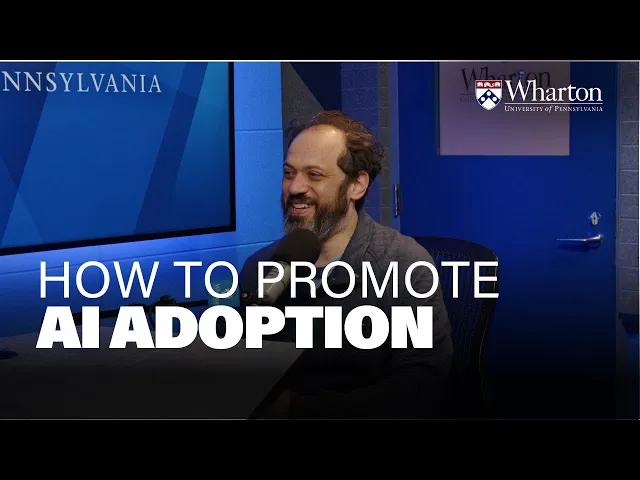
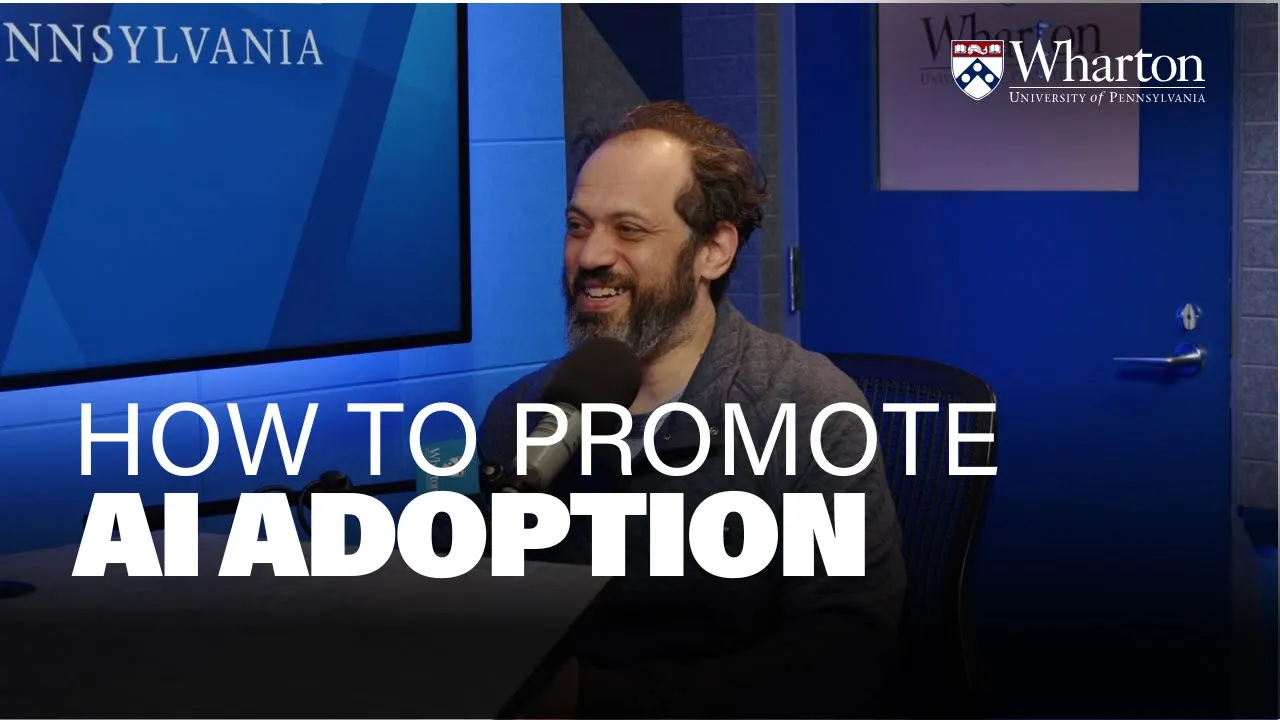
well as we head towards 2025 the role that AI is playing in our lives feels like it's increasing significantly each and every day and to that end understanding how to lead in a landscape like this is going to be very important as well a new Wharton Executive Education Program will be focusing on that element specifically it is titled leading in an AI powered future it's going to be six weekly sessions focusing on a variety of topics starting on January 27th Ethan mik is co-director of the generative AI lab here at whorton as well as an
associate professor of management great to see you again how are you I'm wonderful glad to be here it is kind of interesting for me and I'm sure it is for you to see how everything in the last year and a half and has been around longer than that but how had has become really the the main focus of so many people in so many areas of business our culture our lives whatever we have a general purpose technology that is by definition a technology that touches every everything that we do uh in different ways that aren
predictable in advance so it's going to affect every field I mean AI is a real thing it's really here to stay we have enough data coming in that it actually has real impacts on performance and jobs I mean I think there's a reason why it's the big topic so as we turn the calendar for 2025 what do you think are some of the most significant changes that AI might bring to a business in the in the near future so there are there's sort of two sets of things happening there's a set of technology advancements that
are going to change things and then there's a set of organizational and Leadership changes happening so on the organizational leadership side I think that lags technology so the technology has been amazing out of the gate what's been happening is individuals have gotten access to these tools and they're getting individual performance improvements those aren't being translated to the organizational level that's because individuals are hiding their use they're hiding it because they're either afraid that they've been told they'll be fired if they use AI the wrong way so they're not showing people they're viewed as Geniuses right
now so they don't want to show people that they're you know nais genuses and the AI being the genius they're worried that efficiency gains translate to being fired or being assigned more work or they won't get credit for it so one of the big organizational challenge is how do we move this from the individual level to think about how organizations can benefit and that's uh that's the big challenge for the next year organizationally so how do you think then leaders of companies F what areas do they focus on in terms of incorporating AI into kind
of the organizational structure so we don't have easy answers I mean one of my biggest fears about AI is that organizations have by and large given up what they used to spend a lot of effort doing which was thinking about organizational redesign right you look at how Ford was successful right or even how Salesforce was successful these companies were successful because they thought about how to redesign organizations like organizational structure now most organizations don't do a lot of R&D on their own organizational structure they count on outside Consultants like McKenzie coming and helping them or
they count on you know building buying software products that kind of impose organizational structure on them you've learned from you know workday teaches you how to use HR in the workday kind of way and as a result they're not innovating because nobody has answers right now we have to figure this out so I think it has to start with with leaders embracing using AI personally getting their 10 hours of AI use in to find out what it's good or bad for for them and then really starting to think at a fundamental level how are we
doing R&D in our organization around this and so then that has the opportunity to impact the quote unquote culture in and around the organization in terms of people really buying in and and understanding how valuable AI can be in various aspects of their work um so I think people are already learning that I think the question is how do we capture that okay right what is an organization that has AI in it look like it can't look the same right with the organizational structure we have today is the exact same one we had In 1855
when the New York and E railroad invented the invented the org chart right and it was designed to solve a bunch of problems that the New York and E railroad had which was how do we coordinate work across a vast distance in real time we invented a whole bunch of new techniques in the 1910s around the around um you know assembly lines in the early 2000s around Agile development but all of them were limited by people it all depended on people being the unit of intelligence and the unit of action that things happened in right
that's not what's going to happen in the future so then how do you see AI impacting different business models as we move forward so I think that's where the technology starts to come in right so one of the big things that we're going to look for in 2025 is the rise of Agents which are already a thing so agents are AI systems that are goal directed and have agency to pursue those goals on their own and that means they can use a computer mouse they can do work for you that starts to look a lot
more like a human doing work than it does a chat bot that you ask a question to yeah it has to be a challenge though for a lot of companies when you realize that your competition is probably you're going to be using these types of Technologies as well and you have to implement them and get them working up to uh Optimum so that you can remain competitive in whatever field it is it's actually much larger than that right because first of all there's no company out there that I'm that is listening to this podcast that's
going to build their own llm there's really it's too expensive to build large llms beat small llms and there's six or seven companies in the US that could do it a few more around the world that's it so you're not going to build your own so that means you're going to be using a you know whether you're using a close Source solution like an open AI or whether you're using something like llama you're still going to be using someone else's large language model and that large language model is uously available around the world every kid
in mosan Beek has access to the exact same tool that your top analysts do so it's about think about structure and approach and how to leverage what you already do to be more successful you're not going to win by a technology play alone how then do you look at not even just next year but the next several years in terms of how AI could potentially have an impact on business so I think that we're going to see you know there's this there's Amara's law which says that people overestimate change in the short-term and underestimate change
in the long term I think that what you know you're not going to see an instantaneous 50% Improvement Roi but you're going to start seeing that in the next few years not the next year or two so the next year or two is still experimentation but that's going to set the groundwork for whether or not you succeed in the long term every piece of evidence we have is that this is indeed the big one yeah like all the controlled experiments a lot of my colleagues at Wharton and I have been doing research on this the
impacts are very very large you mentioned a moment ago about the uh the leaders the managers within the company getting their 10 hours getting that experience how invaluable though will that component be as we move forward and we try expand AI in throughout our organizations of the leaders having the understanding and the background around AI so you don't need a lot of understanding to make this work you just need to use it I mean I talk to Executive audience all the time maybe 10 to 20% of the audience has spent 10 hours with a Frontier
Model trying to get to do real work if you don't do that you have no idea what these systems can do you cannot have your direct reports tell you what to do because these things are already operating at a high enough level that it is executive in a lot of ways right we have some research there's some research showing that it gives as good advice as strategy professors at top Business Schools you know when you ask up thei multiple times we know that you know already high performing entrepreneurs in Kenya who get advice from the
AI only advice not extra help but advice have an 18% Improvement in profitability like these are real things and so if you're not using it you're not going to know what it can do and it's not a technology that works like Tech it's bad software AI doesn't work like software software shouldn't argue with you or refuse to do work the AI does all those things it works like a person if you're a good manager of people you'll be good with AI even though it isn't a person so how important then do you think bringing this
type of a course forward now is in kind of the landscape of where we are with AI but truly diving deeper into the leadership side of of of being able to implement and build it out so I think that we don't have a perfect Pathway to getting to AI implementation right so I'm not going to claim that this course is going to be something where it's like okay now you learn how to implement AI we're actually and it's also multiple people at won because we have different viewpoints and outside of Orton all kind of discussing
this because we don't have answers yet right really good research going on but answers yet but I think the most important thing is to demystify I mean it is still weird and strange and mystical but to demystify using it at least to get people on board with understanding the implications of this to see that it's a very big deal and to get agency over their own use and that's really what I hope the corporate ACC and I think from from you know doing the show that we do on SiriusXM every day you hear the conversation
about you know who all will really benefit from AI as we move forward and it seems like there are elements of this that are working for multiple Generations it's not just the younger generation that's going to come in and have the greatest Advantage older Generations are being able to dip their toe in this water and and see the benefits as well actually it's worse than that we actually have a study I did my colleagues at Harvard MIT University of Warwick where we went to Boston consulant group and we found massive improvements in productivity but we
also found that Junior employees were actually much worse at explaining how this technology should be used in senior people because they don't understand how work Works they don't understand how management works so they it's not a technology problem like that's the most important thing to get across to people there is a tech element to this but it's mostly a management teaching and and you know and structural problem it's an executive problem not a it problem and if you assign this to your it Department as your first go this is not the right way to approach
AI but then it will have a significant benefit moving forward in terms of how leadership kind of runs an operational perspective of a business because you'll have the component of AI in the mix right I mean it's not just component like I've already done you know you can have ai watch the scene and give you feedback on what's going on you can have it's good at advice it's not like I think again there's a lot of another problem Executives have is they're anchored on AI prior to 2022 with non-generative AI which was all about making
predictions about the future the the the LMS are not good about predictions what they're really good at is about acting like people and doing people like jobs great to see you again Ethan thanks very much for your time thanks for having me Ethan mollik from here at the Wharton School who is a co-director of the generative AI lab and also associate professor of management