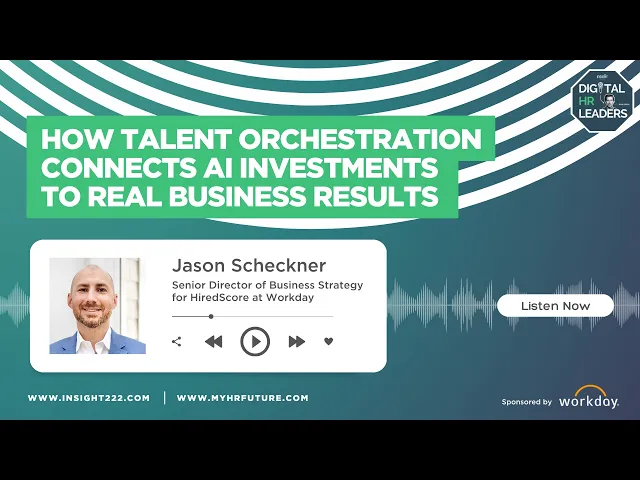
[Music] today I'm delighted to welcome Jason shechner senior director of business strategy at workday high score to the digital HR leaders podcast Jason welcome to the show I'm looking forward to our conversation be before we dive in um for those who may not be familiar uh could you start by giving us a quick introduction to yourself and to hired score love to and first of all David Thanks for having me uh on behalf of workday and hired score uh to share what we're up to um yeah so my my background has been really uh back
to 2008 I joined the hrtech ecosystem I did my first startup back then um I've since done uh two or three other companies in the startup space two of which were also HR Tech Focus so vast majority of my career this workday is now my fourth company that's in the HTM space um but but most excitingly and relevant To this conversation I joined hired score as the 11th employee back in 2017 uh so when I joined again very small number of employees I think we had three or four customers at that point uh so really
early in the uh in the go to market life cycle and my focus really when I joined um and uh agreed to sign up with Athena was really about how do we take this story to Market about what we're working on uh the challenges the HR facing how AI can help help solve Those and it was really early um so we buil out the go to market side uh that included sales marketing customer Partnerships and then in my last two years uh really David last time we connected I was I was uh in role called
a chief business officer and that was really focused on the intersection of our customers our Partnerships and actually our Innovation and so I got to work across our customer base focused on really sort of what were the big Challenges they were solving how AI could unlock those um so to travel really all across the country world uh sitting with our customers um focused on the next generation of their transformation initiatives and uh and then this uh this spring we required by workday which has been a really exciting uh transition and then have since then moved
into a role called senior director of business strategy which again largely focuses on how a hired score can uh uh Connect to the workday ecosystem so that's me it's been a been a fun journey and excited to be with you today and and you said a a big big particularly big year for for you and the and the high score team being becoming part of the workday family um I I was at um I was actually at workday Rising a few weeks ago in Las Vegas I know you were there and I know you're doing
the rounds on the conference circuit at the moment um workday Rising unleash um HR Tech um and And this the season it is it's the season to be jolly maybe but maybe not so jolly with the with all the air travel I can definitely subscribe to that um and and I and and certainly I I saw a at workday Rising you know a real Buzz um obviously about high score as well so you know huge us to to you and and and the team for um for bringing that into the the workday family and I
know a lot of the focus um on your talks and has been around Talent orchestration Being the next evolution of talent intelligence I'd love to dig into that a little bit more um could you share a little bit more about what talent orchestration is for our listeners and how that builds on the foundation of of talent intelligence yeah of course and yeah Rising was amazing I mean it was uh just as a side note I mean having been to it in the past as a partner was one thing but to go as an employee and
and sort of be on that side of it it was uh It was really amazing event so um but yeah I I think your your question around Talon orchestration you know again we we made a really important decision about three or four years ago when the market Talent aret intelligence started to emerge and there's this really tough decision around did we want to become a system of record a lot of our clients were happy with us and they said well maybe you could build some of the functionality that some of these other Companies are working
on and there's no shortage of those you know Solutions um and I I give credit to Athena really and our team we decided that the world didn't need another system of record and really what we're were going to focus on was leveraging the system systems customers already have um and connecting to that data connecting to those processes the the systems and and leveraging that data rather than giving them another system and putting that Back to work for the customer and so if we think of talent intelligence David it's it's sort of been this all-encompassing catchall
for everything from skills to crms to Talent marketplaces and a whole bunch of other things um and a great you know again great examples are what they're achieving is bringing AI insights or a aut into the ecosystem often um so no no problem with Talent intelligence overall um I think it was the Natural Evolution From where platforms were but where Talent orchestration takes the next step is it's really about outcomes so insights are great automation's great but at the end of the day we care about are we change fundamentally changing the way the businesses are
driving talent and so in order to do that you have to connect to multiple systems really well you have to understand different data types you have to understand various personas policies procedures and then Ultimately you have to tie that back to a business objective and so when you do that successfully you go really beyond the insights into the outcomes phase which is what I was talking about and so maybe a practical example is you know Talent intelligence in in the world of talent intelligence an employee for instance would have to go to a talent Marketplace
they'd have to input their skills or upload information and once they did that they might get an insight About jobs that they could possibly move to in a few years okay great and and I think a lot of companies were excited about that and that's a cool feature and and functionality and employees got excited about it orchestration example of how it's an evolution is without the employee telling me anything I can consume all the data across the system so I can take your HTM data I can take any skills data your talent profile learning data
even application data on The other side of systems I can unify them I can meet the employee where they are in a system like Microsoft team so I don't even need them to go into a platform I can understand all the mobility rules policies procedures around moving fully understand compliance gdpr all the fund privacy regulations and give them recommendations that are highly relevant without them having to give me more information so I'm achieving the outcome But I didn't need something else to to get there and and it's it's an outcome in the form of employee
you know for instance moving to to a new role so it's my best way of kind of giving you a practical example of how orchestration is a bit different but there's countless use cases um across the Enterprise now that we're part of workday I think even even broader things that we can do Beyond uh what we're doing before really interesting really strikes you know the Insight versus outcomes um you know there's a great quote from PI schme who was the head of PE analytics at Johnson and Johnson at the time um I heard at a
conference and he just said Insight without outcome is overhead um which I think you know quite relevant for for us that we all get very EXC excited about our Insight sometimes but if no one takes action on it and it doesn't lead to a business outcome then then there arguably a it's nice but it's doesn't it Doesn't have the impact that that we want to have as well so so listening to you Jason you know so to Talent orchestration you know as isn't just about optimizing individual processes it's about connecting all those pieces of the
jigsa the around the HR systems and data together I mean how does this from the likes of data lakes and system of Records yeah so again I think we're fundamentally rely on systems of record and again now part of workday that's a Little bit more obvious because we sit on top of workday systems and we'll talk a little bit more about some of the things we're planning to do there um but but even even prior to that again we were system agnostic David as you know so we were connecting to all the major players in
the market pretty much if you think of what what types of systems in f500 kind of company might might have generally we were connecting uh to to most of them and so for a system of Records you know HED score didn't exist because we weren't a system record by making that decision we needed by definition the systems a record so they had to have an ATS they had to have an HTM they had to have a learning system a VMS whatever we were connecting to CRM Etc so we're we're fully supportive of those I think
the one question mark you know we could talk a little bit more was really in the phase we're in does a customer need Point solutions for all Those things do do is is the best of breed actually a better decision as we start to look at this data Islands problem that we've identified uh in the market but either way our job wasn't to tell them which to pick it was if they did pick them how do we pull all that together um I think the question around data Lakes is a little interest different um again
it's not an either or so it's not an orchestration or a data Lake a data Lake in in many ways serves A really different purpose um it it's it's not about action again going back to this kind of actions and outcomes it's really not about actions you're you're moving data into a data lake so it can be more easily combined offer you know easier endpoints for integration access um potentially solve different vendors not touching uh your your core systems for security and other reasons um but you still need to build an application or workflow on
top of that Data to execute the process so what what what's great about orchestration is I don't need to then build another workflow on top of of workday or your ATS system I can take the data inside those but again that could be in the ATS theoretically I guess it could be in a data Lake as long as there's there's strong apis and data flow but you you we're we're creating the action by understanding the processes and then driving connecting to like let's say a Hiring manager for example wants to understand if their employee might
be eligible for a movement and what roles they could move to that in data data Lake world you even if you had a data Lake that doesn't really help the manager they're not going to go scour the data Lake for you know with some sort of search mechanism so you still have to make it simple for them to ask the question called Hey can David move to a new role and what are Those roles and so those are the kinds of things we're orchestrating so Lakes are generally I mean again to be clear I'm I'm
not for against them I just would say they're great for research storage um and needed when you don't have generally good API enabled platforms which is another another major issue they're solving for so um again generally generally understand why they exist and and um for us we don't need them um because of again our depth of Integrations typically um we're we're we're not opposed to them by any means so it sounds like because let's be honest many organizations their HR Tech ecosystem has kind of evolved over the years and you know for whatever reason they've
got what they've they what they've got and in some cases they would have spent a lot of time um and money implementing these these Solutions what it sounds like you're doing with Talent orchestration is You're actually meeting the individual organization where they are and through your technology helping them in a way get the most out of their Investments without any major resurgery is that is is that kind of where you would say you were yeah and I don't know how many consultants or Si are listening to your your podcast but in theory you know some
of the the orchestration means that they don't have to reoptimize their system to get to achieve the next business Objective right so if their worklow that they've built is what it is normally to go to the next business change or let's say the business goals change I might need to change I might need to modify the workflow I might need to change permissions I might need to Institute new policies orchestration simplifies a lot of that so I can coordinate that down if the business let's just say we go from you know hiring Surplus excuse me
to hiring Frees that's a tough thing for companies to adjust to but in orchestration you can just change the SLA that and and focus for the recruiters and what they're what they're targeted with and you can drive that down through orchestration so I don't need to reinvent the systems I don't need to rethink the business processes or anything like that um as a simple example so and that's a practical one because again HR objectives shift quite Often um but again it's how do I connect back to the business management the other thing that orchestration we're
seeing does is it it takes a lot of the change management hassle out of the equation um that's falls on HR to for instance a great example are there's a lot of HR processes are driven through nonr personas so think of like the manager the employee but HR doesn't own those individuals right so how do you get them To adhere to the policy procedures if they're not you know required to do so and so orchestration can do that really well so if I meet a user in teams it's a very UI less experience I can
update policies procedures in real time and if they're opening a new role next week it'll remind them what the new policy procedure is related to their rle so I don't have to retach that roll out new training and things like that I I can easily integrate that into the process And then the other thing you mentioned was Data Islands um Love love you to talk through that concept a little bit for our listeners and and and listening to what I'm assuming that Talent orchestration does is it help Prides a bridge between some of those islands
yeah so that actually um I think you know Ernest on our team um Ernest had done a really great body of work uh he'd come over from Salesforce leading their people science and and data analytics Team and um he did a great body of work what IID said is you know we're connected to all these systems it'd be interesting perspective for us is this kind of system agnostic you know orchestration layer to understand like what is the efficacy rates of these various tools um so a customer might have five different systems of record that they
invest in what does that actually mean and so we found some fascinating data um and again this isn't Published to be clear but but these are our general stats for comfortable sharing across our customers um and we're founding things like and and most these are corroborated by other analysts in the community that've done similar research you know less than on General less than 30% of users were going into the CRM so again it's not mean a CRM is a bad tool can have great value but the average customer weren't getting users To adopt it and
then you take a further look and 50% or more of the data was redundant from the applicant tracking system which meant that you had very few people using it and a majority of the data was an overlay or overlap I should say of the the prior data so then we start to ask ourselves well what is the the value where little people use and the limited data right so that that that that that's a fascinating question and then you start to look at the talent Marketplaces where you know th those David were a lot about
how do we get employees to find Flex workor or gigs or you know different things like this mentors great ideas love them but again when you look at the efficacy rate we're seeing less than 20% of people actually I think it was down to 12% of people actually going to the talent Marketplace proactively uh skill is another interesting one right the skills is everywhere but less than 20% of Employees proactively updating their skills some companies do much better at it trust me they have great initiatives but but generally in the marketplace and so you have
all these Investments and I'm just kind of highlighting and that you know I'm not getting even into the contingent worker and the difference between the data types and the fact that one sits in procurement and one sits in HR and that the challenges there but we're just sing fascinating disconnects Between these data and understanding and then the utilization rates of these tools and so you know you start to ask yourselfself a question even if the platform um has less functionality than the point solution but I get most people to use it am I better off
than if I have more features but I get less people to use them I'm not an expert here David but there's a math equation there that probably answers that to some extent and and so I I would guess in most cases Less is actually more um and so we started to see some fascinating things there with these data ey live problems not only that but your cost of ownership is higher your project de cost your success rate of those deployments is risky so there's some fascinating things but this is the market we work in and
there's a lot of great vendors out there it doesn't mean they're they're doing a bad job it's just uh organizations CH struggle with with getting a sort of the Results out of all these things which is what we start to see and I'm sure some of those challenges you've highlighted and some of those adoption rates you've highlighted will resonate with with with many of our listeners I suspect in in their companies um Jason one of the data points you you highlighted in um from I think it was from BCG at your recent um presentation at
workday Rising which re resonated with me was that 89% of Executives rank AI as a top priority but Only 34% are happy with their progress so there's quite quite a gap there between expectation and and and reality I guess um why why do you think companies are struggling to make real strides with AI and and how can Talent orchestration help bridge that divide so it's it's actually really fascinating on one hand we have to applaud companies because they are trying to experiment right so there and the because of the AI what we saw in the
last few years with The the absolute wave of AI technology and sort of the early easy access the entry point to AI became easier which chat GPT and everything else um we saw really um a great way that companies could start working on these different projects so on one hand I want to you know say that's great and we should encourage and and applaud that the the challenge that we're seeing is um where companies are choosing to experiment is sometimes counterintuitive meaning if I'm a pharmaceutical company it's great for me to to deploy AI cases
for things like drug development or drug release or something like that because I understand how that's going to impact my business and drive outcomes Etc but what you end up having happen is you've got you know different engineers and and things like that and so when they put together a list of experiments like I had one customer that and again it was a cool initiative they said I want every Department to come up with you know several ideas for how AI can be deployed in their department and so you know HR comes up with a
few great ideas they bring it to the the the committee and the committee says we can you know we can build that and so you get people building in a domain that they don't have expertise and so what you often get is you get a POC that works or looks good like I can you know write a job or I can write a this thing or I can you Know synthesize this information whatever it is with these large llms that they have access to but they don't anticipate the scale challenges of that um and that
is really where the rubber hits the road so you know in HR you have things like compliance you have Global regulations you have I mean the need to adapt to Lang different languages and uh for for different user experiences you have different I mean the data types are fascinating because once they get into The weeds of well the data even even in workday by the way you know workday is is an amalgamation of a a HDM platform a recruiting platform now a contingent platform which is great you have one platform and one data structure but
there's still different object types and so I still have to connect to different apis and so there's there's that that and then just the amount of processing that has to happen to make that work there's understanding the workflows and Processes obviously the compliance and all the regulatory sh that are happening and keeping that up to speed and so I think particularly HR I guess my point is they don't anticipate I imagine this is similar in places like finance and other highly regulated areas but unless you're an expert at that anticipating all those challenges you probably
don't foresee those and I think that's nhr in particular why companies will experiment or they you know like you have the Amazon case from five you know whatever is it's now old I think 2018 but where they publish the findings where they do these things and then they they run into to bias issues and other things like that and then abandon the projects so I think that's one major thing uh just the difficulty and the the lack of of understanding of what's going to come up and then I think the other thing is we're still
in an economic global environment that Requires you know sort of prudence in terms of how we spend our money and getting results and so if you balance experimentation with like cost outcomes um it's a tough environment meaning like there's not a lot of appetite to keep going with experimentation if we're not getting business outcomes and so um so I think that pressure also means the experiments don't have time to maybe progress to a point of value because if it's not giving me something get rid of It work on something else um so there's less desire
um and this is why orchestration is great because we've already done the Legacy R&D that's so hard to connect all the systems and the objects and the workflows and the policies and the rules and it already reads all that so instead of having all that barrier we can get right to the hard stuff and then start actually experimenting beyond that and so we've got customers now that are on their Third fourth fifth AI use case and they're starting to come to us with problems saying hey could could we orchestrate this um which I love to
hear yeah and I guess it's the same with everything isn't it in when it's a a new shiny thing for want of a better phrase you know it's about yeah but let's apply it to a real business challenge that we've got so as you said that in a in a period where maybe organ many organizations are careful about what They're experimenting on and they want to see the value from it if we connect AI to some of the business challenges that we're trying to solve as as organizations then we're more like to see some of
some some impact from it and some value from it and then we can invest more as we move forward yeah and one one other thing I've observed is even in the if you go beyond the the customers and so they have their own initiatives right and then even if you Look at whether it's the co-pilots or all the different you know models that are coming out um so customers have their own LMS you've got obviously quite a bit of generative AI in the areas um of of the vendor ecosystems but what we're seeing actually is
that a lot of this the functionality that's coming out are addressing um and they're they're good use cases again I want to be clear I don't want to knock any of the Technology I think it's awesome um but it's addressing things like you know writing a job or can I better synthesize interview notes or can I um find an answer to an employee question easily I love all that stuff but I will I will say the following when you look at it on a transformation scale let's just say it's a huge company maybe they're writing
5,000 10,000 job descriptions a year but at an employee level you or I David might do that once or twice so It's nice and that one time I do have to write a job yeah it could be better but in terms of changing how I work every day it's probably not fundamentally changing transforming the organization outcome I'm not saying if you add up those increments over a bunch of different tasks that isn't valuable maybe one to three% gains but it's not transforming in entire way role Works um and so again I think that's where we
see the the sort of scale of impact is much More significant as we look at some of these deeper augmentations or disruptions in the orchestrations um that's our observation so far and it ties back to again that outcome of that pressure to have the initiatives actually deliver value um that that's where you also see a disconnect I think yeah that make actually makes a lot of sense when you when you put it that's a great example actually you know large organization as you said you're probably Only working one or two job descriptions a year so
as you said it's nice but as an individual it doesn't make a huge lot difference so yeah yeah interesting um what be let's think about talent orchestration and you know in in the in the kind of um areas of um employee retention and internal Mobility because I know these is two areas which are big Focus for I think for you and the team but also for a lot of the companies that that that We're working with um you know what tell us a little bit about that what does talent orchestration mean in those two areas
and if you're able to share some some case studies I think that would really help um listeners really kind of see see the opportunity that yeah of course so what what's exciting about this and this is actually where I think the combination of like workday plus hired score is is very exciting because workday already had Solutions like um they have a a module called Talent optimization which sits on top of core HCM and so it's got functionality like their career Hub and their um their Flex teams and uh you can you know attach learning in
there and other things that um performance and and manager insights and so there's a variety of successions in there there's all sorts of great things they're already packaged in there you know again for the manager for the employee to Build on top of you know the great stuff that workday does where hired score had been approaching it again prior to the acquisition is we had sort of looked at what what is wrong with why do some of these Talent internal Mobility um initiatives suffer and I go back to the data island problem for a second
and I say well the data says less than 20% of people updating their skills and less than 12% of people proactive work looking for new roles so right off the Bat you have a you have a data sort of input challenge before you even get started which is if I'm going to get employees moving and that's dependent on them giving me more information that's why you've seen other vendors emerge now that are starting to to like anticipate what skills the employee might have and prepopulate those so there there's there's ways they're trying to solve that
but that's a fundamental issue and so what hired score did is we actually Took a different approach and we said well in orchestration we we know actually a lot about the employee it's just sitting in different places so in the HCM for instance I know everything about what job they have what division they're in how long they've been in that role and that's just their basic employee profile in every single HDM system in the world you keep that data about your per your your employees right and so from that you can almost Structure a resume
even where there isn't one or cvu even where there isn't one because we we sort of know which job they held how long what division what you know maybe even to some extent what skills okay um so that's one thing then I can also look at a lot of these systems have an employee profile construct so this is where the employee can go in add their preferences or they open to relocation what skills do they have so if that data exists and we just Said that it won't always exist but if it does exist I
can take that and then there's actually a third fascinating component which is application data so when an employee applies like David if you were hired by a company a year ago we have the application from a year ago again within gdpr retention policies and all that now also if you're applying to new jobs that is an intent point and it's a new data set so I can take all of those different information I can Str Kind of amalgamate that and for most employees that gives me an understanding of the employee at least for everyone I
at least have their HDM data so without asking them information I now went from 20% to 100% of people that I can activate as essentially at some level so that's that right off the bat I I've got huge gains right and then what I can do is what's fascinating about human behavior is when you ask for something to give something you get more Resistance but if you give something and then ask for something you actually get an A more interesting uh contribution rate and so we're seeing that if we say hey employee here's a couple
jobs we recommend that are fit for you and oh by the way if you tell us a few more things I can even tune these recommendations more now you're getting better skills uh data now you're getting better other intent data and that benefits the company as a whole not just in this this Effort but across all the other aspects of their module right in those like in workday for example in other areas that the manager might be looking at the employee skills based on your know performance reviews and whatever it may be so now it
benefits everybody and the the cool thing about that is so we we're we're we're uplifting and so that creates a loop so next time around you know the AI has more data again and and can be more effective um and so that's One major thing the other the other thing is that what I saw a lot of the solutions focus on it goes back to that intelligence versus orchestration was a lot of it was about you know again um things like the talent Marketplace like if I come in or career pathing if I come in
and I put in my information again I had to give you the information but if I did that you might be able to tell me where I could move in the future and I think that's really cool again love it You know it gives people kind of hope and confidence about where they can go the problem practically though is every customer I talk to says we can't figure out our Workforce plans for this year let alone the workforce plan for three years from now to make sure they deliver on all the roles that people wanted
to move to that the system told them so I do think you're going to see a disconnect between all these things that what they project people can be and Whether companies can deliver on that so we're we're kind of focused on the Here and Now of like where can they go now what learning could they do now what projects are available now because that's going to start to build the progress and then that's going to make them more marketable for the future so it's a little bit more that current Supply Demand versus the future I'm
not saying the future isn't important and workday has actually got some cool Technology there but we we had sort of focused on the things that are going to deliver the outcomes and that's moving an employee now that so they're not moving to another company um tomorrow um so the last thing that we did and this is actually fascinating is that we invested in post-pandemic in our collaboration U platforms like Microsoft teams and so a big bet there David was if you can meet the employee where they are um we we used this expression said That
said the new UI is no UI and so if I can meet the employee where they are and I don't have to ask them to go anywhere but I can meet them I'm also going to get a higher success rate so you ask about success examples we're getting right now like one out of two employees that we serve a recommendation to will apply for a job we're seeing a 40% increase in one of our customers um I just did a case study at at um at hrtech and and um and Rising with a big Pharmaceutical
company and um and they talked about a 40% increase in internal applications as a result of launching this initiative so now you've got the classic feedback you get from employee surveys is it's easier to apply externally than it is internally like it's easier to find a job and so we're immediately solving like 10 ible things that are on that sort of complaint list and then when they do get uh apply we can even now using that orchestration Alert the recruiter that high value employee just applied so they don't get missed in the black hole with
orchestration if they do get rejected after they interview you could even alert their manager to say hey your high value employee just was rejected and so maybe you want to consider uh mentorship or other recommendations maybe learning for them so this is where it gets really exciting because you can actually achieve those long-term business Objectives but it's not about going to another system it's taking the data you already have taking the information um and I'm not even getting into all the rules layers and all the stuff you can embed underneath this the campaign types um
so you can even for instance Outreach to a redirected um impacted employee which would be a much different message than a top performer for obvious reasons but you want to get that right and that's all about the the message content The Experience so long answer but this is H what we're working on no no really good and you know and also if you think about it the way you were describing it it's almost like a an internal Talent detective that's bringing data together from sources that are already there and the more data you've got I
guess in in most General respects on on a on an employee the more relevant the recommendations will be for them and as you said if you're serving Those up then people are going to interact with them more and maybe fill in some of the gaps that you might have to make those recommendations even better in the future well I mean and and companies have struggled because they have those traditional like job alert systems and you know we've all gotten those over the years where you get the job alert from something and it totally misses the
Mark um so even even there's an intent layer to the recommendation Engine so it says Not only would this person be qualified but it says if I showed them this job would they be likely to apply so that's going to take into account your career progression and you know non-traditional Pathways and things like that to say is this job not only are they qualified relevant would they be interested and by the way are they even able to move so worst thing you can do is show somebody something that they really want that they can't Move
to because they're not permitted to because they haven't been enrolled long enough so the system is even smart enough to say are they meeting the mobility requirements to move so that all of that's true creates a clear pathway for them for the uh the conversion and all of it adds up to better employee experience better candidate experience if we if we think about internal candidates as a cand Cates as well because they are and and As you said it's AR could be even more important to give a great experience to a high performing internal candidate
then it perhaps is from someone from the outside but a lot of the focus particular from Talent acquisition teams is on on improving external candidate experience and maybe what you've just walked through there Jason helps us to actually deliver the same level of experience to internal candidates as well I love what you just said because Even today like we say Talent acquisition and talent management it's all one continuous Talent journey and yet they're still siloed so again like a lot of these Talent marketplaces focus on can I get a job recommendation to the employee but
then you've got to remember that the second they apply they're now in a talent acquisition workflow how does the talent uh recruiter even make sure that they don't miss that person if a manager now gets The employee how do they know that they've been past a high value employee these are those opportunities to really connect that experience throughout those processes and make sure nothing gets missed very good um so we we we've talked a little bit about AI um you know and you you referenc this a little bit about how how do you how does
your Approach at high score ensure that the the AI driving the talent orchestration remains ethical remains safe and I know A phrase that and and I know practices that work they putting in you know adheres to responsible AI well first of all let me say that I think this is one of the things that made the acquisition super attractive for both parties was that workday had a very strong responsible AI framework um ahead of it um they've touted for years their you know their one data structure and platform and so I think that really set
us up well um now hired score the the The benefit for us was that we had been in the market since 2012 pretty much last 12 years um as a AI for HR only um so we didn't have other use cases um and and I emphasize that because going back to even the examples of customers building on their own there are so many Lessons Learned over 12 years and cost that went into building these models and doing it the right way but the architecture was there from day one um and it's actually made It easy
because because ath and the team build it that way um it's made it easy to adapt to a lot of the changes so when new laws come out we're not scrambling to figure out how we retrofit those laws into it a lot of the framework's already there to adjust and I can give you some examples but I would say there's four kind of key tenants that we talk about in the responsible AI framework um that are really important especially with all the geni llms and all things coming out So our models actually historically are machine
learning models so we're not using typically generative AI the reason that's important is not because gen is bad but because a lot of it's open source you you have a a sort of a blackbox element to where did the decision come from and so in our case all of our models are inhouse so if we ever did identify an issue unfortunately that's that's not really the case but if we ever did identify an issue we would Know how to solve it derive the problem and and modify it so that's really important when you're coming talking
about this kind of AI use case so that that's one major thing the second thing is that all of our AI is transparent we talk about transparency in a couple levels David so the first is the user level so the actual AI was designed to tell recruiters managers whomever is interacting with it what did we like about that relative to the job so if We're serving a recommendation to a recruiter we actually allow them to turn the AI inside out and see why did what do it under what do we like what do we know
about the job how do we understand the structure of the job how do we understand the CV resume and and what was their matching criteria whether skills or experience or certifications whatever may be so that it highlights those those elements for them allows them to have confidence in the in the Decision we also publish all of that back to the the core platform uh for audit purposes so the grades the prioritization that all goes back into the system automatically um and so the customer can run whatever uh analysis they'd like to and and more companies
are doing that as they launch like AI Coes and so it makes it easy for them to actually do their own analysis the third element is actually a proprietary method that we've done and this goes back to I Think the danger of a lot of the methods which is that the the training set can influence bias and so we take customer data um to drive the models for rediscovery and things like that now that that part is fine the challenge with the customer data set is it could have inherent bias in it so one of
the things we do David is something called um uh balance learning so we actually use a down sampling technique to modify learning rates such that we're Learning even where for instance not not to their fault women had applied at a lower rate than men historically which maybe meant men were hired we sample so we don't learn from that characteristic in any way shape or form that that was positively attributed in the model even though we also remove race ethnicity gender nationality any of those kind disability data from the AI it never touches it we still
do this as a method to ensure we're not accidentally Learning a characteristic that could be attributed to to any of those um at risk categories uh so that's that's important and then the last thing we do is um uh everything um that we're doing is fully in compliance with all regulation law so whether it's in the US that's the ofccp or EOC um in Europe they now have the high sensitivity law in New York you have you know Statewide laws now the New York 144 law and and there's versions these more privacy oriented some are
More ethical constraint um some are about compliance with with government laws the flavors are different but the the general themes governed somewhere around again this ethical or safety parameters we've got everything built into the AI from like even opt outs um we publish all of our findings uh annually on our website um we test and publish that publicly um that's actually a requirement of 144 so this is all in the background here and again credit to To Really Athena um she's dedicated about a third of her time historically to compliance regulation um ethics safety so
it's been a really Cornerstone for us um and so it was really easy for us to make that transition to the larger workday ecosystem with that Foundation but those are some of the the kind of core elements that we're known for yeah and it's so important isn't it you know not just because it's the right thing to do but because there's more and more Regulation coming in so whether you're a technology firm operating in the space or whether you're an organization deploying some of this technology it's something that we have to stay fully up to
speed with and anticipate like it sounds like you've done i' score all the way through your journey to do that and as you said Athena and but those listening Athena is the CEO H school you know she's spending a third of her time um on that and it is kind of you really Indicates the level of importance around this topic yeah and I I think the adaptability to it as it goes on because this is where you know a new law comes out and you have to now retool your whole thing to to comply with
that because you were taking in a data that you're not allowed to take or you have now a requirement so and the other thing that we've done that again I think is quite cool is we we take sort of the strictest interpretation so if for Instance ofc ofccp has a thing that doesn't apply in the EU but we think it's actually the right thing for fairness and ethics we'll still apply that globally so another example of that was the opt out um functionality that the 144 law required which is the candidates not only needed to
know that AI was in place but they had the right to opt out the EU act for instance doesn't require the opt out we still offer it to customers not because the Law requirement but because we actually like that ability to say hey we're being transparent here we'll give you this chance and it's actually played well for things like workers Council approvals and things like that because it's not a requirement but they like that it's got the same posture as like a gdpr or something like that that really takes into account personal privacy and consent
I really like that because it's almost like a lot of this regulation Will have you know good practices that maybe could be better employed elsewhere in other jurisdictions and it allows you to provide that more of that consistent experience for for employees wherever they happen to reside within a global organization um and and hopefully in some respects maybe even simplifies it a little bit for for for that organization as well perhaps so I like that that's a that's a nice um yeah Jason Moving On In terms we talked about outcomes you know And it's you
know it's about you know making these insights you know and helping translate them into outcomes and one one measure of outcome is is obviously how we measure the effectiveness of this so you know on that on that topic H how can we measure the effectiveness of our talent orchestration efforts you know what kind of metrics or or outcomes do you typically focus on to to to help your client gauge success yeah so listen Every client as you know from being in the space the clients will decide uh there's a lot of different things they can
Define but what we found over time is that there're generally some common categories so it doesn't mean that these are exclusive categories these are probably just the most common um and these aren't guarantees that I'm going to share with you but these are like averages across the customer base so every customer is different based on you Know their their particular problems challenges timing Etc data sets um but typically we would categorize the savings erors and by the way we don't just talk about outcomes David we call them iconic outcomes okay so we're trying to move
the needle big big time here um all right so we talk about recruiter capacity and productivity so again it can be expressed different ways at GM they estimated that that translated into 23,000 hours of FTE Savings okay so that was one expression of it um another big Global um PHA company described as 140% recruiter capacity increase so they had 400 recruiters that that that is now 40% better off um in terms of now what could you do with that you could give them more reck you could assign them more resp responsibility you could have them
focus on other tasks again that that's up to the company um we're not dictating what they do with that capacity the Third example we see is is actually um sort of role uh sort of leapfrogging meaning like they're now thinking of what are the roles of the future so we had one client in the airline business that said we're going to actually take that savings and we're going to reallocate those recruiters to focus on internal Mobility so they created a career office for their employees for example so companies will treat the the the savings different
way but the Savings are are inevitably about capacity and productivity that are gained from the recruiting organization say the second major that's kind of in that traditional recruiting Talent acquisition is usually like a time to savings and that can be expressed as like you know time to review time to manage a review time to offer um and that'll depend on which Solutions they're implementing to be honest so if they're focused on the recruiter Productivity that might be top of funnel efficiency midf funnel um as we get the manager uh deplo the manager coach deployed that
will typically have mid funnel late funnel uh impact so time to offer starts to be impacted um so fiser just uh we were on stage they talked about a 31% Improvement in time to offer as a result of the uh the AI so again the Expressions will look a little different but you've got some sort of time to impact is the second major in The talent acquisition and I I'll I'll give you a chance to answer a question but um I can highlight one or two of the mobility improvements as well yeah yeah yeah good
to hear about the mobility improvements as well I think tyon yeah okay so the on the mobility side you're really looking at the re-enabling of their data so you either have external candidate rediscovery and that has impact on candidate experience recruitment marketing savings and agency Savings with one healthc Care customer in the US estimate tens of millions of dollars of agency avoidance um post pandemic as a result of rediscovering talent in their own system so that's pretty cool um and then on the internal Mobility side you've got the employee experience and sentiment as a result
of what we just talked about and then you have the increase in internal applies so again keeping your employees and then you have the employee of uh conversion Of employee recommendations so that's really the rate at which employees are actually moving and um expressing interest in those jobs so those are the general ones I mean there there's a lot more um we look at you know all sorts of interesting things but uh those are probably the most common that we talk about a lot really impressive set of outcomes as well um you you we talked
about the future um Jason so I'm going to ask you to peer into your crystal Ball a little bit now we're coming to that time of year where do you see Talent orchestration going in the next few years you know what's the next FR Frontier you're exploring a h score and and most importantly how can organizations start repairing now well I think what's cool is once customers start to understand how orchestration Works they actually will start to come and say is this a good use case and so we've had you know even our road map
Starts to get furnished a little bit by buy our customers ideas but some of the areas we're excited about that are already currently um talked about in the uh the public road map for hired score and workday uh we're going to be looking at democratized succession planning so how do you take what was typically reserved for the top 500 to a thousand employees of big companies and make that available to any manager who wants to think about the future of their team um We're we're talking about recruiting managers as an interesting unlock um so there's
a lot of technology for candidates for employ employees for recruiters but the recruiting managers and and the leaders are often overlooked um and I find that a lot of uh organizational outcomes are driv through the managers um and they're an overlooked group and so we think the recruiting manager Talent managers they can be a really interesting unlock and So how could you have an AI co-pilot coach agent whatever you want to call it assisting that person better understand capacity um bottlenecks um you know challenges in their um their current team roles whatever it may be
um so we think that's interesting uh Athena's got some really cool ideas on workforce planning um it's early but but now that we're part of workday there's so much you can do there and every customer seems to feel like they're not Successful in this area um some really cool stuff on the contingent side so we're starting to connect to systems like vinley um contemplate contingent workers you know not only can we deploy the AI on top of prioritization and rediscovery there but could you actually take somebody coming off project move them over to uh in
a recruiter inbox for a job that they've posted could you think about at the point of recreation you know is this job better suited for Um you know a project a contingent um uh uh assignment or is it a full-time role um so you can invert that both ways and then there's some really cool stuff customers have started to come to us on agile Performance Management um we're hearing a lot about this but it's difficult to achieve and so orchestration seems like a potentially would be well designed to actually handle this Sile concept because it's
really hard to to build into a system And encourage the manager to always do it but orchestration could actually be quite effective there so these are just some of the areas I'm I'm probably missing a few but um I know we don't have so much time but um a lot of exciting stuff and that's just on the HR side you know again now that we're part of workday I I don't know where we'll go from there in terms of some of the other um components but they have a broad AI road map which you saw
um and certainly You know I think we'll continue to look at areas where we can connect data end types yeah and as you as you highlighted you know you've been part of the workday family for just a few months now so that opens up a whole world new new world of possibilities and ex potential ways you can develop and and I you know I share aena Athena's view around you know workforce planning you know that not you know so many companies are still struggling with that to be per honest I Think that's a good area
of opportunity so we with a penultimate question now Jason so this is the question we're asking everyone on this series of the podcast um how can and I appreciate you might be summarizing some of the stuff you've already said in this how can organizations use Workforce data to drive culture inclusion and engagement thanks for sharing the question um so I am going to connect it back to orchestration and and I think summarize It um but I I think if we think about data as the sort of connection to these culture engagement inclusion efforts then I
think what we would agree to is that impact is result again it goes back to this action and so if or if we if we take the earlier supposition that orchestration is well suited to drive action um then I think what it can encourage is the right behaviors to drive the outcomes so for example you know we we're now part of workday so I've actually started to look at a lot of the peon data which is coming from like employee sentiment surveys so it's great to actually understand a group sense of belonging engagement levels but
the next step of that is actually some sort of action to to respond to that so again we now have the employee telling us that you know something is good bad um whatever it may be and and actually the peak on data is fascinating I'm I'm actually finding it really valuable as a Manager but then how do you orchestrate something off of that whether it's remind the manager give the manager a warning actually put together a plan for them on how they could prioritize these things so it's not leaving up the manager to interpret the
data act like process the Insight come up with the plan action the plan like there's so many steps in there that that sort of leave the outcome um up to chance or you know strong change management either way It's hard um but by the time everything's agreed on design I think it's been six months nothing's to Chang the employees still you know dissatisfied whatever um and I think the AI can really really do that at scale um so that's just one example for that I see um practically um a really cool opportunity to actually drive
more engagement and and actually um let AI do the work uh for delivering the desired outcome in through the Orchestration very interesting and and Jason the whole conversation I found it fascinating and really exciting I think what you're already doing um at H score and workday and and where you potentially can can take this further in the future Talent orchestration you know and I I'm sure many of our listeners will agree is is is an exciting area I think for for us to go as as HR professionals and organizations moving forward before we go Jason
can you share With listeners how they can contact you on on uh social media presuming LinkedIn is one of those options and find out more about the work that you're doing at at hi score and at workday as well yeah so in terms of um in terms of me I'm I'm easily contactable on LinkedIn I'm just at at Jason shner you can search me or um you know in I think it's j shner um same on Twitter although I'm not I'm not as active as I'd like to be there X or whatever we call it
these days so that's At J schner um in terms of uh if there's interest in anything we talked about related to workday um most if if there exist in customer um I highly recommend they'll just connect with their account teams um if they're a prospective customer same process you know there there's a a perspective teams and they they have ways that they can start to pull in there's all wonderful Solutions consultants and experts now trained on hired score um Certainly they can always ask for me and I'll I'm happy to step into whatever I can
where possible uh but uh but yeah that's that's my recommendation on how to find more and uh as always this has been a really really conversation no I really enjoyed it Jason and you know this episode will be published after the unleash um conference in Paris next week but it I think it will be before workday Amir Rising which is in Amsterdam from the 10th to the 12th of December I think Those are the dates and you know I presume you and Andor some of the high score team will be there I'll be at unleash
next week so looking forward to seeing you there and uh and then yes uh Athena will be back um and I will be uh with her on stage at Amir Rising so definitely look forward to connecting with uh yourself and others there if any of your listeners will be there come say hi forward to it and Jason take care I'll see you next week and I'll see you In Amsterdam as well all right cheers David great to see you all right take care in this series we will be speaking to a range of senior leaders
who are pushing a datadriven and digital HR agenda make sure that you subscribe by your podcast app of choice and also bu our YouTube channel for free regular interviews with the digital HR leaders of the future