I've been studying Japanese on and off for seven years okay seven are you okay no four years of studying atat tuni and 3 years of self-studying I believe I have enough experience Waging War against the language myself and Life to share my experience with you and I hope you will find some of my tips helpful those four years of uni were a bit of a roller coaster I found myself losing interest in the language quite often because the teaching Pace was slow and I started thinking of studying the language as something I must do rather
than something I want to do which of course slowed down my progression considerably I've been fairing much better since I started self-studying with that said let's start with goal setting what is your goal for studying Japanese are you studying it as part of your degree and you want to pass your exams are you studying it for work to watch anime without titles to Read Manga in Japanese to live in Japan to talk to your partner in their native language or to pass the jopt figuring out your why is the first step to finding the right
approach to studying the language the second step is to figure out how many hours per week you can realistically spend studying and my biggest tip for this is to go lower than you think you might begin thinking oh I can do 2 hours every day after work oh I can study eight hours over the weekend unless you're someone who is very organized and very disciplined you will probably start letting yourself down very quickly so just be kind to yourself when you're setting your study goals and learn to be okay with being flexible if you have
to change things also and this is very important self-studying doesn't work for everyone some people need an external party to guide them and to push them to study turn to page 394 so if you find that self-studying is not working out for you that's perfectly normal and okay and if you can afford to consider tutors and courses then you shouldn't waste your time trying to do something that just doesn't fit you today we're going to focus on two goals studying to enjoy Japanese media in Japanese and passing the jopt I think quite often people confuse
studying a language with studying a language to pass an exam it's possible to have a good grasp of a language comprehend and speak it fairly well and yet fail a language exam it's also possible to pass a language exam but not be able to actually speak the language if you're a non-native English speaker you might have heard of iot which is the language proficiency exam I had to sit to get into my UK University even though I felt very confident in my English skills back then I still attended a prep course and did mock exams
because there are certain things that are expected of you and certain exams that don't really apply to real life the same can be said for the jopt this video will be divided into five sections and each section will address the two goals I mentioned now before we dive into the NR let's take a moment to talk about mentality the hardest thing is to start we all know this what I found works best for me is to create a let's say welcoming environment that makes it easy for me to sit down and study my textbooks have
to be on my desk waiting my study schedule has to be either stuck on the wall and staring at me or written down in a bullet journal and kept open on my desk my stationer is there the chair is comfortable the light is good and all I have to do is just sit down and start I have to make sure that my room is clean and there are no chores waiting for me because I am the type of person who will find any excuse to do other productive work that would delay me from doing the
work I actually have to do studying a language is not a race it's a marathon can I confidently say I'm fluent in English yes but do I still make mistakes do I still learn new vocabulary every now and then and mess up my pronunciation quite often also yes and I can say the same applies to my native language you will never be done learning a language so if you need to take a break take a break there's no point in feeling pressure to reach a certain level because someone else has reached that level in a
shorter period of time than you of course if you have to reach it because you have exams to pass or conditions set by the company you work for that you have to fulfill that's a different thing but if you are genuinely studying Japanese for yourself then there is no point in stressing yourself out a tuni I used and honestly I wouldn't recommend them for self studying I think they are way more suited for studying in a classroom with other people I've also used basic Ki book which I never completed because this style of learning Ki
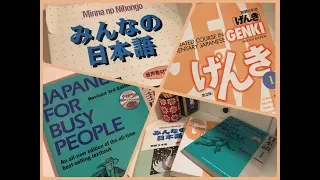
just doesn't work for me for self studying I only used two textbooks master and if you studing to enjoy Japanese media in Japanese then the textbooks I've used won't be really useful to you apart from this one which is pretty much a compilation of all the Japanese grammar you ever need and it's great to have at hand to search for something quickly however I've been told that geni is great for casual studying for beginners and when you reach intermediate level you can look into other textbooks like to and so on if you're studying for the
jopt I do think the best option is the shin Ken Master combined with a good grammar dictionary like the one I mentioned before I know some people enjoy making pretty notes and flashcards or writing the same thing over and over again I personally can't be bothered I could never be bothered even when I was studying English for me I find it easier to learn words in sentences however that is a bit harder to do in Japanese because if you stumble upon a sentence and you can't read the Ki you're usually stuck until you consult a
dictionary so finding a way to memorize Ki is important I'm also not a huge fan of vocabulary list I feel like they actually slow me down which is why I prefer already made flash cards and space repetition as well as just reading and learning words that way if you are studying for the jopt you will have to do a lot of CI drills while if you're studying casually obviously you can do it at your own pace I found that for both the best way to study is through using a good Ki app which is why
I would now like to introduce you to Moi Ki who are very kindly sponsoring this video what Machi kanji does is combine space repetition with a special algorithm that analyzes your learning history it then generates your golden time which is the ideal time for you to revise before you forget the kin vocabulary you've learned through the app it has pre-made flashcards with kin is fuana English translations and example sentences and it honestly can save you so much time Moi Ki can help you memorize 1,000 Ki and vocabulary in one month once it's time to revise
you get a notification you just have to click on it and get started the review quizzes are like games and include Reading Writing and listening what I particularly enjoy about mangi is the varied way it allows you to practice your vocabulary which is perfect for preparing you for the jpt at the same time it also makes studying fun because of its cute interface so it's also ideal for casual studying you can plant seeds in your garden and they grow if you study for a number of consecutive days you can also create a team with your
friends and grow a garden together it's honestly adorable it's really easy to learn with Mandi even if you don't have a lot of time to spare I use it when I'm commuting and it makes time fly the app has a substantial list of courses covering N5 to N2 as well as job related ones like it and nursing and courses covering Min hongo and gy vocabulary it can help you choose the most suitable starting course for you or you can select your own as you progress through your studies the app will divide your Kent vocabulary into
five levels from level one just learned to level five long-term memory and you can check each word level in the digital notebook and of course the higher your level for word is the less you review it the app now has a new feature dedicated to practicing Ki from N5 to N2 you can select your level and practice the stroke order which makes memorizing Ki easier M Ki also has an integrated dictionary which allows you to search and save over 10,000 words the dictionary will show you the words meaning reading type and an example sentence so
if you encounter new words while you're studying outside the app you can just open the app and look them up there and then add them to your notebook you can download M Candi from App Store or Google Play and you can also access it on PC if you're interested I've included download links in the description box and the comment section thank you much AI for sponsoring this video studying Gramm can be quite tedious because to memorize it properly you actually have to use use it and by that I mean making example sentences and doing plenty
of grammar exercises if you just learn the rule but your brain doesn't learn how to make sentences on the spot with that rule you haven't really learned it now if your goal is to consume Japanese media while your grammar is important you don't really have to drill it as much because once you've acquired a good amount of vocabulary you can understand quite a lot from Context and emotion although to be fair in my experience dealing with written grammar is far easier than dealing with spoken one because you can actually see the structure while when you're
listening at the beginning you have to actively listen for the patterns okay see now what I just heard blah blah blah blah blah blah blah blah blah blah blah so at the least you should be doing a good amount of grammar exercises so you will have the structures stuck in your brain at some point you will want to know what sounds right and wrong without having to think about grammar rules if you are studying for the jpt you need to be able to tell which is the correct grammar point that should be used in a
sentence and to construct the given sentences in the correct order you have to be able to do this under time constraints what I personally did is that when I was practicing with the shinkansen master I timed myself for every test and even if I didn't know a word I didn't look it up until after I was done with the test you don't have to know how to write every Ki but I have found that for me trying to incorporate new Ki into whatever I'm writing helps me memorize them better memorize not how to write them
but what they mean and it makes it easier for me to recognize them in big texts if you have a friend who's also studying Japanese an easy way to make it fun for both of you is to chat in Japanese whenever you can my housemate and I decided to keep Diaries in Japanese so every night we would sit down together and write and decorate them with washi tape and stickers and then we would exchange them and read each other's entries I found it very fun and relaxing and I miss doing it dearly now that we
live separately the jopt doesn't test your writing skills so if you only want to pass the exam you don't have to practice writing but as I've mentioned I don't think you can properly learn your grammar without using it so at least you should be making example sentences with the grammar points for the exam and if you don't don't want to write by hand just make a Word document and write sentences there which might even be better practice considering how most of the Japanese writing you ever have to do will most probably be on digital devices
this might be controversial but for the love of God you don't need romaji use it when you're learning hiragana and Katakana the moment you learn those ditch the romaji by the way does anyone else hate Katakana I find it worse than kji it mostly has to do with the fact that kakana takes foreign words and twists their pronunciation and I find my brain in constant battle with the correct pronunciation of the words and their Japanese pronunciation anyway I aim to read either at my level or a level above but never below manga books news anything
you can get your hands on honestly a very good resource is NHK easy I've also used Japanese stories for language Learners something very important is watching Japanese content with Japanese subtitles you can also watch non-japanese content with Japanese dub and subtitles that's how I rewatched Brooklyn 99 on Netflix the best resource I found for watching anime or Japanese subtitles is animelon doing these things should be more than enough practice if your aim is to understand Japanese media however if you are prepping for the jpt you do need to do more the jopt tests two things
in its reading section speed and comprehension so my best advice is to time yourself and when you're doing mock tests don't look up words and make sure to read the questions first please don't forget that people in real life don't really speak the way anime characters speak so if at some point you want to learn how to speak Japanese you have to diversify the media you consume there are plenty of free resources available on YouTube and I highly recommend trying out some podcasts or just watching some Japanese YouTubers for those prepping for the jopt focus
on doing mock listening tests and listening to Japanese radio and TV Japanese people tend to speak faster than exam recordings so if you get used to listening to fast speech without reading subtitles you will find the exam easier at Uni we were only allowed to do a certain number of credits per term and in the first term of my second year there were a lot of politics modules I wanted to take but that meant I had to sacrifice my Japanese classes now here's the punchline to study Japanese in the second term at a higher level
I lied to my tutor and told them I took Japanese classes over the summer and so she let me take a test between terms under the condition that if I did well she will let me join them in the second term well I procrastinated for the whole of term one cramed a whole term of language studying in less than a month passed the test and of course when I joined the class I felt so intimidated and I was always worried people would find out that I shouldn't be in the class 10 out of 10 this
is when my fear of making mistakes and being judged with regard to Japanese developed and I've struggled with speaking Japanese since then don't be like me don't be afraid of making mistakes and embarrassing yourself honestly no one cares you're just Sab sabotaging yourself it's easier said than done believe me I know I am still struggling now for the gals you're looking at in this video mastering Japanese pronunciation in Pitch accent is not really necessary however I do think it would be useful in the long run so repeat what you're hearing mimic as accurately as you
can and talk to yourself the jop doesn't test speaking but real life does so at least get comfortable talking about generic daily life things there is no best way to learn Japanese you will find countless videos and articles giving you different advice what's important is that you find the best way for you if something is not working change it experiment don't just do something because you've been told it's the best the last time I picked up a Japanese textbook was about a year ago life happens priorities change I had to focus on my LW degree
and other things happening in my life and the last thing I felt like doing was studying Japanese yes I've consumed some Japanese media in the forms of anime and news but that's about it so naturally I have forgotten a bunch of stuff and now I have to revise before I can start studying new material language is a skill that has to be maintained I studied French for 5 years in high school I was somewhere between B2 and C1 one and I could write essays and Converse with no issue now I can string a sentence together
it is what it is this should not demotivate you okay just take things at your own pace Journey before destination I hope you found this video helpful if you have any tips for self-studying that work for you please share them in the comments Let's help each other out if you want to hear more about my strategies for passing the jopt then you can click here and if you want to hear about my experience in Japan then you can click here thank you for watching bye-bye