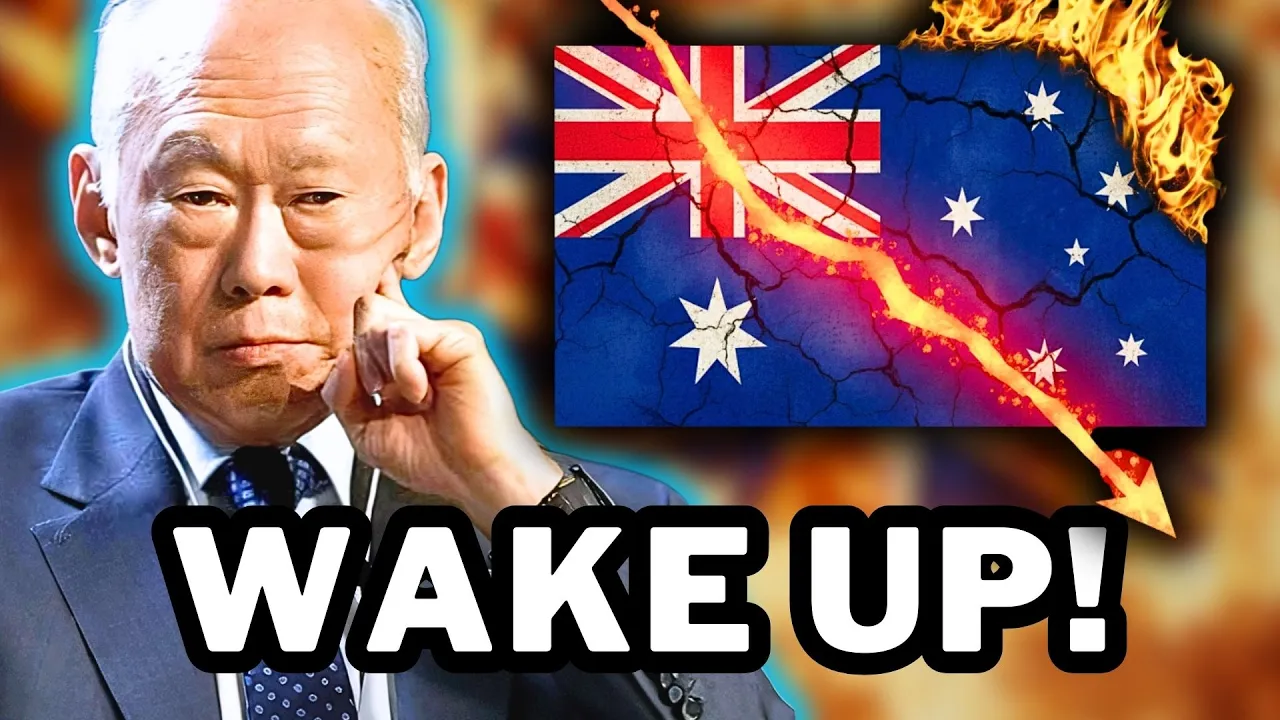
When you take up Australian citizenship, you immediately owe so many thousand dollars in unpaid foreign debt. You become a Singapore citizen, you automatically have acquired so many dollars in assets. We hold assets.
So I said that's correct. But at the same time, they say what's underneath in under the ground. Have we got gold, rubies, diamonds, opals?
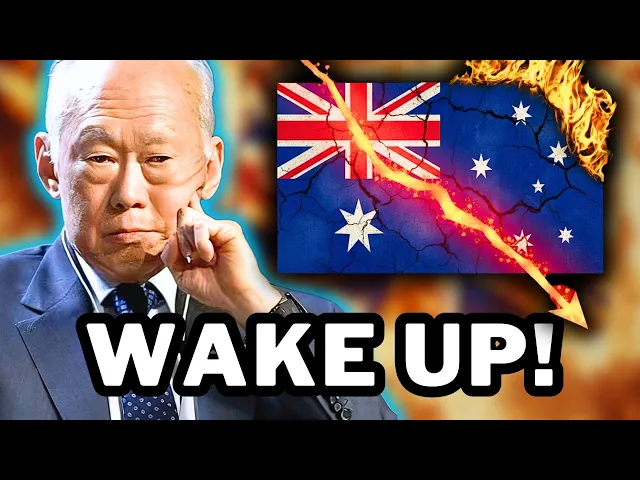
Well, there we lose you see, but above ground cashable assets, fungible assets, we have. In 1980, Lee Kuan Yew looked at Australia and saw something disturbing. A nation blessed with unimaginable natural wealth, yet populated by people who seemed content to simply dig it up and sell it off.
No innovation, no intensity, just coasting on geological luck. He called it the "White Trash of Asia". In the 1980s when Singapore was surging ahead and Australia risked stagnating.
He said uh that we risked ending up to use that phrase the "poor white trash of Asia". Madam Speaker, that phrase stung because we feared that it might be true. But that wasn't even his most brutal observation.
In 1994, standing before an audience in Melbourne, Lee said something that cut even deeper. Australians view Asia as a third-world hell hole of sweat shops, "sex tourism", and repressive regimes. The Australian media's reports on Asians have tended to be condescending, critical, or censorious.
Basically, because Australian reporters do not consider Asians to be their equals. Think about that. Australia's entire economic future was being built on Asian demand for its resources.
And yet the nation's media and its people looked down on the very customers keeping them afloat. Lee saw the arrogance, the complacency, and the ignorance that would lead Australia down a path of decline. And while he passed away over a decade ago, the data suggests his prophecy is now coming true.
Today, Australia's economic standing is in freefall. For example, its economic complexity index has crashed from 64th in the early 2000s to 105th in the world, a ranking below Uganda and Senegal, confirming its status as a simple raw commodity economy. Productivity has flatlined with living standards and disposable incomes falling.
Additionally, national debt is at record highs and housing affordability has reached record lows, creating an unprecedented wealth divide. Even once proud institutions are crumbling, the CSRIO, the Australian National Science Agency that gave the world Wi-Fi, now faces persistent funding cuts and job losses. This is the story of how Lee Kuan Yew saw Australia's decline, decades in the making.
In April 1965, Lee made his first visit to Australia. As a gift, he received Donald Horne's famous book, The Lucky Country. While many Australians think that title is a compliment, it isn't.
Horne actually wrote, "Australia is a lucky country run mainly by second rate people who share its luck. It lives on other people's ideas. And although its ordinary people are adaptable, most of its leaders in all fields so lack curiosity about the events that surround them that they are often taken by surprise.
" Lee read the book and after observing Australia over the following decades he came to his own damning conclusion stating, "I have a theory which explains why countries like Australia and Canada are different. They are both vast resource rich continents with small populations that will never be able to consume their cornucopia of national resources in a thousand years. This immense wealth has created a resource-rich syndrome.
The opposite of the resource poor syndrome of East Asia. The resource-rich syndrome results in a relaxed not an intense society. Therefore, Australians have high consumption, low savings, low competitiveness, high current account deficits, and high debt.
Australia's abundance, the very thing Australians celebrated, was actually a curse. It created a culture of complacency. Why innovate?
Why compete? Why save? Just dig another hole and the money will come.
Lee warned them directly. Unless Australia improves its lack of economic competitiveness, it will again fall prey to the resource-rich syndrome and be forever vulnerable to price fluctuations in the international commodity markets. 2/3 of Australia's exports are still agricultural and mineral commodities.
But adding to this problem wasn't just how Australia made money. It was how they spent it. Lee watched Australia build a massive welfare state that entrenched a high-cost environment.
He was particularly critical of the Whitlam government's rapid expansion of welfare in the 1970s, predicting that free university education and universal health care would prove unsustainable. You have Medicare in Australia, and I know Australia very well because Malcolm Fraser when he took over from Gough Whitlam knew that this was going to lead to trouble. Just blossom forward, big budget.
Malcolm Fraser came in and tried to trim it. Never succeeded. Lee was famously opposed to expansive welfare states, especially in a democracy.
He believed politicians were essentially selling out future generations, buying votes today with bills their children would pay tomorrow. You look at other advanced developed countries. Every election they promise the voter everything that he would like.
Free health, unemployment benefits, pensions. Who pays? They never raised taxes.
Oh, lets amortize over so many years, which means some future government must raise that money, right? Net result is you have mortgaged in your future. The Australian government owes 115-117 billion US in external debt.
I read that they are smaller. . .
The debt is as large as Brazil and Brazil has 120 million people and Australia has 17 million people. To be fair, in the 80s and 90s, Australia did try to reform after Lee's comments. They floated the dollar and cut tariffs.
For a period, it looked like they might beat the white trash label. But then something happened that made all those reforms seem unnecessary. China.
As China industrialized in the 2000s, Australian commodity prices didn't just rise, they tripled. Iron ore, coal, natural gas. China needed it all.
This was the opportunity of a lifetime. An extra $1 trillion in export revenue flooded the country. It was the chance to build a sovereign wealth fund to secure the nation forever to invest in tech, education, and infrastructure.
But they blew it. Instead of saving, the government chose short-term political gain through tax cuts and cash handouts like the baby bonus. But crucially, by retaining tax breaks like negative gearing, much of the wealth was funnelled into a non-productive housing bubble that continues to crush subsequent generations.
While Prime Minister Kevin Rudd finally tried to tax mining profits in 2010 to save some of that wealth for the public, he was swiftly removed from office by a mining-backed campaign. It confirmed exactly what Lee saw in many other countries. Corporate interests, not the people running the show.
Australia's failure to convert its mining boom into lasting national wealth is highlighted by global peers. Norway established the government pension fund in the '90s, creating a financial anchor for future generations that is now valued at over $1. 7 trillion.
Singapore with virtually no natural resources built sovereign wealth funds in the 70s and 80s now worth an estimated $1. 4 trillion through disciplined budget surpluses. Australia in comparison created the relatively small Future Fund in 2006.
Today valued at $170 billion solely to cover the retirement bills of Canberra's bureaucrats and politicians. Worse, this fund was primarily financed by selling off long-term income generating public assets like Telstra, trading future revenue for a one-time cash injection. Norway and Singapore saved for a rainy day.
Australia didn't. Fast forward to today, the official story is that Australia is an economic miracle. They boast the world record, a nearly three decade run of uninterrupted GDP growth paused only by the pandemic.
But the miracle is a deception. Here's the problem. In 2023 to 2024 alone, Australia added 446,000 net migrants, one of the highest immigration rates in the developed world.
But while GDP grows with an increasing population, the country actually endured 21 consecutive months of per capita recession. Without mass immigration inflating the numbers, the decline would be impossible to hide. But even worse, out of this influx of immigrants, Australia isn't attracting the innovators, the entrepreneurs, the worldclass talent that would start companies and drive productivity.
It's attracting people seeking stability, better weather, generous welfare, the truly ambitious immigrants. They move to places like Silicon Valley or low tax havens throughout the world. As Lee noted in a 2008 interview about Singaporeans who immigrated, he was blunt.
Those who seek less rigorous competition, a more relaxed lifestyle, go to Canada and Australia. The result, Australia's population grows, but its productivity stagnates. More people, same economic output, everyone gets a smaller slice.
But while Australia increasingly relies on migrants from Asia, it still hasn't accepted its place on the continent. Lee always believed that Australia's future was inextricably linked to the region. While he saw leaders like former Prime Minister Paul Keating and Foreign Minister Gareth Evans attempting to pivot toward Asia in the 1990s, Lee recognized a deep-seated culture that fundamentally did not respect Asians, stating to be part of the Asian dynamics, it is necessary for Australians to understand Asians, to feel at ease with Asians and to make Asians feel at ease with them so that they can all work together comfortably and on equal terms.
This is not possible if Australians do not quite accept Asians or are disdainful of those with different values or habits. Additionally, he was well aware that many Asians were not being used to their full advantage to capture the Asian growth story, stating the growing number of Asians in Australia will help in this process. The process will be slower if they are employed as specialist technocrats or backroom boys, but faster if they are part of the political, social, cultural, educational, media, and corporate establishment.
But decades later, Asian Australians now make up over 20% of the population. Yet, they remain absent from real positions of power. Lee noticed successful individuals like Penny Wong, but they're the exception, not the rule.
The bamboo ceiling he identified decades ago still firmly in place. Asian Australians are systematically underrepresented and underused. Some Asians complain that in many companies and organizations there is an invisible ceiling for Asian employees.
In other words, beyond a certain point you cannot be promoted. Goh Chok Tong wrote to me and gave a similar reason from his experience. He calls it a glass ceiling.
So this is a subject of considerable uh refinement amongst immigrants. They have developed a special vocabulary to describe their problems. However competent the Asians are, they seldom rise above a certain level.
Furthermore, they they tend to be shunted to technical and operational jobs rather than given key management managerial appointments. Then there is the intellectual retreat. Lee explicitly warned that Australia needed to build up its understanding of Asia, stating, "Australia will have to develop centers for East Asian studies to build a core of experts and specialists, historians, political scientists, sociologists, and linguists who will be a reservoir of knowledge of the history, cultures, languages, and characteristics of the various peoples in the region.
But fast forward to today and Asian language enrollment in Australian schools is at record lows. Universities are shutting down Asian studies programs. The expertise Lee said was essential is being actively dismantled.
Perhaps the most damaging loss, however, is Australia's declining soft power in the region. Decades ago, students who came to study in Australia on the famous Colombo Plan went on to become key ministers in nations like Indonesia and Singapore. Today, almost no regional ministers studied in Australia, signalling a sharp, undeniable collapse in regional influence.
Finally, we reached the breaking point, housing. Sydney made headlines this year as the second most unaffordable city on Earth, behind only Hong Kong, where buying a house costs 14 times the median income. An entire generation of young Australians has accepted they'll never own property.
The dream of owning an apartment, let alone a quarter acre block with a house, is dead. While Lee didn't critique Australian housing specifically, his philosophy in Singapore explains exactly why Australia is failing. Lee believed a nation is only stable if its people own a stake in it.
He stated, "We have created a property-owning democracy. That's why we have stability in Singapore. You want people to defend this country, you must give them a stake.
They are not going to defend this country for corporations like Far East properties or Hong Leong or whoever. You own this home. You will fight for your family and yourself.
Though not without its challenges, Singapore treats housing as essential national infrastructure, not a speculative investment class. Under their HDB scheme, the state houses 80% of all citizens. It's an engineered strategy where new buyers can secure their first home at a price substantially below market value.
This ensures the vast majority of flats are owner occupied. Today, young Australians are asking, "Why should I work hard or fight for a country that I can't afford to live in? " One Redditor summed up the situation in Australia.
30, born here, educated, financially stable, investing as best I can. Despite all that, I can't see a viable future in Australia anymore. Job markets cooked for my field.
Housing still mental even though I can afford it. And the culture feels like it's going backwards. I feel like I'm just treading water here.
No real community. No sense that the country actually wants to retain people like me. Genuinely considering leaving, which feels weird to say as someone whose family's been here for generations.
Today, Australia is trapped, dependent on welfare programs it can't afford, funded by a mining boom that's ending with an immigration policy that masks its decline. In Lee's final book, published in 2013, he made one last comment about Australia. Asked where he'd keep Singapore's financial reserves, he said, "I will keep part of our reserves in the Australian dollar so long as the Chinese require enormous quantities of resources.
" Notice the language. So long as. Even at the end, Lee's faith in Australia was purely transactional.
He wasn't betting on Australian innovation, Australian productivity, or Australian ingenuity. He was betting on China's relentless appetite for rocks. That was the nation's entire value proposition.
And now, China's slowing down, diversifying its supply chains, and looking elsewhere. Meanwhile, Australia faces an impossible geopolitical split caught between its security ally America and its economic lifeline China. As regional tensions escalate, Australia's leverage is quickly evaporating.
As the easy money dries up, the question remains, has the lucky country finally run out of luck, or was Lee right all along that without the rocks, Australia is destined to become the poor white trash of Asia? But of course they've got gold rubies, uranium, coal, oil, gas.