[Music] Welcome to History That Doesn't Suck! I'm your professor, Greg Jackson, and I'd like to tell you a story. Patrick Henry has the gift of gab, and he's not afraid to use it.
Language and delivering speeches are kind of his things. The 29-year-old tobacco-farming lawyer only had formal schooling until he turned 10, but between some tutoring from his dad and his own talent for self-learning, Patrick picked up Latin and Greek as a teen. Yeah, Latin and Greek—no biggie!
Throughout the course of his days, he'll use his revival style of speech to bring the heroes of ancient Greece and Rome to life for captivated crowds. He gives speeches that electrify America. Patrick made a name for himself a couple of years back when his defense attorney skills crushed Anglican clerics suing for back pay after Virginia's Twopenny Act cut the man of God's earnings for a bit.
The jury had to award something; awarding nothing wasn't an option. But thanks to Patrick, the sum was as low as possible: the jury awarded the good Reverend a single penny. And you know that line, "Give me liberty or give me death"?
Yeah, that's him—that's Patrick. If Twitter had been around back then, that phrase would have been hashtag and trending all up and down the East Coast. But let's not get ahead of ourselves; he won't drop that immortal phrase until 1775.
We're still a decade away from that. Right now, it's late May 1765, and Patrick's a newly elected member of Virginia's lower legislative house, the House of Burgesses. He, like so many other colonial Americans, is pissed over the Stamp Tax set to take effect later this year.
So today, he's not going to pull any punches. Patrick's presenting several resolutions condemning the Stamp Act in the House of Burgesses, and the debate over them is fierce. Everyone agrees the Stamp Act sucks.
Many, especially the older members of the house, lay the blame for what they see as an obnoxious, unconstitutional tax on Parliament and the Prime Minister. Patrick, though, has no problem calling out the king, and for the most part, he's got the other young, new blood, idealistic legislators with him. The first four resolutions get through just fine, but the voting gets tighter on his fifth resolution.
It's pretty intense, and it's also just one sentence long. Let me read it to you: "Resolved therefore, that the General Assembly of this colony have the only and exclusive right and power to lay taxes and impositions upon the inhabitants of this colony, and that every attempt to vest such power in any person or persons whatsoever other than the General Assembly aforesaid has a manifest tendency to destroy British as well as American freedom. " Did you catch that?
It's the English language, but 18th-century lingo is a little different, so let me translate: Patrick just suggested to his fellow Virginian legislators that they tell London to get the hell off their turf, because no one in London has the right to tax a Virginian. And if Parliament even tries to do so, it's an insult and an attack on the freedom of Britain's bold words for a British subject. Patrick takes the floor to defend his resolutions.
Imagine this moment: only 39 of the more than 100 legislators are present. Probably a good thing, given that Patrick's only got the young crowd on his side. The older, wealthier planters were far more willing to roll over for London.
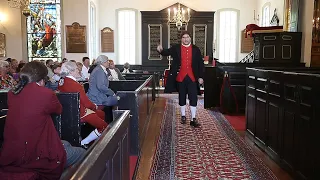
A few others are there just to watch, like this 22-year-old law student from William and Mary College named Thomas Jefferson, hanging out by the lobby door. The legislators are seated on the wooden benches lining the room. Patrick looks out at them with his wide, sad eyes.
He gives off an austere and serious look with his straight, pointed nose and well-set jaw. There are a few versions of Patrick's exact words, but the gist is the same: he channels his inner reverend and bellows out, "Tarquin and Caesar had each his Brutus; Charles the First, his Cromwell; and George the Third, treason! " cries the speaker, cutting him off.
Patrick didn't say it directly, but the implication is all too clear. Brutus helped arrange Julius Caesar's assassination in ancient Rome, while Cromwell led the revolution that got the English King Charles beheaded about a century ago. Patrick's saying someone should kill King George the Third.
The members of the house turn to each other excitedly—defending or denouncing Patrick: traitor or patriot. The first of those titles carry grave consequences. Now there's a lot of doubt about this next line.
Personally, I don't believe Patrick said it. I think this is the stuff of legend, because it really is that legendary. But there's a version that says Patrick met the speaker's accusation by upping the ante, saying, "If this be treason, make the most of it!
" Damn this guy! To use the parlance of the era, Patrick has stones. So what's going to happen to Patrick?
Will he face the music as a traitor? And if you think things are getting intense in Virginia, wait until we get to Boston. Things are on fire up there—literally.
We have to talk about that too. But before we can carry on with Patrick or head north to Boston, let's figure out why all this crazy got unleashed in the first place. To do that, we're heading two years further back to 1763.
Ready? Let's rewind. Remember last time how I told you the end of the French and Indian War, also known as the Seven Years' War, kind of set the stage for the beef between colonial America and the crown, or the mother country, as they often called it?
Yeah, those factors start to play out immediately the same year the war ended. In 1763, King George comes out with his proclamation line. It says that even though the outcome.
. . Of the Seven Years War, Britain gained control of just about everything in Canada and east of the Mississippi.
Colonists are not permitted to move further west than the watershed of the Appalachian Mountains. This doesn't sit well with the land speculators and westward-minded colonists, some of whom were banking on heading west immediately or have already settled there. The reason is that Britain might control this territory on paper, but American Indians live there now.
Parliament and the Crown do want colonists to move there eventually, but they want to make sure they take this land with as few casualties as possible because, of course, American Indians are going to put up a fight. What would you do if someone knocked on your door and said, "Hey, I signed a paper with this other dude, and we agree that your house is now my house. Clear out!
" So, yes, there’s going to be violence. For instance, while the 1763 royal proclamation that creates this line is still in the works, we have Pontiac's War. This is a moment when several American Indian tribes in the Great Lakes region ally and push back against British rule.
Furthermore, Pontiac's War also demonstrates another harsh truth about Britain's new territory in North America: Britain doesn't really control it. So, how can Parliament better control and govern all this new land? Well, come to think of it, the army needs a new job now that the Seven Years War is over.
So why not leave 10,000 soldiers in North America to make sure the Indians stay away from the colonies and that France or Spain doesn't try to retake Canada or Florida? This way, the soldiers have work and the Empire is secured. It's two birds with one stone.
The only problem is, it's expensive. Remember that big freakin' price tag that came with the win over France? You know how the war doubled the Crown's debt?
Well, on top of that crushing national debt, these troops in North America will be another major expense for the British Empire. So, Parliament definitely doesn't want to foot this bill, at least not entirely. But the new Prime Minister, George Grenville, has an answer for that: have the American colonists help pay for the troops!
After all, the troops are protecting them, so they can contribute, right? All we need is a new tax on the Americans to raise those funds—enter the Sugar Act of 1764. Now, don't let the name fool you; it's taxing a lot more stuff than sugar.
That's why it's also known as the Revenue Act. This will raise some of the revenue needed to cover the two hundred twenty thousand pound cost of the soldiers. It's also going to launch Lord Grenville's crusade against American smugglers.
So, while the proclamation line upsets land prospectors and settlers, this tax will upset merchants who are now paying for the soldiers enforcing that line. It's also going to do some things that many think are unconstitutional. But let's not get ahead of ourselves; let me tell you what exactly the Sugar Act is taxing first, because it's a whole lot more than sugar.
Then we'll get into its fight against smugglers and its questionable legality. Remember that wine I mentioned last time? Yeah, Madeira wine—that's the stuff.
The stuff drunk all up and down the American colonies, coming from the Portuguese island bearing the same name. That island sits to the west of Morocco and is about the last place a ship heading to the Americas stops off before braving the dangers of a transatlantic voyage. It cranks out wine at a good price and is a great trading partner for the American colonies.
But Madeira wine has never had a duty on it. But the Sugar Act is about to change that: seven pounds per ton! This means taxes for London and, with some luck, breaking the Portuguese domination of the wine industry in the Americas.
Parliament sees this as a win-win. Lumber? Didn't see that one coming, did you?
Yeah, lumber can't be exported directly to another country with the Sugar Act; now it has to pass through Britain first. So a place like, say, Madeira that might want to buy American lumber can't do it directly, meaning American ships won't go there. So they won't be picking up wine to sell in the colonies either.
See how this escalates? How one industry starts to impact another? The Sugar Act flat-out bans foreign rum—ya know, Bacardi for the Americans!
Ok, just to be clear, that was a joke, but Bacardi rum doesn't exist yet. The Bacardi family won't set up their initially Cuban-based rum operation until the mid-19th century. And for future reference, I promise to always clarify any joke that could even smack of throwing off your understanding of history.
Don't worry, people, I got you! Are you starting to see how this one act is going to screw up trade across sectors? Good!
This plays out the same for coffee, sugar, iron, and some other commodities, all of which will be taxed at ports. And for future reference, remember that as they pass through ports—kind of like paying customs today. This is an external tax; I promise later you'll be like, "Oh ho, a really good thing I knew that!
" You're welcome! There's only one other industry that I have to mention to you—it's the biggie, the real target of the Sugar Act—molasses. To raise more cash, Parliament cut this tax from sixpence a gallon to three pence a gallon.
You heard me correctly; they cut the tax. Yeah, seriously! Let me explain.
See, here’s the thing: if, like me, you have ancestors that hail from colonial Massachusetts or really any colonial port, there’s a fair chance you descend from a smuggler. Smuggling was, of course, illegal, but most of colonial America couldn't care less. They didn't see themselves as brigands breaking the law.
Hell no, they saw themselves more like Han Solo in the Star Wars franchise—just an awesome, "I make my own rules" kind of guy, sticking it to the Empire. And as long as we leave out the adjective "galactic" or "British" next to the word "Empire," that last sentence could just as easily apply to Solo as it could to a smuggler from Massachusetts in 1764. The biggest difference?
One uses a blaster, the other uses powder. So this is how the smuggling molasses trade went down: a colonial ship would pick up molasses from one of the Caribbean islands, where innumerable slaves are literally worked to death in one of the cruelest industries of the day—sugar cane plantations. The colonial merchant ships looking to buy didn't care which Empire's flag flew over the island; it was all about the best price.
They might call at the French colony of Saint-Domingue, now known as Haiti, or the Dutch colony of Sint Maarten. When these ships arrived back in the North American colonies, let's say the port of Boston, the captain would have a nice chat with the customs agent. Now, the following dialogue is fictional, but to help you better envision one of these acts of bribery, it might go something like this: "Evening, Captain.
" "Evening. I'm so, Captain, what do you have in the hold? " "Oh, you know, stuff.
" "Uh-huh, like six pence a gallon stuff? " "Mmm, how about more like I give you a half pence per gallon that you pocket, and we leave it off the books? That kind of stuff, huh?
" "Now, before you start judging His Majesty King George III's customs agent, let's point out that the agent's boss is often not in the colonies, like he's supposed to be, but rather he's living it up in London on his fat salary without doing his job. Meanwhile, this agent gets a pittance for wages—he's struggling to even make ends meet. What would you do if you were him?
" "I'd say 1 pence per gallon sounds better. " "You know, I just realized I'm really thirsty. I think I'll go get me a pint.
Too bad no one will be here to see you unload. " "Good night. " "Good night.
" This mutually beneficial arrangement, which kept more coin in colonial pockets and supplemented the underpaid agents, was so rampant that royal customs collectors brought in a whopping 1,800 pounds per year. That's nothing! But of course, let's not overreach either; it's not like every agent would take bribes, but enough would.
Meanwhile, merchants and captains also succeeded at just flat-out scaring the hell out of some of the more honest ones. So maybe these agents didn't take a bribe, but they weren't about to piss off this gruff American captain and his crew. Imagine being one of these agents, facing down some recently docked colonials who have no problem detailing the pain you're going to feel if you keep insisting on a full tariff.
In this case, the conversation we just recounted might not have happened. Instead, it could have gone like this, returning to our captain: "Oh, full tariffs, huh? Shall I pay that tariff on the tar sitting on my ship?
Maybe we should heat it up before we give it to you with some feathers. How's that sound, friend? " So from London's perspective, all of this adds up to a lot of smuggling.
Meanwhile, from the colonial merchants' perspective, many of these guys, despite the Han Solo reference, probably don't even see themselves as doing something all that bad. They're just ignoring a stupid rule that everyone knows not to take seriously. You know, like jaywalking in Boston today.
Sure, it's illegal, but good luck finding someone who cares. But now all that's changing. Grenville is ordering customs collectors sitting in London to actually go to the colonies to do their jobs and otherwise change the infrastructure to enforce his new 3 pence a gallon tax.
And in doing so, Grenville is really screwing over New England's vibrant rum industry. All right, all that domestic rum—well, I guess New England might not miss Bacardi Rum, even if it did exist. Okay, so now you understand what the Sugar Act is, why it exists, and how it will crack down on smuggling.
But remember how I said it might not be constitutional? Let's address that. First, suspected smugglers, like John Hancock, can be tried by the Admiralty court without a jury, instead of in colonial courts based on common law where juries and local judges might want to take care of their own.
In these trials without a jury, merchants will be guilty until proven innocent. This is yet another measure to tamp down smuggling, but it also upsets colonists who feel they have a right to trial by jury. The other constitutional question is the fact that the Sugar Act seeks to raise revenue.
I know what you're thinking: isn't raising money what taxes are supposed to do? Well, at this point in history, duties on the thirteen colonies have been used to regulate their trade and orient it towards England, rather than seek to raise funds to flat-out tax a people just to raise money. Those people must have representation in Parliament; or to put that another way: no taxation without representation.
Now, before we dive into the nitty-gritty of taxation without representation, I have to introduce the act that really pisses off the colonials because it's the real focus of the representation discussion: this is the Stamp Act. Like the Sugar Act, the purpose of the Stamp Act is to further contribute to the cost of maintaining British troops in North America. The Stamp Act is proposed in 1764, and it is a direct internal tax.
This means that, unlike the Sugar Act's duties, it is not just taxing at the ports; it will tax any. . .
Time an American purchase all sorts of things: legal documents, college diplomas, bonds, deeds, mortgages, leases, contracts, bills of sale, liquor licenses, playing cards, dice, pamphlets taxed by the page, no less; even newspapers and almanacs. They get hit with attacks, so both acts are potentially unconstitutional because of the representation issues they raise. Two interesting questions arise: one is, is there a constitutional difference between an external tax like the Sugar Act and an internal tax like the Stamp Act?
And two, were colonial Americans represented in Parliament and therefore able to be taxed either way? Let’s first address the internal-external distinction. As I said earlier, when I told you to remember this concept, an external tax is only assessed at ports.
That matters because it means the Sugar Act is less like a tax you and I, as citizens, encounter in our day-to-day lives and more like a duty you’d pay if, while traveling abroad, you actually managed to buy enough stuff to have to declare something and pay a duty at customs. See what I mean? So, as an external tax, Americans only questioned the constitutionality of the Sugar Act because its stated goal isn't regulating trade, but raising revenue so Britain can pay for its army in America.
If the goal had been just regulation of trade, we’d have nothing to debate on this aspect of the Sugar Act. Well, what do Americans decide on this internal-external thing? Let’s answer that with the words of James Otis.
He's an assemblyman from Boston, and by the way, get used to me talking about Boston; those New Englanders are a feisty bunch. James writes a pamphlet, which might not sound like a big deal to you, but writing a pamphlet that gets some attention in colonial America is the equivalent of making a video or post today that goes viral. So, James goes 18th-century viral with his pamphlet "Rights of the British Colonies Asserted and Proved.
" In it, James calls BS on this external-internal distinction. To quote page 63 of his pamphlet: "There is no foundation for the distinction some make in England between an internal and an external tax on the colonies. " See?
External and internal—it doesn't matter to James. Any Act of Parliament intended to raise revenue, not just to regulate, is unconstitutional in his eyes, and most Americans come to agree with him fast. Can I also add something else that’s awesome about James?
This is from the same pamphlet: "The colonists, black and white, born here, are free-born British subjects and entitled to all the essential civil rights of such. " Slavery isn’t the focus right now, and I don't want to distract from our plotline of Patrick and the Sons of Liberty, but it’s worth pointing out that slavery continuously lurks in the background, and that even in the mid-1700s, before America became America, there were white Americans who knew slavery was awful, contrary to everything the revolution stood for, and they made sure to make their views known. Okay, so colonial Americans are rejecting the distinction between external and internal taxes.
Got it. Doesn’t that make both the Sugar and Stamp Acts unconstitutional? Well, now we move to our discussion of representation because many in Parliament, including Prime Minister Grenville, say the colonists are virtually represented.
Let me explain. I need you to set aside your American ways of thinking; this is going to be a real mind-bender. Ready?
The British of 18th-century Britain believe it doesn’t matter if you personally have a representative in Parliament. They see Parliament as representing all Britons, not really the region they come from. It’s a concept known as virtual representation.
Let me give you an example to make that a bit clearer. Have you ever heard of the cities of Manchester or Birmingham? They don’t have representation in Parliament at this point—nope, nada.
Meanwhile, there are also these things called rotten boroughs, places where you people or no one at all live, yet these places have parliamentary representation, like the town of Dunwich. It used to be a big trading port in centuries past, but by the 1700s, the North Sea had swallowed just about all of it. Old Sarum is the best example, though; it’s basically an uninhabited mound, but it still has representation.
Further, keep in mind that hardly anyone in Britain even has the right to vote at this point. You have to be male and own land. With those qualifications, only one out of six adult British men can vote.
So, Britain might have a Parliament in the 1700s, but this isn’t a robust democracy yet, and with such spotty representation of the British in 18th-century Britain, can you see where colonial cries of “no taxation without representation” don’t really resonate with a lot of people there? And so, a few English proponents of this virtual representation gladly take up their pens to write pamphlets to try to set those colonials straight. Alright, now I need you to totally embrace your American thinking.
Put on a baseball cap, eat some apple pie, order an excessively large soda—whatever gets you there. I'm not judging! Americans couldn’t be further from embracing this virtual representation in Parliament business.
This is partly because some of the American colonies have existed now for well over a century, and for the most part, they’ve been left alone. That’s plenty of time and space to evolve a different point of view on the rights guaranteed by English law and the 1689 English Bill of Rights, which prevents the king from doing things like keeping a standing army in the country without Parliament's consent, quartering soldiers contrary to law, allowing trials lacking qualified jurists, and having any tax without Parliament's consent. Those are all rights some colonials will say have been violated between 1763 and 1775.
But to keep the focus on virtual representation in Parliament, let’s look. . .
At why many Americans disagree that they have this to start: because the colonies are fairly new compared to England, there aren't any crazy, ridiculous rotten boroughs due to historical arrangements with lords or shifting populations to dilute the idea of individual representation. While voting is still restricted to males who own property in the colonies, the lack of titles and greater distribution of land ownership in the Americas means most men here can vote—try two out of three—instead of Britons' one and six. Can you see then where this "no taxation without representation" business is going to make good sense to the Americans?
It's definitely not a democracy giving a voice to all people; yet it's a far cry from it. We won't get there until the twentieth century, but colonial America has kind of already become a limited suffrage republic by accident—it just doesn't know it yet. Now, some Colonials accept the idea of virtual representation in their own colonial legislatures, but that's because a colonial man living there who can't vote could realistically acquire land and later gain the right with Parliament.
Though an American man could own half of Virginia, he'll never get a vote. Still, others go further and reject the theory of virtual representation entirely. To quote our Bostonian buddy James Otis once again: he says, "Virtual representation is such a load of crap that Britain needs to fix its lack of representation in cities like Manchester and Birmingham.
" As he states, "If those now so considerable places are not represented, they ought to be. " So for James, if a land-owning man can't say, "Don't blame me; I voted for the other guy," then those taxes are not just. And hey, for the record, Britain does so in the centuries to come; it will make major leaps and bounds in representation with the Reform Act of 1832 and continued reform in the following decades and 20th century.
So the justifications for calling the Sugar Act and the Stamp Act constitutional, or "Oh for—" in the colonies, Americans just aren't buying the external/internal bit or the virtual rep stuff. Frankly, they aren't buying the idea that Parliament can ever tax them under any circumstances. Period.
So let's talk American resistance to these acts; it's time to start pushing back against the Empire. Again, I still mean Britain. We're done talking about Star Wars.
Let's start with the earlier of the two: the 1764 Sugar Act. The key thing here is that the colonists protest against it more on economic grounds than for its constitutional problems. They boycott British goods, and by "American," I mean it isn't made in America.
It just isn't needed. Screw the latest fashions that require wearing clothes manufactured in England. Colonial newspapers urge people to drink American brew, and assemblies from eight of the colonies send petitions across the Atlantic decrying the economic woes of the Sugar Act.
Now, there's good reason for this economic focus, not to mention the Seven Years War. Again, the colonies were already in something of a post-war depression before the Sugar Act came along, and to make matters worse, Parliament also passed the Currency Act in 1764. This little gem prohibits the American colonies from continuing to print their own paper money.
There is some discussion of the Sugar Act's constitutionality. We already discussed James Otis's 1764 pamphlet, which addresses the external/internal taxes bit. New York and North Carolina's assemblies address constitutional concerns too, but since most of the dissent is framed in economic terms, Parliament comes to think that's the only problem.
Oh, try to remember that; I know it seems small, but it is a big part of the miscommunication that's mounting between London and the colonies. We'll come back to this later, but for now, let's talk about the even bigger fight, which is against the Stamp Act. This one gets more attention because, unlike the other acts we've discussed—like the 1763 Proclamation Line and the 1764 Sugar Act—the Stamp Act hurts everyone, even the poor, who buy a newspaper or dice from time to time.
So when this act starts getting discussed in 1764, on top of all the other crap going down in the past year or two—oh, it's on! And it will be protested primarily in two ways: one, peacefully with the written word, such as resolutions or declarations; and two, with violence. Let's watch both unfold, starting with the peaceful side of things.
I think you now better understand where our buddy Patrick is coming from with his fifth resolution when he suggests that Parliament has no business imposing any kind of tax on Virginia because only Virginia's legislature can do such a thing. He's saying exactly what James Otis argued in his pamphlet and what more and more Americans all up and down the thirteen colonies are coming to believe: only colonial legislatures can tax Colonials. End of story.
You with me? I think it's time we revisit Patrick. We left him in a potentially treasonous staring contest with the House of Burgesses' speaker.
"Treason! " cries the speaker. "If this be treason, make the most of it," Patrick says.
Maybe we don't really know. Patrick then did what few could with such a serious charge: he smoothly apologizes while explaining he simply got carried away in his desire to protect liberty and its awesomeness. The speaker accepts it, and the hubbub subsides.
Thomas Jefferson later noted his mad respect for Patrick's silver tongue. Just like the first four, Patrick's fifth resolution passes by a single vote: 22-19. The young Thomas Jefferson later wrote that after the fifth resolution's most bloody debate and vote, he overheard the Attorney General, Paton Randolph, say, "By God, I would have given five hundred guineas for a single vote.
" Of course, the Attorney General knew, as did Thomas, that one vote would have made a tie on the fifth. Resolution allowing the speaker to deny it: Randolph's still got his way, though they overturned the fifth resolution the next day. While Patrick's not there, overturned or not, Patrick's words send tremors across the colonies.
His resolutions, which may have included two others that never passed in the House of Burgesses, make a possible total of seven. Publication in various newspapers far beyond Virginia, a Massachusetts paper praises Virginia's legislators while condemning its own. Many Americans come to think all the resolutions actually passed and that the fifth never got overturned.
Rhode Island's legislature proclaims the Stamp Act unconstitutional and tells its officials to ignore it. Eventually, in October, several colonies send a combined 27 representatives to New York in order to present a united front against the Stamp Act; this is called the Stamp Act Congress. Now, don't read too much into this: only nine of the thirteen original colonies participate, and their resolutions, called the Declaration of Rights and Grievances, may attack the constitutionality of the Stamp Act, but it also opens, quote, "with the warmest sentiments of affection and duty to His Majesty's person and government," close quote.
It further affirms that colonial Americans owe, quote, "all due subordination to that August body, the Parliament of Great Britain," close quote. So yes, you are seeing the first united colonial effort against Parliament. That's noteworthy, but it's still relatively loose, and no one here is talking independence; no one in the colonies is going there yet, not even close.
But I am afraid you're getting the impression that colonial Americans are a calm, well-behaved bunch, so let's head to Boston and burst that bubble with some violent protests. On the morning of August 14, 1765, some Bostonians hang two effigies in a tree near the Boston Commons. Just in case you know Boston, it's about a block away from where you'll find the Boylston T stop off the Green Line today, but we'll keep the focus on this much smaller 18th-century Boston of only some 15,000 people.
Now, do you know what an effigy is? In case you don't, it's some sort of representation of a person or thing, generally used to disrespect and protest against that person's actions or the thing itself. These effigies aren't very subtle: one looks like a man—think scarecrow—and has the initials A.
O. for Andrew Oliver. He's Massachusetts lieutenant governor's brother-in-law and soon-to-be distributor of official taxed and embossed paper required for all those things we talked about earlier.
The Stamp Act won't go into effect until November first, but with Andrew's future job already known, the protests have already begun in the streets. The other effigy is a big boot, with a devil in it, and in the devil's hands is the Stamp Act. Things start out innocently enough; these effigies raise the protesters, who start approaching passing carts and pretending to stamp their merchandise.
Can you picture it? As with the smuggling merchants earlier, let me give you my own fictional account of how this afternoon might have gone for a merchant to help you visualize the scene. Here's a merchant passing through, his cart filled with goods.
He comes around the corner, nearing the Boston Commons, and a man steps out into the road, forcing him to stop. "Well, hello, Sir! " exclaims the man, hands in the air.
"It looks like you have a number of goods—taxable goods! Now, have they been stamped? After all, you do love our King, don't you?
God save King George the Third! AHA! But God won't save your pennies!
No, no, Sir! King George needs those pennies, not your children! Here's a stamp for you!
" Thud! He hits the side of the cart in an exaggerated, playful manner. "Carry on, Sir!
” he says with a knowing grin as he winks at the merchant. He and others continue with their sarcastic mocking and playful stamping. Okay, the fictional visualization is over.
Once again, everything I say is straight-up history. These stamping protestors draw attention, and soon more and more Bostonians flocked to the tree—possibly thousands. And again, keep in mind the city only has about 15,000 inhabitants at this point.
Men, women, children, white, black, free, and enslaved—the lieutenant governor sends the sheriff to take down the effigy of his brother-in-law, but by this point, the law doesn't dare to intervene—too afraid. Come evening, the Bostonians hold a mock funeral; six men carry Andrew's effigy towards the cemetery, with thousands following. They chant, "Liberty, property, and no stamps!
Liberty, property, and no stamps! " Can you imagine how terrifying this must be for Andrew and for his family? They end up going to Andrew's newly built office building at the dock; they destroy it, leveling the office of this government official with a battering ram.
The next stop is Andrew's home. There, in the street, right in front of it, and in plain view for anyone inside, they behead the effigy. Can you imagine looking out your window to see an innumerable crowd holding a scarecrow meant to represent you and watching them cut its head off?
Some throw rocks at the windows. Well, don't worry too much: Andrew and his family aren't stupid; they're long gone, or at least they were by the time the crowd goes in and vandalizes the home. But that's jumping the gun.
Before they go in, they build a fire out of wood from destroyed structures on Andrew's property and burn his headless effigy. Once inside, they break things and drink his liquor. [Applause] Amid all of this destruction, the lieutenant governor takes one last desperate attempt at enforcing the law.
He and the sheriff go to Andrew's home to talk with the mob. Here's a word of advice: don't try to reason with mobs. There's a reason we talk about mob mentality; people aren't individuals anymore—they've become this larger collective.
Rational thought isn't a mob's strong suit. The governor and the sheriff. .
. “To your arms, my boys! ” yells one of the leaders, a man named Ebenezer McIntosh.
The mob hurls rocks at their government officials as they dash into the dark of night to save their own lives. Ebenezer gets arrested later, but the Loyal Nine, a patriot group that includes Samuel Adams, will get him off the hook. Andrew sends word the next day.
For some reason, he doesn’t want to come in person; he’s resigning the position he doesn’t even have yet, effective immediately. Now, lest you think this is an isolated act, let me reassure you, there’s plenty more violence where this came from. Only ten days later, that same rebel rouser, Ebenezer, leads another mob to the home of the lieutenant governor, Thomas Hutchinson.
The family is warned with time to get out, but only just. Urbane users crowd, smash down the front door, demolishing furniture, art, Thomas’s personal papers, and stealing his silverware. The house is barely standing by the time they’re done.
Meanwhile, a new group is forming in Boston: the Sons of Liberty. They’ll use violence to enforce a boycott of the Stamp Act. They also spread to New York, a city full of ethnic diversity.
The Sons of Liberty rely on the multilingual John Lam to reach New York’s non-English speaking Dutch, French, and German populations, because tar and feathering government officials and burning things shouldn’t be limited to English speakers. We’re fighting for equal rights here, people! Symbolic protests are happening, too, across the colonies.
Americans hold funerals, carrying Liberty’s coffin in a funeral procession. One guy would be inside as they arrive at the cemetery and prepare to lower the coffin into the cold earth, signifying Liberty’s end at the hands of Parliament. The guy inside would jump out: Liberty has been revived!
So how do you close out this happy yet macabre scene? Why, with drinks, of course! Take the party to the pub; drinks all around!
I don’t know why, but this just seems like the most colonial American thing I can think of—liberty in a pub. But we don’t want to end on such a tame note, nor do I want you to think that only the Northerners know how to scream, riot, tear down buildings, burn things, and otherwise intimidate people. Southerners have got it going on!
Let’s go back to Patrick Henry’s Virginia. It’s the evening of October 30th, two days before the Stamp Act goes into effect, and Colonel George Mercer is ready to take up the position of distributor and stamp collector. Basically, he’s the Andrew Oliver of Virginia.
He’s a local boy, born and raised in the colony, and had served as aide-de-camp for none other than George Washington during the Seven Years War. He’s accepted the position because, well, it looks like a good career move up the ladder—right? Wrong!
When George arrives in Williamsburg that evening, he’s met by a large group of men at the Capitol building. These men are from all over the colony of Virginia, and they want him to resign. Things still feel calm enough; he says he shouldn’t make a decision so lightly and asks to have until Friday at 10:00 to get back to them.
That works, or so it seems, but they follow him. Imagine being George, walking the streets of the city with a large group of men who aren’t your fans trailing you. He goes into a coffeehouse where the governor himself is hanging out with his council and other influential, well-to-do gents.
Now, while they are all inside, the crowd outside grows and grows and grows. They start hollering. Forget the Friday business; they want an answer now!
“Well, that’s Russian! ” calls out a voice. See, Boston’s not the only place where mobs can put the fear of God into government officials!
To the governor’s credit, he braves the crowd. He steps out onto the front steps of the coffee house, maintaining his poise. Astonishingly, he calms them.
At this point, George Mercer comes out. He promises an answer shortly, and the crowd allows him to pass. The governor pleads with him not to resign.
“Take the post,” the governor says; he should only resign if he genuinely fears for his life. George resigns the next day. Well, both of these damaging acts get repealed for reasons having nothing to do with the American colonies.
King George dismisses Lord Grenville as Prime Minister in summer 1765. The new Prime Minister, Charles Watson-Wentworth, Marquess of Rockingham, thinks his predecessor’s tax plan is stupid. He sees the violence in the colonies and thinks it’s best to repeal.
I want to emphasize that violence did the trick. Now he can’t say that to Parliament—no, no, no! So he gets British merchants who trade with the colonies to complain that Parliament will respond.
Come 1766, both the 1764 Sugar Act and the 1765 Stamp Act get repealed. Oh, but do we have some miscommunication between the Americans and Parliament! Now listen up; this is crucial.
Remember when I mentioned the colonists boycotting English goods? Well, merchants also adopted nonimportation agreements. They did so thinking they could hurt the British economy enough to get Parliament to repeal the Sugar and Stamp Acts.
Well, when the Acts get repealed, the colonists mistakenly think their nonimportation and boycotting did the trick. So now they incorrectly think they can get Parliament to cave with nonimportation in the future. Because of that, you’ll see the colonies try this again and again with future taxes in the decade between now and the Revolution.
But the miscommunication doesn’t end there. In making these repeals, Parliament also passes the Declaratory Act. This declares the King and Parliament have the right to quote, “make laws and statutes of sufficient force and validity to bind the colonies and people of America, subjects of the Crown of Great Britain, in all.
” "Cases whatsoever. " Parliament avoids the word "tax," but they thought they were clearly saying, "We are repealing the Sugar and Stamp Acts because we've decided they aren't that great. " But make no mistake: we have the right to tax you, colonial America.
But you know what the colonists heard? "We in Parliament have the right to pass laws, but only your colonial legislators can tax you. " Talk about hearing what you want to hear!
Good grief! Oh, and in one more miscommunication, while repealing these acts, Parliament also passes the 1766 Revenue Act. Among other things, it replaces the Sugar Act's 3 pence a gallon tax on molasses with a 1 pence a gallon tax.
It raises revenue, but it's also about as cheap as smuggling by bribing officials, so no one really bulks at it. Well, that tells Parliament that the colonists really just have a problem with internal direct taxes, like the Stamp Act. Clearly then, external taxes really are okay with the American colonies.
So Parliament thinks, "Ah, that's what the colonists get for mostly voicing their opposition to the Sugar Act on an economic basis rather than a constitutional basis. " To think all of this because Britain got new territory in North America and wants to leave an army to protect it! As the next decade passes, these mutually exclusive interpretations of the rights colonials have as English subjects, along with miscommunications between the colonies and Parliament, are going to lead to more tax crises, more destruction, and more troops, and soon blood in the streets of Boston.
I want to give you a heads up on what we are talking about next time. But first, if you enjoyed hanging out with Patrick and riding with the masses in Boston today, please be sure to like, share, and subscribe. You can join the podcast's Facebook page or follow on Instagram at historythatdoesntsuck.
And if you're really digging this and thinking bi-weekly podcasts just won't be frequently enough, please consider a $2. 00 per month Patreon subscription. You'll find us at patreon.
com/historythatdoesntsuck. You can get access to new episodes a few days early and help me move toward my goal of hiring the help I would need to make this a weekly podcast. Now, next time, let's see the British Navy seize John Hancock's ship for suspected smuggling, and British troops will kill five men in Boston.
Is it a massacre or just an unfortunate policing action? Join me in two weeks from now in episode three, where I'd like to tell you a story.