The story of how most countries in the world came to adopt legal reinforcements for technological protection measures, commonly known TPM's, is very long and complicated. In this last segment of the lecture, I'll provide you an abridged version of the story. If you'd like more detail you might consult chapter three of my book, Promises to Keep, from which this abridged version will be distilled.
In the early 1990's, entertainment companies dismayed by the increasing frequency with which digital copies of their products were being copied and redistributed, and by the apparent inability of the law to halt this behavior, began to experiment with encryption as an alternative way of preventing, or at least discouraging, unauthorized uses their products. Examples of such experiments included the content scramble system, commonly known a CSS, which is used to inhibit reproduction of the copies of audiovisual works housed on DVDs, the secure digital music initiative, commonly known as SDMI, which was supposed to provide even stronger protection for sound recordings, and the Real Audio and Real Video format's developed by the firm Real Networks that enabled users of those formats to turn on or off of a virtual switch, which controlled whether person's to whom formatted works were streamed could make copies of this works. As the entertainment companies soon discovered, this strategy was at best imperfect.
Every time they deployed one of these technologies someone, surprisingly often a teenager, would crack it. Once the technological wrappers had been removed, the naked digital files could be re-distributed promiscuously. So the entertainment companies began to look to the law for aid.
To understand the nature of the strategy it may help to turn, once again, to copyright theory. You'll recall, I hope, that the premise of the welfare theory of copyright, and of intellectual property in general, is that intellectual products are public goods that will be produced at suboptimal levels unless the government intervenes in some way to stimulate their creation and dissemination. Over the centuries, governments had used five different techniques to provide the necessary stimulus.
The five options, with which you should now be familiar, are listed on your screen. Until this point in the lecture, we have been overwhelmingly concerned with the fifth option, the essence of which is that the government protects authors and artists against competition-- in other words, forbids competitors to make, distribute, or perform copies of their works without permission. That, as you well know, is the fundamental principle of copyright law, at least as seen through the lens of welfare theory.
When the entertainment companies sought the assistance of the law in buttressing their shaky encryption systems, they were in effect stepping outside the zone of copyright law and relying on an altogether different approach. In particular, they were employing a variant of strategy number four. They were relying upon a self-help approach, specifically technological protections for copies of their works, and soliciting legal reinforcement for that strategy.
In this respect, their approach was analogous to trade secret law. In that context as well, companies rely on self-help, specifically efforts to keep their innovations secret, but then turn to the law for aid when economic espionage or faithless employees cause that secrecy to fail. In short, the entertainment companies new approach was not really an example of copyright law at all, even though, as you'll see, they plugged the statutory reforms they sought into the copyright statute in the United States.
In truth, this approach is a different animal altogether and had quite different strengths and weaknesses. For that reason, it's sometimes referred to as paracopyright. OK.
Back to our story. The law in the United States as it existed in the mid-1990's failed to provide the entertainment companies the aid they sought. To be sure, the federal statutes contained a few specialized provisions that forbade circumvention of particular encryption systems.
For example, it was illegal to manufacture or distribute devices designed to descramble the signals provided by cable television systems or digital satellite systems, but there was no provision forbidding encryption circumvention in general. Judge-made law was even more unhelpful. For example, in the case of Volt Corporation vs.
Quaid Software the Fifth Circuit Court of appeals had ruled that the creation and sale of a software program designed to circumvent the copy controls on a diskette did not make the creator of such a program liable for contributory copyright infringement, because the program had a substantial non-infringing use, mainly enabling the making of archival copies. And as I explained in lecture number nine, in the Sega enterprises case the Ninth Circuit had refused to find a game manufacturer liable when it circumvented Sega's lockout mechanism preventing unlicensed game developers from building games compatible with its Genesis console. So, existing law was unhelpful the companies therefore sought new law.
The path to the reforms they wanted proved circuitous. First, they plead their case to the Information Infrastructure Task Force, commonly abbreviated as the IITF, the group appointed by President Clinton to articulate and implement the administration's vision for the National Information Infrastructure. The crucial subcommittee within the IITF was the working group on intellectual property rights chaired by Bruce Lehman, a former copyright industry lobbyist who had recently been appointed the commissioner of patents and trademarks.
Lehman and the IITF proved receptive. In their preliminary report, known as the "green paper," and again in their final report, known as the "white paper," they recommended the adoption of a quote, "prohibition on devices, products, components, and services that defeat technological methods of preventing unauthorized use of copyrighted materials. " Ignoring the objections of some vigorous critics of this proposal.
Surprisingly however, Congress was more attentive to the critics arguments and moreover was distracted by an upcoming election, and as a result failed to adopt the administration's recommendation. So Mr Lehman cleverly pursued an alternative approach. Instead of continuing to pound on Congress's door, he turned to treaty making.
In 1996 in his capacity as the United States delegate to the World Intellectual Property Organization, Lehman pressed for adoption of a new treaty that would embody the critical provisions of the now rejected argument in the white paper. He didn't get all that he wanted, but he was able to secure-- specifically in Article 11 of the WIPO Copyright Treaty-- a moderate version of the provisions that he had originally sought. Quote, "contracting parties shall provide adequate legal protection and effective legal remedies against the circumvention of effective technological measures that are used by authors in connection with the exercise of their rights under this treaty or the Berne Convention.
And that restrict acts in respect of their works, which are not authorized by the authors concerned or by or permitted by law. " Lehman then returned to the United States and approached Congress with a new argument. Congress, he argued, needed to modify federal law in the United States to fulfill the obligations to which the United States would soon be subject under the new treaty.
There ensued a protracted hard fought battle among the relevant interest groups, a battle chronicled by Pam Samuelson. Lehman and his allies eventually emerged bloody but victorious, specifically as part of the Digital Millennium Copyright Act, as you now know conventionally abbreviated to DMCA. They obtained two new provisions now embodied in sections 1201 and 1202 of the copyright statute.
Of the two provisions, 1201 is the more important. The critical language is indicated on your screen. Section 1201(a)(1)(A) provides that no person shall circumvent a technological measure.
It effectively controls access to copyrighted work. Section 1201(a)(2) provides that no person shall manufacture or import, offer to the public, provide or otherwise traffic in any technology product service device component or part thereof that is primarily designed or produced for the purpose of such circumvention. Finally, section 1201(b) contains a similar ban on the production or distribution of technology, primarily designed to circumvent technologies that effectively protect the exclusive rights of a copyright owner-- the exclusive rights to reproduce the work adapted, performed publicly, and so forth.
Parties injured by violations of these rules can bring civil lawsuit to halt the practices and collect damages. In addition, willful violation of the rules for commercial advantage or personal gain subjects the offender to substantial criminal penalties. As you undoubtedly noticed, there are some important ambiguities in these provisions.
What exactly does circumvent mean? For example, if I give my password to a friend who then uses it to gain access to a copyrighted recording or program, have I or has she circumvented the technological protection system that requires that password? What does it mean to effectively control access to a copyrighted work?
What activities other than manufacturing and distributing are encompassed by the ban on trafficking in circumvention technologies? Some of these ambiguities are addressed, though not with great clarity, by definitions contained in other parts of the statute. The prohibitions contained in 1201(a) and 1201(b) are tempered, as you can see, by a list of exceptions, some of which are also vague.
For example, technologies that are not primarily designed for circumvention have a more limited commercially significant purpose other than convention and are not marketed for circumvention are exempt. Nonprofit libraries, archives, and educational institutions are sometimes permitted to engage in circumvention in order to decide whether to acquire copyrighted work. Circumvention activities for the purpose of reverse engineering to achieve interoperability among computer programs, security testing, encryption research, and controlling minors access to pornography are all privileged.
Finally, every three years the librarian of Congress is required to promulgate regulations exempting from the anti-circumvention provision persons who would otherwise be adversely affected in their ability to make non-infringing uses. The most recent round of regulations in 2010 generated some intriguing safe harbors. In culmination, the importance of the issues addressed by these statutory provisions and the ambiguity of several of their dimensions have generated a great deal of litigation.
The principal cases are listed on the map. If you follow the links you will find summaries of their facts and holdings and copies of the opinions themselves. In the first and arguably most important wave of these cases, the copyright owner's that had pressed for these statutes and that stood to benefit most from expensive interpretations of them prevailed decisively.
In later cases, however, the courts have rejected especially aggressive applications of the provisions. A very rough generalization concerning the pattern of outcomes in these cases is that the more they have to do with the kinds of entertainment products that initially provoked the statute-- music, films, games, and so forth, the more likely the courts are to find that the behavior of the defendants were unlawful. By contrast, in cases where the plaintiffs have sought to rely on these statutory provisions to support business models unrelated to traditional entertainment products the courts have been much less sympathetic.
That's a crude guideline, to be sure, but for better or worse it has some explanatory force. By way of illustration, I'll describe two of the cases. Here's the first.
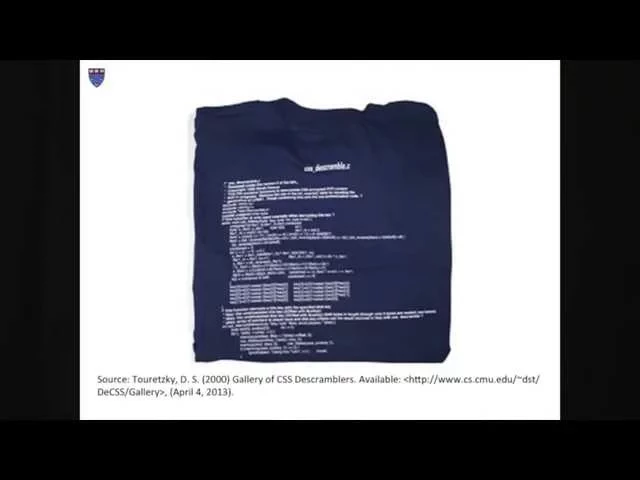
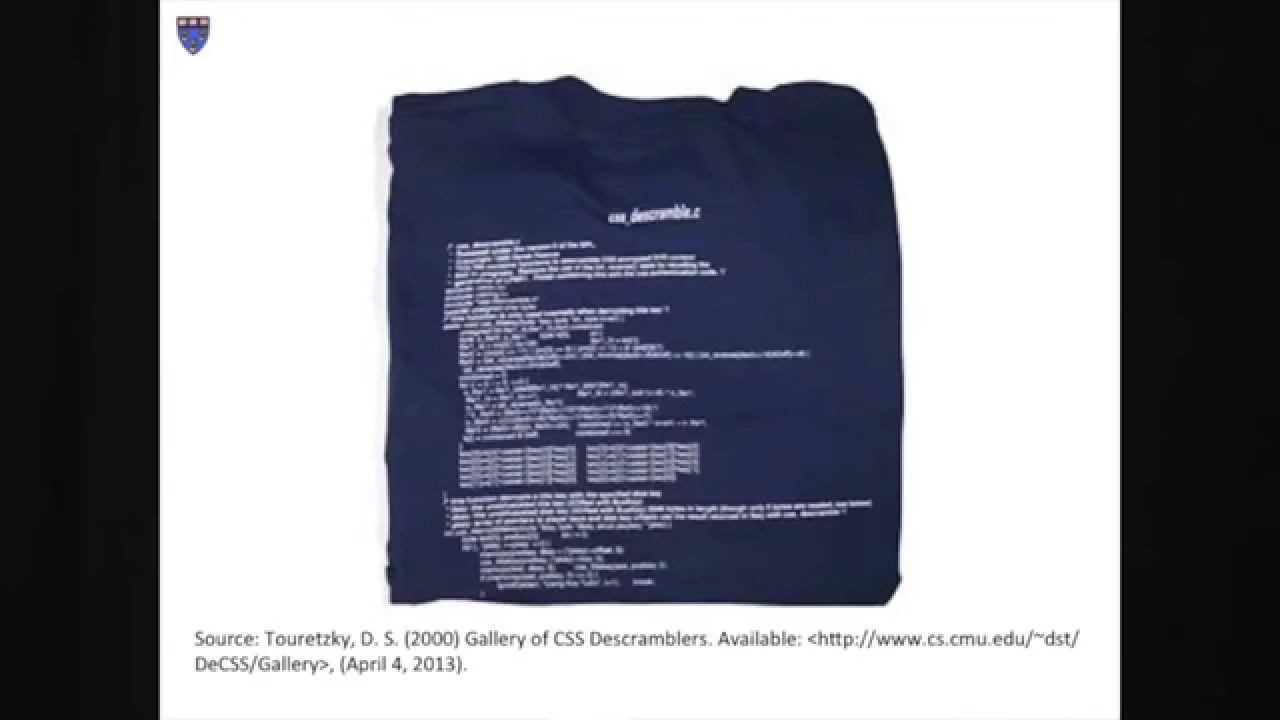
In 1999, John Johansen, a 15-year-old Norwegian, reverse engineered a licensed DVD player and used the information he obtained to write a short program designed to descramble a signal that had been scrambled by the CSS security system-- the system that I described a minute ago that is designed to prevent ripping DVD's. Johansen's program, which he called DCSS, was relatively simple. The original version consisted of 60 lines of computer code.
It has since been reduced to seven. Although Johansen's original purpose apparently was the relatively benign goal of developing a DVD player that could operate on the Linux operating system, his creation enabled many other less innocent uses of the video recordings distributed on DVD's. Once descrambled, they could be stored, compressed, reproduced and redistributed.
Copies of DCSS spread quickly over the internet. Within a month, many websites offered user-friendly downloadable versions the program in both source code and object code. The major film studios, seeking to stop or at least slow the spread of what they regarded as an infection, invoked the DMCA to demand that the operators of those websites remove the program from their servers.
Some of those operators, including Eric Corely, the editor of a print magazine boldly named 2,600: The Hacker Quarterly, and an accompanying website refused to comply. In response, the studios brought suit, accusing Corley and others of quote, "trafficking in circumvention technology. " Judge Lewis Kaplan found that the defendants had indeed violated Section 1201(a)(2), the ban on trafficking in technology designed to circumvent restrictions on access to copyrighted works.
In his judgment, none of the statutory exemptions were applicable. He then rejected the defendant's argument that the statute so construed would violate the First Amendment's protection for freedom of speech. In his final ruling, Kaplan ordered the defendants to remove the program for their servers, and more controversially, to disable all hyperlinks to other websites where copies of the program could be found.
The Court of Appeals for the Second Circuit affirmed, like Judge Kaplan, the Court of Appeals found all of the exemptions inapplicable, nor did the statute, even when thus broadly construed, violate the First Amendment. The court conceded that the anti-trafficking provisions in general and as applied in this case, did restrict speech, but that restriction it ruled is content neutral, advances a substantial government purpose unrelated to the suppression of expression, mainly assisting copyright owners and preventing unwanted access to their property, and burdened speech no more than necessary to achieve that end. And thus, it's constitutional.
The ruling in the Corley case seems to have had little effect on the distribution of DCSS. While the case was ongoing, hackers and Corley sympathizers continued to distribute the program in a wide variety of formats-- on t-shirts, in the form of a haiku, set to music, and so forth. On the other hand, the ready availability of DCSS on the internet still today does not seem to have adversely affected the use or profitability of commercial DVD's.
The revenues generated by which are tracked by the yellow sectors of the graph on your screen. As you can see, the ready availability of DCSS starting in 1999 certainly did not prevent the DVD format from conquering the home video market. Perhaps copyright owner's anxiety was unfounded.
In any event, the Corley case has proved highly influential. Its crucial features include a lenient interpretation of the requirements that technological protection measures effectively control access to a copyrighted work, an expansive interpretation of the prohibition on trafficking in circumvention technology, rejection of the position that TPM's must accommodate the privileges traditionally enjoyed by users under the fair use doctrine, and last but not least, the declaration that despite these interpretations, the statute does not run afoul of the federal constitution. An example of a decision that took a more skeptical view of TPM's and invocations of the law to reinforce them, is Chamberlain, decided by the Court of Appeals for the Federal Circuit in 2004.
Chamberlain manufactures and sells garage door openers, these are devices that enable homeowners to avoid the inconvenience of getting out of their cars to open their garages when they returned home. A homeowner need only press a button on the remote control depicted at the bottom of this photo, and the machine depicted at the top of the photo will cause the door open. Chamberlain's system incorporated a copyrighted quote, "rolling code," close quote, computer program that constantly changed the transmitter signal needed to open the garage door.
Now as you know, with some frequency homeowners lose or break the remote controls necessary to run their systems. The defendant in this case, Skylink, catered to such consumers, offering them replacement generic remote controls capable of opening Chamberlain's doors, as well as those of other garage door opening companies. Chamberlain was unhappy, primarily it seems because Skylink was undercutting Chamberlain's ability to sell its own replacement remote controls.
So Chamberlain brought a DMCA suit against Skylink contending that Skylink's products quote, "circumvent the security inherent in rolling codes," close quote, and therefore that quote, "Skylink is in violation of the anti-trafficking clause of the DMCA's anti-circumvention provisions, specifically 1201(a)(2)," close quote. Court of Appeals for the Federal Circuit eventually rejected this claim ruling broadly that 1201 prohibits only forms of access that bare a reasonable relationship to the protections of the Copyright Act otherwise affords copyright owners. As David Nimmer, the son of Melville Nimmer and a notable copyright scholar in his own right, points out it's very difficult to derive such a limitation on the scope of 1201 from the language of the statute or from the legislative history, and indeed the Court of Appeals for the Ninth Circuit in the more recent MDY case, refuse to follow the Federal Circuit in restricting the reach of the statute in this fashion, but MDY involved video games, not garage door openers.
Though the statute itself makes no reference to the nature of the device in which the copyrighted work guarded by the TPM is embedded and thus as Nimmer argues the distinction between Chamberlain and MDY is hard to justify on the basis of statutory interpretation. It's neither surprising, nor terribly troubling, that the courts are more protective of entertainment products where unauthorized reproduction is arguably pernicious than they are of more industrial products where we have long thought competition is socially beneficial. So that's where things currently stand in the United States.
The legal reinforcement of TPM's is by no means limited to the US. 90 countries currently are signatories to the WIPO Copyright Treaty and the WIPO Performances and Phonograms Treaty that as we've seen impose on member countries duties to adopt and enforce rules of this general sort. How have other countries sought to implement the principle?
The responses, as you might expect, vary considerably. As my colleague Urs Gasser points out, the language of the relevant treaty provisions leave member countries considerable discretion on several fronts. Most importantly, the treaties leave countries free to decide whether to buttress only TPM's that reinforce the kind of exclusive rights enjoyed by copyright owners, namely the rights of production, distribution, public performance, and so forth.
Or also TPM's that limit user's ability to gain access to copyrighted works. The countries are also free if they could figure out how to do so, not to penalize circumventions of TPM's for the purpose of exercising one of the privileges recognized by the copyright system, such as the privilege of engaging in fair uses. On the latter issue, the European Union has adopted an approach very different from the United States.
You'll recall that in the US the DMCA contains a list of specific exemptions to the coverage of Section 1201 plus an administrative mechanism enabling the Librarian of Congress periodically for three years to add additional exceptions. That list is widely considered to be very narrow, enabling copyright owners in the United States to use TPM's to curtail lots of activities that they would be unable to forbid by invoking the regular rights under the copyright statute itself. The EU, by contrast, requires member countries to create mechanisms to ensure the TPM's do not interfere with the privileges that consumers enjoy under copyright law, unless the right's holders develop and implement such mechanisms voluntarily.
Gasser points out the countries within the EU have sought to accommodate that obligation differently. Greece and Lithuania, for example, have set up mediation systems in hopes of reconciling TPM's with the traditional privileges of users. The United Kingdom has set up a special administrative mechanism that purports to enable aggrieved users to challenge TPM's that constrain their freedom to make lawful uses of copyrighted materials.
And Ireland permits aggrieved users to appeal directly to the Irish High Court. Whether any of these mechanisms is effective is far from clear, but they at least purport to tilt the scales more toward consumers than does the United States. During the past 15 years, controversy over legal reinforcement of TPM's has been intense.
My guess, for what it's worth, is that in the future the controversy will gradually fade. The reason is not because countries will converge upon a solution to this issue that satisfies all parties, that's extremely unlikely. The reason rather, is that TPM's and their legal supplements are designed primarily to protect business models that rely upon distributing copies of copyrighted works to consumers.
Increasingly nowadays the businesses that have traditionally depended on copyright law are shifting to cloud-based business models that do not depend upon providing consumers copies of works. As a result, for better or worse, technological shields enveloping such copies will become less important. At the same time, alternative practical and legal mechanisms for preserving the traditional privileges of consumers will become more important.
Thanks for your attention. Next week we'll take up the last of the topics in this lecture series-- the remedies the law provides for copyright infringement.