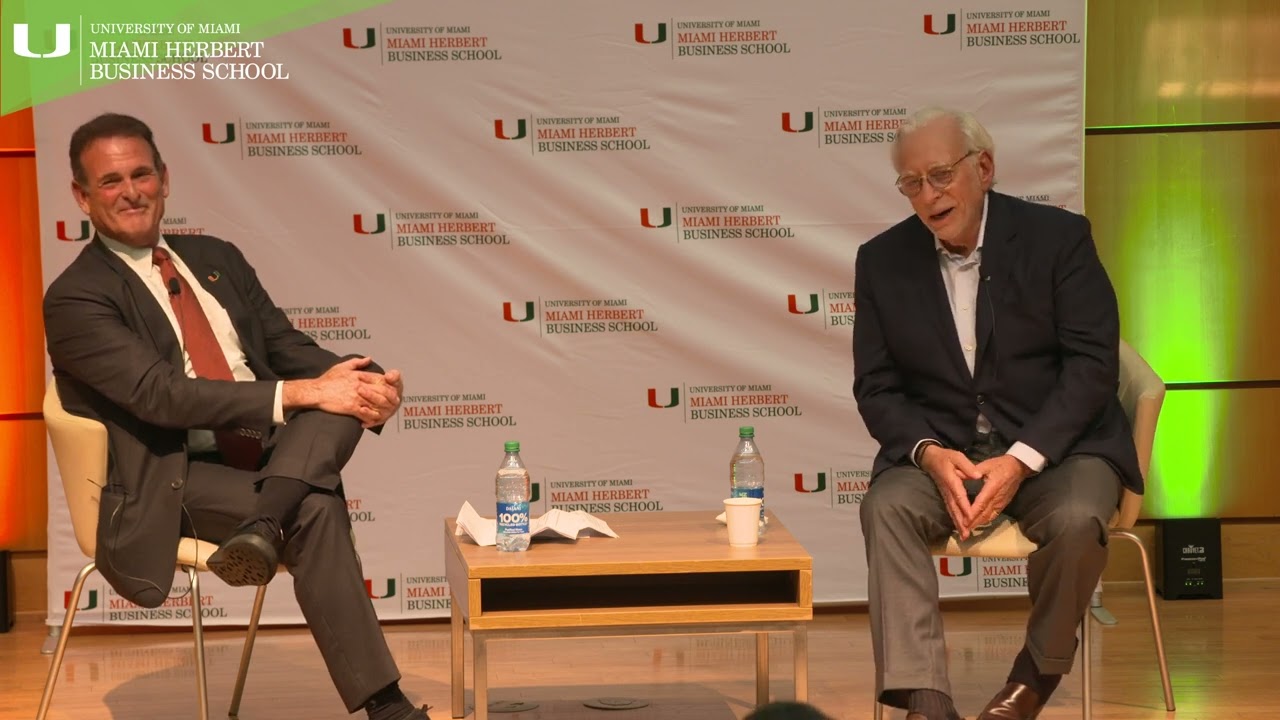
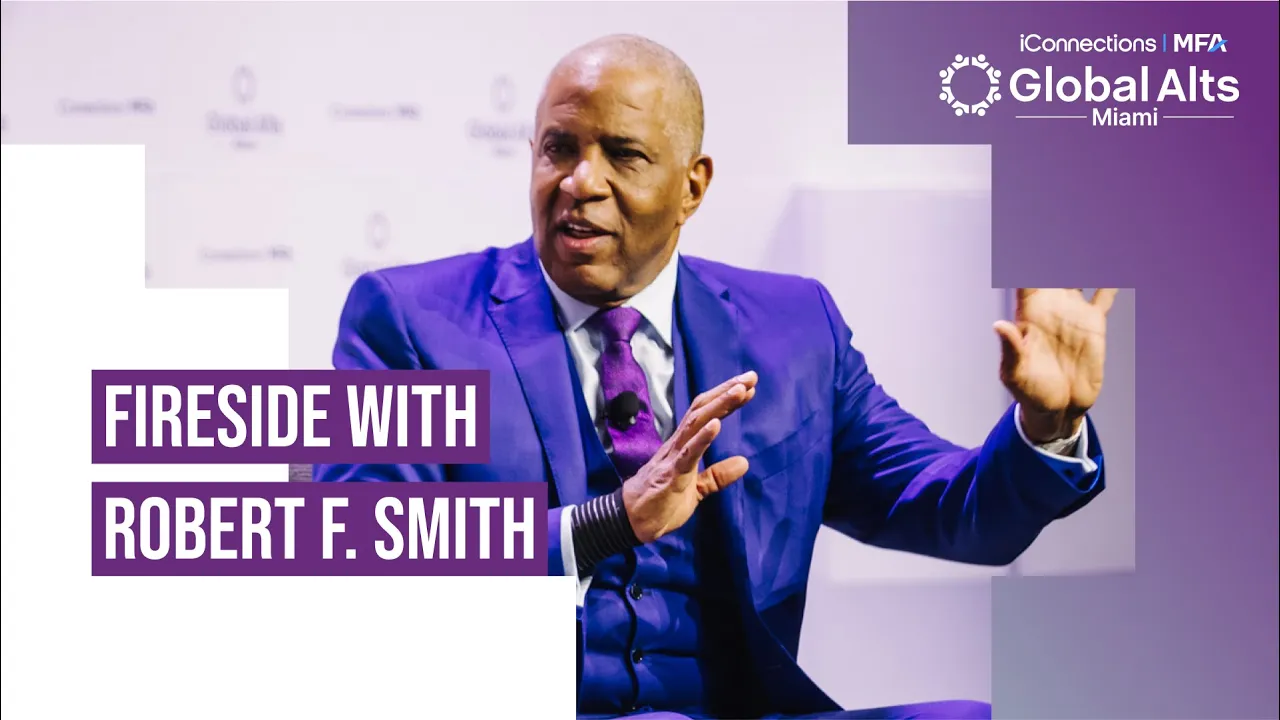
everyone Robert how are you today fantastic you good seeing you um you and I met a few years ago and I think one of the things we did first was a podcast and I think think I told you back then that not to worry because we had editors to take every mistake I made out of it we actually don't have the benefit of that today but the good news is people are here to listen to you and live and In Living Color today live and In Living Color um we're going to talk about Ai and
I want to hear a lot about um deep seek and Stargate and all the things that we've been reading about in the media in the last couple of days but uh a lot of folks first I think are familiar with Vista that are in this room but a lot of people may not know the the story you know I know that when I started in private Equity over 30 years ago if someone said go buy a software company and grow and put some debt on it they would have looked at me like I had four
heads and came from another planet and yet you've built a tremendous firm on the basis of doing things just like that so I wonder if you just take a few minutes and tell us a little bit about the idea for Vista how you grew Vista and of course this year's your 25th anniversary so we'd love to hear some of the surprises and and opportunities youve found along the way yeah I don't know how much time we have but we'll we'll make it succinct um I think as you know my I started my career as a
as a chemical engineer uh and at a time when uh chemical Engineers were really focused on automating process Industries and so at the first time we were actually putting compute Cycles into the process uh industry sector um and what you found in that environment was uh typically process Industries you're going through some activity uh you know it might be a a chemical reaction of some type and you're observing um something some event and then you have to intervene in that event so I call it some method of observation some method of intervention that changes the
nature of that reaction well in the past it was all done through analog and so you would have people actually watching and making changes and so I call up control Paradigm looked something like that but when you introduce compute you could actually you could actually observe you know 60 times a second M some activity uh and then you could intervene or whatever interval made sense so you went from control paradigms that look like this to control paradigms that look like that and so everything under the curve is a is waste and so in essence as
Moore's Law kicked in and we were able to distribute compute power uh across the planet in essence what came to be very important was the value wasn't in the hardware it often wasn't ultimately ultimately wasn't necessarily in the systems but was in the software because it was a software that you could constantly modify and once you separated the software from the hardware created a massive investment opportunity and open by the way Hardware you'll buy once and you'll go through some refresh Cycles hard is software in essence you buy it every day because we built business
models that had people first pay some original license and maintenance and then we went to a subscription base but in essence you're paying for it every day and you're paying for upgrades and you know additional uh added features and benefits now you build it once you sell it many times there's no really no cap X associated with it right it's negative working capital if you actually manage you know your your your operations well and so you can have a pretty high conversion of Revenue implenting to ebaada and ultimately to free cash flows and so the
key to what Vista is all about is bringing a set of operational procedures or best practices to running software companies so that you can manage that conversion from revenue to free cash flow uh efficiently we've now done what over 640 transactions in the last 25 years uh with with with that design point in mind and did you have any idea back then that the firm or the industry or the opportunity was this big yes did and I and I say that with all humility in so far as I knew the power of what enterprise software
would bring you know enterprise software is the most productive tool that's been introduced in our business economy in the last 50 years and likely will be for the next 50 and if you actually think about it artificial intelligence General artificial it's software and we have now call it 89 companies in our portfolio we measure the productivity of the products that we sell to our customers so no matter what business you are in or industry or anywhere on the planet your likely you know best use of your next dollar is to buy more software to make
your people more productive your systems more streamlined you know your go to market more effective uh in in in manage and also managing your cost so that very nature is a tremendous Tailwind uh for this industry and over time of course that productivity comes down on certain applications we get better and better better at it uh but there's always an opportunity to reinvent or I always call this one of the few businesses that you can actually take data from your customer set and develop a new set of products that only you can sell to that
Customer because you have the benefit of data and insights and workflows and information that no one else has because they're using it every day you know in some cases you know billions of times a day that inform how that process process can be you know tuned how that process can be modified to actually bring more value to your customers so just by the very nature of how Enterprise software operates it creates a a wonderful ecosystem for Value creation and then of course our job is to do the value capture from that value creation okay so
let's talk a little bit about AI then and how that's Shifting the equation here I hear a lot when we think about AI around uh productivity and I hear about cost efficiencies and I hear about product development and software code writing and end customer benefits but what what is the opportunity in AI today Robert it is all that you have named and a little bit more um one of the advantages in the way that we operate is I I'll say to some degree we have you know again today as we sit here 89 software companies
I've got a value creation group and I like I was sitting with the CEO of one of the largest banks in the world and we were comparing kpis on some of our our product development or sorry our our our code development and what we're seeing is now how do you take these results and drive them from not just cost offsets to actual cost savings on the one hand or go to market enablement on the other and I think one of the videos will show a bit of that let me give you an example one of
our companies uh which is again one of our medium-sized businesses they have a customer service organization like all of them do and in this case uh if you had a problem with you know it's it's a product that you actually used to now go uh you know to work out in gyms and move for go from one gym to another and you know one day you want to do Soul cycle next day you want to do orange theory if you do that you use basically a token to go do that workout but say you show
up and and the instructor has given the seat away to you know to you know their their friend and you didn't get the seat and so now you want to complain and you want your money back and we may offer you other places to go but the point is our CEO there uh months ago five months ago said listen look Robert I I can get a 40% deflection for that customer service call with a 98% resolution with a higher kpi for what we call NPS score or the you know net promoter score so was a
higher a higher satisfaction two months later um with the CEO he said I'm at 60% I made a breakthrough I think we're going to get to 90% so if you just think about the implications of that for all customer support customer services where you can now deflect 90% of the customer service calls using a an agent with a higher degree of satisfaction with a high degree of resolution there's massive implications as to what that leads to that's just one area within one company that not only can we do it in all of our companies but
you think about how you can now uh enable your customers to use those solution sets and then in some cases your customers customers so that is the extensibility of what you know generative AI can do for an Enterprise software company but and I you talked about this a few months ago when you when you were in our offices about what what's important and in the world we live in which is Enterprise to do this you have to have sovereignty and dominion over the workflows and the data in order to to enable this to work in
aure to your benefit if you don't then you know you can think about any other large scale even small scale llm out there can train on your workflows can train on your data and deliver products ultimately to your customer set now there may not be the connectivity of the workflows ETC but but but that creates a a a a dampening to the economic value that can be captured by the Enterprise if you do not have sovereignty and workflow of of or of the workflows and the data sovereignty dominion over the workflows and the data so
that's an important call it first principle around uh gen enabling Enterprise software very different than consumer but critical than Enterprise very critical and you said something to me a couple of years ago Robert that stuck with me that I'd love for you to just comment on for the audience and that is you've got portfolio companies that are actually using gen to create new products for their customers can you talk about that a little bit and how that actually works sure I mean the the the advantage of what this tool does is you can now evaluate
not only workflows and data in an environment and how people are using it but you can now create a completely different product and deliver a use case to them and say Here's the use cases actually is more productive for you to use okay I'm going to show you a video here so just not to get up but we we'll show that a little bit later um but I think that's an important thing actually why don't we show that now this is one of our companies I think this one's gainsight um you know spectacular company great
great CEO great leader uh and part of what we've been doing with that business is okay how do you gen enable um uh in in an organization so that all the data in and around a customer can be more effectively managed by the cons customer service agent the coverage officer whatever it might be so I don't know if the if the tech team has this teed up but if if you do i' I'd love for you to show show the video picture this your team just lost a high value customer you thought the account was
Rock Solid imperfect health so how do you explain the unexpected churn everything looked great on paper right what if you could see everything even the signals hiding in plain sight staircase AI by gain sight digs deeper it finds the emails you weren't cced on Highlights an expansion opportunity hiding in support tickets and flags meetings that seem great but maybe weren't with staircase AI every customer interaction is automatically logged and analyzed in real time you'll get instant alerts for high-risk sentiment shifts real time insights into relationship ship strength and even visibility and recommendations on how your
team is spending their time you can't find every needle in the Hy stack on your own but staircase AI by gainsight can stay one step ahead of churn so in that context if you think about it you now can enable your customers to identify where you know their missing issues change in tone change in sentiment as opposed to just someone saying oh I'm not interested in that that product um all of those things you know to call it the Adept user the Adept manager uh will highlight that we need to do something and create some
action and of course we have a next generation of that that says let's actually create the intervention that can be gen initiated which can be an email a note a tone or something of that sort so there's all of these are like all the the extensibility of this of this Tool uh this this this activity um is somewhat in some cases bounded by by the imagination of the users but in some cases it isn't even bounded by that if you actually put it in the right environment and have your te your teams work on it
we we have a whole series of product development you you you I've talked about it initiatives we've had four in the last 18 months we bring our top developers we bring the top developers from all of the largest uh you know call the foundational model providers to actually write code with our teams and from there we have you know prizes and awards and all that and I think this is one of the products that actually came out of one of those one of those we call them hackathons but one of those environments and I think
that's an important part you know the first few that we did I saw some really interesting developments now what I'm seeing in interesting developments are that kind of second order effects of utility and understanding and and and comfort with using tools and and identifying what sort of data sets and and workflows uh should now be should now be analyzed uh and and and and acted upon utilizing these tools and then that's where the benefits really take off we're seeing in some cases multiples of that in terms of the ROI using a gen solution for the
customer set so that's why it's it's quite astounding and so it's really the question of making sure you know that the the the large scale pivot happens uh effectively across all the companies so I I definitely want to come back to the ROI issue because I want to ask you your thoughts on pricing but before then I got to get to what I call the Star Wars topics here which weren't even in my head until yesterday but deep seek Stargate I know you a lot of thinking about utility Innovation infrastructure build what's your initial thinking
on how these pieces fit together and how should the audience be thinking about the topics yeah I mean so I when you and I were together I think last what one of the things I've been been been walking through with my teams and our teams and our investors uh is understand kind of the call it the Paradigm of scientific revolutions and how that occurs especially in the world of technology um and uh uh call it compute oriented technology you know developments there's always this first wave where the vast majority of the economic rent really goes
to the Silicon providers okay because they are developing some new chipset orientation that has uh a massive and kind of you know see change of opportunity and processing speed power you know utility uh the second wave usually goes to the infrastructure providers how do you now provide this compute uh so it becomes more or utility like any of these general purpose Technologies all go through this cycle the third cycle usually the software providers captur the vast majority of the economic rent and that has happened from the time that we rolled out the first you know
when we went from you know the the the main frames to the to the you know the desktop or to the you know to the minis to the desktops the laptops all that that has been the cycle all along um even we went to mobile that was the same cycle the internet the same cycle where so this is not surprising you know so you you look at the application I just showed you yep fact is we don't need a rack of h100s to do that okay because in the enter in the Enterprise so consumer is
very different in the Enterprise you usually have a a unique set of outcomes that uh can be defined for the most part and so you're looking at high frequency and utility to enable that outcome to come faster to lower cost to the provider of that solution set and so no I don't need the the creativity of 50,000 h100s in order to to solve a Property and Casualty Insurance claim you see right and so for the for by the mere fact of that and you think about the economy overall the business economy doesn't need necessarily the
capacity that has already been planned for and I know of $1.3 trillion dollar of SP spend for this infrastructure and you know you can do the math and try to the the the average business activity doesn't need any a a fraction of that now don't get me wrong business will evolve and we may have higher utility rates in in utilization and then you have to balance out against the cost right I mean these high power demands and you know you you can you can argue you know the announcement that was made yesterday lower power lower
training you know I we've got to wait for some scientists to kind of come back and say okay is this the same utility that you're seeing in some of the larger scale platforms and if so I think there's going to you know there's going to be an acceleration of that curve that I just talked about yeah that second order effect so that's the that's where we are um it's not it's not surprising I think people surprised where it came from because there's supposed to be a moratorium on h100s but you know you and I know
as we travel quite a bit around you know there there's more motion on high value products like in h100 than people probably care to admit uh especially something that can literally change the landscape of opportunity for not just companies but for countries uh and so there's always going to be that competition but uh again I I am still of the belief that those who are utilizing the capacity uh to capture advantage and utility as opposed to necessarily coming up with the AGI State uh have a massive Mass massive amount of opportunity they can they could
take advantage of which is where which is where we're clearly focused right so is it fair to say there may be some overbuild out there but the ideas will make it useful over time when you hit the second order effects time and time again yeah I I think so I look I I abs for I think at least what I've seen so far and at least the the the information that I have and the numbers that we that we've done uh I think you know we're at a state of it will be overbuilt for for
the for what's envisioned uh but like all things you know there may be a new a new equilibrium State and something else that that says oh this this consumption rate is sustainable it's hard to look at the market caps of some of those companies and a vision for investors okay how do you compound that at 14 15 16 20% for how long and how big is that relative to the overall economy I mean the numbers get pretty astronomical uh in some respects and you have to look at what is a use case well what is
the actual use case especially on the hardware side when there's there's other chipsets that we know in development that actually can take out entire parts of the marketplace because they're going to focus on an industry delivering a set of solutions specific to that industry much lower cost much lower power utilization higher frequency of of of Engagement um with the user and and the compute cycles that that say you don't need those sort of you know that that sort of build out in order for it to be effective right I want to come back to customer
Roi and pricing because I know this has been changing in your mind as well and if you think about certainly SAS products forever it's always been how many seats do you have how much you going to use and I'll give you a price for it's been a volume based game yeah and I've heard discussion lately about maybe that equation is changing and people aren't going to be pricing on volume anymore how do you see that evolving you you can't we we are in the midst of this um the simple way to think about it you
know we we at Vista converted businesses from on Prim to I'll call hosted everyone else kind of calls it SAS SAS is kind of a business model but uh then I think any institution on the planet we built a whole Factory and an engine around it and of course the natural extension is how do you move from you know hosted or SAS to agentic right right that pivot is a a critical pivot for the Enterprise and in some cases you've got to evaluate that that pivot will eliminate call it you know certain of the seats
that you priced against but the utility will go up so there has to be a a there will be an evolution of a new business model which is what we literally are working on today how does how do you price that to Value how do you capture the fair share of value uh for your in our case our companies our our stakeholders which are our investors um and that is where the puck is going and so we are in that Arena right now working on you know different ways to to to do that effectively and
in a way that creates uh the right sort of uh economic exchange with our customers where they can see you know the value that they're looking for and we of course uh get paid for the value that we bring which again workflows Data Insights infrastructure agentic Solutions uh and it's it's complicated um but you know we've been on it for a while and I think we we'll emerge with some different models and test them and see where we go from there the idea makes a lot of sense right I mean value based pricing is what
we're talking about exactly if the customer gets the value and they see the value then paying a fraction of that value with a high Roi makes all the sense in the world versus a volume based pricing approach the ecos all that is true but remember the ecosystem has one more level of complexity it's not just the customers now also who are the compute providers all this capacity we're building out is if you think about it is it's compute On Demand right and it's going to be various inference States and delivery models and mechanisms uh you
know with different latency components to them uh that you have to take into account in those models because like all things you know our job is to make sure we get our fair share for our shareholders um for for our investors uh in ways that uh you know if if you go from using seats to compute on demand and the compute Cycles aren't with people in their seats because there's an agent who's always in their seat and they're always calling on Computing they're always creating value there has to be uh a different model that emerges
so that's that's what we are working on today Robert I I have to ask you as as we close here we're kind of in the first inning if you will of 2025 and there's a lot of positivity notes out there for private markets and increases in Deal making and there's a lot of worries too but you have probably the clearest crystal ball of certainly up on the stage with you and I so like what do you see as the the market for deal making in 2025 in general yeah you know you and I were chatting
about this it's interesting you know if if you talk to my Capital markets people they think the IPO Market's going to really open up and and and uh I hope that they're right uh but what we are seeing is the Strategic buyers of our our companies uh have accelerated in their interest their activity their Pace um we've had a change in administration here which uh it appears will be more friendly uh to business MH um and very large companies uh are realizing that now is a good time to now either butress certain aspects of the
business that they were were reluctant to move on or in some cases enable their businesses to become in our environment you know a gentic faster gen enabled faster because they haven't necessarily moved their teams as far along as we we've moved ours you know we as big as we are in some respects uh we are 89 companies Nimble as opposed to one very large company uh not necessarily as Nimble so and like all things when you're make when you're in a process of making change and and adopting new technologies you want you you you you
want to embrace accelerance uh that can really you know accelerate and catalyze change in your organization and doing add-on Acquisitions or or mergers with with you know our enterprise software companies uh I think is an effective way to do it and so that's that's the lad so we've seen the activity level jump pretty pretty dramatically over the last four months mons so the strategics are back the confidence is there the pipelines are full and we should be expecting a busy year 2025 it it it already is and probably will will accelerate um interest rates aren't
going to help this uh because I don't anticipate them changing much near term we'll we'll see I think today next day or whatever it might be uh uh but I think the the strategics are out there now realizing they need to probably make a harder pivot faster uh than than what they anticipated last year Robert as is always terrific to hear your thoughts and very enjoyable thank you always fun with you thank you so much yeah thank you all