Good morning good afternoon good night everyone it's it's great to see you all um it's great to have you welcome to this week's law science event um I'm Daniel hefka I'm a jst candidate at Cornell Law School uh I will be the moderator for the session and before turning to today's speaker five Michaels I am I will briefly introduce the law of science project um we are an academic initiative Coordinated by by a group of jst candidates who share the same belief in legal methodologies uh which are which often understood as a discipline distinct from
science so traditionally consisting of doctrinal analysis and and normative questions and through the series of interdisciplinary talks we we aim to show that legal research can really be improved and and can benefit from Intel disciplinary talks we we aim to show That legal research um is is better when it's provided with like systematic ways to approach questions um so if you want to learn more about about the law science project please visit our website or join our email lists um one of the coordinators is gonna drop the the link in the chat and actually that's
a good point to to introduce the Other coordinators so we have Simon Sun he's an sjd at Indiana University Memorial School of Law he's also the co-founder of this initiative we have Marilyn hash jsd candidate from the University of Virginia school of law also a special shout out to the legal Research Forum at UVA which I also see here represents it we also have Vanessa Villanueva with us she's a senior fellow and the chief editor of The the legal method lab and to form a coordinator and then we also have Representatives at diverse other law
schools in the U.S such as um Berkeley upen University of Illinois Georgetown University of Washington Colombia and Fortune I see sound familiar faces here so hello to to you and to everyone else if you're interested in getting involved we are always looking for new law science Representatives we also host a Blog on Legal methodology illegal method lab um for which we are currently um still searching for the editors so if you are interested in getting involved by either becoming a representative on editor you will find a link in the chat for that as well great
but um let's turn to our speaker for today um welcome to arrive Michaels he has studied law in Paso Germany and in Cambridge he was a fellow at Harvard Princeton and the American Academy in Berlin and he has since taught basically everywhere including the universities of Montreal and Paris Princeton up and Toronto Tel Aviv and the London School of Economics um for 17 years he was a professor of Lord Duke and since 2019 he is now the director of the Max Planck Institute for comparative and International Private Ryan Hamburg Revival has made incredibly valuable and
Insightful contributions to the field of competitive private law and especially the methodology of comparative law thus I could not think of a better speaker to start off the semester's law science talks the session today concerns the topic of the colonial comparative law and the need for uh for a shift in how we study and compare private law we will have time for Q and A at the end so please prepare questions the event will will be recorded and uploaded to YouTube So you can either raise your hands or you can write down your questions in
the chat box and then I'm happy to read them out for you but now with without further Ado um thank you so much for joining us and um the floor is yours professor thank you very much Daniel thank you everyone else who organizes this I think it's quite fabulous that um not only that you have this initiative but also that you use our newly found Competence on bringing people together from different places to actually work together I think in many programs of sjd jsd programs that can be immensely useful I remember that at Duke we
had Fairly few such students and they often were not there and so loneliness was great and I think a few overcome loneliness through this already that is something uh great thanks Daniel for saying you could not Think of a better speaker than myself I can think of better speakers but they're not here I'm here and so you'll have to deal um with me I understand there's no formal introduction but I would be interested if you could um just somehow notion how many of you have a background in comparative law any background that is either I've
taken a class or are Writing in comparative law in the broadest sense that's a good number of the visible people I can't tell about the invisible people um um that's a good number uh the challenge the reason I ask is is that our project on decolonial comparative law that I started and I'm leading together with Lina salimi who is currently based in Oxford and Mainly in Paris um has two directions really and the one is an intervention within the discipline of comparative law it is an attempt to see how insights from the colonial Theory can
be made fruitful within comparative law there is in comparative law and ongoing you know 30 years at least I think and somewhat tiring methodological debate and self-awareness and self-critique Um that I have not found to be that I found fascinating for some time and less so recently because it's become something of a a ritual that you have to complain about the state of methodological advances in comparative law you have to complain about swaggered and pets and the functional method and then you write something why everything has to be different and then you do whatever you
Do often has little to do with that critique but anyway so one of the approaches is an intervention within comparative law specifically in the sense to see how can it make how can we make the colonial the other of course is an attempt to um offer comparative law as a discipline who students of law in general and to students in equilonial law in the broader sense more specifically it is also to suggest that The way that we should study law is comparative and that the way to study decoloniality in law needs to be comparative in
some sense and so those are really the two directions of this project I have a presentation prepared I'm going to go through probably half of it and skip the other half because it's fairly generic we have an article that Lena and I wrote that I don't know if it was distributed Beforehand but it will be on my first slide and anyone interested in that to look up the article it's not very long and it is openly available so I'll talk about a case study and then I hope maybe that in discussion we can see whether
we find common ground or not so but maybe before I start one point about the role that we see for decolonial comparative law Within These two directions that I just mentioned that is An intervention in comparative law and an invention in general legal studies and decolonial legal studies in particular I think there's a common sense about law that law like any Endeavor that we're in has to be decolonized in the broader sense and some of the aspects of decolonization have to be to overcome a eurocentrism and to overcome a narrow focus on Um our own
Northern world that is then universalized so an openness to other approaches to multitude entanglements Etc all of things all of those things that are um well known to you now for a long time comparative law offered itself as the discipline opposing to do just that at least in a broader sense that is comparative law has always praised itself as able to overcome heroicialism nationalism Um eurocentrism um a sense of superiority Etc by suggesting things like there is there are more than one ways of doing things in the world doing things in law we can understand
ourselves better by looking at ourselves through the other etc etc and so in one sense the problem that we face in law in general that is eurocentric that is universalized that it is colonial finds a response Historically already always in comparative law which opens up to other perspectives but only partly so and the reason for that is that comparative law itself as a discipline um is also Colonial there is this colonial in Origins much of modern comparative law emerges from uh um colonization or at least from Colonial thinking in the 19th century some of it
implicitly some of it Explicitly but explicitly I mean the use of comparative law the deliberate use of comparative law as one of the tools of colonization by implicit I mean ideas in the 19th century about a certain internal hierarchy between less developed ecosystems and more developed ecosystems with European law at the top of this and non-european laws behind that trying to catch up to the stage of of Europe and so it has been argued the process of comparison as a very process Of um of ranking of juxtaposing of othering Etc and so if we want
to use decolonial comparative law as a way to help decolonize law we first have to decolonize comparative law in order to turn it into a discipline that then can be of more General use I think that's one reason why we think Lena and I that's starting with the colonial comparative law Decolonizing comparative law does not mean ending with comparative law but it means preparing comparative law to be that discipline that helps in this context so um that's basically what our project is I'll say a little more about the Practical parts of the project I'll also
advertise in the end because we have a bi-annual workshop and Conference and we'll have the next one in Brazilia in 2024 and we'll look for papers on comparative to Colonial property law and uh certainly including it from sjd students working in those fields and I'll say a little bit about that in the end let me let me try if I succeed this time um am I able to share a presentation down here Simon it should be if I make you co-host wait a minute uh let me find you [Music] Um okay um I just make
you close so you should be able to do it now yeah this should this should work however you have to find my presentation and trying this now okay yeah nothing good as I said I'm not going through all of this but I want to give you the case Study because the case study might be of interest and then I want to say some few things about the process of comparison and then open up for discussion because in this project in particular I'm interested in discussion almost more than in presenting this so Lena and I established
the decolonial comparative law project in 2020 we had earlier thought about doing comparative religious laws and then figure that this is only part of a broader project of Um the colonial comparison and we have a website that goes with it that has a bibliography that may be helpful for you both on the colonial Theory more General and the colonial Eagle studies none so far on the colonial comparative law we're setting this up but that might already be useful for you and there you see a link to the article that we wrote is called the colonial
comparative law conceptual beginning and It is very much that it lays out some beginnings of the research rather than a finite research program we think that's in accordance actually with the demands of the colonial Theory more generally but that's that's where we stand that's what you can look at at least for um for our purposes I know that um shirali munshi presented in this series some time ago she uh we invited her in fact uh to the kind of the workshop that we had where we try to Set up our own project and so this
um owes certainly something to her as well to some other Scholars but we think it's sufficiently distinct to deserve its individual um presentation and development week so when we talk of comparative law to talk about to start with that first what do we do in comparative law as a discipline so comparative law emerges in the 19th century at least as a modern discipline Together with other modern imperative disciplines and most of those are genealogical in nature but if you look at comparative literature comparative linguistics what they're trying to do is they try to explain similarities
and differences between different languages as the results of common or not common ancestry so certain languages behave in a certain way Germanic languages can be traced back all the way to Old Indian languages Arab languages have different Origins and so we find differences between these languages and we find also that these differences are caused by different Origins and then we have some explanations why some languages are better than others and people with some languages are better than people with other languages so anti-Semitism as one example starts If you want as a linguistic issues to demonstrate
why Semitic peoples have inferior languages and therefore are inferior people and so on and so forth to some extent comparative law emerges from that same dual focus on comparison that is the finding of similarities and differences and the explanation of that through genealogy that is the impact of earlier laws on contemporary laws and I would say those Are two important parts today still of comparable the first would be the comparison between legal systems or legal orders or legal rules but it's the finding of similarities and differences and doing something with that that is explaining them
explaining their Origins assessing them finding which of those is superior using them for example in Forum Shopping Etc and methodologically we have in comparative or different ways of doing That one would be doctrinal comparison where we compare just ego rules most people claim that nobody does that although most people still do that some of that is culturalist comparison and is somehow understanding laws as emerging from or representing broader cultures that is by comparing Chinese law and Japanese law we would really be comparing Chinese culture and Japanese culture in so far as they express themselves through
laws And a third perspective of that would be functionalist comparison that understands legal rules and institutions as responses to certain problems social problems in particular and explain them as such and compare them as such that means first finds that different societies find different solutions to common problems and that those Solutions are then functionally equivalent because they perform the same functions that is compensation of Accident victims through Insurance schemes or through talk rules would be different ways of responding to the same problem that is the compensation of accident victims but they would be functionally equivalent because
they perform the same function they're equivalent in the way in which they perform that function another thing that functions comparison sometimes does is to see which law uh performs certain functions in a in a Better way all of those are really methods emerging from a European from a global Northern context so they're different obviously and they they fight along amongst each other but they all emerge from a eurocentric background and they use eurocentric Concepts formal law is a very northern European way of doing law culture is very much a 19th century um a romantic concept
at least in so far as It shapes a lot of comparative law where we have a lot of essentialization of cultures where we speak a lot of national cultures Chinese culture as I said Japanese culture the anthropological approaches to culture are often quite different but they're marginalized in comparative law in a functionalist approach also I would suggest is a very um either instrumentalist or sociological approach emerging from Specific Northern ways of thinking so that's one strand of comparative law and it's very effective in what it does but it's at the same time very very eurocentric
in that way a second one is the discipline of legal transplants where we look in particular on the transfer or the copying you should really say nothing rules institutional Solutions Etc from one legal order to another so you have a law reform project you want to reform your Health insurance and what you do is you look around the world find models of health insurance and adopt one or the other and the third in this goes beyond comparison already is the examination of transnational law that's the the understanding of global law as both one and many
one in the sense that we have one law in the world really that all law hangs together in some way but it's many because it is internally uh plural and So comparative law would be the discipline to understand Global law in its plurality that's basically three traditional approaches to uh comparative law and what I want to do is demonstrate in a case study how they play out and what problems are come with that and then stop so instead of giving a very brief introduction to decolonial Theory and decolonial comparative law I think you can find
much of that in our Article in our bibliography I want to take the case study as starting point maybe for a for a discussion to make some of these things clearer the case study concerns the doing business reports that is the project here of the World Bank started in 2004 and ended in 2020. which tries to compare uh the ways the the ease in which it's possible to do business in as it says here 190 economies really at first it is 130 Countries so what do these people try to do they try to understand how
easy is it to do business in a given country and to compare that possibility as among different countries why is that comparative it's obviously comparative we compare these different economies why is it comparative well it's done by economists and so in that sense it's bad comparative law not because it's done by economists but because these economists didn't care very much about comparative Law but it is comparative regulation it compares the Regulatory Field and in that sense it Compares law I was an advisor to the project for two years and they asked me to look at
specifically the law aspects by which they meant adjudication but I say really all that you're measuring here is is law hiring and firing employees renting um uh renting factories setting up a Operation Etc all of that is law now that's what started in 2004 it was ended as you can see here in 2021. um because there were um irregularities within the project as you see here on the left push staff to inflate China data so a New York Times report suggests there was a intrinsic problem on the right you see a report from Africa that
suggests this is actually a great altogether because it's Doing business report was was terrible all along and I think the colonial comparative law perspective would side with the letter assessment said this is intrinsically problematic why so what's the method the method is essentially arises from a theory in comparative law although this is a theory that emerged from economists and the idea here was to say that legal Origins shape institutions and Institutions shape outcomes what does that mean in particular in a colonial context say these economists it is to some extent a result of random distribution
whether an area was colonized by a civil law country or a common Lookout so it was random whether a colony and later a country received a civil law system or a common law system but that had impact on the number of Institutions that were built up because they were built differently in civil law countries from common law countries and now in return we can measure how good the outcomes are from these particular institutions so what we can do in this approach is we measure on the level of outcomes which countries are better which countries are
worse from there we can deduce which institutions are superior I know if we take all of that back to its Origins we can determine whether the civil law or the common law is better and not surprisingly these actually cargo economists so obviously the common law comes out as Superior in every in in every regard you can already see some of the clear shortcomings in this method one of which is that what is being compared here in the context of Africa and Latin America is only the distinction between civil law and common So both uh Colonial
legal orders imposed on those areas what is not being compared is um um or toxin is normative orders Etc so this is basically the method what is then done is um the projects set out a number of indicators um starting a business you can see here what they try to measure on the left starting a business getting electricity dealing with construction permits Etc And then they measure certain things how many steps does it take for me to register a cooperation how many months does it take to fire a tenant who is doesn't pay their bill
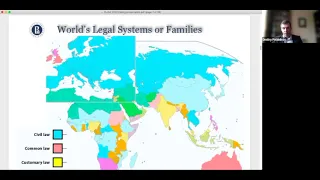
how easy is it to dismiss employees when they said that up the international labor organization complained at some point and said look you're actually giving High values to the breach of international labor law and the economists say like this of course because that's what we measure we Measure just how easy things are so that's but the method is they try to measure how well legal systems function um on a map like this so this is the map of the legal Origins project and you can see the entire world is colonized the entire world consists of
English lower French law some German law China is German law for example some Scandinavian law some socialist law little pockets so it's really the a 19th century dream more there's more Colonization than there was in the 19th century right even China is and Japan are actually Germany in this context but because the focus is on the colonial Origins here and not on the current law filled independently what is then done in this measurement is that the countries were ranked according to how well they did in terms of doing business and you can see here the
ranking some things are not so surprising so New Zealand Singapore Denmark at the very top there might not be some surprising Eritrea in Somalia at the very bottom that also might not be so surprising for the ability of doing business but you can see that this is not intrinsically um correlated with with wealth so Georgia does extremely well which is a little suspicious because one of the economists and the project joined the Georgian government but the other one I Want to focus on is Rwanda at 29 so Rwanda is ranked here higher than Spain higher
than France higher than Portugal so you can see a clear desire or a clear result that does not merely prioritize European over non-european countries in that sense seems not to replicate the internal hierarchy of 19th century colonialism in which Europe is at the top of development and others are catching up Rwanda has surpassed France which Created considerable complaints in in France how realistic is such a list that is how how much would you really think that you'd rather set up your business in Rwanda than France it depends of course on many things but for many
purposes you would go to France and not to ruin that so this measures something hypothetical to some extent it also measures in the case of Rwanda the fact that the Iranian government for some Years took these measurements so seriously that they directly engineered their laws so as to fit the indicators of the project very much like law schools administer their admissions precisely to match the US World and news report the one that did some of that you can see on the left on among the improvers the top 10 the top improver in 2018 was Afghanistan
and as you know that was not Sustainable in the list so what this measures is not so fully clear uh in that sense it tries to overcome a north-south dichotomy but what it replicates thereby and that's the even stronger thing is it rewards not being part of the north but it rewards adopting rationalities and laws in the way in which the global North emphasizes that so if you look back to what is being measured here um how fast can you start a business how Fast can you register property how fast can you get rid of
your of your workers this is a inbuilt northern capitalist rationality translated into an objective measurement of what makes good or bad laws that is the economists would say we're not seeing good or bad we're just saying what complies specifically with these requirements it's not normative in the way in which economists tell us that they're not normative and of course the normativity is built into this into this Very rationality um and why does this then break down because of uh manipulations the first manipulation that I have here is there you can see how the project um
was biased against the socialist government in Chile the socialist government did significantly bad that in concert worse than conservative than the conservative presidency even though the measures that the values were the same because indicators were changed the what Broke the project was the China manipulation China was very unhappy but not rising in the rankings but instead falling and the risk was that they would drop again in 2017 and China threatened to withdraw funding of the World Bank if they dropped in the rankings and so a lot of discussion was made about what can we do
about that first they say we incorporate Hong Kong and Taiwan and people said that is somewhat Problematic from a public International perspective so then they said let's just focus on the most important economic cities let's just focus on Beijing and Shanghai and then someone said we'd have to do that for all the countries and we have no idea what comes out of that and so they just then cook the indicators and said how do we reverse engineer the results so to make sure that China doesn't drop in the rankings by valuing some things very highly
that China does well in and others less so that China doesn't do so well and then the rankings will stop and the project is now uh stored and the attempt is made to have a better measurement that can't be manipulated so easily and maybe also to under underestimate under emphasize the rankings although the rankings were what made this so successful rankings are what people love as you Know rankings is what law students love when they have to pick a law school rankings is which journalists love when they find these results but remains to be seen
what comes of that What are problems of this project some um should be immediately visible one is the priority polarization of formalized law over other forms of social ordering that is what is being measured here are formalized legal processes The way in which I register a corporation that is I have to go through the formal steps of registering a cooperation whereas informal businesses are not measured in this context in a very legal Origins what gets transplanted there we have a legal transfer were largely formal rules and institutions and it's not the specific ways in which
normativity is created the specific ways in which society organizes itself so we have here classical Shortcoming of comparative law made even stronger by The Economist that is the focus on formal rules over actual processes in fact early early versions of the project looked at legal rules and thought that legal rules themselves have impacts in society only later it'll be cling clear that institutions mattered as well but Society was not really assessed in this project second problem here methodological Nationalism that is the focus is largely on Nations on States how easy it is it to do
business in China to use that recent example but China is not China obviously that is doing business at different places in China has tremendous differences huge difference is much bigger than the differences between the median of China and the median of some other country so we have here a problem that also emerges from comparative law where we compare French Law to English law or Egyptian law to Iraqi law that is we focus on Nations as our objects of study and compare those there's a second shortcoming related with that is an assumed homogeneity within legal traditions
and systems I guess we assume the entirety of um Rwanda to be homogeneous and that means we overestimate official over unofficial law majorities over minorities Um cities over Countryside Etc so those are three uh critiques that can fit also in a traditional critique of comparative law the fourth then is the one where some ecolonial approach is entered and not as the implied superiority year of the global North what we have here is not as I said a superiority of Northern laws or States over Southern laws or state but um More perfidious if you want a
superiority of Northern epistemologies over Southern epistemologies about Northern ways of doing law over Southern ways of doing your own it is to the extent that uh countries in the global South adopt buy into these rationalities they can arise higher in the rankings to the extent that they reject them they will not rise higher in the rankings so we have here one classical uh move of coloniality that is the universalization Of contingent and specific ways of doing law the second is here the idea of separation that is we separate out from each other these individual legal
systems these individual countries and what the project proposes is the transfer of successful solutions from one system to another what that means is it separates donor and recipient country does so in the colonial context it says that laws Are made in the colonizing country they're made in England and then they are transferred to a separate recipient that is the former colony and they recommend the same process for law reform today to say look at the successful law reforms that Rwanda has made and transfer those to your system in Guatemala or wherever you want to make
more info and so this is not only methodological Nationalism it also translates into a separation between legal systems all of which are in reality of course connected within a global capitalism that is the trans that is colonial laws already were made against the background of the colonies there is a as we know a backspell if you want from the colonial Endeavor back to the Metropolis France England Etc these transplants here can only be Viewed as separate if we focus only on legal rules that is we take the legal rules of Rwandan law and transfer those
to Guatemala that's a clear transfer otherwise the way we understand the diffusion of laws and legal ideas is a much more much more complex process one much better explained through Concepts like entanglement and the likes and actual transfers between separate uh um entities and then the third problem is here in exoticization or Normalization of the global self exoticization as saying this is other than Europe normalization is saying this is the same as Europe and this is perhaps the most um challenging most problematic challenge for comparative law because it goes to the or of the problem
of comparison because if comparison is putting things in perspective and in in relation and understanding the the other through The self then intrinsic in that is always a certain hierarchy if I if I sit in in Germany and I say I'm now comparing Chinese law to German law to my own law I'm immediately making in some way German law the yardstick against which I evaluate China the yardstick not in the sense that I say German law is necessarily the Best law Chinese law could never be better because the less German it would be the less
good it would be that's not what happens Chinese law may very well appear Superior from that perspective but what I'm doing is epistemologically I'm defining China I'm understanding China in its relation to Germany where they typically don't do the same I don't understand Germany in the view of China maybe from the perspective of China I would do that although power Imbalances mean that there's less that that this kind of colonial gaze happens also in um outside of the global North but certainly from my perspective in Hamburg or from the perspective of Chicago or from the
perspective of the World Bank in Washington that's what happens that is the Global Soft is understood through the lens against the perspective of the global North and it's that process in particular the Challenges I think the project of traditional comparative law but also of decolonial comparative law so the last thought that I want to leave you with here I jump over all of this as I said um and also about the responses uh I want to suggest this because there is a critique drawing very much on that last point but also on the colonial Origins
that I mentioned earlier against comparison more generally It is the suggestion that comparison as a concrete project concrete intellectual project is about dominating and hierarchy hierarchism it's about hierarchies traditionally it's about a certain development from earlier stages to better stages something that we see in the 19th century in colonization something that we see in the doing business which suggests that the poor economies May improve and thereby come up to the Higher economies and in that sense it's about a development through certain stages and it's about hierarchizing but having those at the top that are successful
in those at the bottom uh that are not so those are problems two problems of comparison the third is essentialization of object that is we compare China to Japan as though those were separate objects despite the centuries-long mutual interactions that existed between China and Japan to use that just one that one exam and so some critique of comparative law suggests that we should give up comparison altogether you should replace comparative law with something uh different in the same way in which we can see that comparative history has made place for to world history a comparative
literature uh has been in crisis it has become something else The comparative law should be should be replaced with something else altogether in order to account for the demands of the coloniality one possibility would be transnational law one would be a focus on legal pluralism one would indeed be a focus on world law and one would be a focus on entanglement we see all of those moves in the discipline and so to some extent to come out and say I want to defend comparative law may seem anachronistic we think Lena And either comparison is Central
you think that comparison is Central to a proper understanding of the coloniality of law not in the sense that objects have to be viewed as essentially separate but in the sense that the self-understanding of law has been precisely that that is the way in which law looks at itself Global law looks at itself is through conceptualizing European law as Something different from Latin American and so it is in that sense the self-understanding of law that it creates these very relations of comparison and rather than denying the fact that this is being constructed within the discipline
we think that it has to be um highlighted but this becomes is comparison not as mere juxtaposition or is finding similarities and differences it's a broader concept of comparison but I can call here comparison as relationality but it's important to understand law we think as something that does not transcend these separations but operationalize them and makes them fruitful I'll stop there because I've spoken longer than I promised I would or I didn't promise um but longer than I should have and instead welcome questions and discussions not only on the Methodological field in general but also
on the specific case study or really on anything else that interests you from your own particular research oh great uh thank you so much for this I think correct thought provoking uh presentation um we have entered the Q a session we have an international student audience I'm sure you have a lot of questions um again the event will be recorded uploaded to YouTube so you can either Raise your hand or you can write them down in the in the chat box if you prefer that and then I will read your questions out to you um
I will insert myself at the Queue at one point also but we start with sign up thank you Daniel and uh thank you so much Professor uh for for the uh for the session um very nice to see another uh former Duke professor as I went to Duke uh for my for my masters Um I have a lot of a lot of questions um but I'm going to start with one and specifically to prepare uh for your Talk I Read um your paper that you co-authored um so um and in your presentation I I can
see that um so an important account I think for in in the colonial comparative law scholarship is about um replacing um homogeneity with priority that that That concept that I saw mentioned um in your in your paper and uh specifically you provided um a kind of in an example there on international law um and you discussed the concept of Ubuntu and you're stressed about the fact that you're not trying to replace something from the global South as someone who came from Taiwan we're not trying to replace something and then as adding it Um but then
uh but then my question lies on that on that lane on on is there any instance um where actually something Universal actually has to be reached and of course in the context of international law um there's the the issue of death penalty um gay marriage and for instance in Taiwan we passed the gay marriage law a few years ago and that's because we Recognize that as a human right but and and the concept of marriage it's itself inherently European Centric and the concept of marriage itself in Taiwan I think has a very different meaning but
then we use that as a way to incorporate and legalize gay marriage so that's like one example so I was wondering like whether um like how would um how would the colonial comparative law kind of address this tension Um there or if there's no tension and how we should correctly apply that um maybe in the international kind of law um area there yeah thanks for the question good question of course I I want the project to stay away a little from international law because we have approaches to decolonization and international law already that I would
not want to Interfere with [Music] um I think you gave some of the answer yourself right because on the one hand you say this is a universal human right but then on the other hand you say so much of that is contingent that is marriage as such is not um it does not mean the same um everywhere what we find I think in Approaches to difference is two approaches that are equally unsatisfying and the one is universalization and the other is relatively universalization suggests that on some level everything has to be of be the same
um and the the critique of that I think is is is is is fairly well known that is we can Demand kind of gay marriage everywhere but it means very different things in very different contexts we have a recent study here at the Max Planck Institute on the global ban on child marriage and on an abstract level everyone always agrees that child marriage is bad but when you look at the specifics of that and the specifics of the plan you see are contingent that actually becomes just as one example in Societies in Which marriage is
effectively uh the shorthand as uh the justification of sexual intercourse then in that sense we have child marriage of course in um American high schools right because it is legitimate on some level for 15 year old 16 year olds who have sex and so the comparison there already Compares different things so universalism is problematic uh more of relative isn't that's often the critique Of course of of these kinds of approaches is also a problem it is the suggestion to say that because Western values should not be universalized really every society should um live by its
own values have its own laws and um the problems of that are obvious as well one those laws may also be unjust even though they're not European not everything non-european is great second this does not account for Internal frictions and struggles within other societies remember the Asian you don't remember but you know of the Asian values discussion in the 1980s 1990s where it was said that Asians just have different values they don't cherish democracy and rights so much and it turned out that especially um heads of state in Asia did not like democracy and rights
so much so relativism is also not the way both of those are ways of not accounting for Relations right so universalism uh doesn't account for diff for difference relativism doesn't accounts for difference but does not create relations between the different entities and the colonial comparative law would have to put these things in relation so the comparison as such is what puts these things in relation and I think that's where we Things become promising so gay marriage in Taiwan is a mix between Uh a global theme that is the global movement towards gay marriage not just
as an idea but something actually pushed forward by transnational ngos and local groups and local values and local contingencies Etc and so the way in which gay marriage is introduced into Taiwan is by bringing these together and then intrinsically I would suggest um comparative process the process is comparative in the sense That it Compares that which is the model I say model here in to the extent that this is modeled on developments in in other countries Compares that with conditions in Taiwan and uses that uses that fruitfully so the problem I think in some human
rights discussions is that this what Sally Mary has called the vernacularization of Human Rights it somehow makes them less pure because for some time the idea in human rights in the 90s in particular Was that human rights are somehow Universal abstract at the top and then yes they have to be translated down to the local context by that translation is a deterior area deterior rates them um human rights no longer thinks that or at least the more Progressive human rights Scholars no longer think that the colonial comparative law certainly would not think that you could
only a Comparative law certainly would think that the universalized standard that exists at some level of abstraction is neither here nor there it's not very useful for anything and if it is directly imposed it becomes um in a tool of of colonial oppression whereas the actual translation process the adoption process as such as an explicitly comparative process is the one that makes these things useful and possibly promising Other of course gay marriage is something that we're all in in favor of anti-sodomy laws have a similar transnational history right where a global standard a a Conservative
Christian standard it's translated into local contexts Uganda um India Etc and um so there's nothing intrinsically good about this process but it's the I think we think both an Observation of what actually happens and a promise of how things can be done and how things can be improved um Vanessa thank you Daniel and thank you requester for uh your very nice presentation today um so I'm going to give you a little bit of context of myself because the question really points out a future project that I have for my research agenda on um the colonial
comparative law or legal Institutions and corporate law and uh so I'm a jsd candidate I'm finishing my program and I'm joining the European University Institute I was trained in Italy but I'm Peruvian so it's a kind of complex context and uh part of the things that you uh presented today such as they're doing business record which was extremely successful because I think it was the first report that actually trying to measure Something and they were not really answering a question in comparative law but it was much more on deregulation so uh the problem that it
had is that it touches upon um comparative law because you are basically not doing comparative law so it was not informed it was a question that was not informing comparative law and actually comparativists didn't have um Probably the elements to do a rebuttal at the time so we joined later in time to uh propose an empirical examination of the same legal institutions but without a comparative framework and uh so my my point is that when you explain about this product and I think that it's really a very encouraging project in terms of the scope of
the project because we really start to sing in making advances in the field of comparative law now my question is that When you are explaining that comparison is not fading away my question is who's making the comparison because if the comparison comes from an European trained person then it's going to affect actually the comparison itself right I'm not sure if it can change something or it can change that much because the observation The Benchmark that we are doing it's also arriving from an European perspective So um what happens especially in different countries such as Peru
or other Latin American countries is that there is one type of law which is much more similar to European law which is the one that it's a legacy from uh colonialism and other layers of law which are less visible because it's much more they pertain to small communities to Indian regions where they have their tribunals Now there is communitarian law within the Indian region so how are we gonna um level up with that uh sort of problem that exists because I think that the Benchmark still is European law yes good that's I guess it's more
than one question almost let me try to um disentangle if I can so I would think that doing business project is explicitly comparative the ranking is exclusively comparative You might say it's not comparative law it is a comparison deregulation levels of deregulation and not law which I would respond that what it Compares is deregulation through law or impacts of law on regulation on deregulation and so in that sense I would say it is comparative law it's bad comparative law and so people have said to me well yes that's a bad case study because this is
bad comparative law and there could be good comparative law and As you rightly say there have been proposals made by comparative lawyers one group out of Oxford to have better ways of measuring or to have better ways of empirically measuring laws Etc and I would say the critique from the equilibrium comparative law is a more fundamental one that says all of this kind of measuring against one yardstick all of this kind of ranking is intrinsically problematic because it buys into a logic of hierarchies of Different stages of development and so in that sense I would
say that the critique of the doing business report can be translated into a critique also of those more modest attempts to um to improve that now one important point that you make in that is that of the perspective you say it's a perspective if a European does it and of course you yourself I've just described yourself as someone with a complex identity that's imparting With cleaning and part none and so we think at least Lena and I the question is less one of actual uh representation that is I am European or you and you are
not um but it is certainly against uh kind of the standpoint to the extent that we come from and represent certain um epistemology epistemological takes on our issue that is to the extent that we are European trained we tend to Replicate European uh methodologies and to the extent that you are European trained in Italy or even in Peru you do the same and the political economic and epistemological superiority greater strength of the global North over the global South has always meant that those kinds of epistemological takes are replicated within the global cell This Global Southern
many Global Southern use replicate those from the global North and especially those that are then trained in global Northern places or that are supported of course of a global Northern um scientific Community tend to be those within that so that's very hard to overcome that's a general problem of hierarchies there one response from the colonial comparative Law would be to move away from universalized objective standards towards comparison as relation that is a relation in that case say between Peru Peruvian perspective and an Italian perspective and to view that as a relation with two ends that
is we have rather than some perspective that transcends those two we have an Italian perspective on Peru and we have a Peruvian perspective on Italy and we have an Italian perspective on The comparison between Peru and Italy and a Peruvian perspective on that comparison and a perspective on that very process of comparison and a perspective on the other etc etc so to try to overcome the problem of universalizing a neutral standpoint would be to focus on the fact that both of those standpoints are contingent upon the other and the second would be an attempt and
that's harder to do to overcome this Epistemological hierarchy between one and India that the sense that the European epistemology is going to be so much stronger than the Peruvian one especially if you focus on the um um in different perspective somewhere in Peru rather than the official state perspective that's much harder to do and our hope is that the pros the project of the colonial comparative law creates this sufficient openness the sufficient Um awareness of that the sufficient uh um ability to to to defer and to the link but I'm not yet sure how successful
that can be because none of that really can overcome the effective power imbalances that exist so simple example we have a call for papers for our conferences and we get high quality papers from the likes of you who are in American law school we get low quality papers according to All traditional criteria of what makes good scholarship from the global sub why lack of training lack of access to materials or simply different ways of doing research of of doing this done that's just very hard that's just very hard to overcome we try to integrate those
voices because they are important and we realized that the voices become more silent in the discussions than the global Northern voices because the global Northern voices are used to speak And they know each other etc etc so those are things that I think need to be overcome through through openness and through practice but I'm not yet sure how effectively but for those of you who apply to come to Brasilia you can help work that out I realized I didn't make the pitch sufficiently I should make that again the the call for papers is on our
website on the Max Planck Institute website Um yeah thank you so unfortunately we have run out of time uh with just on the one hand I apologize no that's fine uh I work on the relevance of positionality and perspective to the comparative method so your last answer gave me so many more follow-up questions but um on the other thing that's a good thing because it meant we had a great presentation and discussion um before I let your go I would kindly ask you if possible to turn on your Camera so we can take a picture
for our social media I think Simon will do that thank you Daniel uh can you all please uh turn on your camera and I'll take a picture uh for all of as well Professor Michael share the link in the chat all right um I'm gonna take a picture uh one two three let's do another one um one two three okay thank you thank you very much Great thanks so we uh by the way we also I think shared already the uh the code for paper through um our our attendance so I hope you get a
lot of good uh good quality um um um people applying um so thank you again everyone for attending thank you so much for the talk um our next session will be in three weeks on September 19th we will host Professor Adam Seitz who will speak on mechanical response today and teachings on the relations of science law and life again was very nice to see you today um thank you so much and I look forward to seeing you all um doing our next event thank you thank you very much bye-bye thank you bye