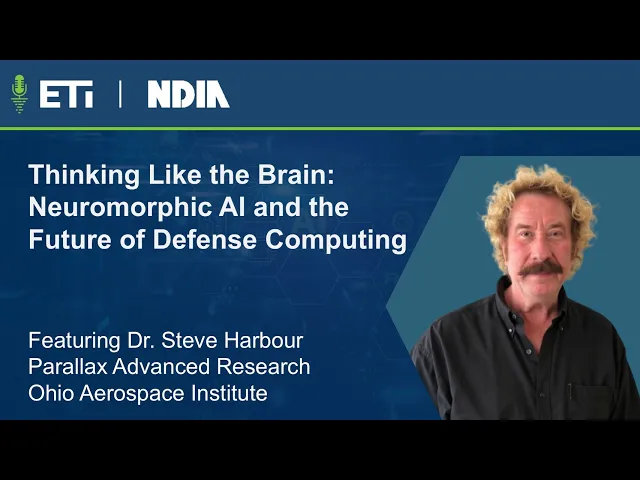
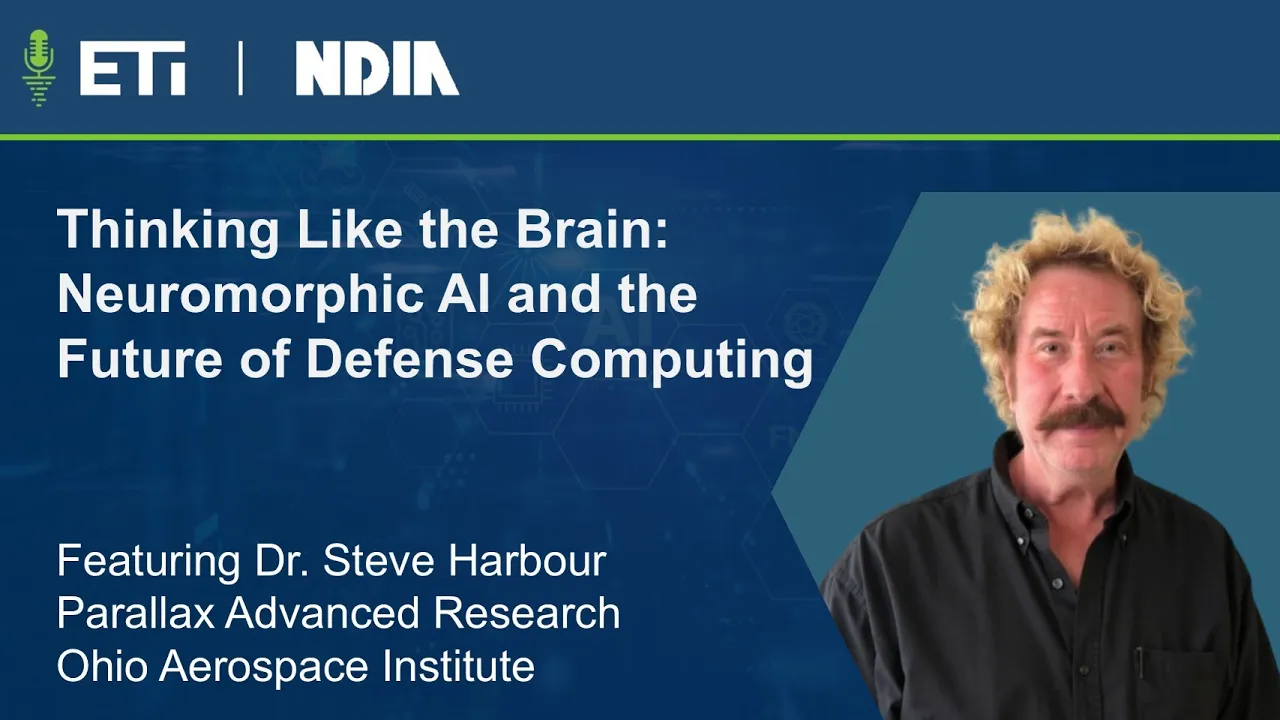
[Music] Hello and welcome to the Emerging Tech Horizons podcast. I'm Arun Sarafin, executive director of NDIA's Emerging Technologies Institute. On today's episode, I'm joined by Dr Steve Harbor of Parallax Advanced Research and the Ohio Aerospace Institute.
and we're going to explore the promise of neuromorphic artificial intelligence. Dr Harbor is the director of the AI hardware research center of excellence at Parallax Advanced Research. Building on Parallax's work in advanced micro electronics and neural networks, Dr Harbor is going to tell us about how brain inspired computing is driving breakthroughs in national defense capabilities, including for things like drone operations, enhanced information processing, and electronic warfare.
Dr Dr Harbor. Steve, welcome to today's podcast. >> Well, thank you.
Appreciate it so much uh being part of this podcast today. Um and uh certainly I go by Steve and to let everyone know a little bit about my background. Um I started out um in the United States Air Force as a pilot.
uh flew a variety of aircraft such as F-16s, B-52s and EC135s. I was stationed at Edwards Air Force Base uh doing test flights and absolutely loved it and love serving my country as well. My academic background involves a bachelor of science degree in electrical engineering and robotics um along with mathematics.
My master's degree is in aerospace engineering and artificial intelligence and machine learning. And then the PhD seems a little bit odd, but that's in neuroscience and as you'll see uh neuromorphics and neuroscience engineering all mixed together. So it makes a whole lot of sense.
Uh I have uh been working for parallax for quite some time and I love doing research and this is pretty much a a breakthrough in computing both from a hardware and software perspective um and it uh breaks the mold from traditional vanoyman architectures that we've had since uh a very long time um since the 70s um and 80s for sure. It's time for a change. Thanks for having me on your program.
Oh, this is great. And so for those of us who don't know a lot about Parallax, can you tell us a little bit about the company? >> Absolutely.
So Parallax is a nonprofit research organization that does research in um areas uh that involve uh fundamental basic research like universities uh but then also applied research which is a more mature level of discoveries and then all the way up through um production. if you will. So, uh we go all the way through that valley of death where things are can usually die or or or blossom.
And so, uh we we dwell in that area and we're involved in artificial intelligence quite heavily, but then also we're involved in hypersonic flight. We're involved in human factors. So, a whole lot of other areas as well.
And uh we've been around I guess for four years so far. And so we're we're like a high-tech startup, yet we're not forprofit. We're a nonprofit research uh institution.
>> And Parallax has been a great partner to NDIA and ETI in the past, including co-hosting a great webinar on how to be a a technology apostle uh just in the over the last uh last few months, as well as participating in uh in our conference for example. So okay, let's get to the conversation now. For those of us who don't know, can you explain what is neuromorphic artificial intelligence?
People are broadly familiar with artificial intelligence these days and what's your spin on it. >> Sure, absolutely. Let me start by talking about uh neuromorphic computing first and then I'll uh bleed over to uh what's neuromorphic artificial intelligence.
Um so uh neuromorphic computing uh we model it after the brain. Um it's bio inpired uh unconventional computing not how it's traditionally done today. Um it can be implemented in software um andor hardware for that matter.
Here's the big picture. The human brain performs the equivalent of 700 pedlops of computation on just 20 watts of power. uh about the power of a light average light bulb.
Uh by contrast, a modern GPU data center burns megawws to get a fraction of that efficiency. And so neuromorphic computing is based in work by sending spikes of information the way neurons fire instead of crunching numbers sequentially like traditional computing. uh this makes um uh the system orders of magnitude more efficient than vanoyoman GPUs and CPUs.
We can run neuromorphic software on those processors and that does help with efficiency but to get the most efficiency uh you want to use a uh neuromorphic processor and we'll talk more about that as the discussion goes on. um to talk more into artificial intelligence. You take that kind of computing um and then you go to AI with it and it's similar to traditional AI.
You first have to train the network um and then once it's trained appropriately you then have to employ that network uh lock it down and implement it for inferencing. Uh that can be prediction that can be classification things of that nature. uh compared to other AI like deep learning systems um they're certainly powerful but they can be brittle and they're most certainly energy hungry.
Uh neuromorphic AI brings adaptability sparse coding and low latency decisionmaking. It's AI that thinks more like us. So when you think about the hardware side of this and you get down to the processors, you're not describing a completely new kind of processing, you know, a whole new set of different kinds of micro electronics or boundaries.
You're just talking about a different kind of circuit. >> That's right. >> Right.
Different kind of design which you could use using our standard lithographic systems and semiconductor foundaries. You just produce something which I would crudely call a neuromorphic chip, >> right? >> Which then could be used in one of these systems.
Am I do I have that right? >> You've absolutely got that totally correct. Yes.
>> Yes, indeed. >> So when you discussing this, you were talking about it kind of modeled after systems in nature, basically the human brain, >> right? >> Makes me think of all the work we've done over the years in biomimetics, >> right?
things like how lizards climb walls and how birds flap their wings. So what inspires the development of neuromorphic systems along the lines of why model AI after a brain? >> Right.
Right. Right. Um well uh you know uh that's an extremely good question and well thought of u you know uh we turn to the brain because it is the most energyefficient and adaptive system in existence that we're aware of.
Um it collate colllocates memory and computation in the same uh location as opposed to off off the processor. uh it learns on the fly and thrives in uncertain environments. Uh standard computing um um traditional CPUs, DPUs are think of them as calculators, number crunchers and they tend to do a lot of operations needlessly that they don't need to do a lot of matrix algebra, linear linear algebra uh that just doesn't need to happen and we don't do that in our brain.
uh the brain is an adaptive reasoning engine and so if we can model that on even existing chips and that's what we're doing best we can uh we get all kind of efficiencies more adaptability and more resilience uh and I've said publicly before that when it comes to the human machine learning and AI uh neuromorphic computing makes the matchup between humans and computers not only easier but more intuitive. uh that's why we model the brain. >> You mentioned the power of a brain and the low power consumption of a brain.
Is the brain still more powerful than the biggest supercomput we have sitting at Los Alamos or San Die somewhere? >> Uh, actually yes. when it comes to uh you know reasoning and and decision making um with with the most assured uh you know um response that is going to obtain at the end of the day uh you know a result that is of highest accuracy.
Yes, the human brain's better at it and and the human brain uh flop equivalence is is higher uh than the most powerful computer um and system and uses a heck of a lot less energy. So, so just imagine if we can model the data center like the human brain uh the the energy savings that if you will that we'll be able to obtain. So absolutely uh the you know bioinspired computing if you will the human brain is absolutely the most efficient more more uh more so than the biggest baddest supercomput.
So now when I think about the applications in the military sense in the in the defense sense what in your mind are the key advantages for neuromorphic hardware over these conventional computing systems even supercomputing systems right so the the AI community started by using traditional CPUs and now many maybe largely have moved over to graphics processing units GPUs, right, which arguably weren't created for the purpose of AI, but have been now used by the by the AI sector. But you're arguing you've got advantages over both. So, if I put on my Pentagon hat, what are those advantages?
>> Very good. Another very good question, by the way, and um it's one that that needs to be asked and answered. Um so, for example, let's talk about a neuromorphic chip.
Now, there's a couple of different ways to do a neuromorphic chip. Uh, you can do it in the traditional digital sense with a neuromorphic mesh overlay. So you're still like you said, you know, sort of in the closer to a traditional CPU GPU realm, if you will, other than the fact that you're moving that compute and memory over to the processor, um, if you will, and and training on an actual neuromorphic chip, and this is rather new, if you will, but training on a neuromorphic chip is actually two times faster on average than training on a GPU.
CPU. Um, and so training on a neuromorphic chip is a relatively new breakthrough. Um, and we have found that you can do it with 60% fewer epics, if you will.
And so that's >> what's an epic. An epic is one uh training cycle, one iteration when you do machine learning and going all the way through the loop, if you will, all through the code and training up uh and getting closer to a weighted equation that is more accurate, if you will, and you have to do that in iterations and reduce loss and reduce error to an acceptable level. Um, and if you can do that in fewer epics, you save a whole lot of power consumption and energy, if you will.
Um, and so if we can do that faster with fewer epics on an airorphic processor, um, that's that's a cost savings. That's a cost savings to, uh, the, you know, the defense of our country. Um, inference.
Now, let's do inference. And that is determining what is out there. So the whole idea about artificial intelligence is to be able to predict the future, if you will, to infer what that image is, what that threat is.
And if you can do it three times faster than a GPU, which you can on a neuromorphic processor, uh, with neuromorphic software, you can do it three times faster. Uh, then that means you can outsmart, outwit your opponent quicker than they can. It's it's like um having a dog fight between an F-35 and a um F4.
Um you know, if you're much faster, you can outmaneuver. And so that's what you get with neuromorphic uh computing processing, if you will, accuracy. Okay.
So um we have found that when you do the right combination of spiking neural networks um it's a um a way of doing neuromorphic computing with spikes as we have touched on lightly. You can mix that with a spiked version of a convolutional neural network which is more traditional can be heavy compute but you can do it we've recently discovered in a spiking fashion and when you do that you can get up to 10 percentage points higher accuracy which is huge right which is huge uh the example data set we used for that was a CR 100 um because you're mixing the um you know feature extraction um um excellence of a CNN with the spatial temporal excellence of an SNN and you're getting the efficiencies of the SNN with the accuracies of the CNN and the right combination and you improve accuracy and efficiency and you reduce power consumption. It's magnificent and we're able to do that.
>> Could you take a step back and sure help us understand CNN and SNN? >> Absolutely. So a a CNN think of it as uh let's talk about inferential statistics.
Let's start there. Um so inferential statistics uh we're all uh learn statistics in school. First you have descriptive statistics and what happened in the system and it tends to be very rather historical and then you get to inferial statistics which makes predictions or makes inferences of what's going to happen in the future based on historical data.
Well, uh, machine learning's a kind of a that that's a segue to machine learning. Well, let's go to to to to with say an artificial neural network. Let's go to a CNN which is based on that.
But a CNN back propagates. So it does forward propagation with the information with the data as it trains on the data and it randomly initially changes the weights or changes the um weights of the attributes of the system to find the most efficient answer, the least amount of error. And so it does that going forward.
But then we do a back propagation and we add basically uh first order uh differential equations if you will derivatives going backwards looking for basically that global minima where the the the slope is zero where you're getting at to a you're getting to a minimum in error in the system and you do that in an iterate inter iter inter uh operation over and over again until you get the best accuracy, the least amount of loss. Um I I apologize. I didn't mean to get into differential equation speak, but I I it was kind of unavoidable at that moment.
But any rate, that's what a CNN is. Now uh I'll briefly tap on you can overtrain and then you train on that data set and it gets real good on that but then the system will not generalize to the real world very well. So you want to train with just the right combination of of of data and and and except uh you're going to have a little error and you have to do that and that's somewhat of a craft if you will.
But when you can do this with a spike in neural network and it it it takes sparse data. So much like the human, right? We we don't have to figure out the environment by um taking a thousand looks at the environment.
Here's a perfect example. Um if you show me a few pictures of what a what a coyote is pretty much humans know what what you know dogs are, standard domesticated dogs pretty much. And if you show me a few pictures of a coyote with my mind, my brain, I can recognize coyotes pretty accurately from then on.
Traditional machine learning or CNN's I have to show it thousands of pictures of coyotes for it to learn that with any hope of accuracy. I'm much more efficient than it is. But if I can do an artificial network that thinks like the human that can do it in a spiking neural network fashion like neurons in our mind then I only need a a small sample I only need some sparse information and I'll put it together.
So with this artificial network if I have orchestrated it to be like the human using spiking neural networks which is how our neurons communicate and that's why it's so much more efficient than a CN. And the primitive examples of that you're describing systems that can learn one more power efficiently but more almost intuitively right more quickly in the same way a human can. And I guess this then allows you to avoid some of the early generation AI traps like kids fooling cars by holding up t-shirts with stop signs on them.
>> Right. Right. >> Right.
because the systems weren't good at context >> and weren't good at quickly learning. And you're describing systems that would be better at those kinds of things. >> That's exactly right.
It's not it's not as brittle as traditional machine learning that you're right that can be fooled much e much easier. So a system that uses neuromorphic computing uh neuromorphic technology um is more adaptive to those type of perturbations. Um, yes, it's more robust.
Absolutely right. >> When I think about military defense applications, what are the mission sets that you think most lend themselves to that style of more energyefficient and I'm going to keep saying it, intuitive, faster learning. So certainly uh we are finding uh on the edge um um systems that operate on the edge and need lightweight um you know GPUs uh a 4090 I know is now being superseded by if it's a laptop 5060 etc.
Those are the if you want a 4090 GPU, um the whole system which it comes with the cooling fan is the size of a banana. Um and it's rather heavy. Um that's just not going to cut it on a small drone.
Um you're gonna and and if you use the cloud, you're now you're exposing yourself to RF going back and forth, right? that can be perceived by an opponent. And so you're on the edge definitely out there.
You want something lightweight. You still want to have that powerful computing capability. And you can get that with a neuromorphic processor, neuromorphic computing.
Um on the edge, very fast, orders of, you know, three to four orders of magnitude less power consumed. um less heat is generated, less cooling required and very adaptive and robust. And you get that with the neuromorphic system for drones, for electronic warfare, um things of that nature.
>> Unattended ground sensors, right? >> Unattended ground sensors. So, they could be very passive.
And since they're neuromorphic, they're pretty much idle. So like the human brain, if nothing's going on in the scene, I'm not going to process. Whereas, you know, a GPU or CPU system is constantly clocked, right, at a constant rate.
Well, um, a neuromorphic processor is not clocked. It doesn't have to be clocked. You can clock it, but you don't have to clock it.
The event itself clocks the system and so it doesn't get in the game until an event happens and then it gets in the game. So you can be very passive, very hidden and imperceptible and then when something's going on well the event started, it's time to get in the game. It gets in the game semiopically.
Um and so it's amazing and we found that with neuromorphic cameras as well. Um and that goes for space operations. Um, we've done a lot of research recently in Martian flight.
There's no GPS system around Mars. So, how are you going to navigate? How are you going to figure out your velocity?
Well, we've discovered a way to do that neuromorphically and this is funded by NASA and the Ohio Space Grant Consortium together. And we did that research and very successfully using a neuromorphic camera and neuromorphics were a in computing we're able to predict um uh with extreme good accuracy uh what the three-dimensional velocity is of that self-contained flying drone on Mars which is you're going to have to have that with these flying machines around around Mars in order to not have mishaps and crashes and things of that nature. And you need lightweight durability, right?
And you get that with a neuromorphic system. >> How mature is the technology, you know, on a TRL scale? Can I go to Costco and buy a a a laptop with a neuromorphic processor on it yet or Best Buy or is it is it something that I see at someone's lab bench and it's all sort of wired up right now and they're promising me it in five years?
>> I I gotcha. So um it has it's in a a stage um that I think we are beyond just a lab curiosity. So I think we've gotten beyond that.
um you know uh for example Intel's Halo point Halo point um which I think is at Sandia Labs is approaching you know it's getting it's working towards pedlops or pedops if you will 20 pops with 15 tops uh per watt efficiency and um and so Intel uh Lohei uh one and two and I work with both those both those processors There's quite a bit is um um you know it's rather labby and um it's um that part is but it's starting to show itself as more applied. is starting to show that um uh brain chip Aikita uh probably has uh if not the first commercialized neuromorphic processor, it's among the first commercialized and you can buy that today. Um and then you get support with it.
Uh again, it's a digitalbased neuromorph processor with a neuromorphic mesh if you will. uh full-blown neuromorphics will will involve something that's very analog like okay like like the mind and we're devel and we're working on that I'm in fact I'm heavily involved in a specific um um program right now doing that so uh but yeah so it's in that stage where it's you know it's not just a lab curiosity project anymore uh but you can't go to Costco you can't you know uh you know we don't have radio shacks anymore but you if we did you couldn't go to RadioShack and buy these Right. So, um you know, but we're we're crossing that that uh that that Rubicon River, if you will, and and it's, you know, it's getting more more commercial, >> but I can buy it as a piece of research equipment today.
You're saying >> that's absolutely right. Absolutely right. Yes.
Yes, you can. >> So, uh there's still a lot of research going on here. So, who who are the big players?
You've mentioned some national labs. Are there industry players and academic players as well? >> Sure, absolutely.
So, of course, Parallax, we're we're heavily involved. Um, and uh, Intel uh, Neuromorphic Labs, Mike Davies is the director for this uh, project out there. Uh, Brain Chip, uh, Akita uh, Brain Ship's involved.
Uh, IBM, IBM is involved as well. they have the true north processor uh out um and so uh there's some big players right there uh ac let's talk about academia for a moment so MIT is involved uh University of California and the various locations are involved Berkeley for example um San Diego um Rochester Institute of Technology Penn State University of Dayton right here in our backyard in Dayton Ohio Carnegie Melon uh Zurich Technical Institute and and Manchester are heavily involved. Uh of course we can't forget AFL uh DARPA and the national labs as well are involved in in this research.
So um you know we've been bridging with various defense labs ourselves. uh we have partnerships at parallax with academia and industry on this and so we're trying to get this uh to uh the war fighter as rapidly as possible. >> Do any of the systems integrators like the locked boeings and palunteers are do you see efforts at at that level as well?
I am starting to see some efforts uh with uh the traditional OEMs and and primes uh Rathon comes to mind um and you know Loheed Martin um and I believe Boeing to a degree uh so yeah they they're beginning to take interest in this as well. Yes. >> And how are we doing relative to the Chinese?
So uh it's a race uh you know I mean and you know uh second place is not acceptable uh and we we are in a tight race with China. I think from a hardware perspective uh we're ahead uh from a hardware perspective um I I think that uh there's some significant areas that we are ahead on over China and neuromorphics. I know they're working on some stuff to um start uh they're trying to get more research towards building a uh perform more research in the area of building something that's more equivalent to a monkeykey's brain, if you will.
Uh they're working on that. Um and from a software perspective, uh the race is a little bit closer. Um, we have a slight edge.
Uh, but it's it's it's it's uh it's closer in the in the software area than the hardware area, but I can tell you um we got to get the lead out and we got to work it really hard and and I and I think we're doing that. I think I'm seeing that occur. and we we just can't rest on our laurels and um and depend solely on uh Vanoyman architecture.
Um uh we're going to this is somewhat of a uh a disruptive technology if you will and and there's and we're going to from a um socioeconomic uh community uh in computing we're going to have to make the shift um you know at some point. >> So stepping back a second let me rewind the clock here. Tell me the history of how this this area is has developed.
Is this a Silicon Valley VC investors going after something or is is there a longer tale to tell here? Where how did we get where we are? >> Certainly certainly Arun there is a longer uh tale to tell here.
So um it all starts with basic research fundamental basic research. Um this is a disruptive technology and and that starts there. It starts with a concept.
It starts with a new kind of theory development where you find a gap in existing theory in science if you will. It starts at the roots of science uh which entails fundamental basic research and Dr Carver me at Caltech. I I'm going to give him credit for the start of this.
Uh he envisioned a um an analog processor if you will and this was in you know the early 80s um maybe a little bit before that in the late 70s. um and and so he started that. Um and at the same time uh the digital concept processor uh was a competitor and at the end of the day we're going to see after the long hall that the analog neuromorphic like processor is going to win out.
But it was rather difficult of you know basically the science and and technology wasn't ready for it. Um and and so the digital processor went out uh we've been there since uh you know ones and zeros if you will and uh you know offboard uh memory and then we you know we've got Moore's law right that's that's catching up to us and so we can always build a bigger processor and that's what's happening now. So GPUs that you can cook your breakfast on.
Uh you can heat a room with um you know are getting bigger and heavier and bigger and heavier and um the data centers are showing that. Um and then we have you know these uh these drones that are small and how you know they can't they can't fly around that kind of extra weight. Um, and so, uh, we're now finding that basic research that we spent a lot of time with and we continue to do so down that long road, we're now getting to more of an applied research with neuromorphics and more to some new applications.
And so, we're seeing that disruptive technology find homes. And the homes for the military first user likely are are going to be on the edge edge computations and that's going to be stuff like electronic warfare and ISR um you know along with autonomy and loyal wingman where you have to have faster reaction time human reflexes if you if you will maybe you're having to interpret signals and microcond reaction submicroscond reaction the only way get there is going to be neuromorphically. Um you know I see health care um even in healthcare um you know smart devices uh and of course Martian flight space right um and so uh but it all starts with basic research you know we we have to have that first or we can't have these short sort of breakthroughs that that we're seeing and and and reaping the benefits of of neomorphic computing.
What do you see as the biggest challenges today as you drive towards scaling up neuromorphic systems to to those defense applications or even to commercial applications? Are what are the technical challenges to overcome? >> Right.
Right. Um so um the it's it's um it's a uh a difficult kind of engineering. Um not that any engineering is simple.
uh not not to imply that, but it's one that's difficult because it's not how we've been doing things traditionally. It's not digital micro electronics 101 that's taught in all double e programs across the globe, if you will. Uh this is a different way of computing.
It's a different way of thinking. It's a different way of designing the architecture of the processor. um and and and so uh many universities don't have courses in neuromorphic computing in neuromorphic architecture.
So it starts there. Um and so we're still finding quite a bit of the research even though applied being done by PhDs and some of the things that parallax and I'm trying to do locally is I'm also a faculty member um agent at University of Dayton and their electrical computer engineering department and I teach u neuromorphics and then practice it in in the lab if you will. So, and parallax is all for that kind of coordination in the entire ecosystem.
And so, it's adapting a new technology and like anything else, it's rather difficult. And so, I think that makes this a challenge for folks to learn and use this technology. We're going to get we're going to get there.
And and so, I think that's that's it. And I think you know the other one is not so much technology but it is to a degree uh and that is you know economics is a big driver or certainly a pole for technology right if I'm not mistaken Bluetooth when it was invented if you will uh there really wasn't a big consumer need for Bluetooth it was a technology in search of a need is what it was now it's used everywhere now it's there's there's a need and there's a market for it. And so neuromorphics I think initially folks kind of looked well hey okay I can do it faster I can do it with less power but you know what I'm getting it done with the GPU and it's taking more power well now we're seeing in the military sub microsconds matters you know in lethality um also data centers um we're seeing the the issues there right?
Um, some data centers use more power than small nations do in a day. Um, and so now we're going to see a an economic need for why not use neuromorphic processors in the data center? Why not use spiking neural networks?
I want to get to the economic argument in a second, but back on the workforce, >> uh, the neuromorphic u systems that you're describing then in terms of workforce, it's not a it's just a differently trained set of computer engineers and scientists. It's a it's not even really a differently trained set of people working in micro electronics foundaries. They're just building to different designs, >> right?
>> Um, is there a different set of programming languages that need to be developed similar to what the quantum computing people are running into that, you know, me with my great forran and basic skills will never be able to program a quantum computer? Will I be able to program a neuromorphic system? And and you can tell me my forran is not good for anything if you want.
No, I think for I think Forran is fantastic in mathematics. I I mean I I'm experienced with Forran, but actually you know uh Python, right? Python is a very common language in machine learning.
We can use Python to do spiker neural networks. uh we can use Python to do um you know even do hybrids uh with CNN and SNN's and so we don't have to radically changed uh the language or have a new language um it's just a little different way of thinking um I mean there is no um you know absolute um huge community yet um or you know an absolute perfect, you know, open up the box of neuromorphic computing tool set yet. Uh we're heading that way.
Um you know, uh PyTorch, for example, has some some um some things that some tools and uh in neuromorphics and SNN's uh that can be utilized. Uh it's just the start. It's just the start.
So I I think that, you know, it's there. It's just a a different way of thinking. Um people are they get in a comfort zone and folks love their GPU and CNN way of doing things and you know we you know ResNet 50 you know etc etc.
Uh you only look once etc etc. Um, and so we just have all kind of folks just jumping on that and then when Neuromorphics comes in the room, you can hear a pin drop. What?
You know, and so I think that, you know, it's just this it's just the standard uh when a new technology comes of um people having to learn a little bit of differences. You're right. It's not like um such a revolutionary difference in how we go about it.
It's it's a revolutionary difference in philosophy and how we compute. That's the difference. And so this is certainly um doable >> when you now back to the economic side.
When you think about the breakthrough technologies like Bluetooth or integrated circuits, it helps to have this killer commercial app no matter how much the government, the department of defense invests early on in basic research and even acts as a early adopter. So what's the equivalent you think to the personal computer or the mobile phone that will drive widerspread commercial adoption of neuromorphic systems? >> Sure.
Absolutely. I think the the mobile phone uh market would certainly be um a a launching pad because the the processors are smaller um than traditional proc even smaller than what you would find in a cell phone and it's certainly on the edge and and you need something that has a very small power footprint uh for longevity and adaptability and so I think that would be a a um a strong market area. Um >> is there any reason why they would generate more or less heat >> than a traditional >> process?
Sure. Sure. Because it's a number of operations basically when you're clocked and you're always doing something unless you're turned off.
Um and then the heavy compute that's done and the processing uh architecture generates heat. uh especially at the GPU level um when you're into like a personal computer um or you're doing some machine learning on your personal computer for example heat generation um it's a it's a number of operations that occur and you know it's it's a waste it's kind of a waste of energy because all those operations don't have to happen uh we don't do that in our human brain we don't need to be doing that in a personal computer either uh huge savings and you can do it much faster. Um, I think besides the military on the edge in space, on the edge, um, you know, I think we're going to see it, uh, with wearable devices in in the medical community, uh, whether they're they're on or inside the human.
Um, I think also I think um, the data centers are going to be uh, a huge driver. Um, one of the uh, so um, um, I've been an innovator for something we call it parallax called the um, living uh, processor and I'm working on that with some universities um, on doing research and it's a it's a processor uh, that could be used for the edge or for the data center. Um, and so I I think that that that's going to be I don't know which is going to, you know, we know that in the military it's going to be the edge device.
It's just it's just going to happen. Uh, in space it's going to be the device of choice. Um, I I believe that uh it's going to be I don't know what's going to happen first.
Either the the the you know the the smartphone uh with an airorph processor or if it's going to be the data center. um you know there's going to be again some challenges with the data center uh you know it's a little different way of computing uh with LLMs but but you know I know we can we can we can break through that one too so I think it's going to be who's going to be first in the civilian market if it's going to be cell phone or data center but all that's going to find its way in the personal computer and uh you know and be more it become more the norm Looking forward now, if you look out in the next 5 to 10 years, what do you hope to see neuromorphic computing or neuromorphic AI in terms of its footprint in defense technology and in adoption by defense industry and the Pentagon? Um, so where where it's going to go first in the in the in the Pentagon arena?
Is that is that your question? >> Yeah. And and where do you Let me let me let's stop.
Let me ask that question again. >> Sure. >> So looking forward then project out over the next 5 to 10 years.
Where do you see neuromorphic computing, neuromorphic AI being first adopted by the Pentagon? And then where do you hope we are at if we have this conversation in 10 years in terms of how widespread is the adoption? >> Got you understand completely.
So um let's talk about defense first. um uh you know since they're low power um that means longer endurance um and that's going to be we're going to use it for drones. I I have to see that that that's what's going to happen.
So that for those that are in the drone business, um neuromorphics, um aircraft, an F-16 for example, not a lot of real estate, um uh and so uh when you're wanting to do fast compute submicrosc uh aircraft neomorphics, uh and then something that we haven't talked about yet, but soldier carried systems. So you know, the soldier has to carry a lot of stuff already. Um, you know, drones are now, um, you know, enemy drones, adversarial drones are are a threat.
And so, gee, um, I think the the way to to deal with that initially on pop-up threats like that is something the soldier can have at the ready that doesn't weigh much, that doesn't require a lot of space that they could deploy uh, within just moments uh, to take out uh, you know, say a small drone that can be lethal um, and take it out. uh you know neuromorphics is is the is the answer to that. Um and so uh you know event driven event driven speed again some microscond reactions to pop-up threats um it's got to be adaptive and resilient resist deception and attrition.
So we have found in high noise environments uh a propensity uh for robustness when there are morphics to to noise. Um, and that makes sense that it would be and and so I I think that we're going to see uh more of that in the DoD and then we'll see it get more widespread um you know again towards um you know again you know more of the you know data center operation and as well as um the um uh you know cloud cloud-based systems as well. we're going to see neuromorphics go there.
And so that's more um I hope all that can happen actually in five years. Um and so you know 10 years from now um you know we'll be asking what's not neuromorphic. Um as opposed to what is neuromorphic going to be what's not neuromorphic?
Um that's what I think we're going to see happen. It's inevitable. How much work is going on with the brain and cognitive science community that usually lives on the medical side of campus and works with NIH?
Is there work going on between this neuromorphic computing AI community and those people who really do study legitimately the brain? >> Right. Right.
>> To develop more optimal. >> Yes. Absolutely.
And so uh this is why uh the the I was very fortunate. Uh so you know the air force sent me off uh to PhD school and they very specifically said neuroscience and again I reminded them I was an engineer. Uh but but I you know I once I did it um I fully understand why it's the neuromorphic piece and you're absolutely right.
NIH is a a pivotal piece in this process. Um, you know, for example, I work with Dr Reema Jha at UC and folks at Penn State who are currently um have an NSF grant uh for a DNA compute layer. I said DNA compute layer u to add to the work that we're currently doing with this living processor.
Um and uh you know and so clearly the more we know about the human brain the better we can make the neuromorphic processor and we can do neuromorphic computing and so yes I may be a engineer and a neuroscientist uh but I'm you know uh I need help from colleagues um in this whole conglomerate of research and so it takes not just engineers but it takes physicist it takes neurologist ologist. It takes neuroscientist. Um, you know, different parts of the brain, the hippocampus, um, we have neurogenesis and we produce new neurons in that region.
Uh, you know, uh, long-term memory never really goes away. Um, and again, we build new neurons. We used to think that once you lose them, you lose them.
Um, and so the human mind is is is as vast as the universe, uh, you know, outer space, if you will. And so we need to know there's so much about the mind we don't know. Um and the more we do know is is and that's going to take NIH funding, NSF funding, things of that nature and a lot of foundational research uh to feed this type of thing um that we're trying to feed uh with neuromorphic technology.
So, NDIA members range from big uh traditional systems integrators uh companies doing a lot of technology work like Rathon and Boeing, Lockheed, you mentioned, Palanteer and Androl to smaller companies ranging from hardware developers to uh software writers to manufacturing companies and including not forprofits like Parallax and universities. uh in that whole community if if people want to get more engaged with the development of this technology where would you direct them? Are there particular journals or conferences or gatherings where you know you think people can see what's going on and see how they fit in?
>> Excellent question. So yes, there is um there are a couple of it's fairly new but there's a couple of different neuromorphic conferences across the nation and and the globe. Um, and one of them is hosted by Oakidge National Laboratory.
Uh, but it travels about. Um, and the best way to do it is to do a Google search on neuromorphic and conferences and journals, but there are a few out there. They're not as plentiful yet, but they are growing.
And I highly encourage folks to go to conferences especially those that are neuromorphic specific um and attend those and start learning and publishing in those and presenting in those. I I attend neuromorphic conferences. I also attend uh electronic conferences and I bring with me research and publish in neuromorphics because uh the more that we can socialize the technology even at the scientific community level the better better this is going to be accelerated here in the US and so yeah there are are conferences that are done that that we can attend to do that and they're they're fairly easy to locate >> that's great Dr Steve Harbor is the director of the AI hardware research center of excellence at Parallax Advanced Research.
Steve, thanks for joining us today. >> Thank you so much. I appreciate you for having me.
Thanks to everyone. And with that, I want to make sure everybody visits ETI's website to sign up for our mailing list and register for our various webinars, events, and educational offerings, including our Tech 101 webinar series. If you enjoyed this podcast, please don't forget to like our episodes and subscribe to our channel to stay uptodate with all of our latest content.
We're available wherever you get your podcasts, including YouTube. A special thank you to Melanie U, Daniel Park, and Wilson Miles for producing this podcast. Thank you so much for tuning into Emerging Tech Horizons.