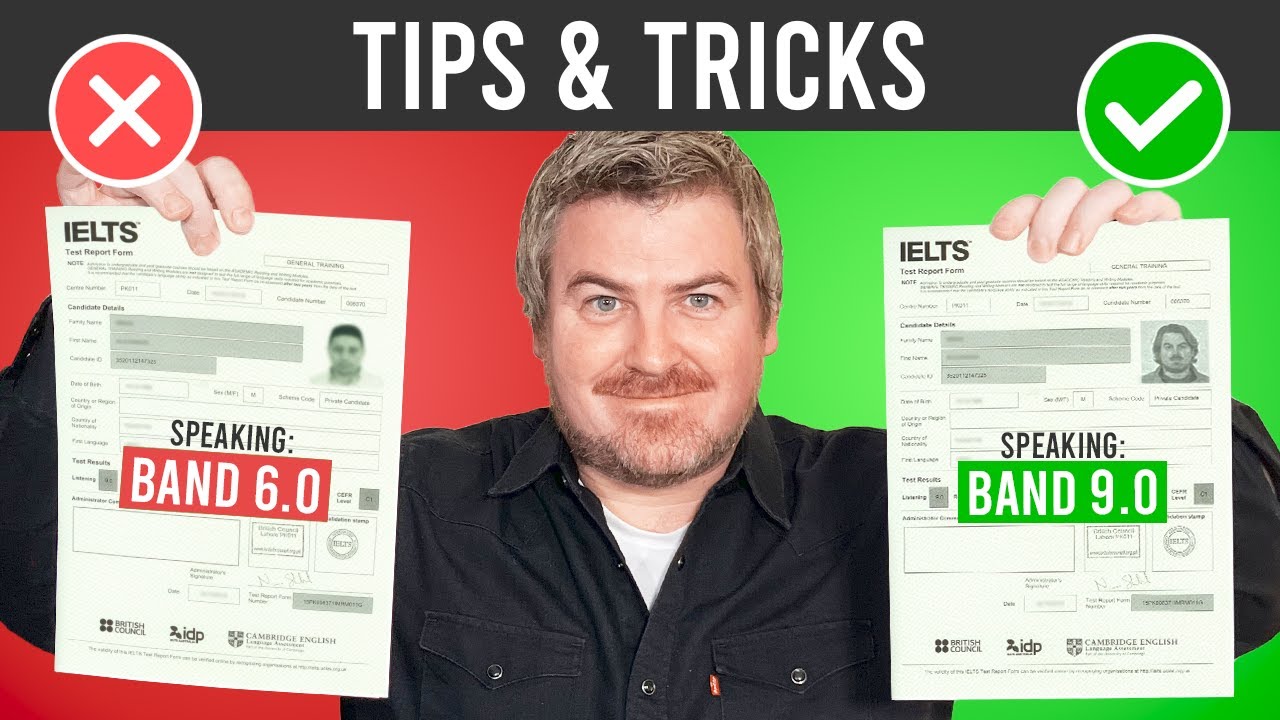
hi guys its Keith from IELTS speaking success and today I'm gonna give you a video that is taken actually from my new course it's an online course on udemy and this video is the kind of video you get on that course it's all about speaking evaluation so how is the IELTS test really evaluated and scored and what do you need to do to get AB and seven listening and find out so in this video we're looking at what the examiner is listening for so what and how will they evaluate your English so the IELTS speaking
test takes place in a room with one examiner live one-on-one they will ask you the questions and the same person evaluates your language they will only evaluate the language you produce they cannot guess what you mean so never think oh they know what I mean no they don't and they won't try so make sure you produce enough language and make sure you speak clearly and loud enough so they can hear you and evaluate you so the examiner will evaluate four things in the exam okay fluency vocabulary grammar and pronunciation let's have a look at each
of these in a bit more detail so first fluency and here there are probably three things the examiner looks at ease of speaking hesitation and repetition and connectives ease of speaking is basically how easily you connect your sentences okay so if I say well I come from Manchester it's a beautiful city it's up in the north of England and I've lived there for a long time it's a nice smooth flow good fluency okay be careful fluency is not speed you do not have to speak fast then there is hesitation hesitation is oh yeah that's your
hesitation repetition when you repeat and repeat and repeat and repeat so you need to be listening to yourself maybe record yourself and notice the hesitation and repetition for example i i i live i live i live in in manchester now when you play that back and listen you'll notice how much you hesitate and repeat so try and reduce the herbs and the repetition next we have connectives basically the words that connect your sentences so for example and but then also too however so all of these are connectives you need to use quite a few and
a good range and spoken connectives not written academic connectives okay so in for fluency basically a band 7 ok would look like this speaks without any noticeable effort may have hesitation at times uses a range of connectors with flexibility let's move on a look at vocabulary for vocabulary there are five things to look at so we have the range the mistakes idiomatic expressions collocation and paraphrase let's look at each one in turn so the range is the range of vocabulary you use a short range so for example air pollution is bad for the air or
do you have a wide range of words air pollution is detrimental to the environment so that range is important secondly mistakes sometimes we confuse the verb for the adjective or the adjective for the for the noun right so be careful of mistakes like air pollutes is badly for air okay be careful with the mistakes thirdly we have idiomatic expressions and these are really important they will include idioms sayings phrasal verbs so brush up on your idiomatic expressions don't throw in the towel and you will sail through the exam with flying colors it's good to use
them maybe not too many but use some next we have collocation you need to be aware of collocation do we say do a shower make a shower have a shower get a shower become a shower oh yeah have a shower it's the words that go together you need a good awareness of collocation and finally paraphrase and this is your ability to to say something when you don't know the word maybe you forget the word but you can't say oh I don't know how to say that you have to find a way to express your idea
so for example I was fixing a plug the other day and I needed that that that long thing made of metal to help me unscrew the top and then I could fix it that long thing made of metal to unscrew the top okay I forgot it's a screwdriver but I can paraphrase and a key part of a band 7 is you can paraphrase effectively so let's look then at what we need for a band 7 uses vocabulary flexibly to discuss a variety of topics uses less common and idiomatic vocabulary shows awareness of collocation can paraphrase
effectively great let's look now at grammar for grammar there are three things the examiner will be listening for simple or complex structures flexible use and mistakes so what do we mean by simple well basically a simple structure is one clause and one tense for example I live in London it's a beautiful city I like it very much one Clause one tense complex though is normally more than one clause maybe two or three and more than one tense and different tenses so for example I'm living in London which is a beautiful city relative clause two clauses
I'm living in London which is a beautiful city and I have been living here for two years more complex sentences okay three clauses different tenses that is complex so the ability to use clauses and tenses flexibly and with few mistakes so AB + 7 looks like this uses a range of complex structures with flexibility with some flexibility and there are frequent error three sentences let's move on let's look now at pronunciation and there are three things really that the examiner will look for it's the range of features of pronunciation features your control of them and
are you easy to understand so let me say something about accent you can have any accent whether it's Chinese Indian Canadian American British Brazilian German accent is okay you can even get a nine with an accent it's about your control of the pronunciation features of English okay so focus on the features typically those features will include individual sounds ow now know now take T so the vowels and the consonants the word stress present present which part of the word do you stress sentence stress is really important each of these sentences has a different meaning I
don't live in London I don't live in London I don't live in London I don't live in London I don't live in London right so where you put the stress changes the meaning five slightly different meanings then connected speech so this is where we connect to words if a word finishes in a consonant and the next word begins with a vowel we usually connect them take for example wake up wake up cup wake up wake up wake up early up early a pearly pearly pearly pearly cap early wake up early wake up early wake up
early wake up early once you start repeating it you hear the sound wake up early it's much more important to focus on the sound than the words that's why listening to audio is so good rather than reading words aloud listen to audio focus on the sounds and wake up early finally intonation intonation is difficult to practice you just need to listen lots and lots of lots but for example listen to the difference here okay that's great oh thank you well that's great oh I'm sorry that's great the intonation can mean it's really good or it's
really bad so intonation is important so for a band 7 what do we have well produces a range of pronunciation features with good control and some ability to sustain over longer turns and can be understood throughout so now you have a clear idea about what is being evaluated your fluency vocabulary grammar and pronunciation and what you need to focus on to get a band 7 so guys if you like this video you may want to check out the complete course it's on udemy if you need confidence ideas and language to get AB & 7 on
your IELTS speaking it might well be the course for you go and check it out below as always subscribe and I'd love to see you soon thank you [Music]