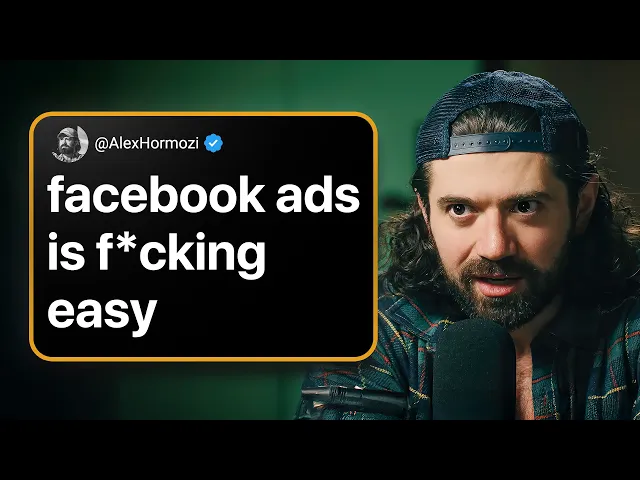
Alex Herozi broke the internet recently with his latest launch of $100 million money models. He generated over $100 million from a single book launch. And many of you know Alex is growing a portfolio of businesses that are generating over $200 million annually.
And I'm 100% convinced that none of this would be possible if him and his team didn't master Facebook ads. Now, the issue is pretty obvious. Alex has 7 years of content that you would have to sift through to find golden nuggets.
So to save you time, me and my team have sifted through hundreds of videos. And in this video, we're going to be going through Alex Hormosy's best advice on Facebook ads. >> So Google already really experimented with this.
So it's the the technical one. The better one is 702010. So 70% is doing the main thing.
So just the one ad that you have, 20% is adjacent to that. So as many different ways as you can think of, you know, versions of it that's not that ad. So everything that I see as permutations of that I see as the 70.
Adjacent to that, similar in style is the 20. 10 is just wild ass ideas of maybe this would work. And so that's how you allocate resources.
And I'm being super real. So if you spend a whole day making ads, so you spend eight hours, that means you're going to do 1 hour or 45 minutes on your one idea and then you're going to spend two plus hours on adjacent ideas and then the entire rest of the day is on how many different ways can I make the same ad per. And that's how you allocate time.
It's the same way we allocate time when we make ads. We look up all the top winners. We start with all those.
We hammer out all that stuff because that's our real work. That's the bread and butter. I said it in reverse in terms of order for the day, but fundamentally I want to get the 70 done first, the 20 done second, and if I've got time and I'm feeling energy, I'll do the third.
>> What Alex is basically referring to is how and where to allocate your time when you're actually creating creative. He's applying a 702010 rule. 702010.
And basically what he's saying is 70% of your time needs to be spent on the main most important content. 20% of your time needs to be spent on secondary content and then 10% is just random home runs. I fully agree with this.
70% of the time or 80% of the time you need to be spending that on things that you know already work. So we're just going to call that main things. They're proven.
And then what you're going to do is you're going to take those those proven concepts and take the remaining 20% of your time and you're going to then create a little bit beyond that. and what that could actually be. In this case, I think he's referring to adjacent examples, but for you, just think about like what's one step removed from what you've currently done.
Not so small as a tweak or an iteration, but what's something you started to see positive signal on that you could then push forward? 10% effort, home runs, things that you would just want to try, random stuff that you're like, I thought was a cool idea. My buddy thought that would be cool.
Let's try it out. And so you're getting all these new ads, but the the real money is, okay, I have this one winner and um I had I'll give you a story. I had an ad that we called the Kale ad.
So Kale was our our GM, right? And he made this ad before you was the GM. Now, when we had that ad, I made about a hundred versions of that ad.
So I made a black and white version. I did a sepia filter version. I reordered the back end.
We swapped out hooks. I put different headlines. I put different subheads.
I changed the fonts. I did I ran it with different ad copy. I will use and abuse it until it doesn't work at all.
And so when you have your winners, you usually just need to run them way longer, way harder in a lot of different variations so you can squeeze way more out of it. >> Okay, this point right here is the thing that almost everyone gets wrong that Alex is 1,000% correct at. And it's actually the gold in the last 5 seconds there where he specifically refers to he will use he will abuse the single ad to drive as much performance as possible out of that ad.
What most advertisers do is they run an ad and they let that ad just simmer off and it eventually fades down. What you need to do as an advertiser is you need to see an ad that works well. So an ad that's performing above your baseline.
Let's pretend that's our baseline. And then right when you notice it's working well, you need to have the big moment which Alex describes right here where we are creating hundreds of iterations of that one ad. And then instead of the ad doing what it did before and dying a very slow death, what it does instead is it sustains this ad performance much, much longer.
Now, it's eventually going to fatigue, but because you have so many different iterations of it, so many different variants that are going to work for different kinds of people because the way that you consume media is different than the way that I consume media. The key is that you have a lot of variations to curate to a lot of different people. That's exactly what Alex exposes here.
And it's one of the best ways to extend the longevity of your ads without compromising the quality of your ads. >> And my recommendation is let your clients talk. So just let proof do the talking.
When I look at all the ads that we've done over the years, like I said earlier, 80% of them are about proof. And so as much as we want to think it's all about us, like no one cares. Alex had the big gym I still do, right?
The big gym company. One, I'm not in the ads anymore at all. And I wasn't for the last two years.
And it was because we just focused on the customers because gym owners don't really care about me. I mean, they care about making money and they're like, "I'm glad he helped. " But really, they just want to make more and see other people like them that they can say, "Oh, this is a good approximation of my gym.
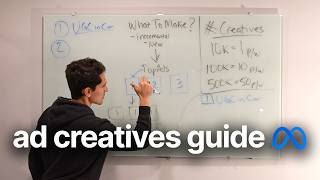
" >> This is a point that I actually don't agree with, but I think it has to do with when this clip was actually created because the algorithm has changed so much. What Alex is basically referring to is an ad concept. So, we're going to mark that ad concept with this blue circle.
old school Facebook, you would take that ad concept and you would deploy that ad concept to as many possible audiences that were successful for that ad concept. So you would take that concept and you would target it to a specific audience. What you do in new Facebook is that ad concept is the targeting.
So you don't have control as much over the audience because old school you would create your audience and then you would create your ad in that audience. New Facebook, which is measured up top here. You take that creative and Facebook determines your audience based on that.
And why that's so important is because in new Facebook, your goal is to have as many successful concepts as possible. If you only have one concept, you're only going to appeal to one target. It's not a game where you take one ad and max out as many audience as you can.
It's really a game where you have to say, "Each of these could perform differently. " For example, this one might spend 100K and it might do so only at a 2x return on ad spend. But ad two might spend 50K, but it might do so at a 3x.
And then ad concept three might only be able to spend 3K, but it could do so at a 7x. The core thing you need to understand is that each of these are helpful on their own as long as the 2x is your baseline target. cuz now number two and number three are well above old Facebook.
You would have killed this top ad concept and only ran number two and number three. But that's how you kill your scale. What Alex is saying here is very valid probably 2 years ago but new updates really really focus on developing multiple concepts.
So in terms of driving now CAC, what I would do is I would look at the top you probably run a thousand ads over the last year. Look at the top 10% or 5% of ads. Look at the first 3 seconds of each of those ads and see if you can model those 3 seconds with all of the remaining ads that you have.
You can even slice that first 3 seconds off of the best winners and paste it onto another 100 plus ads. So that'll get you 10, 50 times more ad creative per good winner that you get so you can squeeze more out of it. So that's from the creative strategy.
You drive down ad cost. >> This is a no-brainer. This goes back to the second concept that we just broke down.
It is so important to double down on what actually works. So, what Alex is literally referring to here beyond doubling down is to take the ad creative that worked the best. Use those first 3 to 5 seconds and then spin up more variations after those first 3 to 5 seconds with using that first 3 to 5, which is really simple.
It's really just easy editing on your side and it's a super easy way to just improve performance. >> First two weeks does 15,500 in additional revenue. That's the average, which means half people get better than that.
And I I give you the other stat earlier. One in 5. 5 gyms is a million dollar gym.
And so I can play with these, you know, with these numbers cuz I could have said 18%. Or I could have said with the percent the the 15,500. I could say that's a what's the outcome, right?
The outcome wheel could be what's the increase. If what's the increase? It might be like the average person, you know, doubles what they do in revenue in the first 14 days.
That's a different way of saying it. >> So what Alex is really saying here is that there's different ways to talk about your offers. There's different ways to talk about your discounts.
I'll give you a great example of this. If you're running a sale and you're running 20% off, but the value of 20% is $60. So 20% off or $60 off, consumers are much more attracted to the bigger number.
So actually pushing your offers with a little bit of different word and verbiage here could go a long way. If you know that your average order value or your average ticket size is let's say $200, then instead of doing 20% off $200, which is on average 40 bucks, you would instead want to say $40. And the reason you do that is because now the consumer sees a much more clear I'm going to get 40 bucks off instead of having to do a little bit of head math and 20% is less than the $40.
You have to play with this a little bit. It's something you can test. And Alex is actually referring this into ads itself.
completely applies the same. >> So you've got the just the increase, you've got the total amount made, you've got the percentage increase, you've got uh a relative increase, which is one that I like, which is what is 15,500 buy you. So 15,500 might be like I would have to look up industry averages, but I would say the a, you know, maybe industry average for a micro gym rent might be, let's say, $2,000 a month.
So I would say in the first 30 days, the average gym in our program pays off 3/4 or 9 months of rent. That sounds kind of interesting, right? Like that's that's compelling.
That's unique. So yeah, Alex is just doubling down on the fact here that you need to position properly. Everyone thinks they can get away with just simple 30% off or our product is better because of some ridiculous reason.
If you actually show results as to why your product is better or what you've done, whether it's testing for your product quality, whether it's customer reviews, showing something that improves the satisfaction and really eases the tension to actually get over that purchase event, it's going to go such a long way. I'm not just talking about discounts. I'm talking about product quality and ensuring the customer will be satisfied with their purchase.
>> Like, this is what I will hunt for. I will look for the piece of data that tells the story that the copy can't tell or it can reinforce the story that the copy tells and makes it far more compelling. >> This is 1,000% true.
Now, Alex is showcasing this in the way of like lead genen or B2B. But if you're B TOC, if you're B2B, if you're lead genen, anywhere in between, this is so true, it's scary. There's usually one nugget of information that you can share to your customer that is so much more important than all the other nuggets.
Think of every detail of your product and then the easiest way to get this, this is my golden nugget, ask your customers why they specifically bought from you. Literally email them one by one and say, "Hey, we just want to know why you bought from us. " You could type up a really simple email and get that information cuz it's going to do so much for you in the long term.
>> And so paid ads give us four problems to solve that are new. Number one is you have to know where to advertise because there's lots of different platforms out there. So how do you pick the platform to advertise on?
Number two is getting the right audience to see it. And this is probably the hardest part of paid ads because fundamentally if you showed the right thing to the right audience, you're going to get a good response. If 100% of the audience was the ideal target, it would.
But most platforms are not that efficient from a targeting perspective. I mean, they've gotten significantly better. And maybe in the future, we'll be able to get so dialed in, it'll be insane, and we'll laugh at these the times that we're doing right now.
Like so archaic. But the targeting is still one of the hardest parts. Number three is making the best ad for them to see.
Now that we have the right people seeing it, how do we get the highest percentage of those people to want to take action? And then number four is once they have taken action, how do we get them to give us permission to contact them again in the future? >> I'm going to give you the cheat codes based on what I've seen in the market really in the last 10 years, but most specifically acutely what's working over the last year.
Knowing where to advertise, Facebook and Google. That's where you start. After that, explore platforms like Tik Tok and Snapchat.
Getting the right audience to see it. Well, first off, I go through a,01 audience breakdowns that you can click around my channel, but that's not here nor there. You could use broad targeting for the most part along with interestbased audiences as long as your pixel and conversions API is tracking properly.
You have to make sure you have adjacent interest audiences, not exact interest audiences. Making the best ad is extremely important because it actually does the targeting for you. Now, continuing to make the best ad is extremely important because you need to be taking information from your ad account, passing that information to whoever is creating your creative, and then rinse and repeat to make sure you're constantly creating more new best creative.
And then fourth, getting permission to actually contact them. So, if you're in e-commerce, doesn't really apply. This really just means get them to purchase.
But if you're in lead genen of some sort, then yeah, making sure they're filling out a form and that there's a fair value of trade. >> I'll give you a little example for me. So when I record ads, I would record maybe 10 meaty ads.
So like the actual value component of it. So I'd break one belief or I I would demonstrate one skill or some little nuance that they didn't understand as well that I knew that I could demonstrate based off experience. And that would be the meat of the ads.
So I record the value separately. And then I would go and record 30 different hooks. And then when you have 30 hooks, you can paste those onto 10.
And I have 300 different ad variations that I can use. And as soon as I have the best converting hook, then I can see which value converts best off that hook. And that's the test and iterate process that creates winners and home runs over and over and over again and allows you to scale.
>> So yeah, this is a really really good point. If you're an e-commerce brand watching this, then how could you create 10 different hooks and 10 different bodies and then create a 100 different ads? It gets a little complex quick, but when you think about it, you could actually just like before take your best performing hooks from your ad account and use those as the hooks and then take your best performing bodies or create new bodies and push those to the second half of your ads.
Now you've multiplied your ad account very quickly. You can then determine what the best hooks are based on what actually performs best with that matching or adjacent body. If you're starting from scratch, then yes, you have to go ahead and you have to go and create ads from the RIP.
That is obviously going to be significantly harder, takes significantly more time, but the payoff of doing multiple variants with multiple different hooks is going to pay dividends compared to just doing one time and always taking a new home run swing hoping that you're going to knock something out of the park. >> I would recommend that you don't skip ads. I don't have any premium memberships, I don't think, to any platforms.
And when you're trying to consume or learn an industry, you should click on every ad of people in that industry, in your industry. So that your newsfeed is filled up with that. Don't let it hurt your ego.
You're learning. And there's no better school of advertising than what's working right now today. This is like the most valid thing.
I do this as well. I think most advertisers that are really serious probably do this. Basically, the way that I treat this that I would advise everyone to do cuz it's so easy.
I have my personal Instagram that's private that really no one knows about and it's hidden and that is my own algorithm. I will doom scroll on that thing. I will watch random sports videos, send them to my friends, whatever.
And then I have my work Instagram, the one that everyone can follow at San Polo. And when I go on that Instagram, A, it's all business content and b all the ads I get are fully business ads because I save them, I share them, I'm sending them to different people within my organization. that goes so long cuz I could actually get a good breath of understanding of what's going on in the market.
I've also been a sucker. I've bought some tools. I've bought some things based on ads and the ads that get me the most, I make sure I save those for those good safekeepings across the board because those ads are the ones that are going to be most impactful for people just like me and I want to create those as well.
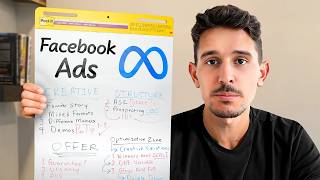
Now, look, in this one, we broke down some of Hormos's best strategies. But if you actually want to see what goes on in the ads manager, how I manage tactically my entire method, my strategy, my structure, my system, then click this video right here where I break down everything step by step so you can copy and paste it in your ad account to get the best possible results.