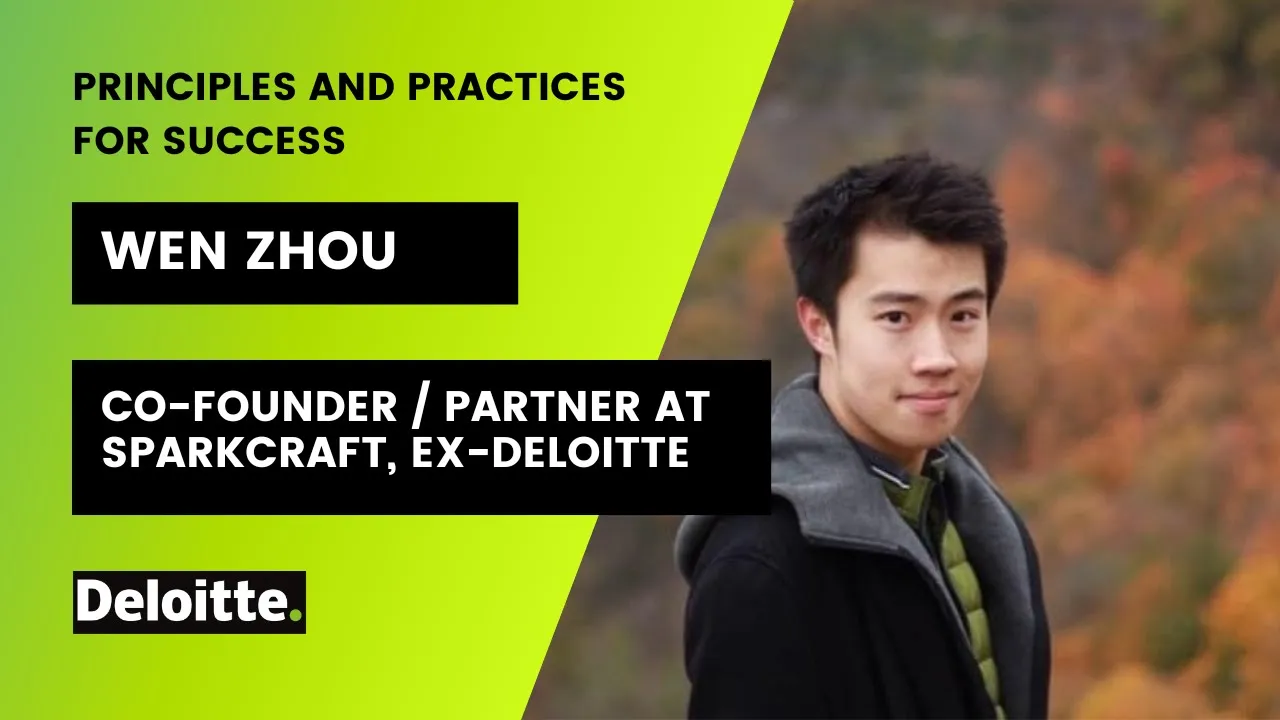
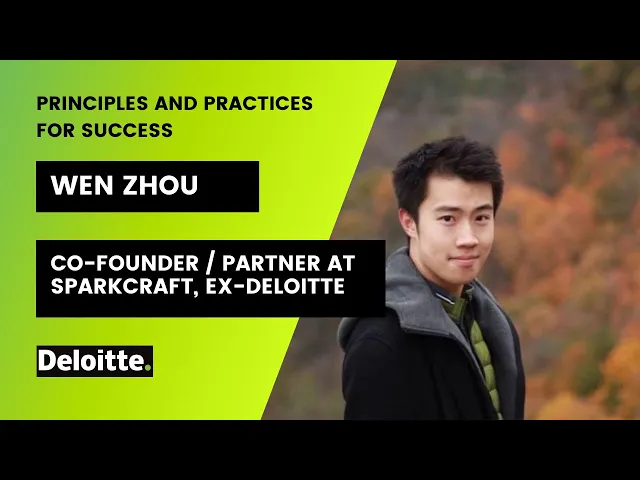
foreign [Music] thank you so much for being here and welcome to the cast we're so excited to have you here and to learn more about your career Journey so I'll jump right into the first question that we have for you you share your experience of moving from a big company like Deloitte to starting your own business what were the main difficulties that you faced while starting and running your own company I think for me it started back when I was an undergraduate I don't know if you guys are in your post grad or undergrad but
I went to University of Waterloo for my undergraduate and I'm the class of 2018. I was pretty involved with our startup ecosystem there we have a program called velocity and we're close to communitech which is sort of like a startup Hub based in Waterloo transitioning to De Luis was actually more difficult because you know I had to learn the rules the ways of Conduct in the Consulting world but luckily like a lot of those skills that I've learned in my Co-op terms as well as my experience building projects and products transferred really well at Deloitte
and then I think the experience transitioning back to entrepreneurship felt pretty natural because I've learned a ton in Consulting and I was fortunate enough to try different service lines while I was there as well so it gave me a pretty well spectrum of skills and it's something I recommend everybody to also you know look at career choices in terms of breaking down not by what jobs I have but the qualities that you want to cultivate most or develop in jobs and that makes the buses of job selecting a lot more awarding and focused yeah definitely
I agree with that aspect of gauging which qualities you want to Foster growth in and then choosing a job following that path I definitely agree with that statement so thank you for sharing just moving past that so during your time in college I'd love to know what subjects you studied and how you think they helped you in your job additionally how did your studies prepare you for the challenges you encountered in your career for me if I had to redo it well I'll first start with the first question is I went to a program called
accounting financial management short for AFM in Waterloo it's part of school of accounting and finance there I I picked that program was because I wanted some good foundation in business I know that both of you go to really awesome Business Schools but for me I needed something that helped me get co-op and sort of tell me something like the boring stuff of business which is also the lifeline which I thought the county was important after I did my first two Co-op I knew accounting and finance wasn't really for me so I jumped into product and
lucky for me was I joined Thompson Reuters AI Labs that Co-op experience real estate the courses I took I didn't take a heavy accounting finance courses I took some things that are more relevant to things I'm interested in so I took a lot of system courses I took a bit of Cs as well so it gave me that breadth of experience actually and also much CS I think it was called Data Mining it's called Data mining forgot the course code and I also took sales courses I knew that those skills would come in handy because
those qualities will be needed regardless the role that you know what we'll be headed into so pretty much that was my experience was really trying to get the co-op jobs using the co-op opportunities to try different things and refining those qualities that I I think you all know what's important or you have a good idea of what you need by the time you graduate I think that information you've given there is very helpful and I agree that it's very important to place a lot of importance on the co-op programs that schools offer as well so
thank you for your Insight on that and I'll just pass it off to Ian for the rest of the questions Ian are you you're welcome to go ahead so for our next question if you had the chance to choose a field of study and courses today what do you think and why do you think these choices would be beneficial for your future considering the current job market and Technology trends I want to break this down a bit because they're very important and I don't want to give the wrong advice I think it's important for all
of us to take source of all sources so what I mean is is it worth going around called the first purple I would take first principle courses what I mean by that is develop the framework the way of thinking so that once you learn that course you can easily translate it to secondary courses I'll give an example uh good examples would be in stem courses it would be mathematics it would be physics because those courses can be found across all engineering disciplines almost having that will help you do really well across multiple disciplines in stem
in business that could be maybe accounting economics those are foundational courses that give you a really good idea of the rules that our world operates in and I think psychology right it's it's way how to deal with people once you have the source of source courses what you'll find is you take one course but you cover a breath of disciplines and it teaches you to learn as you do especially as you guys you know go into the workforce I think picking surface of course is good too but you have to have a really good reason
to do it is it to learn to build a product is it to land a job is it to you know but I would definitely take the first principles for sure and then there's such a huge Paradigm Shift right now not just in North America but the rest of the world what we're seeing is sort of like the closure of industrialization what I mean by that is where humans are so good at optimization we're replacing ourselves and replacing what kind of job we're replacing any job that uses our logical side of the mind so everything
that is logic based that you can describe the logic to a machine and it doesn't require deep critical thinking those skills will gradually be replaced by Ai and we can jump that topic later because I did spend two years working in this field so I think we're seeing this Paradigm Shift where I think it's important for us to learn to use both sides of our brain jobs that require both so I'll give an example product management I think would do really really well the ability to r d a product and ship it to customer that
line is getting really really easy for for all of us if you click of buttons you can already ship a software now the teams are getting smaller and smaller being aware of this I think would give you a good idea of like you know I don't want to compete with robots and I also want to you know use what humans are really great at doing creativity Innovation working with people sentiment analysis all these things we can go in detail on that but I would say technology wise I would focus specifically on artificial intelligence it embodies
a lot of the previous Tech so if you can really have a good grasp of intelligence and you have enough understanding on how it can benefit you before you go deep dive into the technical I feel like the future I almost say like Inseparable like AI is like the new internet almost that's basically my thoughts on your previous question is field of study for sure pick those principal courses and then you can double down in areas that you're interested in like if you want to do marketing I think that's a really good field to go
in finance I'm not sure anymore because it depends what kind of Finance I think a combination of business or an SN course would be ideal I think a lot of universities they're offering binary courses now so they offer like a mix of these right brain and left brain if you come here to Waterloo and Laurier you'll see that we have a lot of dual degrees or something something and something something so because in The Crossroads of these discipline that's where you can innovate you can you can do new things and for our next question how
can students Gain real world experiences Beyond internships and what are some practical ways for students to develop their skills and feel more confident about their future careers I would go back to Sophie's earlier point right I think having a really good first principle understanding that if you were to sort of do a CT scan you know we go to hospitals to get our body scanned but if you look at your scan of like your qualities your skills what we call kind of like your elements instead of focusing on things that don't motivate you or I
just need a safe job I think we're in an era where there's a lot of opportunities to do something we're passionate about and do really well and I think a recent Harvard report I forgot the name but they measured that the single most success factor for any any person in the workday is how happy they are at work and you know happiness can come from different factors but if you can find something that you really enjoy doing and micro dive it into its qualities and then find projects or even clubs or even joining conferences and
Talks by attending these things you're already developing those micro qualities for example the ability and I'll give you some white probably that probably are foreign to you guys number one is how do you deal with mental distress you know we we all feel anxiety we all feel I hear students say like imposter syndrome how do you deal with the mind right that's a quality that unfortunately is not really taught in school that well I could be wrong but I think those things are highly important and you should develop these qualities too the ability to work
with people the ability to manage stress those are things that are not really taught but then there's also things that are readily taught so going down to these qualities and finding projects that have that would be amazing and now to be more concrete I would say how to develop their skills I think the most impressive thing that employers that I know they look for are the ability to go from zero to one and now I call it zero to nine the ability to come up with a completely Innovative solution to a hard problem and then
come up with a great event show that you can leave the Innovative idea and ship it because I know that most companies that I talk with they're not in need of optimizers and now it's a real thing because with AI now people are literally producing the same thing faster so how do you kind of understand the customer better and create new value the AI can't produce there's a word in Chinese I forgot a name it's called in English It Means A Blank Spot in in the world you need to go to those Blank Spot and
you need to have courage unit quality is how courageous are you are you willing to be the first person to step into no man land and that's where I think you know having those qualities to go with you to go to almost like to war to battle because that's where the future where you know you bring your AI and you create completely new things which is very exciting but also a bit scary to some people but hopefully that answers the questions you had just there so for our next question what methods did you use to
cope with overwhelming situations and just maintain a good balance between work and personal life okay let's see I think the biggest stress was how I felt like I was treating myself you know there's people talk about your relationship with your parents with your peers but for me I think I was pretty strict on myself in a way that you know people say like when you're I'm very nice to other people I'm in fact sometimes you know I don't hold them to the level 10 I hold to myself but I think for me the ability to
handle stress is to understand yourself better and that can take a year that can take five years that can take 10 years and then once you understand yourself better you start to realize those things that really kind of make you stress make you unhappy and you start to tackle those more I thought I was good at that in a way that I wasn't always trying to be the best of the best I I always prioritize my health I always prioritize how happy I was and you know I was someone pretty deep in my thoughts too
so I was very lucky to work with my mental leadership so I didn't get to a point where it's very difficult but I think another thing that I hear from my peers is that they have this sort of fear of the future because there's so much competition from the peers they have you know people like to compare themselves to the closest competition they see like their peers for yourself might be your peers and then you compete for jobs and then it starts to stack up you know for me how I dealt with it was I
really looked at the strengths of these students and I tell myself why is it that they're able to get these jobs it seems like they're really passionate about it they have a lot of Drive that drive is so authentic that for them it's like a painter right when a painter is happy doing the drawing the art tends to be good but on the other hand I see students who do it out of pure I would hate call it like kind of status game or call it like I'm safe I'm like that tends to produce unhappy
people and they don't tend to end up in places that they can thrive in it's usually people who are authentically happy and motivated to do those things they do that so how do you call up with overall situations or ask yourself this why are you overwhelmed do you really enjoy what you're doing by not enjoying it eight hours nine hours a day you're probably not gonna have most of the time and the the sort of stress that the workload is coming to you are you able to deal with it with a positive mindset or are
you gonna constantly suffer through it right so ask yourself why over and get to the root cause of it usually I find people who are really really motivated to do what they do and are in a place where they are honest with themselves they don't end up in situations where they're extremely overwhelmed they're stressed because it's part of life but they're able to manage really really well so that'll be what I've learned in my experience during undergrad and since I graduated too it was really focusing on that relationship towards myself too yeah that was really
insightful and I think our first conversation was about this topic and I still think about it to this day um so that's good yeah that's good means you're introspecting right you're doing the inner work first because that's that's the first step and then the outside really is just a projection I think sometimes my king calls it stuck in The Matrix comparing to other people looking at the outside role you know wanting more and more and not being grounded to like how we truly feel how our mind works I think that's where all the trouble starts
to brew up but that's for my take yeah perfect and I'm just gonna pass the last question back to Sophie I really loved your answers to those questions and just for the last question it's another double question but I think you've batched on the second part in your previous answer which was what lessons you've learned from your experiences that could have helped you earlier in life but the first part is a little bit different if you could go back in time and give yourself advice to your younger self what exactly would that advice be if
I had one thing I'd give us and fall in love with learning fall in love with growing yourself to become the solution to not just your problems but everybody else's problem I think almost all the problems begin with our thinking because we didn't have the perspectives the the knowledge the wisdom to think about it and then all the solution also begins with our thinking so I think fall in love with learning and growing our wisdom and our way of thinking our way of seeing the role getting more perspective that process will turn into a powerful
solution when you truly feel empowered because you have the internal resources to deal with whatever is on the outside that is truly very fulfilling experience I would tell myself instead of looking for external resources all the time or you know like I can pay this guy to help me build this I can ask my mentors which is important to to to give me all the advice I would find the middle way sort of in a way say that hey I want to learn how you think I want to grow so that I can become the
solution to my problems and I think I've realized that a bit later not too late either but I think that's where I truly felt empowered you are the solution that's great I love that advice I agree that The Learning Journey never ends and it starts sort of internally which people can have trouble understanding that aspect of it but I agree with that and I really like that Insight so thank you when and that's the last question that we have for you today so thank you so much for attending we really appreciate your time and I'm
sure our Learners will really benefit from all of your Insight and hopefully it will help them in their future career path so thank you so much no worries thank you for having me foreign

![[2023] Pass the Deloitte Interview | Deloitte Video Interview | Deloitte Job Simulation](https://img.youtube.com/vi/j-2CImUlLFs/maxresdefault.jpg)