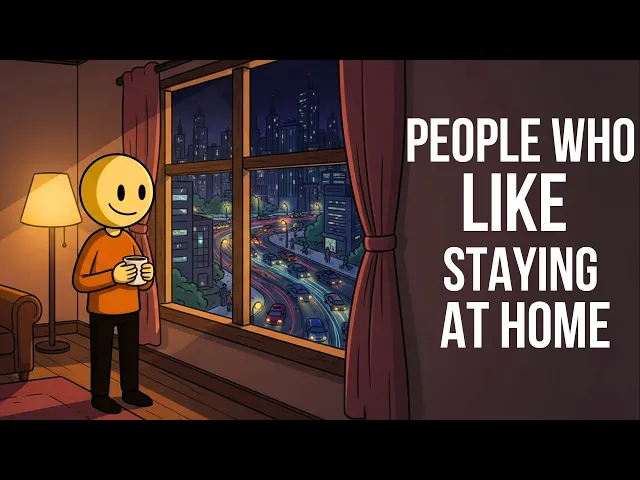
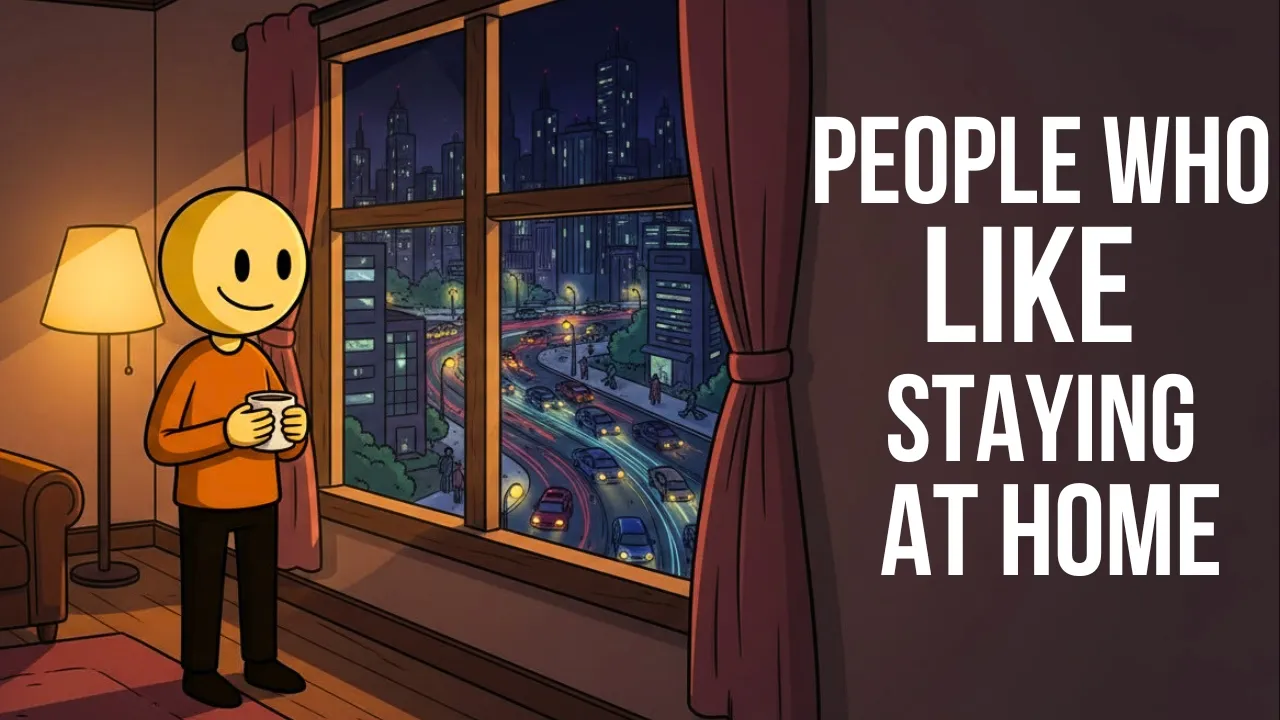
There's a specific kind of peace that some people only feel when they close the door behind them and the outside world finally stops demanding their attention. It doesn't come from laziness or fear or some failure to engage with life. It comes from something deeper, something quieter, something that most people who prefer constant activity will never fully understand.
The relief of being exactly where you want to be. Doing exactly what feels right without having to explain or justify or pretend that you're enjoying yourself when you're not. Maybe you know someone like this.
Maybe it's you. That person who turns down invitations not because they don't like people, but because staying home isn't the consolation prize, it's the actual preference. Most people think that enjoying solitude means something is wrong.
that people who prefer staying home are antisocial, depressed, missing out on life, wasting their youth or their weekends or their precious limited time on Earth. But psychology tells a very different story. For most people who genuinely prefer being home, the choice isn't about avoidance.
It's about alignment. It's about finally being in an environment where their nervous system can relax, where their energy can replenish instead of constantly drain, where they don't have to perform or monitor or adjust themselves to fit whatever the social situation requires. The staying home doesn't happen because they hate the world.
It happens because they've discovered that home is where they feel most like themselves, most at ease, most capable of doing the things that actually matter to them. Here's the part that makes extroverted people uncomfortable. People who like staying home aren't broken versions of social people.
They're wired differently. They process stimulation differently. They recharge differently.
and what looks like withdrawal from the outside often feels like restoration from the inside. They stayed engaged with social expectations for as long as they could. They went to the parties, accepted the invitations, showed up to events they didn't want to attend because they were told that's what normal people do.
That's how you build relationships. That's how you live a full life. And every time they forced themselves to go, they learned the same exhausting lesson.
that being around people, even people they genuinely like, costs them something that being alone doesn't. That the energy required to be social, leaves them depleted in a way that solitary activities somehow restore. And what's fascinating is that the brain does not process introversion as a deficit.
It processes it as a legitimate temperament difference with distinct neurological patterns. Research in personality neuroscience shows that introverted brains have higher baseline activity in the frontal cortex, the area responsible for internal thought, planning, and problem solving. They're literally more active when they're thinking internally than when they're responding to external stimuli.
This isn't damage or dysfunction, it's design. The human nervous system comes in different configurations. Some people are energized by external stimulation, by crowds and conversations and constant activity.
Others are energized by internal stimulation, by thoughts and ideas and quiet reflection. And when someone with the second type of nervous system tries to live like they have the first type, something breaks down. This is why people who like staying home often say something that sounds contradictory to people who don't share this preference.
I love my friends. I just don't want to see them very often. Not because the friendship isn't real or meaningful or important, but because the internal experience of socializing, even enjoyable socializing, requires a kind of energy expenditure that needs significant recovery time.
That recovery doesn't mean something went wrong. It means the nervous system is doing exactly what it's supposed to do, returning to baseline after a period of heightened external engagement. Psychologists describe this as introversion or high sensitivity, but those terms don't quite capture the lived experience of it.
It's not just about being quiet or shy or preferring books to parties. It's about having an internal world that's so rich, so engaging, so genuinely interesting that external activities have to compete with it and most of them lose. The mind isn't trying to reject people or experiences.
It's trying to protect the internal space where thinking happens, where creativity emerges, where processing occurs. And here's where the misunderstanding deepens, where the judgment from more social people becomes most intense. Staying home is supposed to be what you do [music] when you can't find anything better.
Right? That's what culture suggests. That home is the default, the fall back, the thing you settle for when you don't have plans.
But for people who genuinely prefer it, home isn't the absence of activity. It's the presence of preferred activity. It's having control over your environment, your noise level, your stimulation, your schedule.
It's not having to perform any version of yourself other than the one that exists when nobody's watching. It's the freedom to follow your own rhythms without constantly adjusting to someone else's energy or expectations or social timing. Many people who like staying home don't actually hate going out.
That's not the issue. They hate the pressure to go out. The implicit message that staying home means you're wasting your life, that you're not living fully, that you're somehow [music] less engaged with existence because you'd rather read a book than go to a crowded bar.
They want the freedom to choose solitude without it being interpreted as loneliness. They want activities that don't require performance. They want relationships where they can be honest about their capacity without it being seen as rejection.
They want space where their natural energy level is treated as valid, not as something that needs fixing or pushing or expanding. And when those needs are repeatedly dismissed, when they're told to just try harder or just put yourself out there or you'll have fun once you get there, something shifts internally. At first, the mind tries accommodation.
Maybe I am being too rigid. Maybe I should force myself more. Maybe everyone feels this way and they just push through it.
Then it tries guilt. What's wrong with me that I don't enjoy what everyone else enjoys? Then it tries resentment.
Why can't people just accept that I'm different? And finally, when enough time passes, it settles into acceptance. This is just how I'm built.
What's rarely discussed is how much peace that acceptance brings. Because choosing to stay home stops being this shameful secret and starts being a simple preference like preferring tea over coffee or mountains over beaches. The guilt doesn't vanish immediately.
It's been reinforced by years of messaging that socializing is virtuous and solitude is concerning. But gradually the internal narrative shifts from I should want to go out to I'm allowed to want to stay home. And that shift is profound.
Psychologically, this is called self-acceptance or authentic living. The behavior doesn't change much. What changes is the relationship to that behavior.
And that change relationship often creates a kind of contentment that no amount of forced socializing ever provided. Not because staying home was the right choice for everyone, but because it was the honest choice for them. Because humans are wired to believe that conformity equals connection.
From a young age, most of us are taught that fitting in is how you belong. That doing what everyone else does is how you prove you're normal, functional, part of the group. So when someone consistently chooses differently, even when that choice makes them happier, their mind often asks a version of the same question.
Am I missing something? Am I wrong about what I need? Should I be more like everyone else?
And that question carries weight because it's not just internal doubt. It's reinforced by every comment from friends saying, "You never come out anymore. " Every family member asking if you're okay because you seem so isolated.
Every social media post showing other people having experiences you're not having. This is where the internal conflict can become intense. Because on one side there is genuine contentment, actual peace, real satisfaction with how you're spending your time.
And on the other side there is this persistent cultural message that what you're doing isn't enough, isn't right, isn't the way life is supposed to be lived. And the brain struggles to hold both. Studies on personality and well-being show that people who honor their temperament, who structure their lives around what actually energizes them rather than what they think should energize them, report higher life satisfaction, lower anxiety, and stronger sense of self.
They don't feel like they're performing a version of life. They feel like they're living their actual life. But here's the psychological truth that doesn't get enough attention, that gets buried under all the cultural glorification of busy social calendars.
People who like staying home aren't avoiding life. They're living it according to their own wiring. They're not hiding from experience.
They're being selective about which experiences actually enrich them versus which ones just drain them. And most importantly, they've realized that presence matters more than participation. You can be physically present at a 100 events and emotionally absent from all of them.
Or you can be home alone, deeply present with whatever you're doing, whether that's reading, creating, thinking, or simply existing without agenda. And that second option for some nervous systems is where meaning actually lives. And grief around social expectations changes how the brain processes belonging.
When you spend years trying to fit a social template that doesn't match your actual needs, the brain becomes hyper aware of the cost of inauthenticity. It learns that forcing yourself into situations that deplete you doesn't create real connection. It creates performance.
So staying home becomes a form of self-preservation, not isolation. It's the brain saying, "I can't keep expending energy on interactions that leave me emptier than I started, and I can't change my fundamental wiring. So, the only variable I can control is how I structure my time and space.
" Another misunderstood aspect is this. People assume that preferring to stay home means being content with superficial relationships, with not investing in people, with choosing comfort over growth. In reality, it often means the opposite.
It means investing deeply in fewer relationships rather than spreading yourself thin across many. It means choosing quality over quantity. It means recognizing that for some people depth requires space, and space requires time alone to process, to reflect, to integrate what they've experienced with others before going back out and experiencing more.
As children, many people who prefer staying home learned to adapt. They went to birthday parties even though the over stimulation gave them headaches. They participated in group activities even though they would have preferred solitary play.
They learned that their natural preferences were often seen as problems that needed correcting. As adults, they finally have [music] the agency to name what they actually need. to say, "I function better with more solitude than most people.
" [music] To recognize that this isn't a flaw or a phase or something that needs therapeutic intervention. It's a temperament. And naming that temperament changes everything.
What was once internalized as there's something wrong with me becomes this is how I'm built and that's okay. That shift is powerful and it is liberating because once you stop fighting your own wiring, you stop wasting enormous amounts of energy trying to be someone you're not. And that clarity creates space for an important question.
Do I structure my life around my actual needs or do I keep trying to meet expectations that were never designed for my nervous system? Neither option is objectively right or wrong, but one creates chronic depletion and the other creates sustainable peace. Here's something rarely acknowledged.
People who like staying home are often deeply [music] thoughtful. They notice things. They process experiences more thoroughly than people who move quickly from one activity to the next, which is exactly why they need time alone.
Shallow processing doesn't require recovery time. Deep processing does. People who skim the surface of experiences can attend event after event without feeling drained.
People who absorb, reflect, and integrate what they experience need space between inputs. The very depth that makes someone insightful also makes constant socializing unsustainable. And that need for processing time doesn't diminish after they accept their preference for staying home.
It just stops being pathized. Many people redirect that quiet time into pursuits that matter to them, creative projects, intellectual interests, skill development, spiritual practices, not because they're avoiding relationships, but because the human need for meaning exists independently of social frequency. And meaning for some people is found more readily in solitude than in company.
From a psychological standpoint, this is called intrinsic motivation or autotellic activity. Engaging in something for its own sake, not for social approval or external validation. The mind structures its time around what feels genuinely engaging rather than what looks impressive to others.
And interestingly, people who embrace staying home often develop richer internal lives. They become more self-aware, more in touch with their actual thoughts and feelings rather than just reacting to external stimuli. More capable of entertaining themselves without needing constant input from others.
Not more isolated, more autonomous. They don't need other people to fill empty time because their time doesn't feel empty. It feels full just in a different way than extroverted people's time feels full.
But there is one part of this experience that can feel difficult. The loneliness that sometimes comes not from being alone, but from feeling misunderstood. Even when staying home is the right choice.
Even when it brings genuine peace, it can feel isolating to have that choice constantly questioned, minimized, or treated as something that needs fixing. Because society doesn't offer much validation for people who prefer solitude. There are countless messages celebrating social butterflies, busy calendars, large friend groups.
There are far fewer messages saying it's okay to have a quiet life, to prefer your own company, to find fulfillment in ways that don't involve constant human interaction. So, people who like staying home sometimes grieve quietly, not for the social life they're supposedly missing, but for the acceptance they wish they had. the ability to say, "I'm staying home tonight.
" without it being interpreted as depression or avoidance or antisocial behavior, just a simple preference that doesn't require explanation or justification or defensive reasoning. And sometimes they wonder if their preference is valid, if maybe everyone else is right and they're missing out on something essential by not forcing themselves out more. But psychology suggests something different.
Sometimes staying home is the most honest way to honor your wiring. Not every personality is built for constant external engagement. Not every fulfilling life looks social from the outside.
And that doesn't make anyone wrong or broken. It makes them different. People experience energy differently.
They process stimulation differently. They find meaning in different places. And sometimes those differences are profound enough that trying to live like someone else creates chronic stress that no amount of social connection can offset.
There is a myth that growth requires constantly pushing beyond your comfort zone. That staying home too much means you're stagnating, playing it safe, not challenging yourself. But growth often means something different for people who prefer solitude.
It means learning to trust your own needs even when they don't match cultural expectations. It means developing the confidence [music] to structure your life around what actually works for you rather than what you think should work. It means distinguishing between genuine growth opportunities and activities that [music] just deplete you because someone else believes they're important.
And that kind of growth, the internal kind that happens quietly without external validation, is often more sustainable than the kind that comes from forcing yourself into situations your nervous system never wanted in the first place. The psychology of people who like staying home is not about avoidance. It's about alignment.
The alignment between how they're wired and how they choose to live. The alignment between their actual needs and their daily choices. The alignment between what brings them peace and where they direct their energy.
And perhaps the most important truth of all is this. Most people who prefer staying home spent years trying to be more social, more outgoing, more like everyone else. They wanted to enjoy parties and crowds and constant plans.
But staying home wasn't a failure to be social. It was the discovery that their version of a full life looks different than the one culture keeps promoting. And that difference, once accepted, changes everything.
Quieter than the world expects, fuller than it looks from outside. Not wrong, just honest.