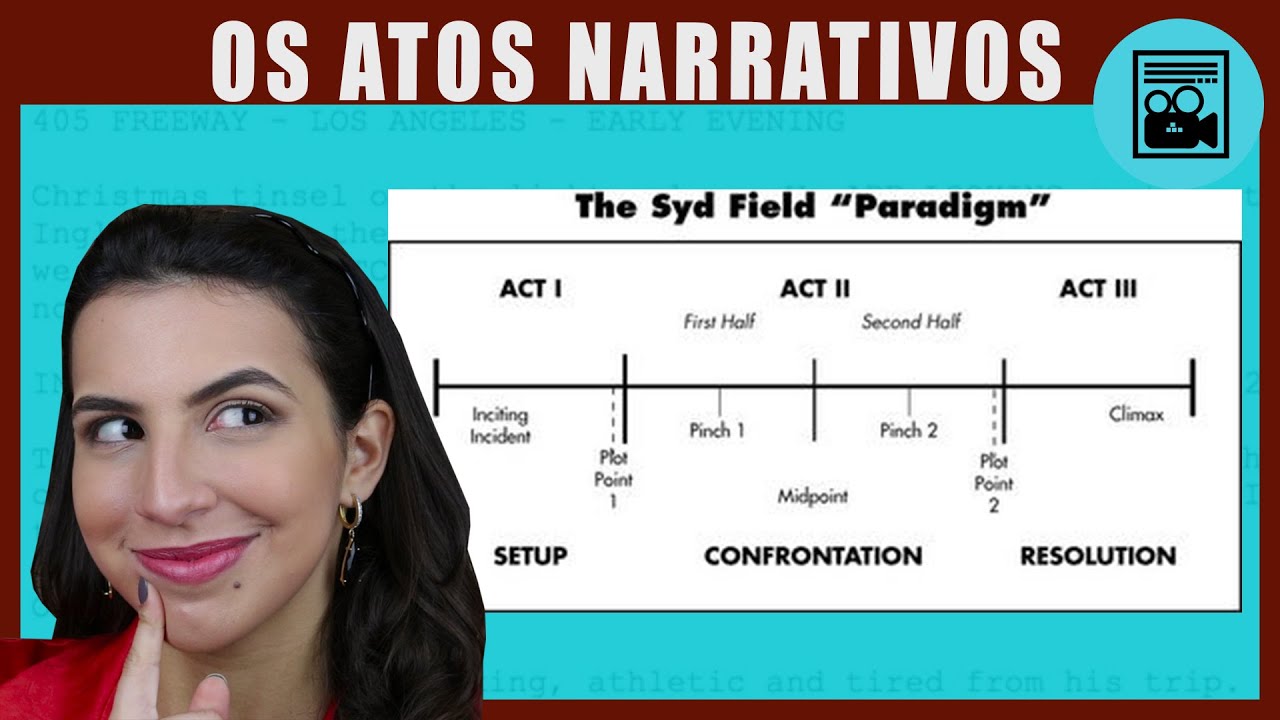
In this lesson we’ll talk about the three acts of a narrative. I'm Guilherme Orbe and let's see a way basic and widely used when narrating a history. The 3 acts are basically presentation, development and completion.
And in each of these points it has its particularity and we will see in this class how to structure and organize the story. Act I A fundamental point in all books is the beginnings. Every author has few pages to hook the reader, and would say even a few paragraphs.
So it is important to pay special attention how the story will start. In the first act, the characters more relevant, but not as a technical sheet, present their customs, their routine, the universe that is inserted. And for that, long descriptions are not necessary, the author needs to situate the reader, so that he imagines the scene, the type of place.
Many films start with an overview showing the landscape to whoever is watching get located. In books this visual feature does not work the same way, but somehow the author needs to reveal where the story begins. It can be simply as the protagonist waking up and showing her routine to get ready and go to work.
Only with a brief description is it possible have an idea of what kind of society the character it's inserted. And it’s good not to explain everything at first, because the mystery is necessary, the pleasure to discover the details of the story little by little it will arrest the reader and make that he wants to read more and more. Control information so that it is clear and at the same time giving a taste of want more is something you learn over time and quite practical.
In this beginning it is necessary to present only the protagonist, but the characters secondary, its objectives, of course briefly, and prepare for the turning point initial. The turning point, or plot twist, is the change of direction in history. The story is being taken to a direction, but something causes it to change direction.
Example: the protagonist gets ready to go work, faces heavy traffic, runs not to be late, and the presentation showing how much he needs the job, how much is important in your life. But when he gets to work he finds out that the company that works went bankrupt for some scandal involving the business owner. Realize that the story has changed direction.
The entire presentation was built for if you arrive at work and when everything arrives changes. And so the second act begins. The change from one act to the next is exactly the turning point.
Act II Usually twice the size of the presentation and the conclusion that is Act 3. If you used 3 chapters for the presentation, 6 will be used for development and plus 3 for completion. But of course you don’t have to stick to that, but this structure works well.
In the second act that development is going to be worked out the consequences of the turning point and the development of what was presented in the first act. How the characters will deal with what happened. In our example, the protagonist who owned much need to work, now fired you will need to deal with it.
And what will happen, what will he do? And it can vary according to the direction that the author wants the story to go. Note that when better presented is greater will be the feeling of loss, if the goal be the deepest drama.
And in this development that we are using example can be the effort of the protagonist to get up, and in that he can count with other characters or not, the family, friends, receive questionable proposals, getting into trouble, dramas, conflicts, everything to meet a need that can be financial or emotional, or any other matter that the book approaches. And at the end of development we reach the climax, that the culmination of history, is the top of the drama. It may be where all efforts go wrong, the protagonist loses everything he fought to get back on, is about to go hungry, left on the street, it may be a moment the hopes are at lower levels, where it looks like no there's more way.
Everything bad that could happen has happened. This is because the example is a more dramatic. If it were more action it could be a bigger challenge, where the antagonist's plans are on the verge of being fulfilled.
But in our example the desperate protagonist, almost hopeless, he realizes he can there is a way to solve it and so it starts the second turning point and starts the third act, which is the conclusion. A point that needs to be borne in mind that solutions should not come out of nowhere because history loses its luster, called deux ex machina *** the term comes from Greek pieces where in the end a god appeared and resolved all. This feature makes the book lose a little grace, so this possible is important solution to be planted from the beginning.
For example. At the beginning it can be presented that protagonist was late to leave because he received an email from a friend with an innovative idea and apparently crazy, and he ignored it because he was so good at his work at the beginning. Just an example.
And at the moment of his worst moment he remembers of this email and others you received from this friend who ignored it, and will talk to friend and hope is renewed. Act III But it is not interesting that everything will be resolved so quickly. That friend may have been hurt and your idea considered crazy is already working, so the protagonist must prove his worth, swallow pride maybe, to get saved.
And so the drama for the conclusion is built probably happier with the conflicts resolved and him being important in this new job opportunity. And with this basic structure applied in a simple example it is possible to vary a lot creating various types of stories. In the third act the story needs to be completed, but it doesn't mean that everything needs to be resolved.
Many stories end in open endings or with a hook for a continuation, and this hook can be a turning point, a change or bombastic revelation. Everything that has been presented and developed needs come back in some way and have relevance in that Score. All experiences, talk, attitudes, need to walk to completion, prepare the ground for the outcome.
And you need to be careful with the ending. A final where everything is resolved may have the preference most people, but an open end or tragic can make the reader reflect a lot after reading. It doesn't matter if it will be a happy ending or not, the important thing is that the ending is satisfactory and consistent for the type of story.
A story with a positive tone may not stay cool with an ending where the villain wins. You need to be consistent about everything that was developed. You need to live up to expectations.
If it is the conclusion of a mystery, that revelation needs to be good enough to worth the effort. So think hard about how it will all end because it can increase the value of the story or screw it up. These are the 3 basic acts of the narrative.
And it is important to note that the more the acts are related the more interesting it gets. Leave clues to the end at the beginning of the story makes a second reading leave more interesting story. But for this it is important to create a script before writing, and let's talk about this construction of the script that makes writing a book in the next class.
So until next time!