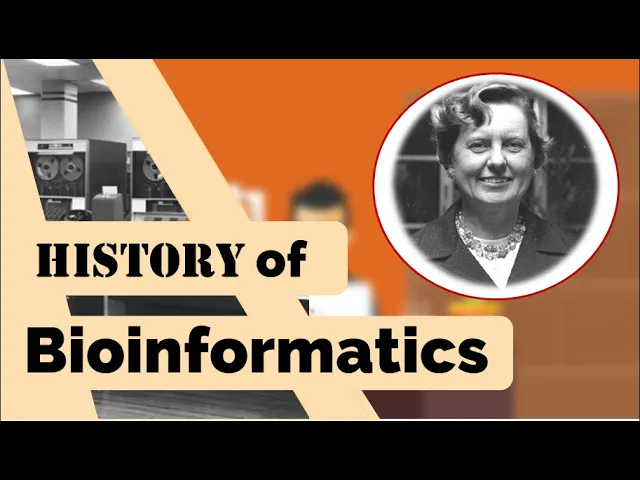
On a cold November of 1962 a woman with an undergraduate degree in mathematics and graduate studies in chemistry was punching cards in front of a huge IBM 7090 computer the computer looked like the one from the 1960 classic sci-fi movie 'The Time Machine' but no the clock said 6:31 when i started and now it was 8:09 a monstrous collection of metal beans with spinning tape discs made a humming noise and reverberated the Ledley lab of National Biomedical Research Foundation Margaret Oakley Dayhoff sat there analyzing the protein sequences in front of her with Robert Ledley looking on. She was trying to deduce the correct sequence of the protein Understanding a protein and its basic units was nothing new for Margaret as a large work had already been performed 20 years back in 1951. Pauling and Corey proposed a structure for the alpha helix.
and the beta sheet with a search for structure and not a search for substance if we want to understand the human body we must know its structure in terms of the cells that make it up if we want to understand cells we must know their structure in terms of molecules Exactly two years later in 1953 James watson and Francis Crick proposed the double helix model for DNA based on the X-ray data obtained by Rosaline Franklin and Maurice Wilkins. this is francis crick your british collaborator in cambridge yes and so basically this this x told you you had a helix of sorts from that helix and it said something about its diameter and it said something about how the bases were oriented there was likely a double helix not four strands but but two and that came from density but when i saw it you know i thought within a month the structure will be known and that was uh maybe the second of february and became known on the 28th and you could say why did it take so long and one of the reasons is i went back and wanted to build these bases in metal so we could have a metal double helix which would be stable. The knowledge of the protein and the nucleotides (also referred as semantides by Linus Pauling and Emile Zukerkandi opened a whole new understanding in molecular biology, but the real breakthrough was obtained after a decade long work(1945-1955) by Frederick Sanger of Cambridge University.
He sequenced 51 amino acid sequences of bovine insulin protein the work gain momentum and the early 1960's saw new sequencing techniques like Edman degradation (Pehr Edman) and Ion-exchange column by Stanford Noore and Willain Stein. The semi-automated Ion exchange column sequenced 124 ribonuclease amino acids which were faster than your sanger's method Back at her lab Dayhoff was busy crunching her FOTRAN programming language code on the IBM7090 computer. Many first generation IBM computers were available for academic resources.
Owning a mathematics degree, writing an algorithm was not much a difficult task for her. She wrote a series of FORTRAN programs to determine the amino acid sequences of protein molecules Taking the overlapping peptide fragments from the partial digestion of a protein the programs deduced all the possible sequences that were consistent with the data conceptually similar to the puzzle solving approach of the early sequencing investigations of insulin and ribonuclease Dayhoff ’ computer programs arrived at the correct sequence for a small protein that is a ribonuclease within a few minutes. Dayhoff and Ledley had realized the feat the computer had performed and how the same work would have taken a team of humans many months to accomplish.
Margaret oakley Dayhoff and Robert Ledley published their work in a paper titled as 'COMPROTEIN: Computer program to aid Primary Protein Structure Determination' it's a very interesting paper if you read it and the whole purpose of the paper was to understand or to find the order of amino acids which is there in a primary protein sequence and if it's a very interesting paper and if you actually go through the paper you will get to know that they have mentioned six programs okay MAXLAP, MERGE, PEPT, SEARCH, QLIST and LOGRED and what they have done is they have given the flowchart for each and every of uh this program watch has what has been used and if you look at the flowchart you will get to know that they have used if else and um loops okay in order to work this entire algorithm around so if you see the last statement that is in the summary and the conclusion they say that the computer program described in this paper becomes useful when there is a large number of small peptide fragments and there's one more interesting thing what she says is is that the application of these techniques uh to the DNA and RNA still awaits further development so the paper stated that this same technique could actually be used for the various nucleotides which she actually did in the future she came up with papers or she wrote papers where she applied algorithms for (last um! ) solving (last uh! ) the problems which is there in the nucleotide sequencing.
Looking at this paper you will get to know that Margaret oakley Dayhoff had actually "applied information technology in order to solve biological problems" which i mean she had actually laid foundation to a completely NEW FIELD! ! Dayhoff later established the Atlas of Protein Sequence and Structure, an annual publication that attempted to catalogue all known amino acid sequences.
Although rudimentary by today’s standards, the Atlas served as the first database for molecular biology. Little did she know that her work was going to gain momentum by the inventions of these Two Geniuses! so steve's kind of a non-technical guy so he came up with this idea that we could rename the thing microsoft window and we will we would have shipped out a long time ago introducing macintosh it does all the things you'd expect a business computer to do it does a lot of things you wouldn't expect a business computer to do and it does some things no other business computer has ever done before.
Steve Jobs (Apple I;1970) and Bill Gates (Windows; 1975) developed desktop computers which became an essential component of every institute and Atlas now had become an indispensable resource for early computational research. the real genius of macintosh is that you don't have to be a genius to use it macintosh the computer for the rest of us. In 1971 the Brookhaven national laboratory designed a data bank for the proteins it was done under the leadership of walter hamilton the brookhaven the brookhaven protein data bank it contained only seven proteins uh way back in 1971.
um slowly with the course of time a number of protein structures got added and finally in 1998 the management of the brookhaven national laboratory was taken by research collaboratory for structural bioinformatics or what we all know as RCSB and 1998 was the birth of RCSB PDB the Protein Data Bank the protein structural database of the proteins which we all know so we can actually say that the Atlas of protein sequences and structures which actually Margaret Dayhoff had developed laid the foundation for the current Protein Data Bank what is there by 1970 Ben Hesper and Pauline Hogeweg had coined the term 'bioinformatics' and defined it as the study of informatic processes in biotic systems. The word came to be widely used in 1978 and by 2002 was included in the Oxford english dictionary, bioinformatics paved the way for a vast area of studies in phylogenetic analysis, omic studies, algorithm development, sequence analysis proteomics, genomics, pattern recognition etc All this said bioinformatics was yet not accepted by the scientific community the way it should have But in 2003 something remarkable happened. .
. i'd also like to acknowledge the contributions not only that they're scientists but also scientists from china made to the vast international consortium that is the human genome project it was a map that defined the contours and forever expanded the frontiers of our continent and our imagination today the world is joining us here in the east room to behold a map of even greater significance we are here to celebrate the completion of the first survey of the entire human genome without a doubt this is the most important most wondrous map ever produced by humankind Bioinformatics had a tremendous role to play in the path breaking human genome project which was concluded in 2003 The Human Genome Project(HGP) was an inward voyage of discovery led by an international team of researchers with the goal of determining the base pairs that make up the human DNA and for identifying and mapping all the genes of the human genome from both a physical and a functional standpoint after the human genome project became successful there were many other projects which were carried out there was the human proteome project, and there's the ongoing projects which is the human microbiome project and the human metabolome project there have been many arguments as to whether we should consider Dayhoff or the Hogeweg as the founder of bioinformatics but what Dayhoff did in the November of 1962 paved the way for a series of quests for the future scientists to work on! Nobel laureate Paul Nurse posted in her science supplement of the Guardian newspaper that "the next quantum leap in biology will be through studying information processing in biological systems" my name is Sanket hope you have liked this video do not forget to like share and subscribe (please) to my channel we'll be back with another such informational video till then bye bye and thank you you!
! !