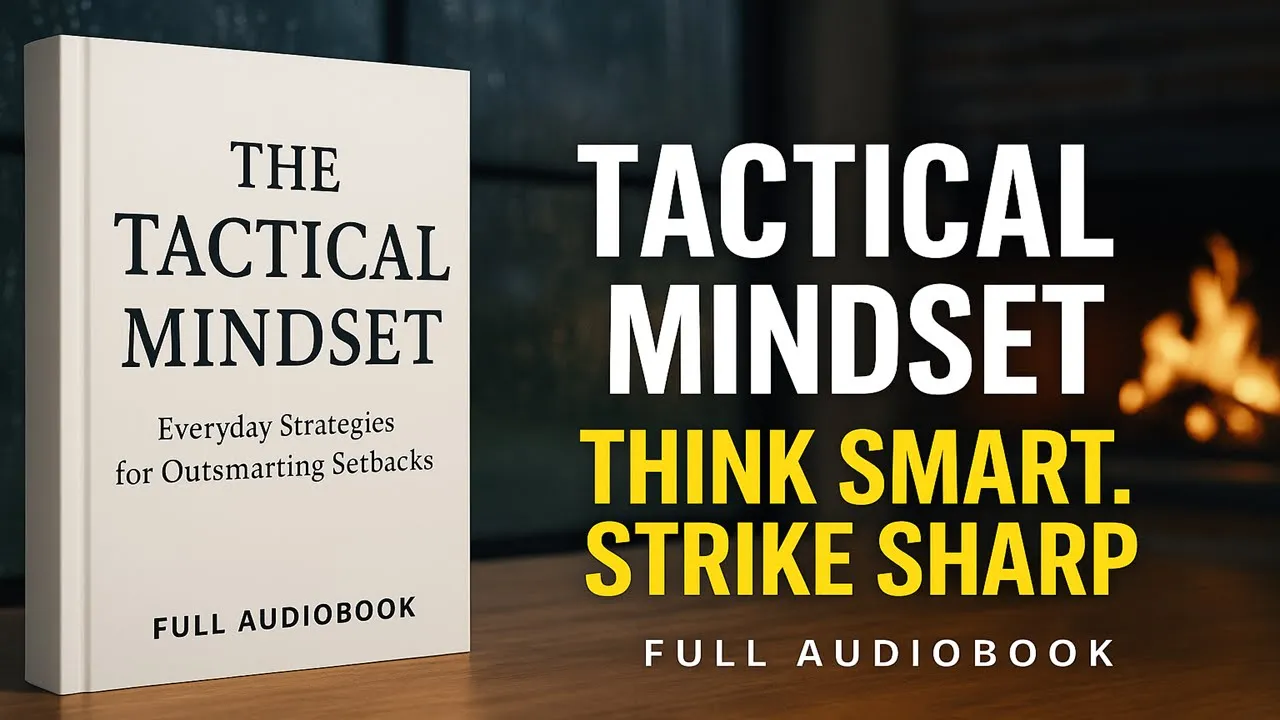
Imagine facing any setback and knowing exactly what to do. In this audio book, you'll unlock the tactical mindset used by elite thinkers to stay calm, plan smarter, and win when it matters most. This isn't about motivation. It's about mastering strategy for real life. Introduction: Life is a mental battlefield. What if I told you the real war isn't out there? Not in the economy, not in Your job, not even in your relationships. The real battlefield is between your ears. It's inside your mind where your thoughts clash, your fears speak louder than facts, and your emotions threaten
to hijack your plans. It's where your success or failure is decided, not by what happens, but by how you respond. Welcome to the tactical mindset. This audio book isn't just the motivational pep talk. It's your mental survival kit. It's the field guide for those who are tired of reacting, panicking, or feeling like they're one setback away from giving up. Because here's the truth. Life isn't a straight path. It's a series of tests, unexpected turns, and unseen opponents. And if you want to thrive in that kind of world, you need more than inspiration. You need strategy.
You need the tactical mindset. Success is more about response than circumstance. Let's start with something radical. Success isn't determined by your environment. We all know people who had every advantage, money, support, connections, but they still lost. And we know others who came from nothing, faced every obstacle imaginable, and yet rose, won, led, created a life of impact. So what's the difference? It's not what happened to them, it's how they responded. Your response is your edge. When things Fall apart, some people fall with them. Others pause, observe, adapt, and strike back with clarity. This isn't about
being emotionless or robotic. It's about emotional control, not emotional suppression. It's about mental strength, not fake positivity. The tactical mindset is about playing chess when everyone else is playing checkers. While others flinch, you calculate. While they rush, you prepare. While they get lost in fear, you get focused on solutions. Why most people break and how tactical thinkers don't. Let's be real. Most people aren't trained to think tactically. They're trained to react. To let stress decide their tone, to let fear decide their choices, to let circumstances decide their destiny. That's how people burn out. That's how
they sabotage opportunities. That's how they spiral. Now, contrast that with tactical thinkers. They understand something Powerful. You can't always control the situation, but you can control your stance. They don't just think about what's happening. They ask, "What's the opportunity inside this mess? What's the move nobody else is making? How can I come out stronger? Not just survive this. They stay calm, not because life is easy, but because they've trained for this. They've built internal systems, mental habits, thought patterns, emotional control tools that allow them To stay sharp under pressure. And that's what you're about to
learn. What is a tactical mindset? A tactical mindset is not about having all the answers. It's about having a system for making decisions, especially when the pressure is on. It's about thinking like a strategist in real life, not just in business or battlefields, but in everyday moments where things go wrong. It's taking a breath before you fire back at a rude comment. Choosing Discipline over distraction. Reframing a failure as feedback. Reading the room before you speak. Being calm when everything says panic. You don't need to be a Navy Seal, a CEO, or a martial artist
to live tactically. You just need to commit to this idea. I will not let life's chaos make me chaotic. That's power. why this audio book exists. I didn't write this audio book to give you a list of success tips. You can find that Anywhere. I created this because most people are mentally untrained for today's world. We're more connected, more informed, and more overwhelmed than ever before. Stress is constant. Distraction is everywhere. Pressure is rising. And yet very few people are taught how to think when it matters most. They learn to chase goals but not how
to stay grounded when goals slip. They learn to talk big but not how to respond when life talks back. They want To grind and hustle but they crumble under uncertainty. That's why the tactical mindset is different. It's not about doing more. It's about thinking sharper. It's about being the kind of person who can outmaneuver panic with patience. Who can make smart decisions under stress, who can turn every setback into a setup for a comeback. If you've ever said, "I overthink too much. I freeze when things go wrong. I feel overwhelmed and Scattered. I know what
to do, but I can't stay consistent." Then this audio book is for you. and you are about to change what you'll learn in the chapters ahead. This book is broken down into 10 battle ready chapters. Each one focuses on a realworld skill that will sharpen your edge and strengthen your mindset. Here's what you'll gain in chapter 1. You'll understand why setbacks destroy some people and strengthen others. You'll Learn the foundational rules of thinking tactically. In chapter 2, we'll explore the power of slowing down to move smarter. You'll discover how elite performers train their brains for
chaos. In chapter 3, we'll tackle the fear of the unknown and how to prepare for surprises without obsessing over them. Chapter 4 will help you master the voice inside your head. You'll stop letting doubt run the show. Chapter 5 shows how to win the micro battles that shape your Entire life. Those tiny decisions you make daily that either build or break your momentum. In chapter 6, we'll break down a powerful tactic, the 24-hour rule. It's your secret weapon against impulsive decisions and emotional regret. Chapter 7 is all about adaptability. When the plan goes to hell,
you'll learn how to shift gears without losing control. Chapter 8 unlocks strategic emotional intelligence. How to read people, manage Energy, and diffuse chaos. Chapter nine teaches the art of the comeback. How to bounce back from losses, rebuild with clarity, and make setbacks your greatest teacher. And finally, chapter 10 will show you how to set up your environment like a war map, so your habits, space, and people support your tactical mind every day. By the end, you won't just feel more focused or motivated. You'll feel mentally armed. You'll carry yourself differently. You'll move with Purpose. And
when life punches hard, you'll know exactly how to pivot, respond, and come back smarter. It's time to think like a tactician. Chapter one. Setback proof. The power of a tactical mindset. The true test of a person's strength isn't how they act when things go right. It's how they respond when everything goes wrong. Life isn't a straight shot. It's a series of unexpected turns, late night Calls, rejections, delays, lost chances, and sudden storms. You've seen it. You've lived it. And when those storms hit, most people do one thing. They panic. They freeze. They overthink. They spiral.
But tacticians, they do something different. They prepare. They expect resistance. They train for chaos. They don't hope things won't go wrong. They build systems for when it Does. This is where your journey into the tactical mindset truly begins. Because today you'll learn how to build a mental framework for dealing with setbacks. Shift from reactive to proactive thinking. Become the kind of person who walks through fire without getting burned. Let's break it all down. Panic is the default until you upgrade your operating system. Let's be honest, panic is natural. We're Wired for it. The brain sees
change as a threat. It can't tell the difference between a tiger in the jungle and a disappointing email. That spike of cortisol, the sweaty palms, racing thoughts, tight chest, that's your primal brain saying, "We're in danger. Run." But most of the time, we're not actually in danger. We're just unprepared. We've built lives on comfort, not on capability. We've trained for ease, not For effort. And then when something breaks, our confidence, our relationship, our plans, we break, too. That's not weakness. That's poor strategy. Tacticians train their minds differently. They build an internal operating system that knows
how to pause instead of panic, process instead of react, pivot instead of collapse. They don't avoid discomfort. They become familiar with it. And you can too. Why Tacticians don't fear setbacks? Tacticians don't panic when things go wrong because they understand this universal truth. Setbacks are data, not defeat. They look at every challenge as an information, a chance to recalculate, reassess, and refine. They prepare for the unexpected, not by being paranoid, but by being mentally conditioned. They play mental chess. They ask, "What would I do if X happened? How can I prevent failure Before it begins?
If I lose plan A, do I have plan B, C, or even D?" This doesn't make them pessimists. It makes them resilient. When the world goes off script, they're not shocked. They're ready. This kind of preparedness gives you a strange and powerful gift. Calm. Not because life is easy, but because your mind is trained. Building mental frameworks for challenge. So, how do you build this mindset? You Create mental frameworks, structures you fall back on when emotion threatens to take over. Here are three powerful ones to start with. Mindset framework number one, what's within my control?
This is your tactical anchor in any crisis, overwhelm, or setback. Ask, "What part of this is mine to own? What actions are within my reach right now? What am I wasting energy on that I can't control?" This simple framework cuts through Emotional fog and grounds you in agency. You stop spinning, you start solving. Mindset framework number two. Respond don't react. Reaction is emotionileled. Response is strategyled. When someone disrespects you, do you fire back or do you calculate the outcome of your reply? When your plans fall apart, do you melt down or step back, regroup, and
re-engage smarter? The tactical mindset builds a gap Between stimulus and action. It teaches you that you are not your first thought. You are the decision after the emotion. That's where power lives. Mindset framework number three. Every setback is a signal. Instead of saying why is this happening to me, ask what is this trying to teach me? Tacticians don't get stuck in the story. They extract the signal from the setback. Was it poor planning, a misread situation, or ignored intuition? Great. Adjust. Move again. They don't dwell. They download lessons and evolve. That's how growth works. From
reactive to proactive thinking. Most people go through life reacting. reacting to pressure, to people, to problems. And by the time they try to think clearly, it's too late. Tacticians flip the script. They build a life that's proactive. That means planning for resistance, anticipating friction, building habits that keep them calm when chaos hits. It means they play offense, Not just defense. They think about what might go wrong, not to live in fear, but to reduce the impact when it does. Imagine driving on a mountain road. Reactive drivers only swerve when the rock appears. Proactive drivers scan
the road, anticipate, and adjust before the danger. Which one would you rather be? Exactly. The three shifts of a tactical mind. To move from reaction to strategy, here are three internal shifts every tactician makes. One, from emotion to Evaluation. Feelings aren't facts. Train yourself to evaluate what's actually happening, not just how it feels. Ask, "What are the facts? What can I do now?" From drama to data. Drama says, "I can't believe this happened to me." Data says, "Interesting. What pattern do I see here?" Drama wastes energy. Data builds wisdom. And from paralysis to precision, you
don't need the perfect move. You just Need the next best step. Focus on precision over perfection. Make one clear move and then re-evaluate. These three shifts don't just make you calm, they make you dangerous in the best way. Tactical thinking in real life. A case study. Meet Aaron, a small business owner. The pandemic shut down her store overnight. She lost 80% of her income in one month. She could have panicked, froze, complained. Instead, she asked, "What's within my control? What's the next best move? What signal is this setback sending? Within weeks, she pivoted online, used
local delivery, started live streams, built community loyalty. Her revenue returned stronger and more scalable than before. Aaron didn't get lucky, she got tactical, and you can too. Tactical mantra. I don't break, I bend. and bounce. Life doesn't reward rigidity. It rewards resilience. Your strength isn't in how tightly you Hold your plan. It's in how swiftly you can pivot without losing momentum. Tacticians don't crumble. They absorb, adjust, and advance. Every setback becomes a set up. Every failure becomes fuel. They don't fight reality. They flow with it, but not mindlessly, with intent, with presence, with precision. That's
what you're building. Your first tactical habit, predecide your moves. Here's a habit to start today. Predecide your reactions. In other words, make emotional decisions before you're emotional. Examples, if I'm criticized, I will pause, breathe, and respond only after 10 minutes. If my plans fall apart, I will give myself 24 hours before making a new one. If I feel overwhelmed, I will write down my top three priorities before doing anything else. These aren't rules, they're systems for resilience. They turn chaos into clarity. Final words for chapter 1. Setbacks are Inevitable. Panic is optional. The tactical mindset
doesn't eliminate problems. It empowers you to face them with control, clarity, and courage. You are now stepping into a new way of living. One where you don't freeze under fire. Don't crumble when life gets loud. Don't spiral when things go sideways. Instead, you scanned, think, move. You are no longer just surviving challenges. You're outsmarting them. That's the power of a tactical mindset. Chapter 2. Slow is smooth. Smooth is fast. In the chaos of battle, the calmst mind wins. It's a saying that's echoed through elite military training, professional sports, and highstakes negotiations. But it's more than
a phrase. It's a principle, a way of life for those who understand that rushing is not the same as moving fast. That reacting is not the same as responding. That in every high pressure moment, the person who breathes deeper, who slows down, who chooses Their move carefully, wins. In this chapter, we'll explore how the world's most disciplined minds train to stay calm in chaos and how you can apply those same principles in everyday life. Why chaos triggers speed and why that's a trap. When things go wrong, when a deadline is missed, when someone lashes out,
when your plan shatters, your nervous system does one thing. It speeds up. Your heart races. Your breathing shortens. Your brain screams, "Do Something now." And so most people do. They rush into a decision, fire off a message, say yes when they should say no, quit when they should pause. But here's the trap. Speed without direction is destruction. Rushing leads to mistakes. Panicked action leads to regret. And impulsive decisions often create more problems than they solve. So what's the solution? Slow down. Not in laziness, in clarity. How the elite train for calm. Let's go behind the
curtain into how top performers, Navy Seals, Olympians, combat pilots train their minds for precision under pressure. They know that panic kills, that speed without control gets people hurt. So, they do something counterintuitive. They slow things down. Navy Seals and controlled breathing. In Buds/SEAL, recruits are pushed to their physical and psychological limits. But when chaos Hits, waves crashing, orders shouted, muscles burning, their instructors teach them one thing first. Control your breath. Why? Because breath controls the brain. Slow, deep breaths tell your nervous system you're not dying. You're thinking. Inhale through the nose. Exhale slowly. Reset your
internal systems. Calm isn't a personality trait. It's a practice. Athletes and mental rehearsal. Top athletes, tennis stars, fighters, race car drivers practice Something called visualization or mental rehearsal. They don't just train their bodies, they train their minds to slow down under pressure. They visualize a missed shot and calmly recovering a tough opponent and responding with poise, a sudden shift and adjusting without losing focus. They rehearse these moments so often that when pressure comes, their brain isn't surprised, it's prepared. Repetition creates readiness. The Smoother they are inside, the faster they appear outside. The tactical value of
controlled pace. Slow is smooth, smooth is fast doesn't mean move slowly. It means move intentionally. When you take your time to observe, breathe, decide, act, you may appear slow to others, but your results will come faster because you're skipping the detours caused by mistakes, drama, and overreaction. Let's compare impulsive action versus tactical calm. Rushing a reply, pausing, responding with impact, buying out of fear, waiting for the right deal, quitting mid emotion, evaluating after a cool down. Tactical calm beats impulsive energy every time. How to train calm in real life. You don't need a battlefield to
practice this. Here's how to bring the principle into your daily life. Step one, practice The 5-second pause. When something triggers you, an email, a comment, a mistake, pause for five seconds. Ask, "What's really going on here? What's the outcome I want from this moment?" This tiny pause is where strategy begins. Step two, use box breathing. Box breathing is a simple Navy Seal technique. Inhale for 4 seconds. Hold for four. Exhale for four. Hold for four. Repeat for 1 to two minutes. Use it before hard conversations, Presentations, or stressful moments. It sharpens your mind and centers
your body. Step three, presscript your high stress moves. Think of three situations that always throw you off. Example, when someone criticizes you, when you're running late, when a client or boss changes things last minute. Now, decide your response in advance. This builds muscle memory for calm. Tactical truth. Calm is a superpower. When the world speeds up, your edge is to slow down. To stay grounded, to breathe, to think, to respond with intention, not impulse. That's not weakness. That's precision. That's not delay. That's strategic velocity. Because when slow becomes smooth and smooth becomes fast, you become
unstoppable. Chapter 3. Think in contingencies, not catastrophes. Plans are nothing. Planning is Everything. Dwight D. Eisenhower. We all have plans. Big ones, detailed ones, even beautifully colorcoded ones. But here's a tactical truth. Plans break. Life doesn't care about your bullet points. So what separates those who collapse under unexpected pressure from those who pivot with power? Contingency thinking. In this chapter, we'll break down how to create fallback plans without spiraling into fear, how to Prepare for the worst case scenario without becoming a worst-case thinker, and how to use what if not as a panic button, but
as a precision tool. Let's get tactical. The catastrophic mind versus the contingency mind. Have you ever had a simple problem? Missed call, delayed payment, awkward silence, and your brain suddenly jumps to they probably hate me. I'm going to lose everything. This ruins everything I worked for. That's Catastrophic thinking. It's when your mind doesn't just anticipate failure, it magnifies it, exaggerates it, spirals into the worst possible outcome, and camps out there. Here's the danger. It feels like preparation, but it's actually paralysis. You're not solving. You're drowning in fear loops. Now, contrast that with contingency thinking. If
X happens, I'll do Y. If I lose this deal, I already have plan B. If this fails, it's not the end. It's just a Redirection. The contingency mind acknowledges risk without surrendering to it. It sees problems and builds bridges, not walls. Fear isn't the enemy. Freezing is. Let's be clear, fear isn't the problem. Fear is a survival tool. It signals risk. It sharpens your awareness. But untrained fear becomes noise. It floods your brain. It makes you freeze or flee. So what makes a tactician different? They don't fight fear. They work with it. They use fear
as data. What am I afraid of? Why does it scare me? What can I do now to minimize that risk? They channel fear into foresight. And then they make a plan. The art of the contingency plan. Contingency thinking is not about living in fear. It's about creating freedom. When you have options, you don't panic. When you've rehearsed the worst, you're not shocked by it. And when you've mentally explored the detours, no Roadblock can break you. Let's walk through how to build smart contingency plans. Target step one. Identify your primary goal and what could break it.
Start by asking, "What's the mission I'm trying to complete? What are the possible roadblocks? Which of these are most likely versus most dangerous? Example, you're launching a business. Likely roadblocks, delayed funding, tech issues, a team member quitting. Catastrophic thinking says, "If this Happens, I'm done." Contingency thinking says, "If this happens, I'll switch to plan B." Write them down. Acknowledge them. Strip them of emotional weight. Target step two, design if then scenarios. This is tactical thinking 101. For every potential issue, create a direct response path. If the supplier cancels, then we shift to backup supplier X.
If I lose my job, then I activate emergency savings and freelance. If this pitch Fails, then I repackage and try two new leads. Why this works? It teaches your brain that problems don't mean paralysis. It builds an internal script. So when chaos hits, your body may shake, but your mind won't scramble. Target step three, create buffer zones. Elite performers always plan with buffers. Extra space, extra time, extra energy because they know things will go wrong. Meetings run late, people back out, emotions spike, so they build in Margins. Examples: Deadlines are set three days earlier than
needed. Money is saved for 3 months beyond projections. Backup options are always listed in advance. This is what gives you calm under pressure. You're not rigid. You're reliable because you're prepared. Contingency thinking in action. Real world examples. Brain. Netflix. Years ago, Netflix had a major outage because of issues with Amazon Web Services, their cloud Provider. Instead of blaming the system or panicking, they built a contingency tool called Chaos Monkey. Software that randomly shuts down Netflix servers on purpose. Why? To test the system under pressure. to ensure they can survive failure before it happens. That's tactical.
Personal example, the mental pivot. Sarah, a marketing professional, lost her job unexpectedly, but she didn't panic. Why? Because she'd Already built a contingency habit. She kept her resume updated monthly. She maintained strong LinkedIn connections. She had three backup income skills in motion, consulting, design, and writing. She was hired within three weeks, not out of luck, but tactical prep. Using what if as a tool, not a trap. What if we fail to what would I do next? What if they say no to who would I ask instead? What if I mess up to how do I
recover quickly? Destructive what if? What if I lose everything? What if they hate me? What if I'm just not good enough? Tacticians stay on the solution side of what if? Every question leads to a plan, not a panic. Tactic drill. Build a contingency map. Grab a sheet of paper and do this simple but powerful drill. Write down one current goal or highstakes situation. Example, preparing for a major interview. List three things that could go wrong. The interviewer cancels. I blank out during a question. I don't get the job. Now create an if then for each.
If they cancel, then I politely reschedu and prepare even better. If I blank, then I pause, breathe, and reframe with honesty. If I don't get it, then I follow up for feedback and reach out to X new contacts. This exercise takes 10 minutes, but it builds the muscle that can carry you through 10 years of storms. The real reward is unshakable Confidence. Confidence isn't loud. It's not about saying nothing will go wrong. It's about knowing even if it does, I'll be ready. Contingency thinkers aren't pessimists. They're tacticians. They look risk in the face and say,
"I've got a plan." And because of that mindset, they move faster, recover quicker, and stay calm when everyone else cracks. You don't need to control the future. You just need to train your mind to face it prepared. That's how Tacticians win. Chapter 4. Tactical self-talk. Mastering the voice in your head. You are not what happens to you. You are what you tell yourself about what happens to you. The strongest people don't just control their time or their habits. They control their inner voice. Because here's the unspoken truth. No one talks to you more than you
do. And the way you talk to yourself can either be your greatest advantage or your deepest sabotage. In this chapter, you'll learn how to recognize and rewrite destructive self-talk. Phrases that turn panic into power. How to train your inner coach to dominate your inner critic. Let's dive into the most important conversation of your life. The one happening in your mind. Your inner voice is always talking. But who's in charge? You know that voice. The one that says you're messing this up. You're not good enough. Why even Try? Sometimes it's loud. Sometimes it's sneaky. But it's
there. whispering doubt, injecting fear, wearing the mask of logic, but carrying the weight of limitation. Let's be clear, that voice is not you. It's your programming. It's every moment of rejection, embarrassment, failure, fear, all bundled into a repeating mental tape. But here's the key. You can change the tape. You don't have to kill the inner critic. You just have to Replace them with someone louder, wiser, and stronger. Your inner coach. The inner critic versus the inner coach. Let's compare the two mental voices battling in your head. Inner critic versus inner coach. You always screw this
up. You've prepared. Focus on execution. They're better than you. You're not them. You have your own strengths. You're behind. Stay consistent. Your time is coming. What if you fail? Then I'll learn and come back smarter. The inner critic thrives in emotion. The inner coach leads with strategy. Your job is to train that coach until their voice becomes your default under pressure. Step one, recognize the sabotage scripts. You can't fight what you don't see. The first step to tactical self-t talk is recognition. Pay attention when you say things like, "I always mess this up. Nothing ever
works out for me. They probably think I'm a joke. I'm not ready." These are scripts, not facts. They come from past moments, but they don't deserve power over your future. Write down your most common negative thoughts. Now challenge them. Ask, "Is this objectively true? What evidence supports the opposite? What would I say to a friend who said this?" This is where reprogramming begins. Step two, rewire with power phrases. Words are tools. And just like a hammer Builds or destroys, your words shape your direction. Start using power phrases when fear, doubt, or hesitation creeps in. Here
are a few high impact ones. This isn't permanent. It's a phase. Helps you stay grounded during emotional storms. I don't need to feel ready. I just need to start. A favorite of performers and athletes who trust action over waiting. I've done hard things before. I can handle this too. Instant reminder of your past strength Calls courage forward. Calm is my advantage. When things get chaotic, this centers you and reminds you that clarity wins. These aren't affirmations you chant in the mirror. They're strategic commands that anchor your brain in high pressure moments. Repeat them often, even
when you're not under stress. Because repetition creates replacement. Step three, speak to yourself like a coach, not a critic. When athletes miss A shot, great coaches don't yell, "You're worthless." They say, "Shake it off. Get back in the zone. You've got this. Focus on the next play." You need to do the same for yourself. When you mess up, don't spiral. Coach yourself. That happened. What's the lesson? Not ideal, but we're still in the game. I've recovered before. I will again. Your inner coach doesn't sugarcoat, but they always refocus you on progress. Practice this daily, especially
when you fail, Fall short, or feel behind. Tactical drill, the voice swap. This simple mental exercise rewires your patterns fast. Think of a recent moment where your inner critic took over. Example, you relate to something important. Write down what the critic said. You're unreliable. You always screw things up. Now, write what your inner coach should have said. You made a mistake. What can we adjust next time? Let's move forward. Now, read both out loud. Notice the Emotional shift. Repeat this with new situations regularly. Soon the coach's voice will become natural and louder than the critic.
Why most people stay stuck in negative loops. People don't fail because they lack talent. They fail because they believe their inner critic more than their inner coach. They don't know how to redirect their thoughts. So they live in mental loops of fear, guilt, and hesitation. But not you. You're training your mind To operate differently, to pause, rroot, reframe. That's what tactical self-t talk is all about. Elite performers use scripts. So should you. You think Navy Seals, UFC fighters, and worldclass CEOs leave their mindset to chance? Never. They use scripts, mental cues, and mantras to control
their internal state. A seal might say, "Calm is contagious." Slow is smooth. Smooth is fast. Stay in the fight. A fighter might say, "Breathe. Focus. Execute. One round at a Time." A CEO might say, "This is a challenge, not a catastrophe. Lead the room. Don't let the room lead you." You should, too. Pick three to five scripts that resonate with you. Write them down. Use them. Speak them. Let them become your mental armor. The voice you practice is the one that leads you. Your inner voice is like a path in the forest. Every time you
think a thought, you walk that path. The more you walk it, the deeper the trail gets. Eventually, it becomes a default. So, make sure the path you're walking leads somewhere strong. Your inner critic didn't show up overnight and your inner coach won't either. But every day you practice tactical self-t talk, you weaken the critic, strengthen the coach, and give yourself a fighting chance when life gets loud. Final word, talk like a leader even when no one's watching. The most important leadership you'll ever show is how you lead yourself, Especially when nobody sees it. Every moment
you choose strength over shame, truth over fear, and clarity over chaos, you build something powerful. A mind that works for you, not against you. That's the real tactical mindset. And it starts with one decision. Speak power into your mind because it's listening always. Chapter 5. Win the micro battles. Most people lose the war because they ignore the daily battles. If life is a Battlefield, the biggest mistake you can make is thinking the war is won in one single heroic moment. It's not. It's won in the early mornings when you get up instead of hitting snooze.
In the quiet decision to finish a task when no one's watching. In the moment you choose to read a page, take a walk, ask a better question, or delay that impulsive reaction. These are what we call micro battles. And in this chapter, you're going to learn why the small stuff is Actually the big stuff, how routines and small wins build unstoppable momentum, and how tacticians identify and exploit leverage moments that shift everything in their favor. The truth about big success. Most people think success looks like this. one viral post, one breakthrough idea, one massive opportunity.
But tacticians know better. They know success looks more like a hundred small decisions no one applauded. A dozen Rejections that didn't stop them. Years of tiny daily wins that quietly compounded. Because here's the truth. You don't rise to the level of your goals. You fall to the strength of your systems. And those systems are built on what you do daily, not occasionally. Micro battles defined. A micro battle is any small repeatable decision that seems insignificant in the moment but leads to massive results over time. It might be Choosing water over soda, speaking up instead of
staying silent, starting the task you've avoided, putting the phone down to focus, waking up when the alarm rings. Alone each decision is small, but together they form the foundation of discipline, confidence, and long-term success. The science of small wins. Psychologists call this the compound effect. Every time you make a choice aligned with your vision, your brain gets a little stronger. You wire Resilience, grit, focus. But the opposite is true, too. Every time you quit early, give in to distraction, or let fear run the show, you reinforce those habits, too. You're always training something. The only
question is what are you training? Tacticians build micro warrior habits. Elite strategists and peak performers don't just focus on the big goal. They obsess over their micro routines because they know a single email can start a movement. A 15minute workout repeated daily can reshape their body. A weekly phone call can build a milliondoll relationship. They don't wait for inspiration. They build rituals that make success automatic. Step one, audit your micro battles. Want to change your outcomes? Start by identifying your daily micro battles. Ask yourself, where do I usually give in to weakness? What small habits
are costing me time, energy, or clarity? What five-inute actions could shift my momentum daily? Write down the top three you lose the most often. Maybe it's snoozing the alarm, scrolling your phone in bed, avoiding difficult conversations, skipping prep time before work. Then ask what micro wind could replace each of those. Example, instead of snoozing, stand up and splash cold water on face. Instead of scrolling, read one page of a book. Instead of avoiding, send one Difficult message per day. The goal isn't to be perfect. The goal is to build consistent tactical wins into your environment.
Step two, create tactical routines. A routine is simply a preddecided series of micro wins. It removes friction. It silences the need for motivation. Tacticians don't wonder, should I do this today? They've already decided. Examples of tactical routines. Morning. Wake, hydrate, stretch, Journal, read. Work. Block deep work time. Turn off notifications. Execute key tasks. Evening. Review the day. Prep for tomorrow. Wind down techfree. You don't need a perfect 20step routine. You just need a repeatable rhythm that stacks small wins in your favor. Step three, identify and use leverage moments. Not all micro battles are equal. Some
moments in your day have extra power. These are leverage moments. Times where one decision ripples into 10 others. Examples: The first hour of your day sets the tone. The first bite of a meal determines if you eat mindfully or not. The first 5 minutes of discomfort determines if you quit or push through. The moment after rejection shapes your next move. Tacticians zoom in on these moments. They pre-commit. They rehearse them mentally. They know win this moment and the rest becomes easier. Real life micro battle stories. James Clear, author of Atomic Habits. Before becoming a best-selling
author, James Clear focused not on writing bestellers but on writing one page per day. That was his micro battle. Win that and over time he wrote a book that changed millions of lives. Dwayne the Rock Johnson. No matter how busy his schedule is, The Rock wakes up at 4:00 a.m. to train. He says it gives him a psychological edge, a daily win. That routine fuels his empire, not the Giant movies, the micro decisions before sunrise. Mindset shift. Progress over perfection. Winning micro battles doesn't mean you'll never slip. You will miss a day, lose focus, fall
short. But tacticians don't aim for perfection. They aim for consistency. If they fall, they reset fast. They don't say, "I blew it." They say, "Let's start the next battle right now." Tactical drill. your micro battle plan. Let's build your custom plan in Five minutes. Choose three daily micro battles you want to win. Example, wake up without snoozing. 10-minute focus block before lunch. Evening review of top wins and plan tomorrow. Attach each to a trigger. Example: wake, drink water, and stand up. Before lunch, set 10-minute timer. 900 p.m. Open Notes app to review the day. Track
it for 7 days. Just 7 days. Win the small fight. Let your brain build momentum. You'll be shocked what three wins a day can do to Your self-image. The war is won in inches. You don't need a breakthrough. You need a system of daily breakthroughs. small, silent, invisible winds. Because life won't warn you when it gets hard, but your routines will carry you through the fire. Tacticians train before the war begins. They don't wait until they're drowning to learn how to swim. They win the morning, win the hour, win the uncomfortable moment, and eventually They
win the war. Chapter 6. The 24-hour rule. Don't react, respond. Every impulsive decision is a future regret in disguise. We've all been there. An email hits your inbox that sets your blood on fire. A text triggers you. A situation breaks your rhythm. And before you even realize what's happening, you're reacting, snapping, replying, quitting, saying something you can't unsay. But there's a rule that top tacticians follow. one that shields them From this trap. It's called the 24-hour rule. And in this chapter, we'll break down why most regret comes from reacting, not acting. How to pause, assess,
and respond with clarity. Realworld examples where waiting turned weakness into wisdom. Reacting versus responding. What's the difference? Let's get one thing straight. Reacting is emotional. Responding is intentional. A reaction is quick. It comes from your lower brain, Fight or flight. It feels satisfying in the moment, but often causes damage later. But a response, however, is a choice. It involves reflection. It buys you time. It puts clarity ahead of ego. Here's a quick example. You're criticized. Reaction, fire back defensively. Response: pause. Ask questions. Clarify. You get rejected. Reaction. Withdraw completely. Response. Reflect. Follow up. Adjust. A
deal falls apart. Reaction. Burn bridges. Response. Reframe. Leave the door open. One choice burns. The other builds. What is the 24-hour rule? It's simple but powerful. When emotions are high, wait 24 hours before making any major decision or response. That includes sending an email, posting on social media, making a business move, ending a relationship, quitting a job, saying yes or no under pressure. This rule doesn't mean you ignore problems. It means you Give your higher mind time to lead because clarity doesn't live in chaos. The psychology of waiting. Why does this rule work so well?
Because emotion has a halflife. Neuroscience shows that strong emotional states, anger, fear, jealousy, tend to peak and fade within 90 seconds to a few hours as long as we don't keep fueling them. But what do most people do? They replay the trigger in their head. They argue with it. They justify their need to act fast. And they mistake urgency for importance. The 24-hour rule breaks that cycle. It doesn't ignore emotion, it contains it so you don't act from your weakest state. Real life example, Jeff Bezos and regret minimization. Jeff Bezos uses a concept he calls
the regret minimization framework. Before making huge decisions, he asks, "If I fast forward 10 years, will I regret doing or not doing this?" It's a mental pause button. It zooms you out of the Emotional moment and puts you in long-term thinking. That's the tactician's view. Don't just think about how you feel now. Think about how you'll feel later. Tactical application. When to use the 24-hour rule. Here are the most common moments when this rule is a gamecher. One, when you're angry. Never send a message, make a call, or post online in anger. Ever. Let the
fire cool, then Revisit with a calm mind. You'll often realize your silence saved your reputation. Two, after a setback or rejection, you feel like giving up, quitting, burning it all down. Don't. Not yet. Give it 24 hours. Often after sleep, food, and distance, your perspective changes. Three, when you're afraid or anxious. Fear speeds you up. It says, "Act now or you'll lose everything." But tacticians slow down. They assess risk, gather Facts, and choose from a place of strength, not stress. Four. When you get a sudden brilliant idea, sometimes excitement is as dangerous as fear. Before
investing, announcing, or leaping, let the idea marinate. Sleep on it. Test it in your mind. If it still feels right after 24 hours, move with confidence. Case study. The email that was never sent. Imagine this. You're a rising Professional. You've worked for months on a project. Your manager publicly criticizes your work in a meeting. Harsh, embarrassing. You go home and your fingers fly across the keyboard. You're about to send the perfect scathing reply. But then something inside says, "Wait." You give it 24 hours. Sleep. Go for a walk. Talk to someone wiser. The next day,
you rewrite the email. It's calm, strategic, focused on resolution. You send it and not only Do you maintain the relationship, but you also earn their respect. That's the power of tactical patience. Tactical phrases for the 24-hour rule. Use these short scripts to buy yourself time when pressure hits. Let me think on that and get back to you. I'll need 24 hours to make sure I respond the right way. Thanks for your feedback. I'd like to reflect on this and follow up tomorrow. This deserves a thoughtful response. I'll get back to you soon. These phrases Aren't
stalling. They're strategic shields protecting your future from your present emotions. when immediate action is required. Of course, there are emergencies, moments that do require fast decisions, medical issues, safety concerns, high stakes environments where waiting is a risk. But even then, tacticians pause internally before acting. Even if they only get 5 seconds, they train themselves to breathe, observe, decide, Execute. It may not be 24 hours, but it's still a response, not a reaction. Tactical drill. The delay and decide habit. Let's build your response muscle. Pick a situation you often react to emotionally. Example: negative feedback, traffic,
rude messages. Create a rule. I don't respond to for 24 hours. Choose a fall back action. What will you do instead? Go for a walk. Journal your thoughts. Talk to a trusted friend. Sleep on it. Each time you follow the rule, you train your brain to trust patience over impulse. Final word, tactical patience is not weakness. Some think patience means softness, hesitation, fear of conflict. But the truth is patience is power. its strength under control, its emotion put on a leash, its knowing when to strike and when to wait. The 24-hour rule won't make every
problem disappear, but it will prevent most of the regrets, explosions, and decisions you'd spend Years cleaning up. So, the next time life tries to pull you into chaos, ask yourself, "Do I really need to act now, or can this wait 24 hours?" and then choose the tactician's way. Don't react, respond. Chapter seven. Adapt like a general when plans go to hell. No plan survives first contact with the enemy. Helmouth vonmolki. If you've ever tried to execute a perfect plan only to watch it crumble in Real time, you're not alone. It's not that your plan was
weak. It's that life doesn't play by the rules. And here's where most people lose. They cling to the plan instead of commanding the moment. But tacticians, generals of their own lives, know something different. Adaptability is the real strategy. In this chapter, you'll learn why tactical adaptability beats rigid execution. How to pivot midmove without losing momentum. Real lessons from Battlefield leaders and modern entrepreneurs who mastered the pivot. The plan was perfect until reality hit. Ever built a detailed plan down to the hour and then the client cancels? The market shifts. A teammate backs out. Your motivation
vanishes. Suddenly, the map you drew doesn't match the terrain you're walking. This is where most freeze. They panic. They restart. Or worse, they give up. But tacticians think differently. They don't just ask, "What was the plan?" They ask what's the new reality and what's the next best move. They adapt like generals. Tactical adaptability versus rigid execution. Here's the difference. Rigid execution. This must go exactly as planned. Tactical adaptability will pivot when needed. Rigid execution panics when obstacles show up. Tactical adaptability anticipates obstacles as part of the process. Rigid execution feels like failure when plan changes.
Tactical adaptability sees change as intelligence. Rigid execution tries to force things to work. Tactical adaptability looks for alternate doors. Rigidity breaks. Adaptability bends and keeps moving forward. The mindset of the battlefield general. In military strategy, no plan is expected to survive the first shot fired. So what do the best generals do? They train from movement, not perfection. Expect chaos. Prioritize situational awareness over Fixed routes. Communicate constantly, adjusting in real time. One of the most famous examples, Eisenhower, the Supreme Commander of Allied forces during World War II said, "Plans are nothing. Planning is everything." In other
words, the plan isn't the point. The ability to shift is entrepreneurial adaptation. Pivot or die. Let's fast forward to modern strategy. Netflix started as a DVD rental company. Blockbuster laughed at Them. But when technology shifted, Netflix didn't cling to its DVD roots, they adapted. They embraced streaming before it was cool. Then they pivoted again into original content. Then again into global distribution. Each pivot looked risky, but each pivot kept them alive and dominant. Meanwhile, Blockbuster didn't adapt and died. This is the difference between defending a plan and defending a purpose. Step one, define your mission,
not just your Method. Too many people fall in love with their method. This is how I've always done it, but I already spent so much time on this plan. It would be a waste to change course. Now, here's the tactical truth. You don't win by staying loyal to a broken method. You win by staying loyal to the mission. Your job isn't to finish the plan. Your job is to reach the objective, even if the route changes a hundred times. Ask yourself, what outcome am I really after? Is this Plan still the best route or just
the most familiar? What are three alternate paths I haven't tried yet? Let go of emotional attachment. Stay committed to outcome, not ego. Step two, adapt midmove with confidence. Adapting in motion is a skill. Here's how tacticians do it. Pause without panicking. Take 10 minutes, step back, breathe, get altitude on the situation. Ask, "What's really happening? What's changed?" Reassess the map. Use real-time intel, Not outdated assumptions. What does the data say? What does your intuition say? Make the next best move, not the perfect one. You don't need to rebuild the plan from scratch. Just shift the
next move, then the one after that. Adapting doesn't mean overhauling. It means course correcting with precision. The OODA loop. Militaryra adaptability. Fighter pilots use a tactical framework called the Oda loop. Observe. What's happening right now? Orient. What does It mean? What changed? Decide. What's the best next move? Act. Move. decisively test, adjust, and repeat. This loop allows for continuous realtime adaptability, which is why elite tacticians always stay one step ahead. You can use this in business, relationships, health, any area where plans evolve fast. Real world example, CO 19 business pivots. When the pandemic hit in
2020, many businesses froze. Gyms shut down. Restaurants closed. Offices Emptied. But some adapted. Gyms launched virtual workouts. Restaurants pivoted to takeout and delivery. Professionals created online brands and income streams. They didn't love the chaos, but they led through it because they were flexible. They had the mindset of a general. New terrain. Let's adapt. Let's move. Step three, train your adaptability muscle. Want to become more adaptable? Practice daily. Run scenario switch drills. Ask yourself, if plan A Dies, what's my plan B? What if my timeline gets cut in half? What if I lost this resource? How
else could I win? This trains your brain to respond, not freeze. Reframe disruptions as data. When something breaks your plan, ask, "What does this teach me? How can I use this to improve? Every disruption holds a hidden edge if you're looking for it. Study the masters. Read about battlefield leaders, entrepreneurs, and athletes who adapted. Embed their Thinking into yours. Adaptability isn't born. It's learned through pattern recognition and repetition. Tactical drill. Your pivot readiness check. Take one area of your life, work, goals, relationships. Now ask, what's my current plan? What's the mission behind it? What are
three alternate paths to the same outcome? What resources would I need to shift? If it all broke tomorrow, what would I do first? Write it out. You're not planning to fail. You're Preparing to win regardless. Final word. Flexibility is strength. The strongest buildings are not the stiffest. They're the ones that sway with the storm and stay standing. Same with practitions. You don't crumble when the plan breaks. You adjust your footing and keep moving. You think like a general. When plans go to hell, you don't beg for rescue. You lead through the fire. You adapt. You
assess. You advance. Because that's what true Strategy is. Not sticking to the first plan, but finishing the mission no matter what. Chapter 8. Read the room. Strategic emotional intelligence. The most dangerous person in any room isn't the loudest. It's the one who listens, observes, and never loses composure. Some people dominate by force. Others by fear. But the tactician, they dominate through awareness. They don't just walk into a room, they read it faster than Most even realize the dynamics have shifted. They pick up on unspoken tension, changes in tone, power plays behind politeness, insecurity hidden in
confidence. In this chapter, you'll learn the art of strategic emotional intelligence, EQ. How to navigate highstakes conversations without losing control. How to influence people, diffuse tension, and remain unshakable even when emotions run high. Let's sharpen your social radar and make you The most centered person in any situation. What is strategic emotional intelligence? Most people think emotional intelligence is just being nice or understanding feelings. But for tacticians, EQ is a tactical weapon. It's the ability to sense emotional currents in a room. Understand what people aren't saying. Guide interactions without forcing them. Stay in control, especially when
others lose theirs. Strategic EQ is not about being emotionally soft. It's about being emotionally sovereign. You're not controlled by the room. You control yourself and influence others through clarity, calm, and confidence. Why most people misread the room? Here's why people miss emotional cues. They're too focused on themselves. They mistake silence for agreement. They ignore body language, tone, and energy. They react instead of observe. And when you miss The emotional dynamics, you push when you should pause. You escalate when you should empathize. You speak when you should listen. That's how leaders lose leverage and how relationships
break. But tacticians, they slow the moment down and read between the words. Step one, tactical awareness of people, tone, and tension. Start with this simple rule. Don't just listen to what's said, read how it said. Ask yourself in every conversation, what's the emotional Temperature here? Who's speaking from fear, not logic? Who's feeling ignored, pressured, or dominant? What's being left out? You'll often learn more from the tone than the words, from the tension than the statements, from the silences than the speeches, quick tactical signals to watch, crossed arms, defensiveness, tapping fingers, impatience or anxiety, rapid speech,
nervousness or loss of control, long pauses, thinking deeply or Emotional suppression, fake smiles, or over agreement. Hidden tension. Reading the room is about emotional pattern recognition. The more you observe, the more power you hold. Step two, how to influence and diffuse without confrontation. Sometimes a room is on edge. You feel it. An awkward silence before someone speaks. A power struggle between co-workers. A meeting turning hostile. a conversation with tension under the Surface. Your goal isn't to dominate, it's to disarm and guide. Use these tactical tools. One, mirroring. Repeat the last few words they said with
a calm tone. Them, I just feel like no one's listening. You no one's listening. It shows attentiveness. People often open up more or soften. Two, labeling the emotion. Call out the tension with empathy, not accusation. It seems like there's some frustration around this or I get the sense this Feels rushed or overwhelming. Labeling reduces intensity. People feel seen, not judged. Three, silence as a weapon. Don't rush to fill every gap. Let silence sit. Most people speak emotionally just to avoid silence. Letting it linger forces honesty and recalibration. Four, lower your voice. Lower the room. When
tension rises, speak slower, softer, more controlled. It subconsciously signals calm leadership. Loud doesn't win. Stillness does. Five. Ask versus assert. Instead of this isn't right, ask what outcome are we both trying to reach. Asking invites collaboration. It disarms egos. Step three, becoming unshakable in high pressure conversations. Pressure exposes people. And if you don't train for those moments, you'll default to panic, anger, or retreat. But tacticians practice composure like a martial art. Here's how. Breathe before You speak. Even one deep breath centers your nervous system. It buys you time. That time protects your tone. Repeat. Play
the long game. Ask, "Is this a moment to prove something or guide something? Short-term ego wants to win the argument. Long-term intelligence wants to win the influence. Choose wisely. Don't personalize the pressure. Someone raises their voice, dismisses your idea, cut you off. Don't take it as a personal Attack. They're reacting to their own world, not yours. Your job is to stay on your mission, not get pulled into theirs. Zoom out midconlict. Train yourself to mentally float above the moment. See the full dynamic. What's really happening here? Who's protecting their ego? Who's trying to test power?
What's the opportunity, not just the threat? Great leaders don't get pulled into the moment. They zoom out and lead Through it. Real example, the FBI hostage negotiator. Chris Voss, former FBI negotiator and author of Never Split the Difference, didn't Diffuse situations with threats. He used calm tone, tactical empathy, emotional labeling, silence, and curiosity. Why? Because tension is not a force to fight. It's a signal to listen deeper. You can use the same techniques in job interviews, family disputes, business deals, and leadership meetings. Your control isn't just in your words, it's in your presence. Tactical drill.
Room reading in 5 minutes. Next time you're in a meeting, family dinner, or even a crowded place, run this drill. Observe for 30 seconds before speaking. Notice body language, posture, eye contact, and vocal tone. Ask silently, who's leading, who's withdrawing, who's uncomfortable, what's not being said. Act with strategy. Soften tension with a calming Phrase. Ask a question to involve the quietest person. Mirror or reframe emotion back into logic. Repeat this daily. You'll go from invisible to indispensable. Final word. Quiet power wins. Tacticians don't need to shout to be heard. They don't need to prove they're
in control because they are in control. They read the room before they speak. They sense emotion before others even label it. They guide conversations not with force, But with awareness. That's real emotional intelligence. And in a world that's loud, chaotic, and reactive, your calm presence becomes your most strategic weapon. The room doesn't shape you. You shape the room. Chapter nine. Bounce back stronger. Turning losses into leverage. Failure isn't the end, it's the intel. If you're playing life like a tactician, failure isn't optional, it's inevitable. But here's the secret that separates elite Performers from average ones.
They don't just bounce back, they bounce back better. They see every loss as a lesson, every misstep as a message, every punch as a pattern to study. In this chapter, you'll learn why your worst moments often become your strongest assets. How to reflect tactically, not emotionally, on failure, the rebound mindset used by special forces, elite athletes, and highlevel thinkers. Let's turn every setback you've ever faced into leverage. Setbacks are setups, if you choose to see them that way. We're conditioned to avoid failure. School teaches us get the right answer. Social media teaches us never look
messy. Culture teaches us don't talk about your losses. But reality, life teaches us that every level requires a lesson. And those lessons usually come wrapped in rejection, loss, delay, disappointment, embarrassment. To most people, these are reasons to Quit. But to a tactician, they're raw material for a comeback. The three kinds of setbacks. To bounce back, you need to understand what kind of setback you're facing. Number one, execution errors. You had the right idea but executed poorly. Example, you started the right business but hired the wrong people. Tactical move. Study your process. Where was the leak?
Number two, external disruption. The world changed on you. A market crash, a global event, A sudden loss. Tactical move. Rebuild with agility. Control what you can. Adapt fast. Number three, misaligned strategy. You are climbing the wrong ladder. Example, chasing goals that weren't truly yours. Playing someone else's game. Tactical move. Re-evaluate your mission. Realign your path. The tactician's golden rule. You don't fail if you learn something you can leverage. That's the difference. Average thinkers mourn their losses. Strategic thinkers Mind them. Tactical reflection. Questions that turn pain into power. Pain doesn't automatically make you wiser. Reflection does.
Here are seven questions tacticians ask after every setback. What exactly went wrong and when did I know it? Identify the trigger. Don't just blame the end result. What did I ignore or assume that turned out false? Most failures start with poor assumptions. Find yours. What was within my control? What wasn't? Separate responsibility from randomness. Own what's yours. Did I act too soon or wait too long? Timing reveals maturity. Study your decision clock. What emotional state was I in when I made my choices? Reactions in fear or ego often cause regret? What signal did I miss?
Almost all failures come with early warning signs. Spot them next time. And how can I turn this pain into a protocol? Build a system, routine, or checklist to avoid repeating The same error. This is how tacticians transform shame into strategy. Elite rebounders, what they all have in common. Study any high performer and you'll find one trait in common. They never let one failure define them. Michael Jordan cut from this high school basketball team. He didn't quit. He trained harder. Years later, he said, "I failed over and over again in my life and that is why
I succeed. Steve Jobs fired from Apple, the company he founded, came back years later and led the greatest product run in tech history. Why? Because he used the time away to grow, not sulk. US Navy Seals, their trading is built on failure. Each drill is designed to push them past their limit to see how they adapt under loss. What do they learn? Control your breath under pressure. Think clearly when tired. Recover fast from mistakes. Don't break. Bend and reenter. That's Not just physical training. That's tactical mindset in action. Step one, reframe the loss. Let's rewire
your language first. Instead of saying I failed, say I gained insight I couldn't have gotten any other way. I blew it. Say, "I exposed a weakness I now get to fix. I'm behind." Say, "I'm building from a deeper level." You're not lying to yourself. You're shifting the story from defeat to data. That's what rebounders do. Step two, find the seed Of leverage. Ask, "What can this loss now make it easier for me?" Examples: A failed pitch that sharpens your next offer. A public rejection that thickens your skin. A heartbreak that forces you to set higher
standards. A missed opportunity that uncovers a better one. You're not just bouncing back, you're bouncing forward with new tools. Step three, build a rebound ritual. Every tactician needs a post-loss protocol. Here's a three-step model you Can use anytime. One, reflect. Don't react. Write down exactly what happened. Get it out of your head and onto paper. Two, reframe. Don't repress. Answer the tactical reflection questions we covered earlier. Turn pain into clarity. Three, reset. Don't repeat. Use what you've learned to set new priorities, boundaries, or strategies. One reflection session can save you years of repeated pain. Bonus
tactic. Study other people's failures. Don't just learn from Your own losses. Learn from everyone else's, too. Study why brands fail, why leaders fall, why teams collapse, why relationships break. Ask what signals did they miss, what patterns repeated, what could have prevented it. Wisdom isn't avoiding failure. It's reducing the number of times you fail for the same reason. Tactical drill. Turn one loss into leverage. Pick one recent loss or setback, big or small. Now, write down What happened. Facts, not feelings, where you had control and where you didn't. What you learned, how you'll adjust going forward,
what skill, boundary, or strength this event forced you to develop. Now, title that journal entry my leverage point. Every time you bounce back, you become more dangerous in the best way. Final word, the comeback is the strategy. Tacticians don't avoid losing. They prepare for it. They expect it. They don't fall apart When it hits. They fall into alignment because now they've seen the battlefield. They've gathered intel. They've urged scars and with them strength. So, if you failed before, good. You're already halfway to winning. All that's left now is to bounce back stronger. Chapter 10. Own
the terrain. Build your life like a war map. You don't rise to the level of your goals, you fall to the level of your systems. James Clear. Strategy isn't just in your head. It's in your environment, your habits, your routines, your allies. You can have the best mindset in the world, but if your surroundings sabotage you, you will break. This final chapter is about one thing, designing a life that defends your focus and multiplies your power. We're going to build a war map around your life, equip you with habits and tools that protect your momentum,
show you how to build an Environment where setbacks don't stop you, they fuel you. Let's lock in your terrain. What does it mean to own the terrain? In war, the general doesn't just look at the troops, they study the land. Where's the high ground? Where's the cover? Where are the weak spots? Where can we set traps, create leverage, or fortify? Because whoever controls the terrain controls the battle. In life, your terrain is everything around you. Your Physical space, your digital world, your daily routines, your energy inputs, the people in your circle. You either design your
terrain with intention or it designs you by default. Step one, design your physical command center. Look around you right now. What do you see? Is your space clean or chaotic? Energizing or draining, focused or distracting. You can't build strategic clarity in clutter. Tacticians own their space. Tactical upgrades. Clear your workspace. No visual chaos. Minimalism equals mental clarity. Keep your tools visible. What you want to do often should be easy to start. Eliminate friction. Need to write? Keep your notebook on your desk. Want to work out? Lay out your gear. Small changes create psychological momentum. Step
two, systemize your habits like fortresses. Tactics don't rely on motivation. They Rely on systems. If you wake up and ask yourself every morning, should I exercise today? Should I journal? Should I focus? You've already lost. Tacticians remove the question by building a system. Create these three habit fortresses. One, morning fortress. Set tone and direction. 10 minutes of silence, reflection, or intention. Tactical question of the day. What's my single highest leverage move today? No social media before your mission begins. Two, focus fortress. Block and protect deep work time. Use time blocks. Turn notifications off. Move phone
out of reach. Set a visual timer for 45 to 90 minutes. Treat this like a battlefield. You versus distraction. Three. Night fortress. Close the loop. Prepare tomorrow. Review the day. What worked? What didn't? Brain dump any tasks or thoughts. Set one goal for tomorrow. Shut off screens 30 to 60 minutes before sleep. A tactician closes The day with intention, not just exhaustion. Step four, weaponize your digital terrain. your phone, inbox, browser. These are all emotional traps if left unchecked. Design them to serve you, not distract you. Digital tactics. Unfollow noise. Remove anyone who drains your
energy or inflames your ego. Use apps that track habits, block distractions, and boost mindfulness. Keep your desktop and phone screen Clean, minimal, and inspiring. Subscribe only to content that educates, uplifts, or aligns with your mission. Your digital terrain should feel like a toolbox, not a trap. Step four, build your ally network. No general wins a war alone. Behind every tactician is a network, not just of friends, but of allies. The difference is friends want to hang out. Allies want to help you level up. Find allies who challenge your thinking, Respect your vision, help you grow
under pressure, are walking their own path of discipline. If you're always the strongest person in the room, you're in the wrong room. Repeat the force multiplier rule. Ask, "Who in my life makes me sharper when I talk to them?" Now, schedule more time with those people. Energy is contagious. So is laziness. So is drama. Surround yourself with people who talk about missions, not gossip. Who talk about tactics, not Complaints. Step five, build recovery zones into your map. Even warriors need rest. In fact, the most elite tacticians don't just train hard, they recover hard. Your terrain
should include time for stillness, sleep protection, play or laughter, nature and solitude, mental reset routines. You're not a machine. You're a high performance human, and humans burn out without recovery zones. Step six, set tactical boundaries. Not every battle is worth fighting. Not every message deserves a reply. Not every meeting needs your presence. Tacticians say no with confidence because every yes is a piece of your focus. Tactical boundary lines. Block low value notifications. Protect your first 90 minutes of your day. Only take calls during set hours. Say, "I don't have capacity right now." Instead of apologizing
for not pleasing People, boundaries don't push people away. They pull your power inward to where it matters most. Tactical drill. Build your war map. Grab a blank page. Draw a simple war map of your life terrain. Break it into five zones. physical space, digital space, habits and systems, people and allies, and recovery and boundaries. Under each, write what's working, what's weak, one upgrade you can make this week. This is how tacticians run their lives like Generals. Not with perfection, but with precision. Final word, make life a stronghold, not a minefield. You've spent this book mastering
your internal game. Mindset, patience, contingency thinking, composure, adaptability. But now it's time to fortify the outside world. Because mindset alone isn't enough. If you sleep next to chaos, wake up to drama, work in clutter, and scroll through noise, your tactics will break. But when your terrain supports you, you don't need willpower every day. You just wake up and walk the path you built. You're not guessing. You're not surviving. You're strategizing. You've become the kind of person setbacks can't stop because you don't just fight battles. You design the battlefield. And that's how tacticians win. Conclusion: Always
one step ahead. The most powerful person in any Situation isn't the loudest or the fastest. It's the one who sees everything clearly and moves with purpose. You've now reached the end of this audio book. But for you, this isn't an end. It's a beginning. A new way of living, a new identity, a new mindset that doesn't just react to life, but outsmarts it. You've learned how to stay calm in chaos. Turn setbacks into strategy. Use mental discipline instead of emotional Reaction. Influence without aggression. Adapt without fear. Design your life like a general mapping the battlefield.
This isn't just motivational talk. This is tactical living. And those who master it, they become unbeatable. You are no longer just a player. You are a tactician. The world is full of people who panic at the first problem. They run from failure. They fight every fire with emotion, noise, and desperation. But That's not you. Because now you pause, you scan, you think, you predict, you plan, you pivot. You've trained your brain to look deeper, act slower, respond smarter, keep moving no matter what. That's what it means to be one step ahead. Not lucky, not perfect,
but strategic. And that edge, it compounds over time. The secret power you now carry. If you take nothing else from this audio book, take this. Calm is a superpower. Clarity is a weapon. And Strategy wins the war. No matter your goal, start a business, get in peak shape, lead a family, build a career, master yourself, you now have the framework to do it with intention, not just intensity. The world doesn't reward the busiest. It rewards those who move on purpose. You've learned to pause before you push. Think in contingencies. Leverage time, tools, and allies. Win
small battles that lead to big Victories. Protect your mind like a fortress. This is the path of the quiet warrior, the thinking leader, the resilient tactician. Setbacks can't stop you now. From here on out, every challenge is just intel. Every rejection redirection. Every loss leverage. Every hard moment a test you're now trained for. Remember, you don't need to be fearless. You just need to be prepared. You don't need to be the fastest. You just need to be focused. You don't need to know everything. You just need to stay calm. Learn quickly and strike wisely. This
mindset alone puts you ahead of 99% of people. A final word of motivation. This is the edge that changes everything. The world is noisy, emotional, unpredictable. But while others react, you strategize. While others get rattled, you stay rooted. While others blame the world, you master your map. That's what being a tactician means. You don't just live, you lead. You don't just survive setbacks, you use them. You don't crumble when the plan fails, you rebuild smarter. So, whatever challenge you're facing right now, remember, you've been training for this. This book wasn't just knowledge, it was armor.
And now you don't just think like a tactician, you are one. Go out there, stay focused, stay sharp, stay one step ahead, and most of all, lead your life. Don't just live it. You've got this.