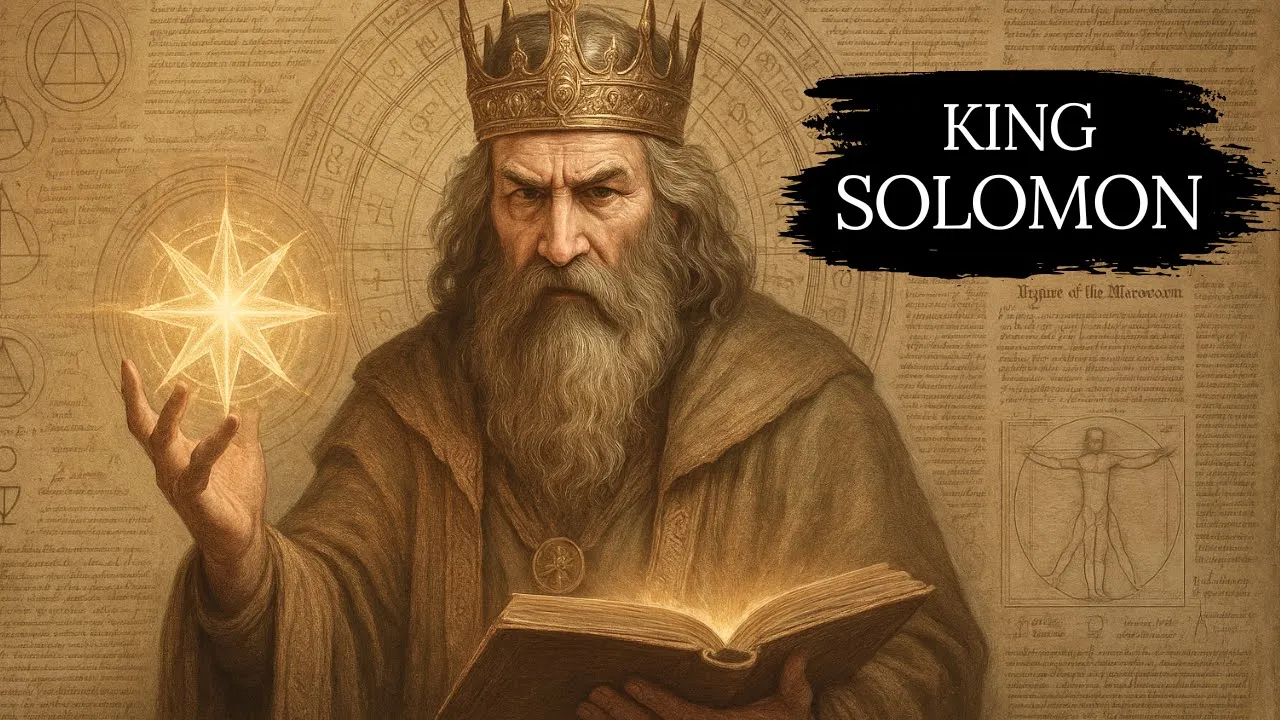
Some names echo through the centuries, others linger like spells. Solomon is both. You might try to find him in the pages of the Bible, in the columns of the temple, in the genealogies of ancient kings, but you'll never truly understand Solomon if you only search on the surface.
Because he doesn't live where history lives. He breathes in the space between history and myth. At that point where faith becomes code and language becomes a tool to bend reality.
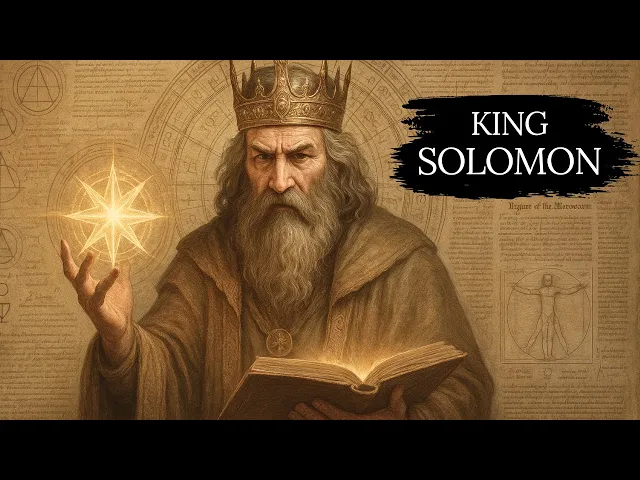
Solomon was not merely a king. He was an operator of the invisible. A man who held the unpronouncable name of God in his hands.
Who sealed entities with words. Who built a temple for something that cannot be contained. We're not here to talk about the Solomon of Sunday schools, but the one whispered about by rabbis in the shadowed corners of the yeshivas.
The one interpreted by Sufis as a master of jin. The Solomon who appears in Arabic manuscripts as the one who spoke with the winds and sealed demons in rings. The Solomon of hermetic grimmoirs and Hebrew alchemy.
the man who used the word as a sword and geometry as a spell. In this video, we won't be speaking about history, but about what hides between its lines, about the esoteric side of the king who built a temple, not only for worship, but for the crossing between worlds. Prepare to walk through the invisible doors that separate Solomon's world from the one you know.
They say God wrote the universe with letters of fire. But when Solomon raised the temple, he did something even bolder. He translated that fire into stone.
The temple of Solomon wasn't just an engineering feat. It was a code, an architectural mandela, a spiritual machine operating across multiple dimensions. Most people see in its construction merely a cultural relic, a milestone of Hebrew religiosity.
But the initiates, the true ones, know that the temple was a mirror of the cosmos, a ritual instrument, a structure designed not to house men, but to host the presence of the ineffable. According to cababalistic tradition, the world was created through the 22 letters of the Hebrew alphabet. This isn't metaphor for mystics.
Each letter holds a vibration, a number, a geometry, a power. They are the building blocks of existence, the atoms of creation. When Solomon began building the temple, he didn't work with mundane measurements.
He traced letters in space. He wrote the sacred into matter. The safer yet, the book of formation, attributed by some masters to Abraham himself, by others to the philosophical millure that Solomon inherited, describes how these letters are used to seal the four corners of the universe.
And so the temple becomes a seal, a space where geometry is not decoration but invocation. The holy of holies, the koteshakodesim was a perfect cube, 20 cubits in height, width, and depth. To the modern mind, this may seem like an irrelevant mathematical detail, but the initiate recognizes the language.
The cube is the symbol of stabilized earth, the plane upon which spirit descends and rests. It is the three-dimensional square, the manifest world in absolute balance. And of course it is also the form of the cubic stone, the hermetic symbol of the adept who has conquered inner chaos.
Geom Scholam, the greatest modern scholar of Cabala, wrote that the temple was the architectural incarnation of the tree of life. Each space within the temple, each ritual object, each veil and lampstand corresponded to a safhara, a divine emanation. This means that anyone who entered the temple wasn't merely walking through sacred space, but ascending or descending the steps of creation.
It was an alchemical right from Malc to Keather, from earth to crown. This idea isn't exclusive to Jewish tradition. In ancient Egypt, temples were also seen as petrified divine bodies.
In India, mandalas are habitable cosmic maps. In Chartra, medieval stained glass windows conceal geometric formulas the master builders never fully revealed. In all these traditions, architecture is not art.
It is magical operation. And like every esoteric architect, Solomon didn't build alone. According to the book of kings, he was aided by a nearly obscure but deeply symbolic figure.
Hyram Abby, the master craftsman from Ty. He was say the cabalists an initiate in the mysteries of metal and fire. His role to forge the sacred utensils.
But on a subtler level, he represents the fusion of pagan knowledge and Hebrew revelation. The union of wisdoms that the modern world has artificially separated. But the question that has haunted scholars since the 12th century is this.
Who gave Solomon the plans for the temple? The biblical answer seems clear. They were revealed by God.
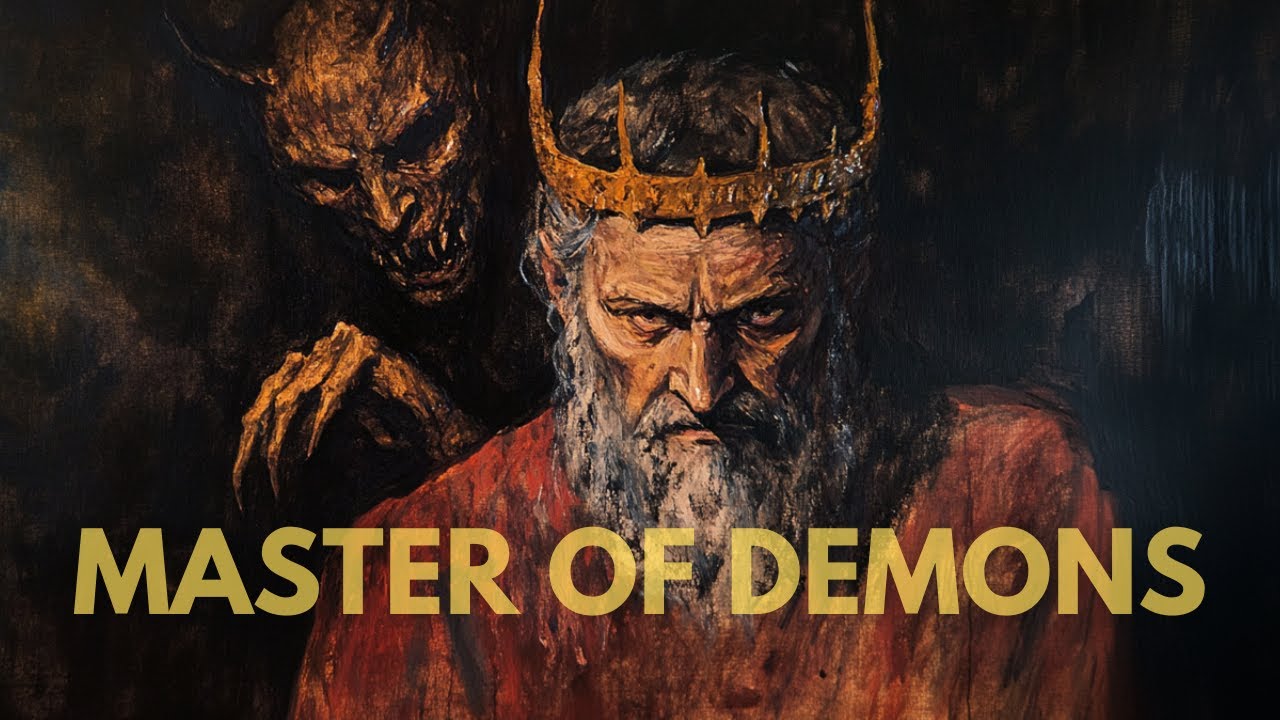
But apocryphal and gnostic texts challenge this view. According to the Testament of Solomon, a manuscript from the 2nd or 3rd century AD, Solomon learned the temple's secrets from entities of the underworld, not from angels, but from demons. One of them is Asodius, the same demon who appears in Persian lore and who in the text is captured by Solomon using a magical ring given by an angel.
This ring allows him to control invisible forces and with its help spirits are compelled to raise the structure. Every stone placed in the temple was moved by hands no human eye could see. This narrative disturbs the religious but enchants the initiates because it reveals the secret of alchemy.
Light is born from mastery over shadow. A temple is not built with innocence. It is built with integration.
Solomon didn't reject the dark side. He sealed it, subjected it to the order of the word. He turned chaos into structure.
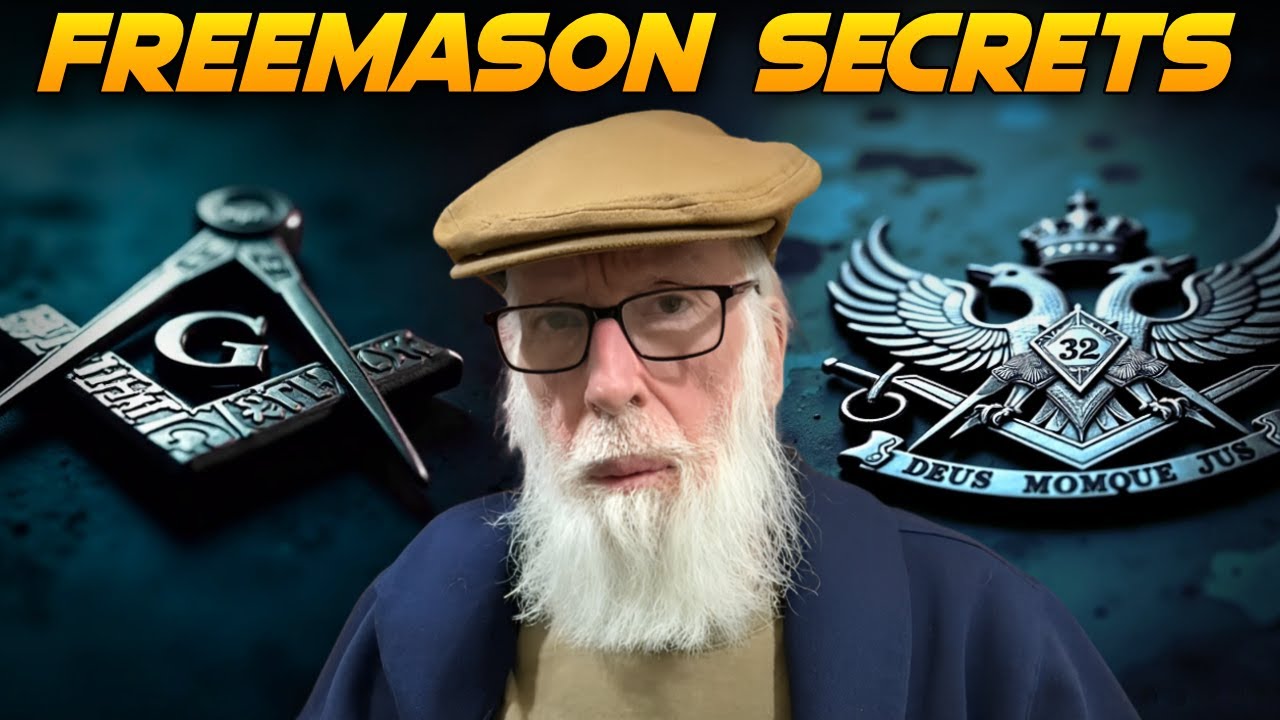
This model of the temple as a mirror of the soul profoundly influenced Freemasonry. In Masonic rituals, the temple of Solomon is symbolically rebuilt at every initiation. Freemasons, freemasons do not build with stone and mortar, but with symbols.
With each degree, new chambers of the temple are revealed, not as physical places, but as states of consciousness. That's why the temple of Solomon never truly ceased to exist. It was destroyed historically, but esoterically it continues to be built stone by stone within each seeker.
The temple is a labyrinth. There is no direct entrance, no visible staircase. Every step demands silence.
Every symbol is a key. Every door, a trial. And at the center of this labyrinth is emptiness.
Because the holy of holies was empty. No image, no throne, no altar. Only the space where the shikina, the divine presence, hovered.
It was a place meant to be inhabited by that which cannot be named. And that is the greatest mystery of the temple. It was built for silence, for the invisible.
On the surface, Solomon's story is that of a king, but in its depths, it is the story of a magician. And like every archetypal magician, he possessed an object of power, a ring. This ring was not merely an ornament.
It was the seal, the boundary between the visible and the invisible. Engraved according to Jewish tradition with the Shem Hamephash, the 72let name of God. This ring allowed Solomon to command forces that ordinary men dared not even name.
But before we speak of the ring, we must understand the power of the name. In the ancient world, a name wasn't a label. It was the very vibrational essence of a thing.
To know the name of something was to know its metaphysical structure. It was to master it. as in the ancient Egyptian writes where knowing the secret name of Rah granted power over the sun itself or in Hindu rituals where the mantra is the sound of the deity itself in Hebrew tradition the name of God is unspoken because to speak is to invoke and Solomon according to the Cabala knew more than just the name he knew all 72 names derived from a mystical reading of three verses from Exodus 14:19-21.
These names are formed by combining three lines of 72 letters in a process of alchemical permutation. The result, a vibrational ladder, a cosmic keyboard, each name a code, each code a key. The shem herphash is not therefore a word.
It is a coded energy field. and the one who bears it as the rabbis of the Zohasay touches the roots of creation. This name according to tradition was engraved upon Solomon's ring and with it the king sealed contracts with the invisible.
In the Testament of Solomon, an apocryphal text dated between the 2nd and 4th century CE. Solomon receives the ring from an angel named Michael. With it, the king invokes, interrogates, and subjugates demons and spirits.
The first to be captured is Ornius, a spirit who drains the life force from young men and women. Solomon does not destroy him. He questions him.
He wants to know where he came from, how he acts, under which star he operates. This is crucial. Solomon does not exercise.
He interviews. Because the seeker of wisdom does not eliminate chaos, he understands it. Over time, Solomon captures 72 spirits, each with its own function, appearance, and domain.
They are described in detail. Some have multiple heads. Others ride dragons.
Some teach sciences. Others induce delusions. But all are parts of the same puzzle.
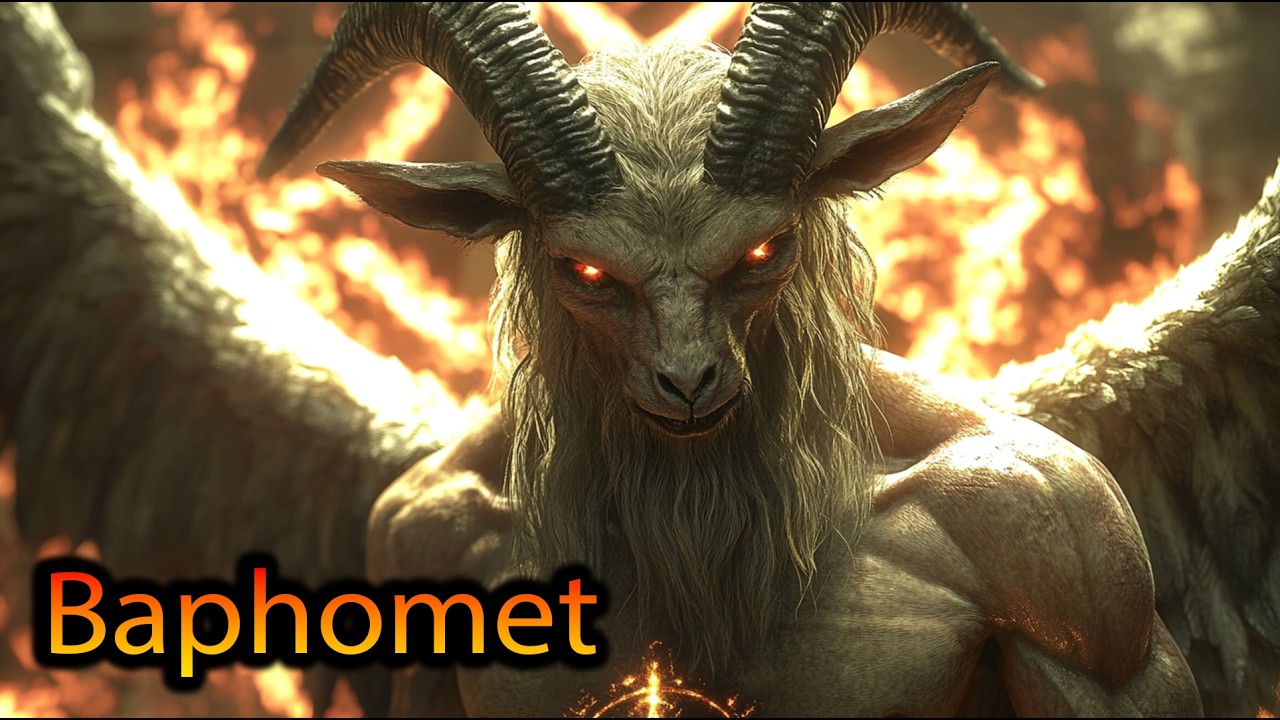
echoes of the powers of the world, raw forces of nature and psyche. These 72 spirits are those who appear in the Ars Gertia, the first part of the famed grimoir Lemagon or the lesser keys of Solomon. They are called the governors of hell.
But that word hell must be understood in the Greek sense of Hades, the inner world, the deep unconscious, the underworld of reality. Medieval European grimoirs turned these spirits into demons, but ancient Solomonic texts treated them as forces of nature and astral intelligences. Later esoteric traditions go further.
They claim each of these 72 spirits is an inverted face of one of the 72 sacred names. In other words, each demon is the shadow reflection of a divine energy, the union of opposites. Once again, the alchemy between name and number.
As Elus Levi wrote in dogma and ritual of high magic, the ring of Solomon is the circle of the will, armed with the sword of the word. He who possesses it justly fears neither hell nor heaven. But beware, the ring is a symbol.
It is not physical. It is the image of the inner power of an initiate who knows the names, masters the word and is unafraid to look into his own shadow. And perhaps this is the greatest lesson of the testament of Solomon.
The spirits he masters are not only external. They are projections of human passions, fears, desires, and obsessions. Each imprisoned spirit is a part of the psyche illuminated by consciousness.
Solomon then is the perfect alchemist. He does not expel the demons. He orders them.
He interrogates them and transforms them into laborers of the inner temple. This vision is shared by hermetic, Sufi, Gnostic and even some tantric Hindu traditions. To master the world is not to subjugate others.
It is to place one's own impulses in service of something greater. In Islamic tradition, the Quran also speaks of Solomon Sullean as a prophet who commanded the winds, the birds, and the jin. In Surah Anaml, the spirits work for him.
They build palaces. They fetch thrones in seconds. But in the end, when Solomon dies, his staff holds his body upright.
And only when worms consume it, do the Jin realize he has long been dead. This image is powerful. It shows that even the subtlest forces bow to the appearance of power.
But true power lies in silent knowledge, not in the gesture, but in the seal. Solomon's ring, then is the metaphor of will aligned with wisdom. It is the dominion of language over chaos.
And the 72 spirits, far from infernal horrors, are teachers of the abyss, involuntary guides whose voices can only be understood by those who dare enter the silence. The name, the ring, and the spirits form a magical triad. Name the vibration, ring the focus, spirit the force.
Whoever has one without the others fails. Whoever unites them builds worlds. And for that reason, in the oldest traditions of spiritual alchemy, Solomon is not remembered merely as a king.
He is honored as Magus Regis, the mage king, the alchemist of language, the lord of names. True wisdom is never comfortable. It is like a blade that cuts through illusion with such precision that for a moment the world seems naked, shapeless, almost unbearable.
Solomon, known in the Hebrew tradition as Schlommo, derived from shalom, meaning peace, bears this name not because he lived in peace, but because he understood the abyss that lies between comprehension and madness. And he chose to dwell in that abyss. When Solomon asks God for wisdom in the book of kings, he is not asking for cleverness to govern.
He is asking for access to the logos, the creative word, the primordial language through which all things were formed. The word used there is chokma, the same found in the Zohar as the second sephira, right beneath Kether, the crown. Chokma is not intellectual knowledge.
It is the spark of creation within the divine mind. This wisdom then is pure fire and fire when touched before its time burns. In apocryphal texts such as the wisdom of Solomon, traditionally attributed to the king but composed by helanized Jews in the first century B.
C. E. we find a mystical portrayal of wisdom as a living entity, feminine, seductive, luminous, and terrifying.
Solomon says that wisdom sits beside the throne of God and that he loved her more than scepters and crowns. The image is clear. Wisdom is not an attribute.
It is a presence. And this presence demands total surrender. The metaphor of a king in love with wisdom echoes Sufi songs and Orphic hymns.
It is the union of the mystic and the logos. Wisdom is not conquered. It is Wednesday.
And like every divine lover, it demands radical fidelity. But fidelity to wisdom is a renunciation of comfort. And this is where the drama begins.
Solomon knew too much. He understood the rhythms of the stars, the flows of the psyche, the names of angels, and the impulses of demons. He understood the language of birds.
A symbol according to the Sufis of the soul liberated from the body. He knew how to interpret dreams and silences. He knew the secret of the unpronouncable name.
And this wisdom was too much for one man. The book of Ecclesiastes attributed to Solomon though composed later reveals the heart of this paradox. We read there, "For with much wisdom comes much sorrow.
The more knowledge, the more grief. " This is not nihilism. It is an initiatory diagnosis.
Those who see too much also see the void. Those who understand the gears of the world know they turn upon impermanent axes. Those who hear the logos also hear the echo of the abyss.
The Solomon of Ecclesiastes is not the triumphant king. He is the weary initiate. The one who says everything is vanity.
In Hebrew, he meaning vapor, mist, something that slips through the fingers. For him, reality is fleeting. The world, a puppet theater whose strings he sees too clearly.
And that vision, instead of bringing him glory, brings him melancholy. Harold Bloom, literary critic and informal cabalist, claims that Solomon is the first literary figure of the divided self, a man who is both master and slave of his own lucidity. And this delirium of lucidity also appears in later cabalistic texts.
In the Sephir Habahir, for instance, wisdom is a tree that only blooms when its roots are planted in non-being. Supreme wisdom they say is to know that you do not know. Solomon then embodies this paradox.
He is the greatest of sages and for that very reason the most confused among men. He is the man who understands the laws of the cosmos but does not understand his own heart. Proof of this lies in his personal life.
The same man who preaches fidelity to wisdom is the one who becomes lost among 700 wives and 300 concubines. Not as one who indulges in pleasure, but as one who seeks something that even a thousand bodies cannot give. Complete understanding of the primordial feminine.
These women, many of them foreigners, are described in religious texts as traps. But in esotericism they are archetypes. Each represents an aspect of the soul that Solomon tries to assimilate but cannot.
It is the eternal dance of the feminine and the logos. Eternal, fascinating, never resolved. In Islamic mystical tradition, Solomon is known as al-Hakim, the wise.
But it is said that his wisdom led him to arrogance and that this arrogance caused him to temporarily lose the throne to the jin who took his form. In Lithuanian Cabala, Solomon is known as the master of the middle gate. He knew both the side of light and the side of shadow and therefore neither held him completely.
He crossed through them. But those who cross too many portals risk forgetting the way back. And that's where Solomon's figure becomes a mirror for every seeker.
Because anyone who follows the path of true wisdom will sooner or later reach the threshold between the logos and delirium, between revelation and dissolution. The secret is not to avoid that threshold, but to remain lucid within it. Wisdom, said Osho, is like the sky.
It allows all clouds to pass, but it does not confuse itself with any of them. And Solomon, in his best moments, was that sky. But in others, he got lost in the clouds of his own knowledge.
It's no coincidence that Solomon's ring, the same one that sealed spirits, was also a symbol of contained ego. For only those who master the ego can withstand the delirium that comes from revelation. Only those who accept silence can speak with authority.
Solomon spoke with the heavens. But he also heard the abyss and his wisdom was both his crown and his burden. And this is the ultimate truth of the mystical path.
There is no illumination without shadow. The price of lucidity is to see the world as it truly is and still choose to love it. King Solomon died millennia ago, yet his influence mysteriously never ceased.
On the contrary, with each passing century, the figure of Solomon is reborn under a new mask. at times as the archetype of the initiate, at times as the patron of ceremonial magic, and at times as the great architect of the inner world. In the hermetic tradition, Solomon is not just a biblical character.
He is a universal symbol of hidden knowledge applied to matter. The spirit who understands the secret structure of creation and uses it to elevate the soul and sometimes to dominate it. But before we delve into the universe of grimoirs and rituals, we need to understand how this image was crystallized over the centuries.
And for that, we must navigate the labyrinth of secret societies, initiatic orders, and manuscripts that circulated quietly through courts, abbies, and the laboratories of alchemists. Let us begin with Freemasonry, one of the most influential currents of the western esoteric tradition. In it, Solomon is the supreme archetype of the builder, the divinely inspired architect who organizes the chaos of matter based on sacred proportions.
In the medieval grimoirs, books of ceremonial magic written between the 13th and 17th centuries, Solomon appears even more boldly. He is portrayed not as a king, but as an absolute magician, master of spirits, codifier of seals, knower of conjurations and banishments, and ruler of the magic circle. The best known work in this cycle is the clavvicular salommonis, the keys of Solomon.
A compendium of magical instructions for invoking angels, creating talismans, consecrating instruments, and calling upon celestial and astral powers. Although its most widespread version was compiled during the Renaissance, its roots are much older. And in all versions, one thing is clear.
Magical authority stems from Solomon. The authority of someone who not only knew the names but knew how to use them. The grimoire provides meticulous instructions.
Which metals to use on each day of the week, how to draw protective circles, which prayers to recite and under which star to perform the ritual. This is not primitive superstition but a complete hermetic system based on the correspondence between microcosm and macrocosm. And the lematon or the lesser key of Solomon goes even further.
It presents the 72 spirits of the Goetia with their names, hierarchies, seals, and specialties. The grimoirs claim that Solomon trapped them in bronze vessels and sealed them with his ring. And that the modern magician, if the rights are properly followed, can summon these very beings for the purpose of gaining knowledge, healing, or protection.
But, and this is the crucial point, the Solomonic Grimmoirs are not books of sorcery for world domination. They are manuals of self-control, of inner silence, of ritual discipline and ego transcendence. Each spirit is a metaphor, each seal a mirror, each invocation a test of one's own consciousness.
While the grimoirs operated within ceremonial magic, the Cabala viewed Solomon as the bearer of daat, the hidden knowledge that unites the opposing poles of the tree of life. Not coincidentally, the name Schlommo can also be associated with Shalm, the complete one. In practical Cabala, the names of the 72 angels derived from the Shem Hameash appear in combination with the 72 names of goic demons.
It is the union of mirrors, the marriage of light and shadow. And Solomon is the point of tension between the two. He is not only wise, he is the axis of the paradox.
In some medieval cababalistic schools such as that of Isaac Lura, Solomon is seen as an incarnation of the tadic, the righteous one. He who sustains the world through his internal balance. But even the tadic carries a crack, a wound.
And that wound is the price of knowledge. In Islamic esotericism, Solomon is Sullean, the prophet king who spoke with animals, controlled jin, and commanded the winds. He appears in Sufi traditions as a symbol of the illuminated soul that masters the four elements.
The Higmat al-shra, the wisdom of illumination, invokes him as the archetype of the king of the inner world. In Gnostic Christian texts, Solomon appears in manuscripts like the Pistus Sophia, where his wisdom is compared to Nosis, the salvific knowledge. He is seen as one who possessed the mysteries of the heavens, but who failed by becoming too entangled with the world.
And here arises the final nuance. Solomon is not just a symbol of the victorious initiate. He is also the symbol of the initiate who made mistakes, who stumbled, who fell.
But that does not cancel him. On the contrary, it brings him closer to us. Because in true esotericism, the fall is part of the journey.
Light can only be known through contrast with shadow. And Solomon lived both intensely. Today, Solomon lives on in Rosacruian orders, in alchemical manuals, in incian magic systems, and in modern hermetic practices.
But more than that, he lives on in every seeker who dares to build their own inner temple. If this video touched you on a level deeper than the surface, share it with someone who is ready to cross the veil. And if you want us to continue unveiling the hidden side of history, leave your seal in the comments because as Solomon himself once said, there is a time to be silent and a time to speak.
Now it's your turn. Thank you for watching.