[Applause] [Music] so we know from our research that one of the most powerful predictors of quality safety productivity diversity you name the result area in organizations is people's capacity to hold crucial conversations but what predicts Your Capacity to hold those crucial conversations in an effective way let me describe an experience I'm sitting a group of of Executives with whom I've worked for about 6 months I'm watching the CFO in particular because he's been strangely silent for the entire six-month period I don't know if that would bother you but for me it was kind of troublesome
that here's this organization making enormous Capital decisions and the CFO is entirely silent as I asked around about this I found out that this had happened about 10 years prior the man had shut up in executive meetings for 10 years years the incident that started all of this was an argument between the CEO and the CFO the two of them differed on some important strategic point the argument got a little bit heated but it was okay everybody was weighing in everybody was pushing their point until one crucial moment at one point the CFO in exasperation
said to the CEO I just don't get it I don't understand why you think what you think there to which the CEO said the reason I think this is because unlike you I've been working in this industry for the past 15 years that was the moment when the CFO shut up for 10 years here's what we know about crucial conversations what we know is that one of the greatest barriers to your capacity to talk about emotionally and politically risky issues is the degree to which you start to move to silence or violence and feel good
about it so often during crucial conversations what happens is we shut down like the CFO or we start to move to what we call violence we start to press our Point start to compel convince control I took my son on a wonderful trip a few years back I had a speech I was doing in Pebble Beach so I asked him he was kind of interested in golf if he wanted to come along he says oh Dad that would be wonderful we had a wonderful golf vacation and uh and since the client was picking up the
T I thought you know I got a little loose change in my pocket he's looking around in the golf pro shop and and I watch him looking longingly at these windbreakers with a little cypress tree on them and so I walked over to him and I said so Samuel would you would you like one of those windbreakers and he looks up at me with big dough eyes and says oh Dad he said could I possibly have one of these I said yeah yeah yeah let's let's go try one on he finds one that fits we
go up to the cash register I hand him my American Express card it costs something like $9 million and you should always check the price first but I thought you know it's once in a lifetime and so we we finished the day the next morning we get up early drive to the airport we got up too early for breakfast so when we get to the airport he goes to one of these fast food places and he gets this box full of French toast sticks and a big giant tub of maple syrup he's wearing his windbreaker
we board the plane he puts down his little tray he sticks the French toast sticks on there he grabs a hold of the foil top to the this maple syrup tub and he pulls and he pulls and he pulls wearing his $9 million windbreaker he's pulling and pulling and finally the thing Yanks all of this maple syrup sprays up into the air and drops down on top of his windbreaker well I'm sitting here in the seat next to him and I I looked over and I'm waiting for some reaction some acknowledgment of the the horror
and Devastation that's just taken place there's none he grabs a french toast stick jams it down into the maple thing starts slashing it into his mouth drooling down the front of his windbreaker I'm sitting here thinking to myself you ungrateful brat and I'm about to say something so here's the moment the moment that predicts how well you do in a crucial conversation is that moment right before you open your mouth our tendency during those moments because of the emotional content of the crucial conversation is to be tempted to move towards some form of Silence like
the CFO or the direction that I'm heading right now why well here's what we've learned through 10,000 hours of observation of people who are magnificently gifted during those moments here's what we know what we know is that the way you are about to act during your crucial conversation is going to be largely and profoundly affected by how you feel right now no big surprise there that's not rocket science but here's the big Insight the huge concept which if you can absorb it if you can Embrace this if you can deeply understand and learn to master
this concept will give you enormous influence during your crucial conversations the Insight is this how you feel during a crucial conversation is not a direct function of what you just saw heard or experienced notice the model what I see in here does not create an emotion me seeing my son jamming French toast sticks into the middle of this giant tub and drooling it over a $9 million windbreaker does not create anger it doesn't a CFO being condescended to and shut down during an executive team meeting in a public setting is not necessarily going to be
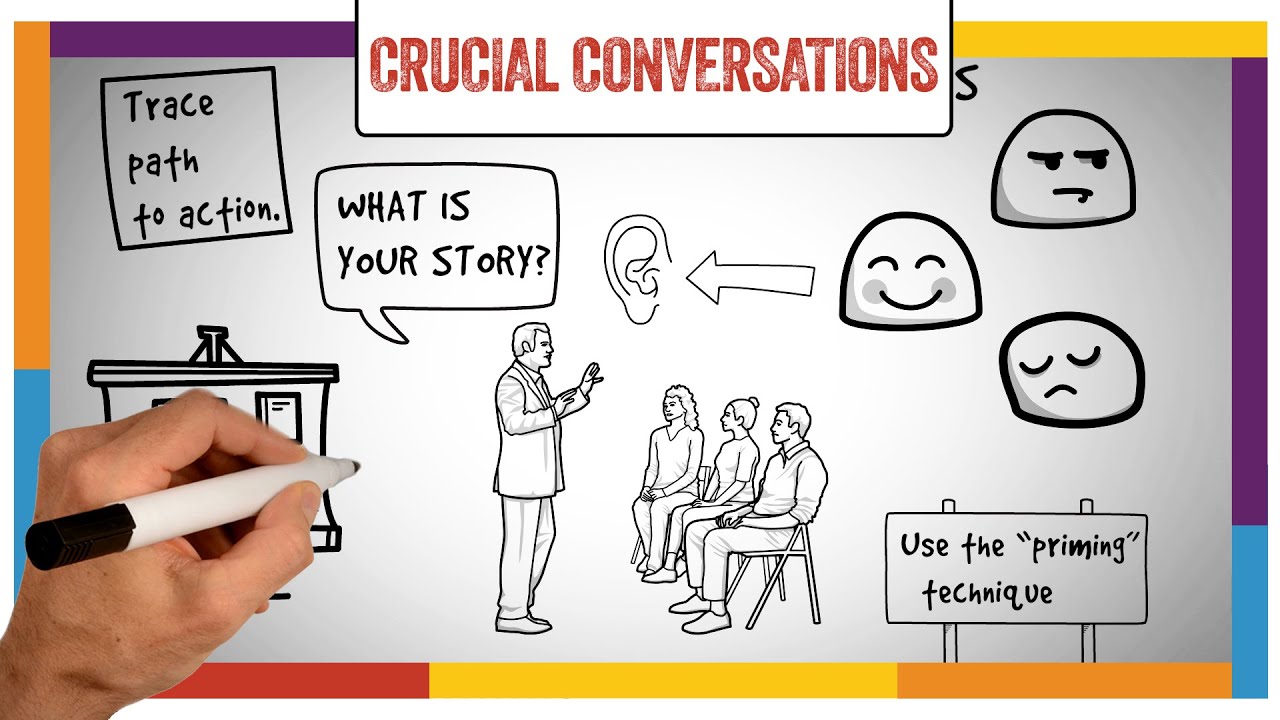
a going to take offense because of what just happened what he just experienced does not create the emotion there's an intervening variable called your story before you can experience an emotion you have to tell yourself a story about what just happened to you now the problem is you and I are hardwired to tell certain kinds of stories and to the degree you can start to recognize your tendency to tell these types of stories Challenge and change these stories you gain enormous control over your own emotions let me tell you a quick example here I'm gonna
ask you to play with this one for a second I was asked a question a while back from a woman who was struggling with a crucial conversation with her husband she said I want you to follow this here she said I just found out that over the past six months my husband has had lunch with his ex-girlfriend now the question I want to ask you is as I start to describe some of that information what story are you tempted to tell yourself think about it for a moment what sorts of things did you add to
the information that I just shared well some obvious concerns might be is he having more than lunch is he having dessert right is there more going on here are they fooling around is there a relationship is he doing something behind my back but look how even more subtly we start to add so much to what's going on in this moment I want you to go back to what you experienced in your brain when I first started describing what that woman said I just found out that my husband over the past six months has had lunch
with his ex-girlfriend what sort of leaps do we start to make now I don't know if you're like me but when I heard her talking I didn't just hear her say lunch I started to see lunch did you do that I started to imagine what the lunch looked like and there was a certain kind of restaurant was there in your mind was it a restaurant with a drive-thru or was it a restaurant that had linen tablecloths and fine silverware was that your restaurant was there a Candlestick were there certain people at the table were there
a lot of people or was it just two in that moment we start to make lots of inferences we start to tell certain kinds of stories here's my son with maple syrup drool all over the front of him and the thing that's creating my emotion is not the maple syrup drool it's the story I start to tell myself about the maple syrup drool here's what you and I tend to do the stories that create our emotions come in two flavors if you're the kind of person like I am who frequently feels frustrated in those moments
who can immediately feel frustrated in concerns the kind of story you tend to tell yourself that creates that emotion is that people are doing what they're doing because they're stupid they're an idiot that's why they're doing that but if you tend frequently to feel deeply offended hurt or even angry there's a different story you're likely telling yourself the story you're telling yourself is that they're doing what they're doing because they're evil not just stupid but evil they have malicious intent they don't care about worthy purposes they don't care about my concerns they have their own
self is motives the problem is there're evil rotten motives that story is what creates that escalated emotion and therefore moves you to either silence or violence if you can learn to intervene and effect that story it changes everything here are the three types of stories you're going to have to learn to watch out for and the problem is you and I are Masters at telling these so go back with me to the airplane my son's sitting here next to me I'm feeling outrage red offended indignant why because the story I'm telling myself is a victim
story to begin with look at what he's doing after all I've done for him I spent all this money I go to all this trouble I make this wonderful experience and he doesn't care a wit about any of it look at the poor victim that I've made myself out to be you tell yourself that kind of story and it subtly justifies you're moving to silence or violence now I can move to violence with my son I can call him names I can punish him and I don't have to feel guilty about it because after all
I'm an innocent victim but the victim story isn't enough you need more to help yourself feel good about silence or violence because for the most part you and I believe we shouldn't do those things we shouldn't withdraw we should speak up we shouldn't sort of move to violence and control and compel but we do anyway so we need a second kind of story to help us out we need a villain story not only am I an innocent victim but look at this kid he is ungrateful he is selfish he is undisciplined he is obnoxious he
is the degree to which I can paint him as evil and awful and rotten is the degree to which I can feel Justified now in Behaving Badly as a parent let's move back to the CFO same story he knows as a CFO he has an ethical responsibility to weigh in and have an influence in his executive team meeting so how can he feel good about 10 years of Silence number one I'm a victim I was mistreated I was condescended I was marginalized number two he's a villain he doesn't care about my opinions he's controlling he's
obnoxious he's arrogant he's egotistical when I tell myself that kind of story I create a certain kind of emotion and I create a certain kind of action as a consequence and I can feel good about those kinds of actions and finally I tell myself a helpless story there's nothing nothing else I could do now where's the power where's the Leverage What if you had the capacity to number one notice when you told these kinds of stories but number two intervene and change them so here I sit on the plane and I'm about to LEAP into
punishment and lecture mode with my son and I bit my lip because I just taught a class on crucial conversations and I paused for a moment and I stopped and I asked myself what story am I telling myself that's making me so mad it didn't take long to articulate that he's an ungrateful obnoxious bratty kid as soon as I told that story I found myself capable of crafting a different story the story sounded a little bit like this the story was not obnoxious brat the story was normal 15-year-old old kid would that change how you
felt now notice what I'm not suggesting is I shouldn't hold him accountable we're going to hold him accountable we need to talk up to the CEO we need to be able to hold peers and others accountable but will I hold them accountable in a better way as soon as I stepped back and came toward him with the story that said normal 15-year-old boy here's what my first words sounded like Samuel did you notice that you got maple syrup on your Cyprus Tree jacket here's what he did he pushed the French toast stick away he looked
down at his jacket and he went oh no started balling uncontrollably sitting there on the plane and then he turns to me and says Dad will it come out and I said Hey to the flight tenant will you please do you have any club soda can we the whole situation changed in that moment now what was the problem why was he doing what he's doing is it because he's an evil rotten villain or is it because he's a dork is it because he's a normal 15-year-old boy and should he learn to be able to manage
his Goods better than he did absolutely but did he need guilt and Punishment No what he needs is ability not motivation if during those moments you gain the capacity to Master Your Story to notice the stories you're telling yourself that are creating your emotional response and intervene and change those you gain the capacity to step up to crucial conversations that will affect results and relationships in every area of your life [Applause] [Music] [Applause] [Music]