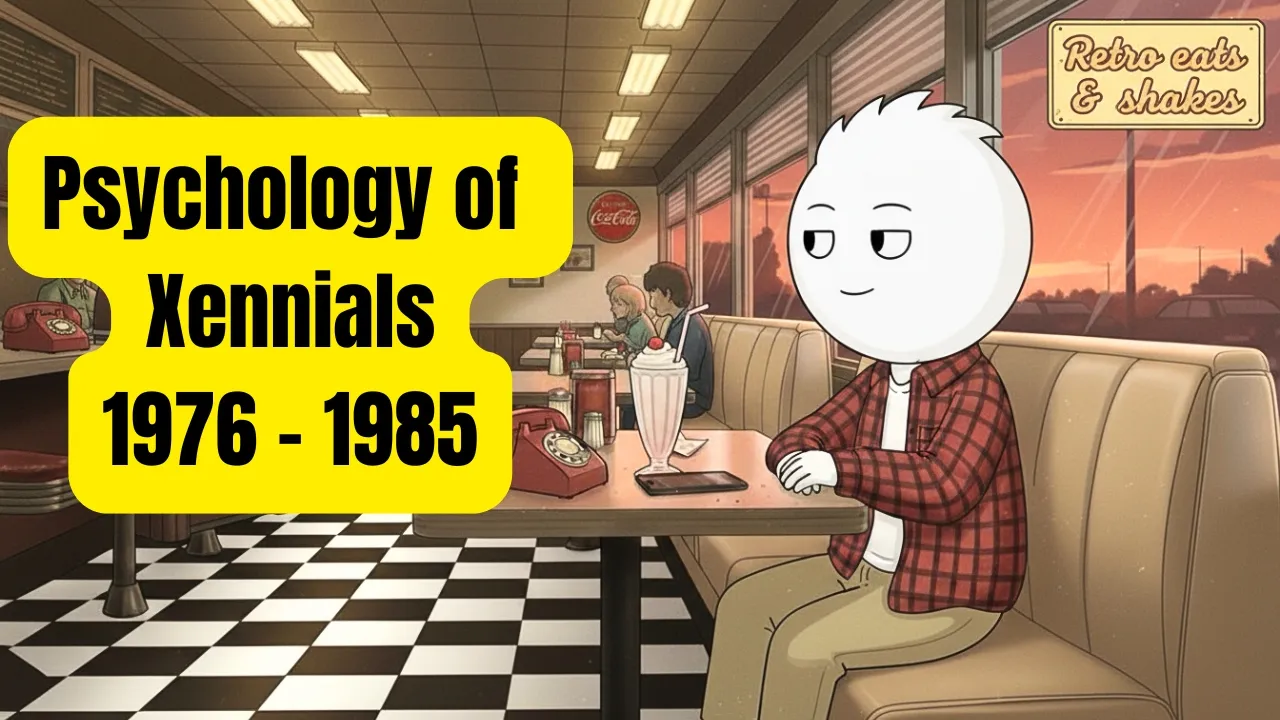
There's an entire generation of people who remember both rotary phones and the first iPhone launch, and psychologists can't quite figure out where to put them. If you were born between 1976 and 1985, you're on the tail end of Gen X, but you're hardly a millennial, even though everyone keeps trying to shove you into one of those boxes. You're what researchers started calling a zenial around 2014.
And some sociologists have even labeled this group a microgeneration because the window is so specific. what happened during that specific slice of history created something that's genuinely worth examining. So today we're going to explore what makes them interesting from a psychological perspective.
From the start, you spent your childhood in an analog world where boredom was just something you sat with, where you had to actually remember phone numbers. And not to mention the dread if you missed your favorite TV show, it was just gone. Yet one day, right as you were moving into adulthood, the entire world went digital.
Not gradually, suddenly. The timing of this shift had consequences that are still playing out. Most generations grow up entirely in one technology paradigm or other.
Zenials, however, went through both of these life-defining experiences during the years when you were still discovering yourself. Your late teens looked very different to your 20s, and the disparity in age was far wider than most generations experience. Consider the implications of this on your daily life.
Remember how much of your teens were spent passing physical notes in class or having conversations that disappeared into thin air or making plans where you weren't able to text running late or where are you? You just showed up and hoped your friends would be there. That required a completely different kind of trust and commitment than what exists now.
But then you were in your 20s and saw everyone get cell phones. You registered with Friendster, next MySpace, then Facebook. Prior to social media, most people only had three different ways to contact someone, either their home or work phone or just by showing up at their house.
Then suddenly, you have 17 different messaging apps, and you simply figured it out. During your formative years, you experienced both worlds. According to research on brain development, the prefrontal cortex, the region that mediates our ability to adapt to new situations and learn complex skills, is still maturing until roughly the age of 25.
A study published in Nature Neuroscience found that this region matures well into the 20s. This means that zenials were still in this high plasticity window when the technological landscape went through a complete overhaul. You were young enough that picking up new technology felt natural, but old enough to remember what came just before it.
Due to being adults when technology first appeared, Gen Xers can sometimes be a bit skeptical of technology. Millennials, particularly the younger ones, have no real memory of life without the internet. If you're a zenial, though, you've experienced both things, which has created a kind of bilingualism that is pretty rare.
You can have a face-to-face conversation without checking your phone every 30 seconds, but you also don't get anxious about learning new software. You remember what it felt like to be genuinely unreachable for hours at a time, which is an experience a lot of younger people simply don't have. But you're also not intimidated by technology the way some older generations are.
And this shows up in ways you might not even notice. Like you probably have a different relationship with privacy than other generations. You grew up in a world where your embarrassing moments just faded into memory instead of living forever on social media.
That seventh grade haircut, that breakup, that drunk night at a party, there's no photo evidence. It just exists in the stories people tell. This creates a fundamentally different relationship with your past.
Your memories could evolve, could become stories, could change shape over time the way human memory naturally works. You weren't trapped by documentation. Research on autobiographical memory suggests that the way we store and recall personal experiences is actually quite fluid.
Our brains are designed to edit memories, keep what matters, and let the rest fade. When everything is permanently documented and searchable, that natural process gets complicated in ways we're still trying to understand. But here's where things get messy.
You also entered the job market right around the 2008 financial crisis, which means a lot of you experienced significant economic instability during the exact years when you were supposed to be establishing your careers. That timing matters more than people realize. Research on economic hardship shows that financial trauma during this life stage can have lasting psychological effects.
People who experience job loss or financial instability during this life stage often carry those experiences forward even after their situations improve. It shapes how you think about money, security, and risk in ways that don't easily go away. So, you've got this generation that learned to adapt to massive technological change, but also got economically burned right when you were trying to build stability.
You can navigate change because you had to. But you might also have this underlying current of what if it all falls apart again running through your decision-m. And nobody really talks about this combination.
The cultural conversation about generations tends to pit Gen X against millennials, as if everyone born after 1965 and before 2000 is basically the same. But the specific years you were born in, especially during periods of rapid change, create distinct experiences that don't fit into those broad categories. Zenials deal with a paradox that's honestly pretty unusual.
You have the self-reliance and skepticism of Gen X because you grew up before helicopter parenting became standard. Your parents probably didn't know where you were for hours at a time, and that was just normal. You learned to solve problems on your own, to entertain yourself, to deal with boredom and frustration without immediate adult intervention.
However, you also reached adulthood during the early days of the internet when technology was still thought to connect everyone and solve everything before we all realized that uh it might be actually making some things more complicated. It is odd to find yourself there. Independent and cooperative, doubtful yet optimistic, digital but analog.
What seems to define zenials is this ability to hold contradictions without it feeling weird. You remember the before and the after, which means you're able to see what was gained and what was lost. Perhaps you're not as nostalgic for the past in the same way Gen X might be since you genuinely appreciate modern conveniences, too.
However, unlike many of the younger generations, you still recognize what we gave up. You lost the ability to be truly alone with your thoughts without effort. You lost the patience that comes from waiting.
You lost a certain kind of presence that existed when there wasn't always something else competing for your attention. But you gained connection, information, and possibilities your younger self couldn't have imagined. If you're a zenial, you probably feel like you don't quite fit in anywhere.
Too young for some things and too old for others. Caught between two worlds. It's not a fault.
That's actually the defining feature of your generation's experience. In a world that keeps changing faster than anyone can predict. Having lived through one massive transition might be one of the most valuable things you could have learned.
You've adapted to a transitional lifestyle. The environment in which you were raised doesn't necessarily have to be the one in which you live forever. The Zenial experience is worth knowing about because of that more than anything.
Not because you're special in some superior way, but because you lived through a specific moment in history that taught you something the rest of us are still trying to figure out. How to adapt without losing yourself in the process. If this resonated with you, I'd really appreciate you subscribing.
And if you want to help me keep making content like this, consider becoming a channel member. Your support genuinely means a lot. I've got some other videos queued up that I think you'll connect with.
Different topics, but the same kind of depth. I'll see you in the next one.