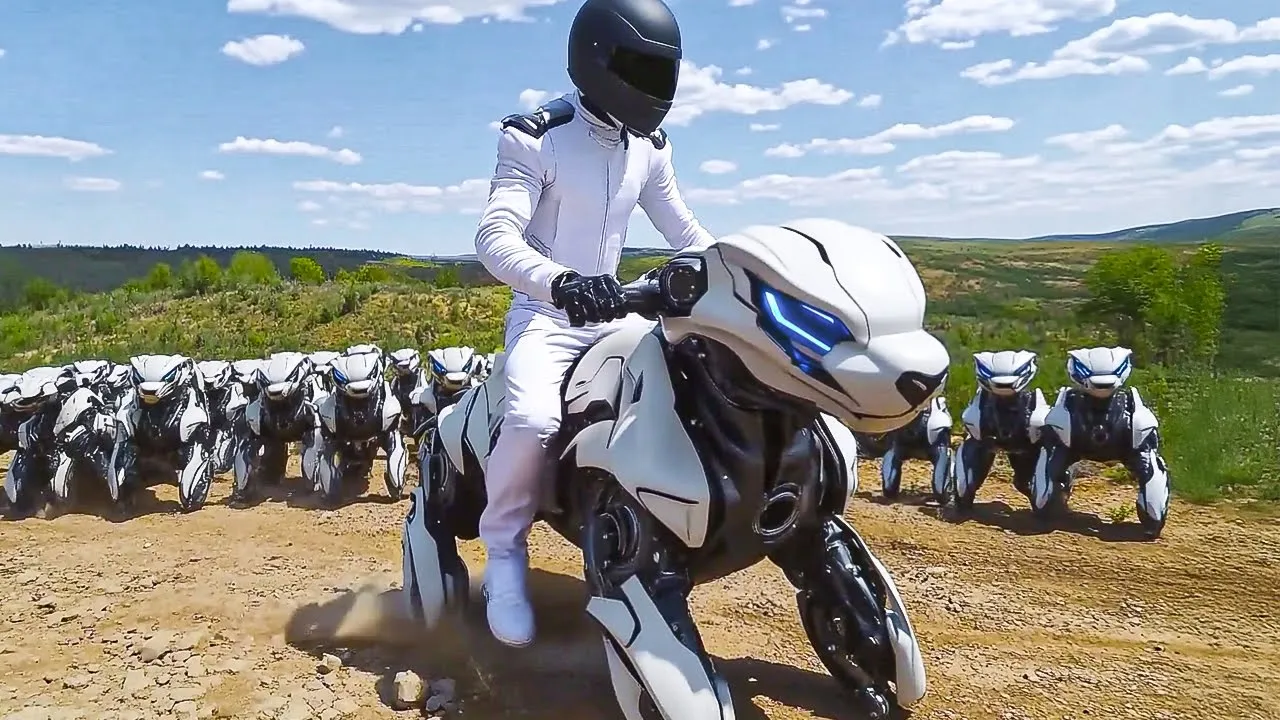
In a surprising turn of events, Kawasaki, widely known for its iconic green motorcycles, has taken a bold step beyond two wheels. The Japanese manufacturer recently introduced a new concept vehicle called Corio, a machine designed not only to traverse all terrains, but also to redefine the very idea of mobility. Imagine a horse that doesn't eat, sleep, or need food.
Now, picture it powered by hydrogen and ready to ride. Kawasaki has just unveiled something that seems straight out of the future. A robot horse called Corio.
Introducing the allnew Kawasaki Coro. A four-legged robot powered by hydrogen. It's built for rugged terrain, runs on clean energy, and could change the way we think about transportation.
Could this be the future of travel? What are its manufacturing components? Join us as we look into this new hydrogen-powered robot horse by Kawasaki that will blow your mind.
Corio Kawasaki's hydrogen-powered robot horse. They say there's nothing new under the sun, but sometimes something shows up that really makes you think twice. In April 2025, Kawasaki Heavy Industries did just that.
At the Osaka Canai Expo, they showed off something no one saw coming. A ridable robot horse named Corio that runs on hydrogen. It instantly got people talking.
Instead of showing off a fancy bike or a flashy electric car, Kawasaki brought out a four-legged machine that looks part horse, part robot, and yes, you can actually ride it. So, what's Corio all about, and when can we expect to see it on the roads? Stick around because this one's going to surprise you.
Corio isn't just for show. It's built to carry people just like a real horse. Kawasaki, known for both bikes and robots, combined both worlds here.
It runs on a small 150cc hydrogen engine which creates electricity to power the motors in its legs. That means it can walk across all sorts of ground, grass, rocky paths, even uneven rubble. Each of its four legs moves on its own and ends in rubber pads that help it grip the ground.
Unlike wheels, which can slip or get stuck, each of Corio's four legs has rubber hooves at the bottom to absorb impacts and prevent slipping. Taking inspiration from natural mountaineers like these homies, Corio's legs can adjust to the surface. It's not going to gallop, but it can walk, trot, and keep its rider steady the whole way.
What's really cool is how you control it. There are no complicated buttons or remote controls. The rider steers using handlebars and simple body movements.
Lean forward or to the side and Corio follows. The handlebars feel like a motorcycles and there are adjustable footrests so anyone can ride comfortably. Right between the handlebars, there's a screen that shows things like fuel level, balance, and how the rider's weight is spread out.
At night, Coro even shines lights on the ground to guide the way. Corio's body is made from a mix of carbon fiber and metal that makes it strong, but still light enough to move around easily. The seat looks like something you'd find on a motorcycle, and the front has a similar shape to a bike's headlight, but once you look down, you can clearly see the robotic legs and joints.
It moves more like an animal than a machine. While some robots, like the ones from Boston Dynamics, are built to move fast and jump around, Coro is more about steady, safe rides for people. The hydrogen tank sits at the back.
When it's working, the hydrogen goes through a generator that creates electricity and gives off just water, so it doesn't pollute the air like gas powered vehicles. Kawasaki says this is part of a bigger plan to explore cleaner energy options. There's no official release date yet, but Kawasaki hinted that robots like Corio could become common by the 2050s.
For now, it's still a prototype, but they're taking it seriously. It's not just some cool gadget for show. Kawasaki sees it as a real step toward the future of transportation, especially in places where cars or bikes can't go easily.
They think Corio could help during emergencies, like in search and rescue operations or be used in areas hit by disasters. It might also be useful for exploring risky places where it's too dangerous to send people. And with more development, it could help in rural travel, tourism, or even military support.
At first glance, a robot horse might seem a bit odd, but when you think about it, it's a smart way to handle rough terrain, slow, steady, and built for places wheels just can't reach. Impact of Corio on future transportation. Corio isn't just some fancy robot for show.
It's Kawasaki's way of saying that maybe we won't always need wheels to get around. Instead of rolling like a car or a bike, this thing actually walks like an animal. And it doesn't use petrol or electricity either.
It runs on hydrogen, which is a much cleaner option. Corio is powered by a 150cc hydrogen engine that generates electricity to drive the robot's four legs. The only thing it gives off is water, so it's better for the environment.
Kawasaki's been looking into hydrogen for all sorts of things, trains, ships, even big engines. So, Corio is just one part of that bigger plan. What makes Corio really stand out, though, is how it combines that clean energy with legs instead of wheels.
Wheels are great on smooth roads, but once you hit hills or rocky paths, they struggle. Legs can step over things, walk on uneven ground, and even manage stairs if programmed right. Kawasaki has built- legged robots before, like the ones that walk on two feet.
But this is their first four-legged ridable one. That's a big deal because making a robot that can carry someone stay balanced and respond to human movement isn't easy. And the way you ride it, super simple.
No remote control or complicated buttons. You just lean your body to one side or forward and it responds kind of like riding a horse or a bike. That means most people could probably get the hang of it without much training.
Plus, it has some smart features built in. It can warn you if you're sitting wrong, tell you how stable the ground is, and even light up the path ahead at night. It's not fully automatic, but it's smart enough to help out when the terrain gets tricky.
At first, a robot horse might seem strange. But the more you think about it, the more it makes sense, especially for places where cars and bikes can't go. It's indeed something to be excited about.
In other news, Kawasaki believes this machine isn't just for fun or show. One of the big ways it could help is during emergencies. When there's an earthquake, landslide, or flood, roads can get blocked or totally destroyed.
A robot like Corio could step in to carry supplies, help rescue teams, or even reach injured people in places regular vehicles can't go. It could also be useful in farming or forest work, especially in rough areas without proper paths, just to check the land or move equipment around. Some people even think it might work for military purposes.
A machine that can quietly carry someone through forests or up mountains without using loud engines or giving off smoke could be really useful. Hydrogen is clean and silent, so it wouldn't easily give away a location like gas powered vehicles might. That said, Kawasaki hasn't officially said anything about using it for the military.
There's also a chance it could show up in tourism someday. Picture tourists riding robot animals through nature parks instead of riding big trucks that damage the land. Hydrogen-powered rides like this wouldn't pollute the environment either, but that's still a long way off.
Right now, Corio is still just a prototype. It's not for sale yet, and Kawasaki hasn't shared the price or full details like how far it can go. What they have made clear, though, is that they're taking it seriously.
Engineers are still working on it and showing it at tech expose to see how people react. Evolution of Kawasaki Heavy Industries. As a leading company, Kawasaki Heavy Industries has always been challenging to open new possibilities for industrial robots.
Kawasaki Heavy Industries is not new to the world of robotics and innovation. The Corleo, their hydrogen-powered robot horse, may be one of the more recent and spectacular creations, but it is far from their first. Kawasaki has been in the business of designing, building, and launching machines long before robots ever entered mainstream conversation.
Founded on October 15th, 1896, the company was originally established by a visionary named Shozo Kawasaki. Born in 1836, he was a merchant and entrepreneur who had experienced several maritime failures. These setbacks inspired him to create stronger, more reliable ships using Western ship building techniques, which were just beginning to influence Japan's industrial rise.
How have they grown over the years? What other inventions do they have? Brace yourself, this is about to get even better.
Shozo Kawasaki's first shipyard opened in Tokyo, but he eventually moved operations to Hyogo Prefecture, where the Kawasaki dockyard company officially began. At the time, Japan was rapidly expanding its military and industrial capabilities, and Kawasaki's ability to produce ships, trains, and heavy equipment quickly placed the company in a critical position within the national economy. One of the most important milestones came in 1906 when the company ventured into producing parts for locomotives, aircraft, and automobiles.
This diversification made the company more resilient and positioned it for further technological breakthroughs. Kawasaki formally became Kawasaki Heavy Industries in 1969 after a merger with several affiliates. But even before that rebranding, it had already begun exploring automated systems and robotics.
The true leap came in 1968 when Kawasaki partnered with Unimation. Industrial technology is now heralding the age of manless production. Numerous tests are being carried out on Kawasaki Unimate, a multi-purpose industrial robot.
The American company widely credited with building the world's first industrial robot. Through this collaboration, Kawasaki produced Japan's first industrial robot, the Kawasaki Unimate 2000. It was a hydraulic machine designed for tasks like welding and material handling in factory environments.
The partnership with Unimation marked the birth of Japan's robotics industry. In the decades that followed, Kawasaki kept evolving its robot systems. It introduced the P series electric robots in 1981.
the E-series in 1983 and later the J series in 1989. These robots became essential tools in sectors like automotive manufacturing where precise and repeatable motions were necessary for welding car bodies. In 1992, the UER arrived, offering higher precision and flexibility.
By 1998, Kawasaki's F-S series robots improved further on speed and accuracy, followed closely by the Z series in 1999, designed specifically for painting and coding. These models showed that the company was investing not only in mechanics but also in software and control systems. One of the most significant shifts in their robotics division came in 2002 when Kawasaki launched the M series robots designed to carry extremely heavy payloads.
That same year, they also released the K series of painting robots and the Y series of picking robots, focusing more on automation in logistics and warehouse operations. In 2007, Kawasaki launched their first clean robots for semiconductor and LCD panel manufacturing. In 2015, the Duaro dual arm robot was released.
Specifically made to safely work alongside humans. It could carry out two-handed operations like a human, making it perfect for tight, crowded production lines. By 2013, Kawasaki moved into medical robotics by co-founding Metacaroid Corporation.
This was a joint venture with Sysmex Corporation to develop roboticass assisted surgical systems. One of their most important medical robots called the Hinuri. Hinotauri realizes sophisticated surgery, intelligent, smooth hospitality.
The one-of-a-kind medical robot has been perfected. Has been tested in hospitals for minimally invasive surgeries. This shows that Kawasaki's interest in robotics goes beyond industry.
It includes medicine, space, and now public entertainment with machines like the Corio. The robot horse itself is not just a gimmick, but a continuation of Kawasaki's long-standing efforts in advanced robotics. While the Corio is powered by hydrogen, this also isn't Kawasaki's first rodeo with hydrogen technology.
In 2022, Kawasaki completed the world's first international transport of liqufied hydrogen using a specially built ship called the Swisso Frontier. The ship carried hydrogen from Australia to Japan, proving that hydrogen could be moved at scale. Kawasaki also built hydrogen-powered motorcycles and fuel cell systems, meaning the integration of hydrogen in the robot horse was the natural next step.
Outside robotics, Kawasaki has contributed massively to transportation. Their aerospace division supplies parts for Boeing and other commercial jet manufacturers. They manufacture aircraft fuselage panels, cargo doors, and wing parts.
In rail transport, they've designed and built Shinkansen bullet trains and urban commuter trains in countries like the United States. In fact, many subway systems in New York, Washington DC, and other major American cities use Kawasaki trains. Kawasaki also has a big name in the motorcycle world.
Their Ninja series, for example, is one of the most famous motorcycle lines globally. It mixes speed with mechanical precision, reinforcing the company's brand as one of engineering excellence. Their motorcycle division started officially in 1960 and has remained one of the most profitable arms of the corporation.
Today, Kawasaki Heavy Industries is organized into several main divisions. aerospace systems, rolling stock, ship and offshore structures, energy solutions, precision machinery, motorcycles, and robotics. The company has production sites in Japan, the United States, the Netherlands, India, China, and Thailand.
The global headquarters are in Kobe, Japan, with corporate functions also operating out of Tokyo. The company employs over 30,000 people worldwide and earns annual revenues of over 1 trillion yen. It continues to develop in-house AI software, advanced sensors, and autonomous control systems for its robots.
Recent innovations also include remote control robotic systems and humanoid prototypes like Kido, designed for use in disaster recovery zones or places too dangerous for humans. What do you think of this robot horse? Would you give it a ride if it ever hits the road and even tracks your daily activities?
While it already performs these impressive abilities, you won't believe what else the Xiao glasses can do. How do these AI glasses made in China compare to the ones Google creates? To find out, join us as we reveal China's cuttingedge glasses that are shaking up the AI industry and changing the game.
Bu's Xiao AI glasses. Packed with many top tier features, BU's Xiaiu AI glasses are surprisingly lightweight and stylish. They offer users a clear view of a smarter world.
One of China's biggest tech giants, BYU, has dropped these glasses into the market like a bombshell, and they're already selling out fast. You might be wondering what makes these glasses so special. Well, for starters, they're powered by BYU's Ernie AI model, like having a super smart assistant at your fingertips.
Imagine walking through a busy street and needing an answer to a question. Instead of getting distracted with your phone, you just ask and the glasses respond instantly. These glasses do it all.
Whether it's translating signs, identifying objects, or even helping you track your daily calories. But the best feature seems to be the question and answer application. And the way it works will change everything you think you know about artificial intelligence and augmented reality.
Suppose you're on a road trip in China, passing through towns and villages that are not familiar. You can ask, "What's the history of this place? " or "What's the best restaurant nearby?
" The glasses will pull up answers right before your eyes. There is no need to pull out your phone or search manually. It's instant knowledge, effortless, and smooth.
But that's just the start. These glasses have features that make them more than just a piece of tech. They're like a companion.
For instance, they come with built-in calorie tracking. Picture yourself at a buffet wondering if you should grab another plate of crabs. The glasses can scan the food and give you a calorie count, helping you make better choices.
It's like having a nutritionist sitting on your nose. Then there's the firsterson photography. Forget about holding up your phone to capture moments.
With these glasses, you can snap photos just by looking and tapping a simple control, hiking, and exploring a new city. What's happening in China's AI space in general, and and one of the key themes that's developed out of that is that consumers in China are not willing to pay for AI services that much. You've got a front row seat to your adventures, and the glasses ensure you never miss a moment.
The clarity and angles make it feel like you're reliving the experience whenever you look back at the pictures. It is amazing. combining artificial intelligence and augmented reality like we've never seen before.
Let's not forget about translation. These glasses are language experts. You're at a market and spot a menu in a language you don't understand.
No worries. Look at it. The glasses will translate it for you in real time.
What else? There are visual and audio translations which make communication across languages easier than ever. It's like a universal translator from sci-fi movies, but it's real and it's here.
But wait, there's more. The glasses also have intelligent reminders. This comes in handy during busy schedules.
The glasses can remind you about meetings, birthdays, or even to drink water if you've been at your desk too long. It's a little nudge that keeps you on track without overwhelming you. That is not all.
Unlike luxurious American AI glasses like Google, BYU engineers designed these glasses for everyday use. They're not clunky or awkward and are affordable at just under 2,100 W or around $290. Whether you're a student, a tourist, or someone who loves tech, these glasses suit everyone.
Unlike traditional smartphones, which you must actively use, these glasses blend easily into your life. They're there when you need them and invisible when you don't. They're not just about convenience, but about enhancing your day-to-day experiences in ways you didn't even know were possible.
You might be thinking, "This sounds too good to be true. What's the catch? " From what we've seen, there's not much to complain about.
The battery life is decent, lasting a full day of moderate use. The design is sleek and comfortable, and the interface is intuitive, even for people who aren't techsavvy. BYU considered making these glasses userfriendly for everyone, not just tech lovers.
Of course, these glasses aren't just a piece of tech. They're showing the world that China isn't just catching up in the tech race. It is leading it and setting a new standard for what wearable technology can do.
And the timing couldn't be more perfect. The demand for smarter, more integrated devices is only growing as the world gets more connected. These glasses are just the beginning.
According to BU, more updates and features that could make them more versatile are coming. Think about it. The ability to recognize faces, even more languages for translation, or deeper integration with other smart devices.
The possibilities are endless, and that's what makes this so thrilling. You're probably wondering how these glasses stack up against other products in the market, especially those coming out of the US. Well, that's where things get even more interesting.
The competition is heating up and the battle for AI supremacy is far from over. We are about to show you how BU's Xiaiu AI glasses compare to Google's AI wearable tech. Trust us, you won't want to miss it.
How innovative is BU's tech? Let's talk about the showdown everyone's been waiting for. BU's Xiodu AI glasses versus Google's AI glasses.
It's like watching two heavyweight champs enter the ring. Each bringing their style. But this isn't about punches.
It is about who's getting the best tech to your face. Google's AI glasses are sleek, smart, and packed with features that make you feel like you're living in the future. They're part of Google's bigger push into augmented reality AR.
And you can tell they've put a lot of thought into them. They're built on the Android XR platform, which means they're designed to handle some pretty heavyduty tech. But Google meant business.
And you know what? They integrated Google's Gemini AI, similar to BYU's Ernie. Gemini is smart, adaptive, and works well across Google's ecosystem.
If you already use Google products like Gmail, Google Maps, or Google Assistant, these glasses fit right in like the final puzzle piece. One of the coolest features of Google's AI glasses is their spatial computing. Let's break that down.
The glasses don't just show you information. They integrate it into your surroundings. Picture this.
You're in a new city and trying to find a beach with Google's glasses, arrows, and markers pop up in the real world, guiding you like a virtual tour guide. Now, BU's Xiaiu AI glasses might not have that exact feature, but what they lack in being flashy, they make up for in practicality. Google's glasses are amazing for AR lovers, but Bus are more about making everyday tasks simpler and faster.
BYU currently focuses on solving real world problems, translation, calorie tracking, and reminders. Google's glasses are the luxury sports car, while BYU's are the dependable SUV you can take anywhere. Let's talk about accessibility.
Google's glasses are undoubtedly powerful, but they're not cheap. We're looking at a price that suits tech enthusiasts and professionals. On the other hand, BU has kept Xiao affordable, making it accessible to students, travelers, and anyone curious about AI tech.
And in this arena, BU has the upper hand. What's the point of groundbreaking technology if only a few people can afford it? Another big difference is the audience these glasses are targeting.
Google's approach feels very global. Their glasses are designed to appeal to users in Europe, the US, and beyond. They've packed features that work in multiple languages and integrate seamlessly with international apps.
BYU, though, is playing to its strengths by focusing on the Chinese market. The Xiao glasses work brilliantly in China's urban areas. Need help navigating a busy Beijing subway?
Shiau has you covered. It's localized, practical, and deeply connected to the Chinese space. But here's where things get even more interesting.
While Google has been experimenting with smart glasses for years, BYU is relatively new, and yet they've managed to bring something to the table that feels fresh and innovative. It's like watching a newcomer steal the spotlight at a talent show. BU's glasses may not be as polished as Google's, but their focus on practicality and affordability makes them stand out.
Now, we can't ignore design. Google's AI glasses are sleek and modern. BU's Xiao glasses, on the other hand, are not flashy.
They're just trying to get the job done, but don't mistake simplicity for a lack of innovation. Xiaodu's lightweight design makes them comfortable for long-term use. And their simple look means you won't feel self-conscious wearing them in public.
And let's talk about ecosystems. Google has the advantage. Remember, Google has a massive network of apps and services.
Their glasses sync seamlessly with Google Calendar, Gmail, Google Drve, and YouTube. BU's Xiao glasses are not designed to work with a larger ecosystem. So, who's winning this battle of AI glasses?
Chinese or American AI glasses? The answer is not what you think. Keep watching to find out.
Growing Chinese AI glass capabilities? Honestly, it depends on what you're looking for. If you want cuttingedge AR features and are willing to pay a premium, Google's glasses might be your pick.
Uh, for years, tech enthusiasts have dreamed of smart glasses that display information as you kind of walk around the world. Now, Snapchat is bringing this vision closer to reality with their new augmented reality glasses called Spectacles. But if you're after something practical, affordable, and tailored to the here and now, BU's Xiao AI glasses are hard to beat.
And here's the thing, this isn't just about two companies battling it out. It's about what the future of AI glasses could look like. BU and Google are setting the stage, but they're not the only players in the game.
Other companies, especially in China, are bringing their ideas up. Some might just have the potential to change the game completely, but that's a story for another time. For now, let's appreciate the fact that we're living in an era where AI glasses are no longer science fiction.
They're real. They're here, and they're only going to get better. When talking about rising stars in the AI glasses world, some companies might not have the big names of Google or BU, but they have big ideas worth paying attention to.
Take a look at Charge Technology. This name might not ring a bell yet, but trust me, they're making waves. They're AI Snap Glasses.
A1 are game changers in the tech world. These glasses weigh just about 50 g, less than your typical smartphone. What's cool about them is how they balance function and form.
They've got a 16 megapixel Sony camera built right in, which means they're perfect for capturing moments on the go. Whether traveling or hanging out with friends, these glasses make snapping photos so effortless you'll forget you're even wearing them. But it doesn't stop there.
What do BU's Xiaodu AI glasses tell us about Chinese efforts in AI technology? Expect rapid growth in the adoption of AI wearables in China. Aside from that, technologies like this will stimulate domestic innovation.
In no time at all, expect a wave of products that integrate wearable AI technology across China. For American tech companies, this means there is growing competition across the tech spectrum. We must continue to innovate ahead of our peer competitors.
China has been shaking up things in the world of aviation recently. All this tension is as a result of their hypersonic aircraft that supersede everything we ever saw in the world of aviation. This jet will allow people to reach any destination on Earth in less than 2 hours.
So, what we're talking about here is called point-to-point space travel. The idea is you get in a rocket with a couple hundred other people and you blast off above the atmosphere and you spend about an hour traveling above the Earth. While the concept of a hypersonic jet for tourists seems like something out of science fiction, it has been confirmed that this project is real.
What exactly is China up to? What is hyperic technology and why are the Chinese better at it than we are? Hypersonics is going really fast.
So, probably about 4,000 m an hour. What are these massive features that can't be ignored? Join us in this video as we share every fascinating detail about this hypersonic jet.
The future of aerospace, China's hypersonic jet changes the game. Since China's announcement of their hypersonic jet, NonChang number one and its crazy features, other nations have been thriving hard and looking for possible ways to match up with this new technology. Drp your thoughts in the comments.
If you enjoyed this video, remember to like, share, and subscribe to our channel. Don't forget to check out the next video on your screen. You will enjoy it.