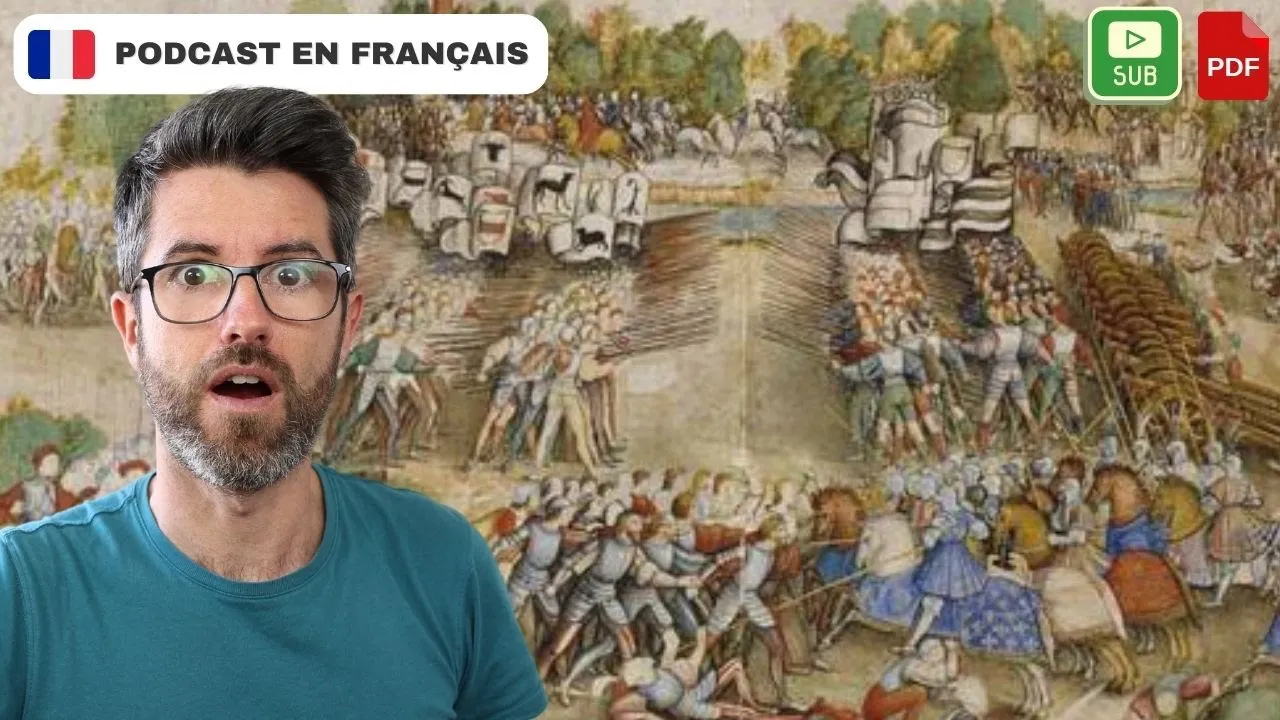
If you ask the French what happened in 1515, they will tell you that it was the Battle of Marignano. It is one of the best known dates because it is a major fact in the history of France which I would like to talk to you about in this episode one hundred and eighty (180) of the fluidité podcast. I will tell you what happened and you will know why this date is important in our history.
So, stay tuned! Before starting, I would like to offer you a unique opportunity to progress in French if you want to go from intermediate to advanced level: our VIP club. It's a private club that I created made up of a large community of +500 learners.
There you will find friends who come from all over the world and together we do oral practice activities in French on Zoom at least 6 times a month. Reading, games, quizzes, discussions on different themes, etc. There is also an interactive course to explain French grammar easily and clearly.
We have a private Telegram group to discuss, share and exchange and where I help learners by answering their questions of course. The VIP club also offers exclusive resources and content. You are all welcome to the VIP club.
Click on the link in the description to get all the information and subscribe. Hello everyone and welcome to this new episode. You asked me to talk a little more about the history of France in the podcast, so this week, I suggest you talk about a significant event, the Battle of Marignano.
And if you want, we will do the same thing for other historical dates in other episodes. Of course, in previous episodes, we have already talked about important and major events like the Second World War, the Hundred Years' War, etc. I am not going to list the events in chronological order, but I will start with the most important ones.
1515 is an easy date to remember since it is 15 and 15. In French, there are two ways of pronouncing old dates before the twenty-first (21st) century. For example, we can say one thousand five hundred and fifteen or fifteen hundred and fifteen.
On the other hand, we cannot say “quinze-quinze”, as in English. So 1515 is a historical date that the majority of French people know. At least they know it's Marignano, but they've generally forgotten what it stood for.
It's a date that we have been taught at school for generations, so I find that it will also be important for you and your general knowledge of France. The Battle of Marignano is part of the Italian Wars which are a series of eleven (11) conflicts spread over a period of sixty-five (65) years, with periods of peace between each battle. Marignan is the French name for an Italian town southeast of Milan.
In Italian it is “Melegnano” and maybe Italians already know it, I don't know if they learn this part of their history at school. This battle took place over two days, the thirteenth (13th) and fourteenth (14th) of September 1515. What must be understood is that these Italian wars were battles mainly between the French and the Italians.
which began at the end of the fifteenth (15th) century. In summary, it was because the French wanted to recover Italian territories under the pretext of inheritance. There are also other countries that got involved such as Switzerland, England, the Pope and the Holy Roman Empire.
So from one thousand four hundred and ninety-four (1494), the kings of France went to war in Italy to try to recover Italian territories, notably the Duchy of Milan and the Kingdom of Naples, when the Italy was not yet a republic as we know it today. For the first Italian war, it was the King of France Charles VIII who tried to regain control of the Kingdom of Naples, but was repelled by the Italians. In January 1515, François I (1st) became king of France in turn.
To begin his conquests, he also wants to take control of the Duchy of Milan which was won and then lost several times during previous wars. The Duchy of Milan is interesting for the kingdom of France because it is quite rich, notably thanks to the Renaissance. So, at the age of twenty-one (21), Francis I decided to conquer this famous Duchy of Milan.
But before going to conquer this territory, he signed peace treaties with the King of England Henry VIII, Charles V and the Republic of Venice to have as few enemies as possible. On the other hand, the Swiss refused Francis I's offer and they therefore became his enemies. Pope Leo X will also defend the Duchy of Milan against the King of France.
Francis I brought together men from the French army, but also thousands of private mercenaries, who could be bought at the time to fight. In total, Francis I managed to obtain an army of around fifty thousand (50,000) fighters in April 1515. Against the king of France, there was therefore the young Duke of Milan Maximilian Sforza helped by Pope Leo of an army of approximately twenty-thousand (20,000) Swiss soldiers, renowned for their formidable combat effectiveness.
During the summer of 1515, the King of France offered the Swiss to abandon the defense of the Duchy of Milan in exchange for money, but they refused. So the conflict between thousands of men seems inevitable. The Swiss will position themselves in the Italian Alps to block the way for the French.
But Francis I and his troops passed through another place, further south. They explode the mountain at the Col de Larche to create a path and therefore manage to cross into Italy. The army of the King of France en route to Milan is led by Lieutenant Bayard, nicknamed the knight without fear and without reproach, who will become an emblematic character and who fought for the history of France.
He is a knight renowned for his immense courage and who saved French troops from failure several times. And once again, Bayard confirms his courage and captures Prosper Colonna, the right arm of the Duke of Milan. The French troops can then settle sixteen kilometers (16km) southeast of Milan, in the town of Marignano.
This is how the Battle of Marignano begins. On September 13, French troops faced the Swiss. The French take the upper hand (that means they have the advantage), then the Swiss, then the French and so on.
At nightfall, the conflict pauses before resuming the next day at sunrise. And on September 14, the Swiss regained the upper hand over the French troops. But, at that moment, the Venetians, allies of the French, arrived on the battlefield and helped the army of the King of France to fight.
The Swiss are defeated and are then forced to flee towards Milan, it is therefore the victory of Francis I and his troops. So, around fifteen thousand (15,000) men died during this battle lasting a few hours. It was the deadliest conflict in centuries.
On October 11, 1515, Francis I entered Milan to celebrate his victory while Duke Maximilian Sforza was taken prisoner. Two days later, the Treaty of Viterbo was signed: Pope Leo X officially recognized the new Duke of Milan as Francis I, it was a historic event. Another major fact, with the Treaty of Friborg of November fifteen hundred and sixteen (1516), the Swiss signed a peace agreement with France and placed themselves in the service of the King of France until the Revolution in seventeen hundred -eighty-nine (1789), another unpublished fact.
The Battle of Marignano marks the end of the Fifth Italian War. It served the young King François I to show his power to the people and it gave him a good reputation. He then became a great king of the Renaissance, protector of arts and culture , while being a respected military leader.
Thanks to his power of persuasion, in 1516, François 1st brought Leonardo da Vinci to France and offered him a castle, I spoke about this in more detail in episode one hundred and thirty-eight (138) on the castles of the Loire. Marignan is the symbol of a French military victory that we like to boast about. But, on the other hand, we talk much less about the battle of Pavia in fifteen hundred and twenty-five (1525) which was a total defeat of François I who lost the Duchy of Milan.
And following this failure, the French will give up Northern Italy forever. This is the essential thing to know about the Battle of Marignano. Tell me if you want me to talk about other historical facts in the comments, I will read them all and respond.
Thank you very much for following this episode. Subscribe to my podcast or my channel so you don't miss the next ones. If you liked this content, let me know by giving a thumbs up or like or five stars on podcast platforms and this is also to support me.
See you soon for a new episode!





![[FRENCH VLOG w 🇫🇷 subs] Life in Nice - The best bakery, Old town and the vintage market 🪞](https://img.youtube.com/vi/4_fHiKwqGRA/maxresdefault.jpg)