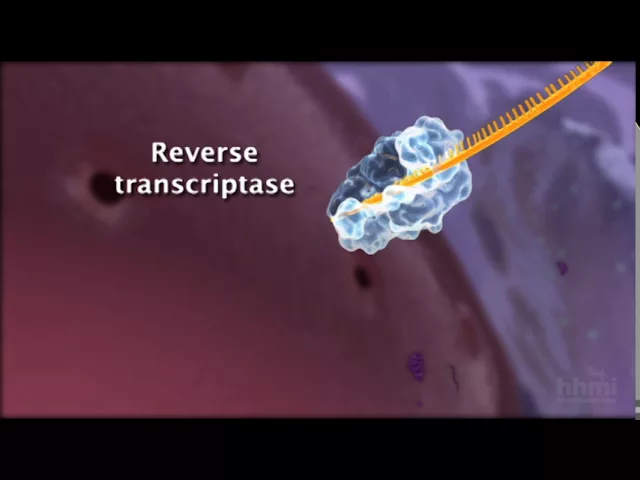
SPEAKER: So this is HIV. It's a typical retrovirus, meaning that it has an outer envelope. And in the center, it has two copies of RNA, as well as an enzyme, here in blue.
That's reverse transcriptase, which will ultimately turn that RNA into DNA. The virus itself, with this outer envelope protein, actually directly infects T helper cells. The way that it does this is that as it comes up to the cell surface, it uses receptors that are on T helper cells and exclusive to T helper cells, which are CD4 molecule, which really defines T helper cells.
It's a surface receptor that binds to the envelope protein. That causes a conformational change and allows a second receptor to grab hold of the envelope. This is the chemokine coreceptor.
It's also called CCR5, and we'll talk about that more. What happens now is that the stalk of the envelope protein pierces through from the virus into the host cell and starts to draw the cell membrane and the viral membrane together. And what ultimately happens is fusion of those two membranes.
And the viral genetic material is injected essentially into the cell. And the envelope protein is left at the cell surface. The virus has a matrix and a capsid protein, shown here in green and red, that essentially are digested when it enters into the cell.
That releases viral enzymes in the viral RNA. And here we have reverse transcriptase, which takes the viral RNA, and using host nucleotides, converts that viral RNA into a single strand of DNA. While it does that, it makes some random errors, which is characteristic of reverse transcriptase.
It has very poor proofreading activity. That single-stranded DNA now is again reverse transcribed into a double-stranded DNA. At that point, another enzyme that has come in with the virus in the beginning, called integrase, essentially grabs hold of that double-stranded DNA and carries it through a nuclear pore into the nucleus of the cell.
Within the nucleus of the cell, it finds the host chromosome. And basically, the integrase enzyme makes a nick in the host DNA and allows for HIV to insert itself into the host chromosome. And that right there is what establishes lifelong infection.
Now, RNA polymerase comes along and makes messenger RNA. Those messenger RNAs encode for different viral proteins. They end up associating with ribosomes at the surface of the rough endoplasmic reticulum.
And here's a piece of mRNA that's making envelope protein, which is directly produced into the endoplasmic reticulum. And it's shuttled then through the endoplasmic reticulum and taken to the cell surface, where at the cell surface, it becomes embedded in the cellular membrane. And at this point, coalescing with other envelope proteins that have been produced, you have this cluster of envelope proteins now on the surface of this infected cell.
At the same time, there are other messenger RNAs that are being produced that allow for translation of other viral proteins. So here are additional viral proteins being made which are going to be used to make up the key components that the virus ultimately is going to need. These are transported again to the cell surface, to the area where these envelope proteins are.
And a strand of RNA, as well as some of the enzymes are part of that complex. This then buds off at the cell surface at this point. But it's still not a mature virion because the polyprotein chain needs to still be digested into its component parts.
That's done by an enzyme called protease. Protease breaks up those polyprotein chains and ultimately allows for them to coalesce and form the mature structures that make up the final virion. And now you have a mature infectious virion that can go on now to infect other cells.
Once that happens now, the cell can produce tons of viruses, and this is really what then keeps the whole process going.