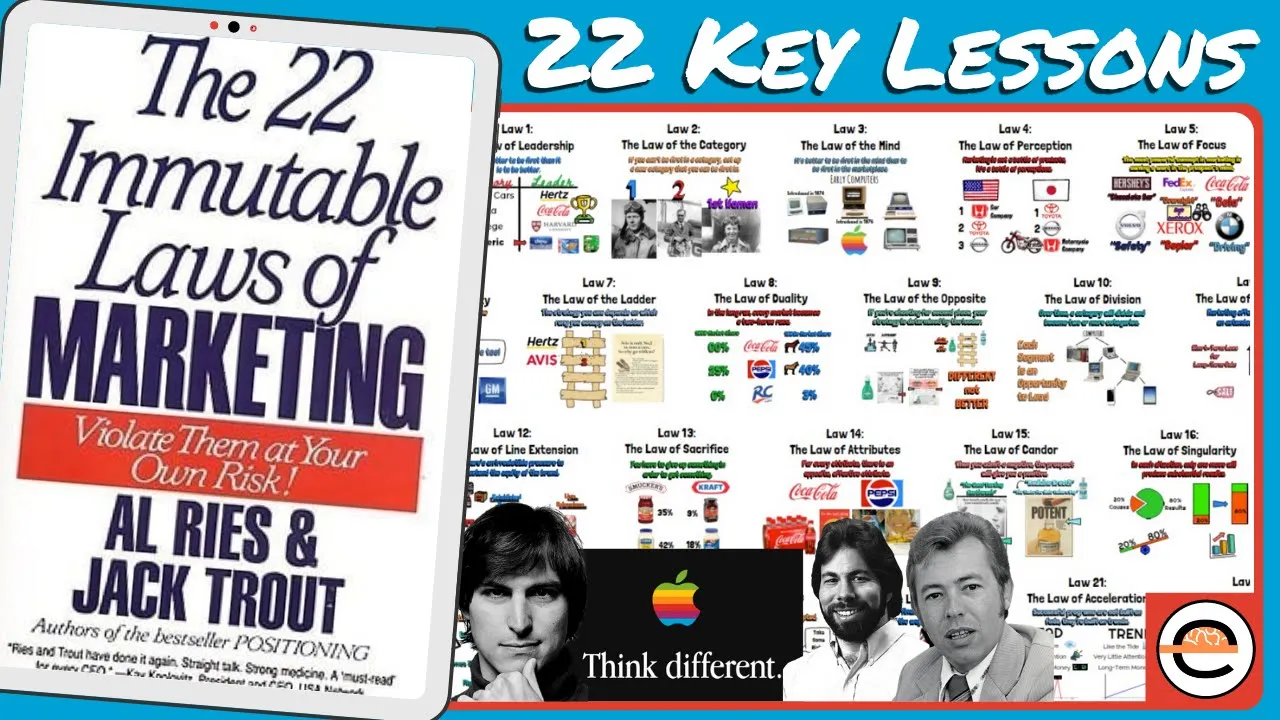
Let me ask you a question: Do you ever wonder how successful brands achieve their success or how they maintain their positions in the market once they become successful? Could it be that there are marketing laws out there that create massive success for the brands that obey them? The answer is YES.
So, Stay Tuned! Because we are about to discuss these laws in the timeless marketing classic: The 22 Immutable Laws of Marketing by Al Ries and Jack Trout. Let’s get right into it.
Law No. 1: The Law of Leadership It’s better to be first than it is to be better. The leading brand in a category is almost always the first brand into the prospect’s mind.
So, let’s talk about some categories and their leaders. What about rental cars? Well, that’s Hertz.
What about cola? That’s Coke. What’s the leading American college?
Harvard University. All these leaders were also first in their respective categories. Being first into the prospect’s mind can even lead to your product’s brand name becoming the generic name in the category.
Some examples of this phenomenon include Kleenex, Band-Aid or Scotch Tape. Law No. 2: The Law of the Category If you can’t be first in a category, set up a new category that you can be first in.
Many people know that Charles Lindbergh was the first person to fly across the Atlantic Ocean by himself. Bert Hinkler was second, and almost nobody remembers him. However, everyone remembers the third person to fly the Atlantic Ocean solo: That’s Amelia Earhart.
She’s famous because she found a new category to be first in: she was the first woman to fly the Atlantic Ocean solo. Law No. 3: The Law of the Mind It’s better to be first in the mind than to be first in the marketplace.
In the early days of personal computers, there were 5 real competitors: The MITS Altair 8800 The Apple II the Commodore Pet, the IMSAI 8080, and the Radio Shack TRS-80. The first of these to market was the MITS, introduced in 1974. Apple didn’t introduce the Apple II until 1976, two years after the MITS.
Which name do you think got into the mind of the consumer first? That’s right, the simple, easy-to-remember brand name that changed the world: Apple. Law No.
4: The Law of Perception Marketing is not a battle of products, it’s a battle of perceptions. For example, at the time this book was written, Honda, Toyota, and Nissan were the top three best-selling Japanese imported automobiles in America. At the same time, in Japan, Toyota was the best-selling brand, followed by Nissan, and then Honda.
This begs the question: If the cars were pretty much exactly the same, why the discrepancy between sales in the two countries? It’s because Honda got into the mind of the Japanese consumer as a manufacturer of motorcycles, not cars, and most people don’t want to buy a car from a motorcycle company. Law No.
5: The Law of Focus The most powerful concept in marketing is owning a word in the prospect’s mind. Let’s talk about several brands you know and the words they own. Fed Ex owns the word “overnight.
” Xerox owns the word “copier” Hershey’s owns the word “chocolate bar” Coca Cola owns the word “cola” Volvo owns the word “safety” BMW owns the word “driving” The most effective words are simple and benefit oriented. Once you decide on a word that will define your brand, narrow your focus and own that word in the marketplace. Law No.
6: The Law of Exclusivity Two companies cannot own the same word in the prospect’s mind. Once a competitor owns a word, you need to avoid using that word in your marketing campaigns. For example, Volvo owns the word “safety,” yet automakers like GM and Mercedes continue to make advertisements that focus on the safety of their vehicles.
Advertisements like this make customers think about safety, which makes them want to go buy a Volvo. Law No. 7: The Law of the Ladder The strategy you use depends on which rung you occupy on the ladder.
Avis executed perfectly when it ran an advertisement acknowledging its number 2 position on the ladder. The advertisement went like this: “Avis is only No. 2 in rent-a-cars, so why go with us?
Well, we try harder. When you’re not the biggest, you have to” This message perfectly related Avis to Hertz within in the mind of the consumer and gave Avis an unshakable position on the rent-a-car ladder. Law No.
8: The Law of Duality In the long run, every market becomes a two-horse race. In 1969 there were three major brands of cola: Coca Cola, which held 60% of the market Pepsi, which held 25% of the market And Royal Crown, which held 6% of the market In the 1990s, Coke held 45% of the market Pepsi held 40% of the market And Royal Crown held only 3% of the market. Law No.
9: The Law of the Opposite If you’re shooting for second place, your strategy is determined by the leader. The key here is not to be better than the leader. The key is to be different, to be an alternative.
Scope presented itself as the good-tasting mouthwash by hanging the “medicine breath” label on Listerine. In so doing, Scope perfectly attacked the leader’s weakness and became the alternative for prospects that didn’t like the burning, medicine flavor of Listerine. This strategy quickly carried Scope to the number 2 position in the mouthwash category.
Law No. 10: The Law of Division Over time, a category will divide and become two or more categories. Take computers for example.
Over time, the category split into other segments, like mainframes and mini computers and then mini computers split into personal computers and laptops. Then, it split again into smart phones and tablets. Each segment of a category is a separate and distinct entity, and each segment is thus an opportunity for a brand to become the leader.
Law No. 11: The Law of Perspective Marketing effects take place over an extended period of time. Companies and people often forget the old adage: short term loss for long term gain.
Let’s use a limited-time sale to illustrate this law. In the short term, a sale will get consumers in the store and increase revenue. However, these limited-time sales often decrease business in the long term because they teach customers not to buy the stuff at regular prices.
After all, why would I buy at the full price if there’s going to be a sale later on this year? Law No. 12: The Law of Line Extension There’s an irresistible pressure to extend the equity of the brand.
A line extension typically involves taking the brand name of a successful, established product and using that name on a new product. When a company does this, it ultimately weakens the long-term stability of the established brand for a short-term increase in revenue from the new product. Here are some examples of established brands and their line extensions: Tanqueray gin and Tanqueray Vodka 7-Up and 7-Up cherry Heinz ketchup and Heinz baby food Law No.
13: The Law of Sacrifice You have to give up something in order to get something. Take Smucker’s jam for example. Smucker’s is a jam company.
Kraft, on the other hand, is an everything company. At the time the authors wrote this book, Smucker’s had 35% of the jam market, and Kraft had 9%. Hellmann’s is focused on mayonnaise, just like Smucker’s is focused on jam.
Is it any surprise then that Hellmann’s had 42% of the mayonnaise market, while Kraft had only 18%. Law No. 14: The Law of Attributes For every attribute, there is an opposite, effective attribute.
For example, Coca-Cola positioned itself as the Original and the “real thing,” and so it was the choice of the older generation. Pepsi noticed this, and then successfully positioned itself as the cola for a New Generation. Law No.
15: The Law of Candor When you admit a negative, the prospect will give you a positive. For example, Scope mouthwash marketed itself as the “good-tasting” mouthwash, exploiting Listerine’s unpleasant taste. In response, Listerine brilliantly invoked the Law of Candor with this message: “The taste you hate twice a day.
” In judo fashion, Listerine used a negative, it’s not so pleasant taste, to reinforce the idea that something that tastes like disinfectant must indeed destroy germs and freshen breath. Law No. 16: The Law of Singularity In each situation, only one move will produce substantial results.
This law is related to the Pareto principle or the 80/20 rule, which states that 80% of results come from 20% of causes. In any given situation, there is one marketing move that will produce substantial results. Thus, rather than spreading a company’s resources over a multitude of marketing strategies, the skilled marketer will study the marketplace and implement the one bold strategy that will produce the greatest reward.
Law No. 17: The Law of Unpredictability You Can’t Predict the Future. Flexibility is the best way to fight unpredictability.
A company may increase its flexibility by focusing on a long-term direction rather than a long-term plan. A long-term plan contains assumptions about the future, while a long-term direction assumes change and volatility. A long-term plan is rigid, while a long-term direction is flexible.
Law No. 18: The Law of Success Success often leads to arrogance, and arrogance leads to failure. The key point here is that ego is the enemy of successful marketing.
As companies achieve success, they often become arrogant and lose the objectivity that made them successful in the first place. The best marketers don’t let their own views and biases infect their marketing campaigns. They remain objective and think like the customer thinks.
The best marketers put themselves into the customer’s shoes and see the world as the customer sees it. Law No. 19: The Law of Failure Failure is to be expected and accepted.
Failures are inevitable, but that doesn’t mean a marketer shouldn’t take risks. Instead, the key is to take calculated risks, expect some failures, and recognize the failures as early as possible. Sam Walton, the founder of Wal-Mart, was a marketing genius who used what he called the “ready, fire, aim” approach to marketing.
Unlike other big companies that punished any form of failure, Wal-Mart rewarded creativity and encouraged risk taking and marketing experiments. Law No. 20: The Law of Hype A company’s financial situation is often the opposite of the way it appears in the press.
When things are going well for a company, it doesn’t need the spotlight or hyped-up press conferences. In fact, if a company is seeking to maximize hype, this likely indicates that the company is in financial trouble. For example, Coca Cola spent hundreds of millions of dollars to launch New Coke in the 1980s.
New Coke received more hype than any soft drink in history, with over a billion dollars in free publicity. The brand was a miserable failure, and Coke brought back the Original formula within just a few short months. Law No.
21: The Law of Acceleration Successful programs are not built on fads, they’re built on trends. A fad is like a wave in the ocean. It’s very visible, but it’s also volatile, and it swings up and down.
A trend, on the other hand, is like the tide in the ocean. It’s nearly invisible at any one moment, but it has a very powerful effect over time. Fads get lots of attention, while trends are rarely talked about.
Fads make a burst of money in the short-term, while trends make sustainable, long term money. Law No. 22: The Law of Resources Without adequate funding, an idea won’t get off the ground.
It takes money to get a brand into the mind of the consumer, and it takes money to keep it there. A mediocre idea with a million dollars to back it up has a greater chance of success than a fantastic idea with no financial backing. For example, Steve Jobs and Steve Wozniak had a great idea with Apple, but it was Mike Markkula’s $91,000 that put the company on the map.
Thank you SO much for watching this video. If you loved it and want to see more content on this channel, please let me know. Smash the like button and subscribe to my channel.
And I hope you have a great morning, afternoon, or evening, and I’ll see you next time on Mental E Fit.









![HARVARD Negotiators: How to Get What You Want Every Time [Getting to Yes]](https://img.youtube.com/vi/BLBRRNwMZNE/mqdefault.jpg)