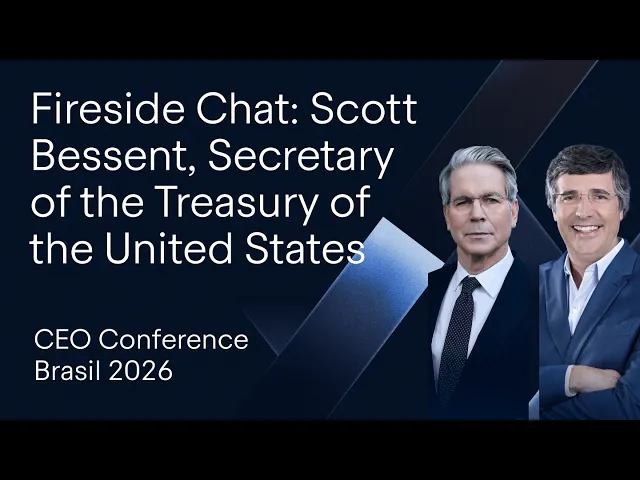
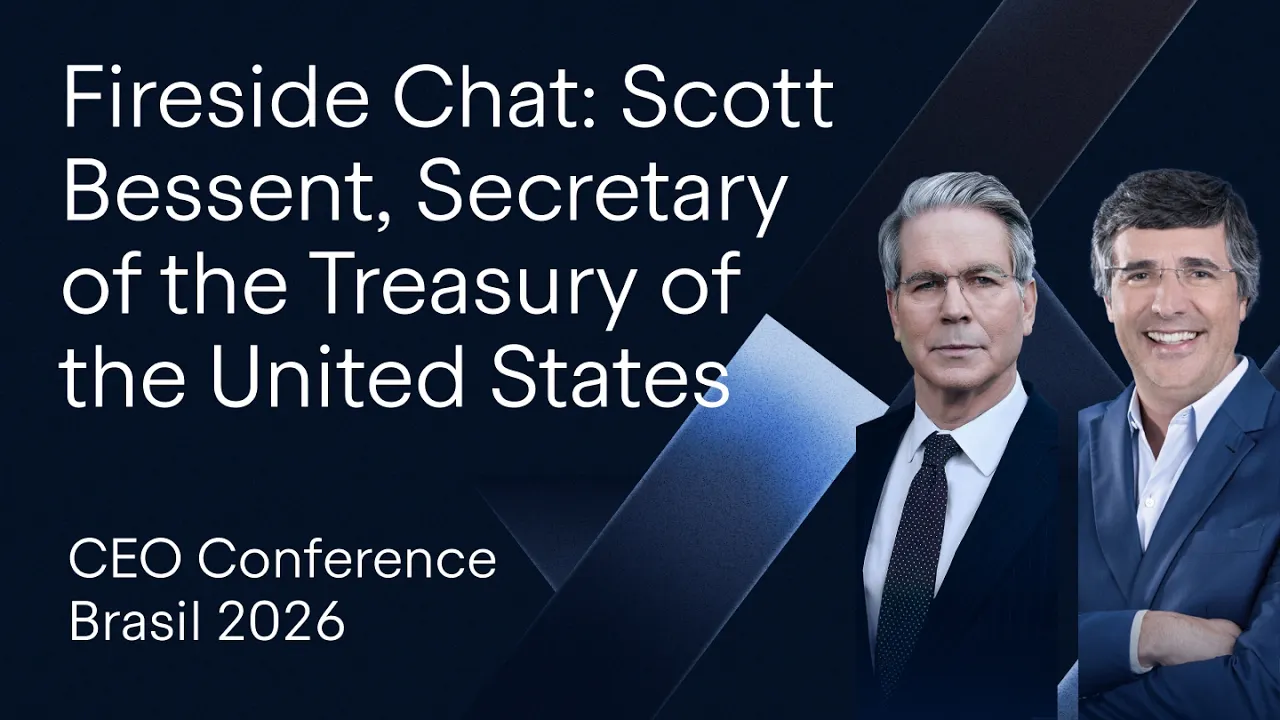
[music] [music] Hello guys, let's start this session. First of all, thank you very much Secretary Bassant for accept our invitation to the BTGCO conference. uh you have in front of you 3,000 investors uh from Brazil, Latin America, abroad and also uh important uh CEOs and CFOs of Latin America Corporation.
So once again it's a pleasure to have you here with us. Um before we talk about the US Latin America maybe uh let's uh explore a little bit on global macro uh we are in a in a moment uh during the pandemic most of the west democracies need to increase their budgets to support the society and uh uh since then since 2122 um we we didn't revert these high fiscal deficits to the moment that we have some of the most important economies like UK, France, Japan or even US or Brazil with high deficits compared to historical standards. um how you see the evolution of these uh these deficits and uh if there is any consequence for the markets and of course the US angle uh about this situation and again thank you very much Scott >> good Andreas good to be good to be with you it's an exciting time to be in the US and it's an exciting the time to be in Latin America as we're seeing with all the changes going on and uh that that's an excellent Introductory question.
Uh this year the US will host the G20. Next year we will host the G7. And for G20 finance track, the US emphasis that I'm leading will be on two things.
Uh growth or the lack thereof as a threat to financial stability and the importance of resilient supply chains and rec reclaiming sovereignty. So the the reason I'm sitting uh here today on camera and not in the audience uh wearing my hat as a fund manager was I went to President Trump in 2022. I said I think you're going to win the election.
I'd like to be part of the economics team and I think this is the last chance to save the US from going into a European style malaise of high debt. Raise taxes, slower growth, slower growth, lower taxes, uh or lower tax revenue, raise taxes, growth goes down. I mean, we're we're going to have the, you know, probably a 4 something percent fourth quarter number, and that's with the longest shutdown in US history.
So, we will average about 4. 1% growth for the three full quarters that President Trump was in. And you you noticed the other day that Europe celebrated.
3%. So, in the US, we are committed to a growth solution. And I think that that can be non-inflationary growth because you know if you look back as you said during the pandemic there was a demand shock created by fiscal expenditure but in the US the Biden administration constrained supply with overregulation.
We are causing a demand shock uh largely through tax policy but we are deregulating and creating the uh more more fa more space and the more supply side. So uh as you would have seen and I'll give you some numbers and then we can continue under the next question. Uh in 2024, the US had a 6.
97% deficit to GDP, highest we'd ever had in uh when we weren't at war, weren't in a recession. Last year, that number was 5. 4%.
I've made it a goal of uh getting the deficit to GDP down to something with a three in front of it uh by the time President Trump leaves office. you know with with that level it stabilizes the debt to GDP and you actually start deleveraging I wouldn't be surprised if the US doesn't have nominal growth the in excess of 6% this year and by constraining spending and growing the denominator then that solves a lot of the problems. No, clearly and uh we all feel globally since US is the the US treasures the free uh risk-free uh benchmark for global markets very important to have someone like you running the economy and uh uh with this kind of uh of mindset.
uh Scott uh there are a lot of uh interesting forces uh around the dollar or even US treasuries right in in we had some uh dollar weakness in the recent months on the other hand uh a lot of investments and stronger growth in US um and also some structural change on global portfolios right that we are in a moment where global central banks are uh increasing their gold reserves. On the other hand, you have uh the the creation of stable coins that are dollar linked and in a certain way increase the demand for treasuries. Um how you are seeing this balance and the role of of the dollar that will continue to be the reserve the global reserve currency but these different forces uh influence the price of US dollar right now.
Yeah. So, Andreas, you know, I often get asked what what does a strong dollar policy mean? And it means that we want to have the fundamentals to keep the the dollar strong.
So, in terms of whether it's FDI or portfolio flows, we want to make the US the most attractive place for capital, which I think we've done through t tax certainty. We passed the the one big beautiful bill the on July 4th which includes full expensing for corporates. Uh we have regulatory certainty as I mentioned.
I think now this administration for every one new regulation has cut 23 regulations and I I believe that was a 1:8 ratio in Trump 1. 0. And people ask me what's my biggest surprise coming from the private sector into the government sector.
And it was the US had lost the ability to build things especially manufacturing facilities whether it was environmental regulations the a lot of state regulations. the and then uh three uh on energy certainty that we we are back to exploiting the the US great natural resources that whether it is uh clean coal the or our energy dominance in crude and net gas. So you we we want to set the fundamentals.
I I to the extent I had a strength in my uh investment career, it was in currencies and currencies on the screen go up and down but over time if you have the right fundamentals then the the the trend uh exerts itself and I I would say on one side what people are calling dollar weakness is actually whether it it's many economies just coming out of a morban Hey, I mean any currency theory whether it's Mundelle Fleming or any other would tell you that what the euro was doing uh should lead to price appreciation that they are creating especially through Germany taking off the debt break their increased uh defense spending throughout the EU. So they're they're in creating a demand shock and then we're seeing all the reforms in Latin America. So I don't I don't think it's so much dollar weakness as a lot of the other countries have been asleep.
>> Yes, Bob, I agree with you. Um uh Scott you mentioned uh a lot of uh deregulation and change in the energy uh polic uh uh all of that were relevant for US investments in in the last five years. I think uh US functional as almost a financial black hole attracting capitals from everywhere but especially to the technological sector that outperformed all the other sectors uh and concentrate a lot of US market cap u to the point that well the the the highest market cap company in US Nvidia is for 4 and a half% of global market cap where Japan is 5% which is the second largest country it's 5% of global market cap um uh on the other hand we see a lot of uh of interest uh in investing in US in classic sectors in promote reindustrialization of US and uh u and a lot of Brazilian companies or Latin America companies also interest on doing that right the the protein companies of Brazil, Imbraer, well us BTG as we as you know and you granted us a national license to have a bank in US.
How you are seeing the foreign direct investments in US other than the innovation sector or in venture capital or the NASDAQ but in the rest of the most traditional economy that underperformed in the last five years. Well, we're seeing both FDI and US corporates reshoring and at the at the end of the day, that's the that's the goal of the president's tariff policy. You know, I I've described it as a shrinking ice cube that, you know, we we begin with very high tariff revenues, but over time, you know, if we say tariff revenues are here, tax revenue is here.
that over time the goal is re-industrialization and to rebalance the economy. So as there's more FDI as US corporates come home then we're seeing a extremely high level of factory starts and you know green green field or factory additions. So the tariff revenue will come down but the tax revenue from more factories the more jobs in the US will go up.
So that that's the ultimate goal of the tariff policy is to rebalance I can tell you as the treasury secretary along the way taking in the substantial tariff income they is very nice also. >> Yes. Uh and and Scott, how you are seeing these uh amazing uh uh uh unthinkable productivity gain uh uh coming from AI and AI adoption in all sorts of sectors.
Uh US of course is on the front run for this the front seat of this productivity uh global run. Uh but what do you think will be the the effects uh in the economy related to labor growth? Uh I think the appointed uh Fed chairman Kevin Walsh has been talking a lot about productivity reigns.
By the way, Kevin was here last year Scott on this conference. So we had a a nice chat about that. Uh how you are seeing these amazing productivity gains that are ahead of us?
uh with the adoption of AI. >> Uh look, Andre, I I think there's a good chance we're back to the '9s. You you and I going to cut our teeth back then and it it was an exciting time.
Everyone asked me because I I ran the Fed interview process for the president and everyone asked me, "What were you looking for in a Fed chair? " and did you demand did you or the president demand lower rates? Did you give them instructions on this?
I said, "No, it was we we just wanted someone with an open mind. " And I I think Kevin Walsh is that person that that's one of the reasons o other than his long long history and credentials. Uh one of the reasons that President Trump selected Kevin Marsh and I I think one thing that's very interesting about Kevin he fellow fellow at Hoover.
they're doing. Stanford's a center uh one of the centers of US innovation and but on the other side you at Dukane he was a macro analyst but he also uh I believe ran their private uh investments in technology so he understands all this very well has a very open mind and when you ask me I I can honestly say that we're watching it closely I I think that there any different paths this can take. What we're seeing thus far is a couple of things.
I I tell all my friends with children in college, recent college graduates, that they should all be a AI natives. Remember the term I think you you and I are too old, but our children all became digital natives in the 90s and the 2000s. So the the real value added for young people is being able to jump onto this productivity boom.
And uh I think it was about 3 weeks ago had a major US credit card company and I asked the CEO, well what's AI going to mean to you in terms of jobs? And he said it's just an internal reallocation. So they [clears throat] will use more AI for billing and credit but on the other side all those pe folks are going to be moved into the travel area.
So no, no loss of jobs, just a reallocation. And historically, anytime we have these productivity booms, there's an employment boom. And what we're going to be watching very closely, and I I assume the Fed under Kevin Worsh's leadership will be also is just to make sure that there's not a timing mismatch.
>> Yeah. No to totally by the way I think it was an excellent choice but we consider Kevin one of the most prepared if not the most prepared name for the job and my second comment related to your question is that we are not that old Scott we still have a long career ahead of us right so you will come back one day to the investment community and I will stay here for other decades so it's a we still have a long path ahead of us. >> Well, [snorts] I just we we we we have me more than you gray hair and wisdom.
[laughter] >> Uh moving a little bit the conversation to Latin America. Um and uh and we are here in the region very excited about the interest of us being the region. uh you being here with us is a statement about that u and uh uh which make us uh excited and proud.
Um but and you also had important intervention in Venezuela and uh pushing the country to a more open direction, a more constructive direction for their society. uh you made a a a very relevant intervention and support to Argentina. Um just added to your bright uh investor career, right?
Because you were the most successful uh uh long paso trader in history probably. So just add it to your CV. uh and uh and uh uh it's uh we perceive here in the region another level of interest and attention from us which I think is the right thing to do right Latin America is uh we are in the same time zone have the same cultural feat it's a most important natural resource area in the world doesn't matter if it's agrees metals or mining or energy and this is available for uh full integration to US.
How you see the US Latin America relationship going forward? I I I think this is a generational opportunity and we're we're obviously in the US very focused on north south and between myself who I I thought on the financial side the Obama administration missed an epic opportunity many governments wanted to try more market friendly policies during the Obama administration they were ignored obviously Secretary Rubio from South Florida of Cuban descent uh the large Venezuelan constituency when he was the senator uh very interested in the region and I I think you give two very good examples. So from Treasury, we were able to do the a a meaningful uh support for President Malay during the election period when we thought the fundamentals were very good.
Uh President Trump endorsed him and the Kersnerites were trying to use market forces to uh cause him to lose support. So we were able to sort of what I would call peace through economic strength bridge the Argentine government during that period. The election was remarkably successful.
He picked up more seats than predicted. And I think what's very interesting is President Malay's support among young people among the very poor is is really spreading out. On the other side, the intervention and the extradition of Nicholas Maduro in Venezuela through military force just shows the the power of the US military.
So, you know, one side a flex in economic power, on the other side a flex in military power. And you know, I I can tell you that the the uh people running the government now in Venezuela, the are the cooperating. I I think it is a very good partnership that will eventually uh lead to free and fair elections, something that seemed unimaginable.
And then we're we're seeing a lot of uh economies come back. Chile, which just seemed to have a bout of temporary insanity, or Bolivia after decades of socialist ruin, wants to come back into the system. We're very keen to help them.
Uh we're work working with the World Bank and the IMF. And then then there's Brazil. I think after a rocky start, President Trump and President Lula have established a good rapport and uh so I I think what's going on in Latin America is extremely exciting and you know as as you know the way these markets tend to work is you get a repricing for the possibility of good policies and then uh you know things may go sideways for a while and it will be incumbent on the government to implement good policies.
So, but I I'm very optimistic about all these countries and that the you the US wants to be there to support them. >> Yeah. No, it's uh and it's absolutely welcome uh on independent on the political uh direction of the governments as long as they practice sound policies, market friendly policies and your participation in Argentina was uh very relevant Scott because at the end of the day allowed society to vote in the direction of stabilization.
That was the choice and remarkable choice that will be extremely benefic the the Argentinian society and here as you said we also notice a lot of goodwill from the Brazilian government and uh it's funny because President Lula has a tradition of good relationship with Republican presidents in US and uh I I think now we are in the right tone with President Trump. I think in the next months there will be some delegation of Brazilian business people in government visiting to you President Trump with President Lula and I think it can be remarkable. So the the your more active role in Latin America is extremely uh well received by this audience here just to as a strong feedback for you.
Um talking a little bit on the the rest of the world Scott uh if you could comment how at this stage you has seen Europe, Japan and China because different things happening in the different areas right you mentioned the change completely in uh economic policy of German uh Japan we are seeing a dramatic change on the political arena the prime minister victory uh this week I think is remarkable and China dealing with shrink population uh but also very successful in certain industries and sectors. How you are seeing the rest of the world from a US perspective? >> Yeah.
So sure on on Europe there there there's a lot of verbiage back and forth but at the end of the day we we want our European allies to succeed and it it it's friendly criticism. I I was in Davos and with with a group of about 130 business leaders and a French businessman raised his hand and said what would be your advice and I said follow the drug report it it's just the the level of productivity the level of bureaucracy there re really has to change you know I I have American tech leaders telling me it's easier to do business in China than in Europe the purpose of the EU was to create the what was to create a frictionless trading zone when when in fact they've created more friction and kind of the supernatural national regulatory body on top uh is just I think stifling growth. So you know I I hope Europe can get its act together.
It's an important ally. Uh you know could it eventually become an innovation hub? I hope so.
But look, they had a failed economic uh plan. The plan was built on cheap Russian oil selling into China and an undervalued exchange rate because of the problems in the periphery. Well, the periphery is actually doing better than the core now or many of the core companies.
You know, we've seen what how the Russian energy played out and now I think that Europe is worried about all the cheap Chinese imports coming up because the US put up a tariff wall. In Japan, I I think the prime minister is a very exciting leader. I I've had the privilege of interacting with her.
Uh she she's dynamic, she's focused. This was a very bold move. she called with the election.
It was the quickest snap election in Japanese history. And she also has the biggest post-war majority. So bold move, the high return.
And she's going to be able to govern you using this super majority. And look, I I think that they understand that they are closer to the end of the aomics reboot than the beginning. But Japan's doing very well here.
Uh Nikke keeps showing us that. I think that the the Bank of Japan, you probably know Governor UEA be I'd known him in my private capacity for more than a decade and I I think he's fantastic. And then China that the USChina relationship now is in a very comfortable place.
We are going to be rivals but um we want the rivalry to be fair. We do not want to we do not want to decouple from China. But we we do need to derisk.
when when I talked about at the beginning when when I talked about our our two G20 initiatives the the first is growth but then the second is retaking sovereignty in strategic industries whether it's critical minerals whether it's semiconductors medicines you know that the US as we saw during co very dependent on China for medical supplies so I I think we can have the a a very productive relationship, but we're we're always going to be competitors. And I I I'm of the view that competition makes you you better, keeps you from stagnating, and you I I'm convinced that the US is winning the AI race. We have the technological lead.
Uh but in the long run, China must rebalance. I I think we're probably going to see the IMF the article 4 uh announcement come out and u we will also see I think at the G7 global rebalancing will be a topic but the the the world cannot have a situation where China persistently runs a $1 trillion trade surplus that that's just not possible. >> Yeah.
No, it's a there is certainly an excess there. Well, Scott, we are coming to an end and uh I would like to tell you that well business is open for us and US companies here. You mentioned this amazing AI revolution and uh here but we when we look globally we see Brazil as one of the most competitive countries to adopt uh data centers given our uh cheap energy cheap renewable energy and a wellestablished grid.
So it's open for for us and it's uh neutral USfriendly it's same culture so quite open for that um and I think the same in Latin America we are seeing more and more market friendly uh uh policies uh uh prevailing here in the region and uh part of that certainly is your support for that. So again thank you very much for being here with us. If you want to say any final word, please.
>> No, I I would just close what I I always uh say is America first doesn't mean America alone. I think the world does best when the the US leads. President Trump is exercising great leadership.
that we won't always get to our goals in a straight line, but I think that we we will see that the reordering that is happening as you very well described in the Western Hemisphere in terms of rebalancing trade and in terms of global security that at at the end of the day the most bullish thing most bullish thing is peace and President Trump is the president of peace. So you take taking out the Venez the Venezuelan uh problem and you the mass migration the threats the from Maduro you know we'll see what happens the with Iran and then I I'm optimistic on Russia Ukraine and if we can calm down these hot spots and get back to the business of business then I I think that's fantastically bullish for markets. Yeah.
Well, Scott, uh, the PAX Americana is more than welcome. Thank you very much for being with us and thank you for leading this remarkable economy, the US economy. Okay.
Thank you very much. A pleasure. Good.
Byebye. Good to see you.