“Delay Adulthood” maybe different from “Delay Maturation”. “Maturation” is a natural progression. We live, we observe, we encounter obstacles, as well as favorable ones. We learn lessons and begin to adapt, adjust, etc, so that our perceptions, emotions and behaviors gradually match the world around us, or at least it gives us some comfort, mental peace. As for "Delay Adulthood", the things you mentioned are all functions of society. - Right? - Yes. “Functions of society”. That is, things like: Delay in going to work, delay in getting married, delay in having children, all of these are social functions, -
they don't say anything about people. - So it's a protest and they're not bad, right? “Delay Adulthood” is exactly like that, it is completely different from “Delay Maturation”. And so, we see there are adults... Let's make a little pun. Obviously, "Adulthood" here is not synonymous with maturity. And that's so obvious, right? There are people who can have wives, children, even grandchildren, but are they mature yet? That is the question. - I will record this part for my parents to listen to. - Have they grown up yet? Welcome back to EduStation season 4. Coming to the
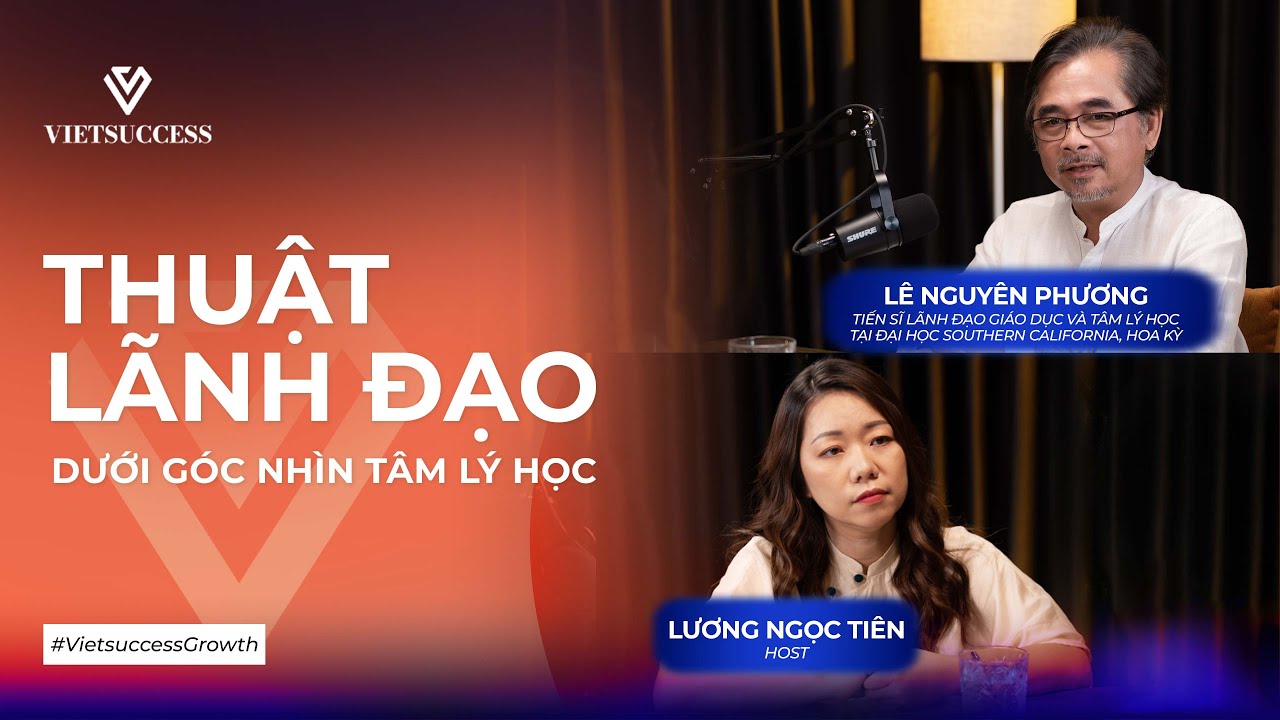
studio today, we are honored to meet and talk with Dr. Lê Nguyên Phương. He holds a Master's degree in Educational and School Psychology from California University, Long Beach, and a Doctorate in Educational leadership specializing in Educational Psychology from the University of Southern California. He has over 18 years of experience as a School Psychologist in the United States and is also a lecturer in the Graduate Psychology and School Counseling Programs at California University, Long Beach College, and Chapman University. At the same time, he is also the author of the book series voted for “The best book
award”: Teaching children in “confusion”, and is the co-author of the Master's Training Program in School Psychology at Hanoi University of Education, consulting studying at the University of Education, Hanoi National University. First of all, on behalf of the EduStation team, as well as the audience of the program, I would like to thank you for taking the time to come here today, to share with us. Thank you very much. Actually, I sincerely thank you, Hùng, As well as the EduStation audience for giving me an opportunity to come here to share my thoughts on a very interesting topic
like you shared. Without wasting any more time, I want to jump straight into the first question. I want to ask you: Is being yourself important? The word "Be yourself" sounds extremely simple, we can talk a little bit about the philosophical aspect. First, what is “yourself”, and what is “be”? Is it a process of becoming, or a process that has already occurred in the present: to be? “Be” or “Becoming”. And “yourself” certainly refers to a state of ourselves: Human. So is "yourself" here personal or general? If it is general, then we are talking about an extremely
difficult topic, Fundamental throughout the history of philosophy, which is: Human nature. In the West, there will be Aristoteles, Darwin, Freud,... the ancestors of, for example, we know that Aristoteles is the founder of Western Philosophy, Freud is the founder of Psychoanalysis. Darwin, the father of the Theory of Evolution. Everyone has a perspective. Plus, there are 3 others in Political Philosophy, we have Thomas Hobbes, John Locke, and Bertrand Russell. In Asia, when talking about human nature, it is impossible not to mention that… we also have 3 people: Mạnh Tử, Tuân Tử and Hàn Phi Tử. I'll just
introduce like that, we'll go through this quickly. Because when we say we want to "be ourselves", we must know human nature through long-standing definitions in the world, so that we can understand what we want to become, or what we want to return into. First, learn what the concept called human nature is. If we rely on the framework of Aristoteles, a Greek philosopher, and also a disciple of Platon and Socrates, we will see that the definition of human nature is also quite complicated. First, it will be seen as something different from what humans create. That means
I was born with natural qualities, and the things I learn, practice, additional, and acquire habits. - I take it into myself. - That's right, and learning, becomes a habit from others. So all that in Greek it means Tecneti, is different from Fursys, which means our nature that we create. That is the first definition of the first view of the word “human nature”. The second definition is also from Aristoteles. he believes that when people are born, they have a blueprint, which will naturally shape them into that person. This leads to what is called “explanatory aspect”. That
aspect explains what a person is like. They are born with a blueprint, and throughout the process of formation, that blueprint is gradually realized, which becomes human nature. From there it leads to a third definition of human nature, which is called "Teleological". This word is truly terrifying. It means that the purpose or the existence of all of us here is to fulfill a certain purpose in the future. That is called “Teleological”. In teleological from Aristoteles, when people are born, they are not yet human. Their nature will be perfected only at the end, they become mature, fully
developed, complete, then the so-called human nature will be completed. It's very complicated. So we will see that the definition of human nature has two aspects. The first original aspect is: Humans are born inherently good, complete with what is called "human nature". It's like "the first nature of human nature is good", right? That's another one. We will talk more about it later. It's not "good" or "bad" here, but at least the process is done. But in the process of socialization, through education, habits, customs, culture,... we become a different person. We are infected. Right. And so, the
process of becoming "human" or "being yourself", using the word "being yourself" for you to understand here means: returning to the first nature. So for example, the concept of healing the inner child, that's an aspect of psychology. But if we understand from a philosophical perspective, we will see that healing a child from the inside falls within the category of: People are inherently good, but are spoiled, corrupted, or lose themself, to put it mildly, I say "no longer be themself". So that child will need to come back. As long as it is healed, the child's insides will
naturally get better, because their nature is already good. That is Aristoteles's blueprint, which is for people to be healed. Another aspect is: People must be self-made people. That means we are born incomplete, we have to go through the process of learning, education, etc. And maybe that process of learning and educating is the process of letting go Everything that is not yourself to become yourself, but that "being yourself" is something that will form in the future. So, from the perspective of psychology, we will have people like Carl Rogers, or Abraham Maslow, they are in the school
of Humanistic Psychology. Thus, human must be self-made. “Be” or “Becoming”? In between those two things is social process, so in the process of "being ourselves", we need to determine that in order to become ourselves, to become something fully in the future. For example, becoming a Buddha. But in the Buddhist concept, "becoming a Buddha" means becoming a Buddha by adding something, or each person's nature is already a Buddha, and they need to let go of everything to become Buddha. I find it very interesting, and I think it's true that this topic is very big. Thought they
were simple, right? That's right. And I think it will probably take us many days to talk about this topic. But within our 90 minutes, I will try to summarize and ask you, first for the target group is young people around 18 to 22 years old. Especially at 18, the period that in Vietnam, we call "entering the larger world", they start having more independent things that should have happened sooner. And the next group is, the first is the individual, the second is divided into a specific age group, and the third is in Vietnam. I think let's
circle these three groups, so we can learn more from you. I want to ask you, now let's talk about "becoming", which means… I want to ask you, do "becoming" means people have an identity that they must gradually perfect? And in that journey, what we choose to do or not do, they in line with what we want or not, is that the journey we call "maturity"? Surely maturity is one of the functions, or missions of our existence in this life. I have a model that I like to call… First, we must satisfy our needs or our
survival mission. If there is no survival, there will be no later thing, right? Because when you die... Is it similar to Maslow? It can be seen as the first two levels of Maslow. Then comes to maturity. The second function, or mission of each of our beings is to mature. Maturity here does not mean that anyone can be called an "adult", we will see each aspect of a person. Some people are very mature in thought and thinking, but they completely lack emotional maturity, which we call “uncontrolled” and “unmanaged” emotional. For me, I like the concept called:
Resolving unpleasant emotions, or harmonizing different emotions. The word "manage" or something like that has the nature of crushing and suppressing, so I don't like using that word. That's unnatural, right? Whether it's unnatural or not is another matter. The third... the third function and mission of each of our beings is Transcendence. I think about transcendence. Here, we can compare with the layer called “self-actualization”. That means bigger than yourself, right? Bigger than ourselves, transcending the human condition That means bigger than yourself, right? Bigger than ourselves, transcending the human condition As an individual in society and transcending human
biological regulations. Bigger than ourselves, transcending the human condition as an individual in society and transcending human biological regulations. Why is it said that biological regulations transcend human biological regulations? We see there are people, because of the ideal of serving humanity, have endured hunger, cold, and even torture. We talk about Martin Luther King, Jr., he was a civil rights fighter in the United States for black people there. We talk about Nelson Mandela, he is the President of South Africa and a human rights champion for South Africa. We see those people, they not only mature, but they
go beyond the so-called survival needs, they accept both death and the deprivations of the first and second levels proposed by Maslow. Then that is Transcendence. That is an example of ontological transcendence. So people have a journey that is, first, satisfying their existence and survival, and then comes the matter of maturity. Going back to maturity for a moment, don't think of maturity as something comprehensive, as I said before. Maturity means we can be mature in this aspect, but not necessarily mature in that aspect. So don't surprise to see an older person analyzing a social issue very
mature. But when it comes to another problem, he gets angry and reacts like a child. We often say that person is immature. So what I mean by simplifying the aspect of maturity is that. Does the word “Maturation” mean… actually, if we understand it in the Sino-Vietnamese sense, Does it mean “Becoming”? “Becoming” means become “Bigger”, “Better”, - or “Commit”? - The process as you see, it is "Becoming", originating from "Survival", according to Darwin's theory. We only have two missions: reproduction and survival. Survival first, then reproduction. Reproduction is to maintain the species. This is completely based on
Darwin's Theory of Evolution. We grow up, we have programs to learn and develop, even meditate, regulate our emotions, attend "healing courses", all are missions to grow up. That is, we are at the stage where when we say the word “healing,” We laugh derisively. We will talk about that later, and it is related to the process called “Being yourself”. And the last one, for Transcendence, “Becoming” could be that. Because that is the destination that almost all... I'm not speaking from someone else's perspective, just from my own perspective, I see that Buddhism, Christianity, the world's major religions,
philosophers of the Humanistic Psychology school, the Transpersonal Psychology school, they all think about becoming one person, and that person... have four pleasures in all societies, and more than adults, scholars, etc. I want to ask you a very important question... Basically, if I were a young person, I would ask you this: Why do I have to grow up? Why can't I be "to be", but must be "becoming"? That's a very interesting question. And perhaps you are still very young, at least in your soul, to be able to put yourself in the position of a young person
to ask such an interesting question. Here, we analyze the phenomenon and essence. If we talk purely in theory, we will immediately see that the question is reasonable in that there are almost two paths: The path of “I am”, and the path of “I must become something different than myself”. And so when young people and you ask that question, The so-called "Why do I have to grow up?" means "Why should I become something different than me?". So now, I will try to answer conceptually and theoretically first, and then answer practically. Regarding concepts and theories, we will
return to Aristoteles. If we consider growing up as a blueprint, it is build into each of our cells, then the process of growing up is a natural process. For example, if you plant melons, you will harvest melons; if you plant beans, you will harvest beans. I take the Western concept that an acorn will give birth to an oak tree. You were born as that seed, then you must become that tree. You cannot try to keep yourself in the "seed" state forever. Like a caterpillar that can't refuse: I don't want to turn into a butterfly. But
to take the example of caterpillars and butterflies, growing up is not a gentle, comfortable, or easy process. It is a very painful process. The process is full of suffering. The caterpillar becomes a cocoon, a chrysalis, then a butterfly. It's not simple, it has to go through pain. And each time, it has to break its own shell. We remember crustaceans, every time they grow up, they have to break their shells and leave them. The transformation process is like that. Otherwise, they will never grow up. So what does it mean? If so, the most dangerous thing is
that they will be eaten by their peers and other animals. They will lose their own existence in the process of social competition, for example. And secondly, it goes against our nature. Talking about essence, such as “becoming”. Now we will talk about the psychological aspect. To understand young children better, instead of just talking about theory, I want to emphasize that: Your nature when you were born, if you want, we can talk about theory, or the discovery through scientific research of Alexander Thomas and Stella Chase about the 9 types of temperament. They are a bit long. You
have formed some temperaments due to genetics, and biological processes, the influence of biology in the mother's fetus for 9 months and 10 days. When you are born, your nature according to some definitions, or in "Tabula rasa", which is a blueprint, according to John Locke's concept, or "Human nature is originally good" like you said, that quote from Mạnh Tử. But when they are educated, especially educated by their family, they feel oppressed and cannot be themselves. We must relate this to Bertrand Russell's sentence: Man is born free, but everywhere he is in chains. Chained by what? These
are the unusual and shallow notions, habits, and emotions of the people around them, of the significant others, of the people that the little child looked up to with so much admiration and love, but in the end betrayed them because of greed, anger, etc. It causes them to impose a model, forcing them to live according to that model, and think that it is to obey society, to obey the clan or to obey family and parents. And that word framed in a double quote: "Obedience". In Vietnamese, what does that word mean? Is it means “Good” or “Bad”?
No. The word essentially means "Submissive". To become what? That's turning them into “submissive” people. Therefore, children will think that growing up means having to obey and accept the rules of society. Not social rules, but social expectations. Unfortunately, those expectations and those rules have been interpreted through a very personal lens and sometimes lack of thorough understanding of parents, combined with the greed and anger of some parents. I'm not talking about everyone, some of them make young people feel like they're living in a prison and becoming something completely against their nature. As well as going against the
desire to be free and loved. What I noticed is... I'm writing down a lot of keywords here. First, that's the story: Growing up is inevitable, it's natural. Second, what I wrote down is: In our nature, humans actually have a desire to progress, to move forward. That is, when we refuse to grow, we are denying our nature. I noted the keyword "suffering". And I think it's a process of struggle. I'll dig into the question with you. I can see… But your answer, your sharing reminds me of a word in my industry we recently did research on.
That is the phenomenon "Delay adulthood". This means that the maturation process is delayed. - Delay. - Delaying maturity. Delaying adulthood as long as possible, It is in the story that many times when we go to work, we don't want to be independent; we don't want to get married, and we don't want to have children. Can I ask you quickly, does this “Delay adulthood”, “Delay in maturity” mean a negative sign? Or is this an unhealthy sign for society? “Delay Adulthood” maybe different from “Delay Maturation”. “Maturation” is a natural progression. We live, we observe, we encounter obstacles,
as well as favorable ones. We learn lessons and begin to adapt, adjust, etc, so that our perceptions, emotions and behaviors gradually match the world around us, or at least it gives us some comfort, mental peace. As for "Delay Adulthood", the things you mentioned are all functions of society. - Right? - Yes. “Functions of society”. That is, things like: Delay in going to work, delay in getting married, delay in having children, all of these are social functions, - they don't say anything about people. - So it's a protest and they're not bad, right? “Delay Adulthood” is
exactly like that, it is completely different from “Delay Maturation”. And so, we see there are adults... Let's make a little pun. Obviously, "Adulthood" here is not synonymous with “Maturity”. And that's so obvious, right? There are people who can have wives, children, even grandchildren, but are they mature yet? That is the question. - I will record this part for my parents to listen to. - Have they grown up yet? Even now, there are books that I don't know if they have been translated into Vietnamese, which is a book to support children with “immature parents”. It is
a concept in psychology and psychotherapy. Immature parents are still called "adulthood". Talking about this story, it is impossible to talk about a sad story. But fortunately, that young man overcame it, and has now become very excellent, and I feel very happy for him. It was a young man who committed suicide three times, and told his parents: “Why do I have to become adult? I don't want to continue living to become an adult, when in the adult world out there, I see deception, injustice, etc." That is the pain of children, and that helps us believe more
in "Human nature is originally good", or... We don’t say the word "good" according to social conventions, but it transcends social conventions. The word "good" is hidden in all spiritual traditions, making children to see lies, deceit, competition, etc. of some adults in some families. And they feel pain. In some cases, if I say this, it will probably touch many parents out there, But perhaps we also need to say it, because it is also a social problem. But perhaps generations like me and you need to support them through programs like this more. Many parents think: For the
future and for the happiness of their children, they choose to continue living together. Although the normal thing is that they no longer love each other, the more serious is that they hate each other, and continue to torture, make each other suffer. And both of them have other lovers. Here, I don't want to use the word "adultery", because it comes from both sides, and there is an agreement. But every time they return home to their children, they have to put on some drama, Or even ruin it by tearing each other down in front of their children.
They reveal all their ugliness. If we use the right word, it should be "evil". But I felt a bit hesitant to use the word "evil", so I changed it to "ugly". They bring out their "ugliness" in front of their children... - The word “ugly” is talking about image, right? - Right. - And "evil" is nature. - That's right. That word defines the soul. That causes suffering for the children. And that's why children have a sense of resistance. They will… If they protest but it's not enough, then they will feel why do they have to continue
such a life? But I also have to say to the young people out there if they are watching this program, That choice is not the only choice to solve the problem. There are many other options. Become independent and build your own life. There will come a time when filial piety means: Continue your own journey of maturity to become an independent individual, and have your own opinions, your own ideas, to live and continue to love, to become the most beautiful person according to your own wishes. Not necessarily because of protest against the way of life of
some parents, of some patriarchs, or some members of an imperfect society that makes you become worse, evil or depressed. Not necessarily.That's not the only path. There are many more paths. In which the path of resistance, like André Marro in… - Peaceful resistance. - In existentialism. When I talk about resistance here, I'm talking about forms of self-existential expression, as in the school of existentialism. - It can... - It also means "to be", right? - It's true that it's "to be". - Well, it can also be considered like that. Like Kierkegaard for example: We will return to
God. Nietzsche: Social protest, for example. Or André Marro: He participated in revolutionary movements around the world throughout his life. Actually, I am very grateful to you for defining and clarifying the word "Delay Adulthood". That means it is the resistance of individuals, or groups, or a generation Against the functions imposed by society. - Or role. - Role. But I also have a little worry, that is, I don't know if they can distinguish whether they are "Delay Adulthood" or "Delay Maturation". Because they choose to avoid, choose... Many times, giving themselves a label for their actions is a
very meaningful thing. So it's potentially dangerous. If so, then I want to ask you: If the process of growing up is obvious and it is true to our nature, then how can young people distinguish that they are not doing something so-called “Delay Maturation”, they are “Delay Adulthood”, meaning Delaying the journey to perform the functions expected by society? That's a very interesting thing. What's interesting is: "How do young people identify the differences?” First I have to ask you, Hùng. And I also ask myself: How can we help young people do that? Obviously, it's through talks like
this, reaching more young people to help them differentiate between the two. Now, for example, through this short talk, we can give a direction so that they can realize that it still requires the self-intelligence of each young person to sit down, and contemplate to see what points towards the universal values of humanity. For example, justice, compassion. Compassion comes with tolerance, kindness, etc. People have a whole group of those words. They are in a grouped system. In righteousness there is: Integrity, uprightness, etc. They are a group. The intelligence group includes: Wisdom, contemplation, thinking, thoroughness, etc. Lots of
words. There are things that aim at universal values of humanity. Those are the criteria, or destinations of maturity. There are also things that only serve social roles, they are "Adulthood". Yes. We will continue to talk about this issue. But there is still a correlation between the two, not separation. For example, one thing is: At a certain age, you have to get a job. You have to be able to feed yourself, right? Let's talk about the next part. We must get a job, it must be a Doctor, a Lawyer, or some other profession that brings honor
to the family. What do we see that belongs to? Belongs to the so-called “Adulthood”. Belongs to the expectations of particular families. But the essence of getting a job is to support yourself, and it comes with personal responsibility. Thus, the concept of responsibility here is a universal value of humanity. That is, people must take responsibility for themselves. Because clearly, when we are economically dependent on another person, Whether our parents or husband, we are still continuing to maintain our slavery, our dependence. In extreme terms, it is slavery. So we have to move forward… And it brings unusual
consequences, for example: Of course, you receive money, you still wear the clothes your parents bought for you, you still eat the food your parents bought for you. Of course, you have to accept the rules, expectations and orders given by your parents. - That's fairness. - Is it fair? Of course. It must be fair. Why are there children who continue to receive things, As well as continue to be raised by their parents, but they say: "I want to do what I want"? If they want true freedom, they must be independent. They must escape, be economically independent
and most importantly, have self-consciousness as if they are an independent individual, not a symbiotic organism with their parents. They can't… Because if they continue to live with their parents, and their parents raise them completely, so they have to be submissive in that. They are obeyed in that cycle of restraint, they themselves resist and do not comply with the family system set by their parents. If so, is the love parents have for their children unconditional? Well, that… That's a difficult question, so I'll move on to another question. - Which means… - It's not difficult. But… Actually,
I want to ask a question: Are there any parents out there think back to the time when they were growing up with their parents, i.e. the grandparents of their children, have they been loved unconditionally? And are they loved unconditionally by their current husbands and wives? Or “Just because you wear this shirt, I think you're cute so I love you. And if you wear a shirt that makes me feel embarrassed, I definitely won't love you anymore. You must wear another shirt.” So do they really love unconditionally? It's really interesting. I think if this part of us
were cut out and posted on TikTok, it would cause a lot of controversy. I want to ask you next question, are we using vocabulary that is a bit heavy? You used the word “slave”. Why don't you use the word "depend"? Of course, each word that each individual uses - carries the meaning and perspective of that individual. - Yes. And for a human being, freedom is the highest value of life. That is, for me personally, I think freedom is the highest meaning of this human life. Because freedom in the Buddhist word "Enlightenment & Emancipation" also has
the meaning of "liberation" as "freedom". Freedom from things, freedom from people, and from one's own ego. So of course, I will use the word "slave". As for you, you use the word "depend", it is just a euphemism. Because I have an idea when using the word "depend". It means something like, first, usually my way is that I usually translate it in a language system that I think is scientific and accurate for me. I'm sorry because with Vietnamese, I don't do it very well. But for example, first, there are words like: Interdependence. Second, that word also
carries the connotation of the word "Belonging". Meaning, just because we depend on someone doesn't mean we are their slaves. And we see that: This is also a need to be loved and trusted. When you use that word, I really want to ask you, from your perspective, are you denying a human need to be connected, to have something to belong to? Certainly the need for "belonging", roughly translated as human belonging to each other. And not only between humans, but between humans and all things, humans and nature. We use another word called “connection”. “Interconnection”: The connection between
ourselves and all of mindfulness of body, feelings, mind, and dhamma With other people, with other creatures, with nature, plants, heaven and earth, all things,... It certainly does. But I want to ask you a question: Can we be truly connected and interdependent with each other if we do not have independence of mind? If a person is still enslaved to another person, obeying someone just because they are afraid, or just for profit. Fear is one aspect, profit is another aspect, and sometimes those two aspects are the same. If a person depends on an ideology, a system of
thinking, Can that person connect and be interdependent with another individual in a meaningful way? For example, I am sitting talking to you right now, if you are my provider, and I am completely dependent on you. I can communicate with you, but in every word, I also have to choose the right words to talk to you. Or, we live in a certain social space where ideological oppression exists, and if we say the wrong thing, then we are likely to go to jail. That infers that there is interdependence in equality. First, let's go back to our topic
a bit. We must be ourselves. We must be independent, we must be free. Only then, does interdependence or connection become truly meaningful. Yes. I got it. I would like to borrow your idea. Actually, because, please allow me to change the topic a little to an area that I am familiar with, because there, I feel… - More comfortable? - That's right. I'll come back to Maslow. When we reach the top layer, which is Self Actualization, the human being be fully realized, or fully... The word you used was “completely”. As for the four floors below, there is
actually a certain dependence on external factors. Even at the level of Self-esteem, it actually still has a bit of resistance to outside factors. I go back to the story, the initial idea that you shared with us, which is: Until it's completed, most of us still have to live in some kind of "interdependence" throughout our lives. I understand your question. I understand that connection will be completely incomplete if we still have some “dependence”. But for me, I still wonder: Can it still have meaning? In particular, I want to ask you… Because as my host, I have
to think: The people listening to this podcast are between the ages of 18 and 25. So are they confused when they hear us talk? That also depends. For example, I don't say this to be boastful, but let me say this: I started reading Philosophy when I was 13 years old. Out there, when we talk about young people from 18 to 25 year olds, we cannot assume that they have the qualifications, intelligence or thinking at the level of 18 or 25 years old, right? Among them, maybe there are a dozen or a hundred ready to become
Vietnamese Philosophers? - So, it's not necessarily... - But what about the majority? It was also a majority. We talk… Well. To clarify this, many statements about creativity have been mentioned. Trần Anh Hùng just mentioned it when he was interviewed about his movie "Muôn Vị Nhân Gian". The most important thing for an artist, and similarly here, I'm talking about a thinker, or a person who knows how to think, let's honestly say what we think, be honest with yourself, and honest with everyone, And the “people” here are the people in our minds. We can't go out there
and pick each person. So, that's also what we look at, and imagine about the “crowd” out there. So the important thing is: I should be creative. That means when I'm sitting here. Every time I speak, I always recreate my thoughts, So that I convey them in the best gift I can give to all the audiences out there. As for each person, they receive and think about it in their own way. This in my Buddhist language, I call “Denial of karma”. But when we talk, we have already created karma. It's like… No. I still take full
responsibility for what I said. But I can't say: “I'm a product that has to fit perfectly out there.” And that is the difference between a creative person and a business person. The difference is that, as a business person, we have to think about the mass and their current situation, what they consume. As for a creative person, it requires us to think about what this product will bring to them and how they will use it. But... there's something I also have to mention. But that will gradually merge. For example, business people, we talk about blue oceans,
red oceans, etc., at the highest level are also creative people. They are ahead of their time and the masses, or the crowd out there, will identify their needs through a product that perhaps has never existed before. I hope what I share is also a product, if speaking from a business perspective, a product that perhaps They have not been aware of for a long time, and they need it. But when they heard this story, they can felt like they needed it to some extent, and they used it as they pleased. They can buy it home and
throw in the trash after 3 days, for example. I want to ask you: Isn't the age between 18 and 30 a very important period for young people to learn to grow up, and grow into a relationship where it begins to belong more to them? For example, in their small family, people often say: When getting married, the wife and husband will become a family, and their parents will become outsiders to that family. If their parents heard that, they would be very hurt. But it also reflects part of the truth. I want to ask you, if people
between the ages of 18 and 30, especially in the period where the dependence is very great, cannot yet be independent, cannot make a living, and step out into a bigger dynamic world. Is moving from “completely dependent” to “dependent” better than moving from “completely dependent” to “independent”? I want to ask you: Is this perspective being too strong? Ok. Normally, any question can be answered, no question can be a challenge to so-called "intellectuals". Because, if an intellectual sees the question as a challenge, then we need to ask again: Are they an intellectual or not? There are many
assumptions ahead in your question, So if I answer according to that, I will fall into a single answer that is already predetermined on a certain track. So now let's try to rephrase the problem. Firstly, the process of maturity that we call "entering adulthood", according to many classifications of psychology, it is more correct that it falls under the age of early adulthood. Are 18 years old. But there is an important aspect that is basic knowledge of psychology, it is Erik Erikson's six-stage development called Psychosocial. Social Psychology is more accurate. Right from the age of 15, people
have a period called the identity formation stage. The word “Identity” relates to the word "Being yourself". At that stage, Erikson believes that the individual's psychosocial mission is to form identity. And about the formation of that identity, Erikson does not say clearly what it will be like, but certainly, according to his overview of thought, we can imagine that it is the synthesis of things that already exist. It could be personality, could be temperament, or it could be things that have been learned so that people can gradually realize their own identity, and then use them as the
foundation for the next steps. The next step is an extremely important step, which is "Intimacy". In that, Erikson means: If you don't know who you are, you can't build an intimate relationship. In this case, it is a sexual relationship with another person. I joke a little that normally, we call our lover "Soulmate". That word means “understanding yourself”. But you don't know who you are yet, so how can you know if the other person really "knows you" or not? So here, we return to the story of "knowing yourself". You must “know yourself” first, then you can
“be yourself”. The second step is about age, as you said it is from 18 to 35. You have assumed that, when I say about “independence”, it means complete disassociation, disconnection - from those around you. - Correct. I'm talking about levels. That's not right. We cannot live like that. Every day when you open the door, you have to greet your neighbors. Or when you feel hungry, you have to go out to buy food. Even if you live in your room all day, if you order something, you still have to go out your door to receive the
goods from the shipper. Right? Thus, it is impossible for you to completely isolate yourself from society. And others, meaning other people, are what you imagine, or what you think and perceive about them. Yes. For example, when I sit here, In terms of senses, I only see your eyes, ears,... By the way, talking about your ear, you have a very good ear shape. And I see your face. But what I think you are, or you should be, or how you should interact with me, those are all thoughts in my head. Right? How can another person go
directly into my brain? If so, existence is still there. So what is maintaining independence? Regarding maintaining independence, here is the process by which we become ourselves occurs simultaneously with the process of establishing relationships that are both independent, interdependent, - or connected - The word “interdependent” is very nice. With ourselves and with others, it is a process that continuously occurs. It cannot be: I wait for me to grow up. What I say means: I find a place and stay there for 10 years. When I feel independent, I will go out to connect with others. How could
that happen? Because that process involves growing up, becoming yourself and being independent with others. So for example, if you are a monk you just look for a place to live, and you call it independence. That's very easy. But until you go to the market and someone curses you, you feel angry. So finally, you're still a slave. And that slavery is “slavery to one's own ego”. Yes. Perhaps I need to say a little more about this. I want to interrupt your questions a bit to explain more about “Independence”. When I talk about “dependence”, I use an
even stronger word, which is “slavery”. What I mean is “slavery to things”, “slavery to people”, and “slavery to one's own ego”. Once you understand that concept of slavery, then perhaps it will resolve your concerns and worries; I like to play with words; of you about: Do we reject others? Not really. What is “slavery to things”? That is, we depend on things. For example, we feel we must have that shirt, those pants. If we don't, we will suffer. That is “slavery to things”. We will define ourselves at the second level. That is, we define ourselves by
the things we own: For example: “I am that house”, “I am that company”, “I am that car”, “I am that child”. “I am that man's wife”, or “I am that woman's husband”. Wait, we're not talking about relationships yet. It belongs to the second dependence. Sorry about that. “I am that car”, “I am that company”, “I am something”, etc. That's called “depending on things”. The manifestation of "Dependence on things" is: Have you ever gone out of the house and suddenly remembered that you left your cell phone at home, and you suddenly feel anxious in your heart,
in case someone calls? The insecurity, even panic when leaving our cell phone at home is a sign of how "enslaved to things" we are. Do you agree? That is “slavery to things”. The second type of slavery is "slavery to people". "Oh God! Without you, my life would be ruined.” - Can't live without that person. That's very wrong. Meaning when someone leaves you, you lose your soul. When we were kids, we used to joke: your soul will gasp. It's like having asthma. That is "slavery on people". And enslaved to… Even back then, when I was young,
I had a younger friend. He was 24 years old at that time, but every time he said something he would say: "My dad said to do like this." All his friends always laugh at him. On the one hand, in Vietnamese society, we can praise it as filial piety, something like that. But a 24 year old person keeps saying "My dad said so". He listens to his father in everything. His entire perception is completely controlled and affirmed by his father. That is non-independence, dependence, and slavery to humans. There are many terrible forms of human slavery, including
people who want to enslave others. But when you enslave others, yourself are entangled in that slavery. There is an American movie from the 50s, I forgot the name. It's called “The Butler”. It's a black and white movie. In that movie, the boss has a very good butler. He told the butler to do all the work But in the end, the movie shows that he is the butler's slave. So the person in power thinks that they are the boss of other slaves. The fact that they themselves are slaves to that thing, And without those people, they
are essentially nothing. That is the explanation of “slavery to people”. Now we move to "slavery to one's own ego". When you talk about it here, you can see that “slavery to things”, “slavery to people” is essentially "slavery to one's own ego". We are subject to fluctuations in love and hate, lust and anger, which turn us around like puppets. Remember Chế Lan Viên's poem: Turning our hearts into puppets for life to control. Therefore, we ourselves voluntarily become slaves to people, as well as voluntarily become slaves to things. In the end, the scariest thing is "slavery to
ego", "slavery to ourself". The process here is the process of liberating us from slavery in our minds. Therefore, we can continue to be able to get married, have children, still love and care for our parents, but our minds are completely independent. That is the core problem, not because of that, and then we ended up rejecting our parents, rejecting everything. I’m so grateful to you for leading and helping people realize… Wait. Can you let me interrupt for a moment? Yes, you are welcome. There is a word that I don’t like to use, and in all talk
shows, I tell people never to use, that is the word "leading". I see. You don't want to use it because it has the connotation of manipulation, right? No. That’s not right. There are many words like "guide", "enlight" or “open”. They are very good words in Vietnamese. The word "lead" has only appeared within 5 years in our Vietnamese language. And I still joke that the listeners, the audience, the students, they are not animals so they don't need others to lead them. Their wisdom already exists there, we just have a mission to open it up. - We
don’t lead anyone. - Can you repeat the word you just said? That is... “Guide”, “enlight”, “open”. I want to ask you that in terms of meaning, you go through each point to help people understand better. The ultimate goal of that action is coaching. But for that process, in Vietnamese, - what word do you use? - Counselor. You want to use that word? This word (Hướng đạo = Counselor), “đạo” in Vietnamese means path, not religion. “Counselor” means “to give direction on a path”. Or there is another meaning that in the past, people used it to refer
to school counselors, especially high school systems, such as: Sương Nguyệt Anh High School for Girls in District 10. In Universities, there is Vạn Hanh University of teacher Thích Minh Châu and other teachers. So in the past, people use the word "Counselor" to refer school counselors. I’m very grateful and thank you very much for sharing, clarifying, as well as giving feedback so that everyone can better understand about growing up, being yourself, freedom, independence, dependence, and also interdependence. On behalf of the EduStation audience, I am very grateful to you. Thank you. Now we will continue. So let's
go back to the word "Be yourself" I can understand, if we don't have that freedom and independence, we won't be ourselves, right? If we are dependent and interdependent, how can we be ourselves? I agree with you. And that process, on the one hand, seems to go forward to form the ideal, to self-actualization the idea to become a Buddha, for example. But that is not the process of accumulating wisdom. Or to be more precise, the correct word is "accumulate knowledge". You don't have to study the thousand books, you don't have to have a PhD degree. For
me, I can say this because I have a PhD. But a PhD degree is worth nothing. It just demonstrates the process of accumulating a bunch of knowledge and applying it a little. Please allow me to interrupt for a moment. Don't we have to have something, like a new research, or a new contribution, to have a PhD? So what? So what happened? A new study or contribution, for a giant they are just tiny. And that is also the wrong thinking of many people when entering a PhD program. They thought they had to do a macro research
project. So finally 5 years later, when they graduated, they finished the program they still had not completed a thesis Because they think their thesis is not macro enough. But really… Let's forget about that and get back to the main problem. The problem is not the accumulation of knowledge to become, but this process is called in modern language "unlearn". Freedom from prejudice, from so-called "conditioning" so that we can be more free. The word "free" means independent. So that we are truly more free, Like before, we talked about "slave of things", "slave of people" and "slave of
one's own ego". So that process does not seem to be adding knowledge, then being enslaved and weighed down under that knowledge, but it is the process of liberating from conditioning, and liberating from knowledge. There is a translator who has translated Krishnamurti's book in extremely beautiful words. That book is called “Freedom from the Known”. That is becoming. So consider walking on the path and then returning. Return to your true self, return to yourself. Return to the original. Recently, I just created a new word. It's not true that I invented them, but my students invented them, after
the meme appeared: Healing is only for the rich, but the poor have to suffer. So the word “heal” later became misused. Everything goes with the word “healing”. So my students and I have created a new word, which is "restore original". - "Restore original”? - Yes. Because… Does that mean “full recovery”? Or does it mean “restore to original form”? That's right. Because if humans have Buddha nature, God nature, all best natures, then the process must restore those natures after being polluted by life. That is the process of restoration. Because of the conflict between the so-called "self"
and the things that corrupt people, it is an extremely interesting topic, especially for those who do not love Karl Marx. It was just his birthday. Please read the part about "alienation" that he wrote, it is extremely interesting and suitable for this topic of "being yourself". Restoration is to return to the original state. Zen Buddhism calls it "Original Face", or "True Mind", "Original Nature", all things like that. That process is called “restoration”: Going far away, thinking you have reached the other destination, but in the end returning to yourself, completely yourself. But it's a process that doesn't
promise to be easy. Like you shared that it will be painful because it comes with many struggles. The struggle is that we keep wanting the world to be according to our wishes. Because, you and I may have differences. But if we talk to each other, we compare and find that we have similar ideas, and are not happy about having that similar idea, or having some different ideas, we are not angry either about that. So what? They don’t arise in conflict. Right? When we cling to our own opinions and completely reject the other person, the existence
and meaning of them, it leads to conflict. If we use violence, verbal violence, physical violence, or even an entire engine, then conflict occurs. Therefore, differences do not necessarily lead to conflict, contradiction does not necessarily lead to conflict. So we should accept each other's differences. Education is so important. Speaking of education, it will certainly be important. But how can each child Become a person with the ability to tolerate all differences, but still be aware that: There are factors that can harm themselves. What factors are harmful to their family, to their survival, to their growth, and to
their own transcendence. When they realize those things, they still know how to "fight", but still know how to live in harmony. So, it is a journey about suffering. For example, in movies, as well as in stories, they talk a lot about the aspect called "Coming of age", that is, reaching adulthood. We see people when they are young... I wonder if you have the ability to remember when you were 4 to 6 years old? I can remember quite a few, So maybe the young people out there can remember it too. That is, we idealize this life.
We see everything clearly delineated. We see our parents as angels, but sometimes, they also become devils. - But in general, they are still angels. - Basically they are still angels to us. We see that life is very simple, and we just live happily like that. But at an age called "Coming of age", we see that the world is not what we thought anymore. The old world began to collapse. The first collapse is when we see that our father also has some shortcomings. Our mothers also have too. We see that a problem has many variables, many
aspects in it, and gray is the dominant color. Some people say "50 shades of gray", it must also have 50 colors inside, not just black and white like before. And sometimes, it happens to us too strongly. That is, events in life happen so suddenly and with so much intensity that they take us out of our childhood dreams, throw us into the real world. Actually, the real world is always like that, it is no different. At that time, we begin to realize. But if we continue to cling to old thinking, old perceptions about life, we will
suffer. And that is called the "Coming of age" process. The process by which when we enter our teenage years, we begin to realize that: The world is not just rosy. Everything is not just black and white, etc. It is just our perception, and we are enslaved to it, but the world is still the same. Our parents are still the same, nothing has changed. In movies, that process is talked about a lot. I still remember there was a work that also talked about that topic: Summer 42. Many other works: The Catcher in the Rye, etc, also
talk about that topic. That is the "Coming of age" process. But there will be children, fortunately for them, when they were young, maybe their parents taught them a very open way of thinking. They no longer have idealization, so they enter that stage very gently. For example, they begin to see that their father has shortcomings, or their mother has limitations, the world is not rosy, but has many other colors, including gray and black. But they freely accept it. They also don’t dissolve into it to become completely corrupted. Thus, the process of maturity is the process of
letting go of outdated, and no longer appropriate cognitive frameworks. So what is that cognitive framework? Here I want to use the word “schema”, and it is not just a cognitive framework of perception, but it is also the cognitive framework of emotions. Yes. For example, when we think about something, we naturally shiver with fear. These are conditioned responses, we can call them “emotional frameworks”. And this concept is included in Hakomi therapy to treat psychological problems. Let me return to a question that I think will be more revealing from my perspective: Surely we have to start from
something very basic, which is understanding ourselves? Yes, that's right. I really want to ask you for some advice. I always end EduStation with the most difficult question, which is to ask you for advice to young people, EduStation's audiences, many of whom are also aged 15 - 18 years old, or from 18 - 25 years old. If we link to the topic of EduStation season 4, they are probably between 18 and 25 years old. I think so. And in this season, I really hope there will be more age groups from 15 to 18, because I think
if those people can listen and they are better prepared, then their adolescence process will be better, from being a teenager to becoming an adult. So how do we understand ourselves? The process of "being yourself", or "becoming yourself" they have an indispensable part, called "understanding yourself". "Understanding yourself" is built on: First, your ability to be self-aware. “Tự thức” in English means “Self-awareness“. Self-awareness anytime an emotion, a feeling, an idea appears in us. Yes. And we track them so we know when they disappear, when they stop, or when they change. And we even know that: Because we
have a certain idea, so we have a next idea to escape, cover up, justify, or oppose the previous idea. . Yes. It's a bit abstract, so an example is needed. One afternoon, you feel lonely. Because of that, you suddenly come up with an idea: Pick up the phone and call a friend. That is the idea that comes next, or an action that sometimes does not appear as an idea, but actually has an idea attached to it, they are latent underneath it. After that, you think that talking to that friend is boring, so now you bring
out wine to drink. You think of an idea, which is to drink alcohol. And then you think about running out of money to buy alcohol, for example. So we see the whole series and how it interacts with each other. When you see that your money is gone, a feeling of sadness or pain will appear. That is, from loneliness, you go through a series of ideas, they interact with each other with the subsequent appearance, which is the feeling of sadness, more accurately, it is the emotion of sadness and fear. The process to see that is called
"self-awareness". After that, we can see the causes and relationship between those things. When we feel lonely, we have a familiar reaction: Call a friend. It is clear that we are being conditioned. Because we remember those fun outings, or whatever, so we want to get into “being connected.” But then, we feel depressed again, because the last time we talked or hung out, we felt some discord. Then for example, we move on to drinking alcohol. So, we see the correlation meaning between those things, and see why we have that cognitive drive, as well as the drive that
leads to that emotion and that behavior. - It is called "self-knowledge". - Yes. "Self-knowledge" also means “Understanding yourself”. You can supplement with psychological theories, and philosophical thoughts. That's what comes next. But first, you must see your progress, then you can truly be liberated and "be yourself". How to liberate and be yourself? For example, when your parents just said something, an idea appears in you, that is: "My parents said it wrong". What they said may be true. But you objected. So naturally, there is a feeling of fear in you. Then you make excuses to yourself: "No.
They are my parents, how can they be wrong? They are always right.” At that time, you are conscious, then you understand yourself and see that, from childhood to adulthood, you were taught by your parents, And in books, it is taught that: Parents are never wrong. Naturally, then you will realize that you are a slave to a concept and that concept leads to differences and contradiction: On the one hand, you see that your parents were wrong in this issue. When I say the word "wrong", it means they don't always say wrong, they only wrong on specific
issues. But on the other hand, you have a constraint: “My parents are never wrong.” Those two things create conflicts with each other. And suffering comes from that. Now when we look, it's just two ideas: In that matter, your parents said something wrong. We have such a concept, and know what comes from this concept. How can we deal with those two things? It's just an idea in my head. When talking about the nature of an idea, what is it? It's just electrical sparks between neurons. But neurons are like pathways. A lawn, or a forest, the more
we walk, the more we will create a path. - Please allow me to interrupt a little. - Sure. Actually, you reminded me of the conversation with Ms. Bùi Trân Phượng. She and I also have a purpose when mentioning one thing, which is... We want people to reconsider the sentence: Parents love their children unconditionally. Because if it's something that's imposed that's obviously true, if a child feels that parents love it conditionally, then that will create many consequences. That's why I really want to ask permission to interrupt you. It is necessary to talk about this issue. Yes.
When it is said that "parents must love their children unconditionally", children will certainly see that most parents do not love their children unconditionally. And that causes suffering. But here, maybe we change a bit: Parents should love their children unconditionally. Because that psychological process shows that, if a person lives in the so-called "unconditional love", they will develop harmoniously, mature quickly and that process will be more stable. And the process of restoration or healing, In every counseling room, in every moment, is still the counselor who accepts the client unconditionally, or gives unconditional positive regard. So first of
all, it's an ideal, and when a young person sees that that's an ideal and the best condition, and sees that their parents don't meet that, that doesn't mean that they suffer. It will lead to painful consequences. Because of ourselves, now we are not talking about young people but ourselves. Sometimes we know what is right, but we cannot do it. So how can we force others, in this case our parents, to know right or wrong,? There are many parents who still don't know what is right, so how can they do that? But it is a rather
painful process. What process is that? It's like the black-and-white thinking of childhood that we talked about earlier. “Our parents have to be like this”, or “we should be like that”, until we see ourselves or our parents as not being what we expected, we become miserable and collapse. Thus, the process of maturation may also be a process of seeing diversification, as I said earlier. That is the diversity of reality. Between black and white, there must be at least 50 shades of gray in between. We see that there are older people whose thinking is very black-and-white. And
that only proves the lack of maturity in their awareness. It is something called a “cognitive distortion” of dysfunctional thinking that the Cognitive Behavioral Therapy (CBT) tries to help their clients overcome. So maturity also means seeing diversity and accepting them as who they are. Because each of our parents comes from their own educational contexts, historical periods, and cultural environments. And when the two of them live together, the things they have to adjust to each other to create a common framework for their so-called "family", it is already very complicated. So the fact that we want our parents
to be as we want, does it also prove our childishness and immaturity, right? - I agree. - It is true that it is an ideal and we even know the very positive results of that ideal condition. But this world, even the physical world, is not as ideal as we want. And it goes even deeper: Do ideals only exist in our minds? The state of the world is not ideal. Reality is a non-ideal situation, but when we want to impose something that must always be ideal and it must be as we want, then we ourselves cause
suffering. But I don't mean passive acceptance of reality. For example, when I’m on the street and see an adult bullying a child, I can still intervene if I have enough courage. Furthermore, when I see a beggar, if I have money in my pocket, I will still give it to them. That still involves our intervention in the real world, not saying: “Reality is like that, so I will let it follow nature”. If so, is our nation's revolution to escape French colonialism, or our struggle for national independence, completely meaningless? Isn't fighting for a more equal, more democratic,
more humane world completely meaningless? Therefore, we continue to transform the world and modernize reality, but we still see humans in it, and we still see the imperfection of the entire world. And we do it with love. People can fight, make a revolution of hatred, but each of us tries to change our parents, or support them to make them happier, because... not because of ourselves anymore, not because of our own hatred, but because we love our parents, and want them to be happier. But if you haven't been able to do that, people often say that "if
you can't do it, please don't try". Because certainly out there, the number could be very small, it could be a lot, I don't have the statistics. But there are certainly some parents, because of their suffering, because of their past, their current financial condition, their upbringing, Have abused their children, both physically and mentally. To such parents, I would still say that "if you can't do it, please don't try". That means sometimes, they have to be separated from their parents for a period of time, so they can mature and build the ability to "emotional resilience", then come
back. Don't continue to live in an environment where you are constantly abused, yourself always triggered. But at that point, in that situation, they have to think whether what their parents are doing is really abuse or not? Or is anything their parents say that goes against them considered abuse? Anything they don't like makes them angry. We call it “trauma”. That is an overreaction to the world. So it seems that there is no advice, no simple path or method other than self-awareness and self-knowledge. Know yourself. When you know who you are, then you can be yourself. Thank
you very much for giving EduStation more than 60 minutes of guiding. I don't dare accept that word. And I believe that this conversation will bring a lot of value to those who are destined to see the full content of your sharing session, as well as derivative content. Once again, on behalf of the EduStation team and audience, thank you for agreeing to take the time to come here and share with us. I am very grateful to you. - Can I share a few final words? - Yes, please. I would like to share a few final words
with the audience of the EduStation program. It is truly a very happy thing that we have programs with technical means, which bring personal sharing from me and other wise people to the audience. The thing is, what I share comes entirely from an experience full of mistakes. I'll be honest, full of mistakes and full of my personal suffering from the age of 13 until... let's say 5-6 years ago. And until now, I still continue to suffer, and continue to make mistakes. But please don't be afraid. Just keep moving forward. Don't be afraid, you can't be smarter
than yourself at any moment. Just think carefully then take action. That is enough. When you look back, you will see: “Why was I so stupid and incompetent at that time?” Then it will make us hesitate to take action. Let's look forward. Try to be self-aware and self-knowledge. And these are the shares of an old man who has made many mistakes, and continues to have limitations. But I sincerely sympathize with your suffering. Because I remember a poem I wrote when I was 18 years old: “I've been laughing hysterically all my life. I make fun of others,
but inside my hearts are being torn apart.” It must be very painful, on the outside, you make fun of everything, but on the inside, you are really in pain and crazy. Thank you to all the young people who are watching this program. Thank you Hùng, thanks EduStation program, and also Vietcetera. I'm very grateful that you had such a wonderful ending, it like an encouragement to people not to be afraid. Thank you very much. Hope we had moments of enjoyment and contemplation. Hope everyone can have the patience to watch this entire episode, and can go back
and watch it a second or third time. Who knows, our feelings will be different. Our experiences will be different, because everything is always in constant motion. Thank you so much for watching, and see you soon.