Hello and welcome to the second podcast. So, I'm going to share my screen straight away. I hope um that um this is recording quite well and that the sound's not broken up.
I'll share my screen. Bear with me a minute. So, um you should see my screen.
Um so today um the session is about um different perceptions of the body um in relation to different aspects of science um that really help us frame um the perception of the body and the way that perception changed um in the 18th century. So um for a start um this is where I asked you to to read or that at least the students in class had to read um the text in the brochure and obviously I encourage um any students to read the brochure as we go. Um so the documents um that we're going to be discussing are the ones in the first um sort of group of texts on um which are grouped under microscopes.
But you'll see that this goes beyond just microscopes. Um since we're starting with something that is not very um material to some extent although it is and that's the kind of um debate that happened um at the time uh between the 17th and the 18th century about uh epistemology. Now, epistemology is um what um philosophers call um the science of knowing how science works on how knowledge is formed.
Um so Renee Deart the French philosopher and John No, an English philosopher were both interested in these questions in epistemological questions. Um that is how we come to knowledge, how our knowledge is formed, how do we have the ideas that we have. Um and if you read the text, you'll see two opposed um visions on that um uh resting on to some extent what value is given to our senses.
And this is why this is very much linked to the body because basically the question that um these philosophers were interested in is whether our senses are reliable source of knowledge or whether they are sources for errors. And if you read the text, you'll see two visions opposed. On the one on the one hand, the vision of uh Deart who is um can be described as a dualist or a rationalist.
Uh it can also be described as an idealist. Doesn't mean that he's got big ideas or big ideals about um um you know living in a commune or as a hippie about peace in the world but because he believes in ideas. He believes in the you know where the purity of ideas and that truth is in the mind and not the body.
Um and as opposed to this vision you have the vision of John Loach who is an empiricist and notist and we'll explain or I'll explain what these terms cover. So on the side of Decart you have somebody as I said who's an idealist who believes in the power in a way where the purity of ideas that is in the mind. This is why he's also called a rationalist and he's called a dualist because he opposes very much opposes the body.
Um which for him is misleading our senses are misleading to the mind where truth lies. Um you remember uh probably uh doing some philosophy at uh in terminal um and you know Deart is the guy who wrote Kitoum. I think therefore I am.
So the truth even of life of being is in the capacity to use your mind not so much in the capacity of using your body and your senses and to um a certain degree a large degree um Reneart was um in the carrying on the tradition in the tradition of Plato Platon um who if you remember your philosophy classes um um is the philosopher came up with the idea of or the the the image of uh la cav uh in which men are trapped and they look at the back of the cavan. They look at the back of the cave and they kind of see shades or shadows and they think that this is truth. But really truth is if you go outside the cave in the in the realm of pure ideas um and this is what philosophers do.
So for Plato, nummen is truth. These are pure ideas. And phenomenon or phenomena in the plural.
And you understand numen is related to phenomenon. It's the same root. And phenomena um um which is what we see, what we perceive in this world in a way are only a misleading um shadow rather than the truth.
The truth is not by looking at the shadow at the back of the cave. The truth is only achieved if you go out of the cave um into the world of pure ideas. Um and on the other side of this debate you have people like uh John Lock who was an empiricist which means that for him knowledge doesn't is not um doesn't just rest in a sort of pure mind but rests and is derived from experience um and for from our experience with phenomena with a phenomenon that is with the real world are not the kind of ideal world of pure ideas.
That is for him truth and knowledge are derived from observation and the use of a senses. This is what he says when he says imagine the um the mind to pe to be a pure sheet of paper with no character on it. How come we have all all our ideas?
And he says from this answer with one word experience. So everything we are not born with ideas according to Loach we form ideas from our experience of the world which means that between um Deart and Loach there's a radical shift in opinions they obviously don't agree about how you form ideas because for Decart senses are misleading and truth can only be found in the pure mind. um the ideas that we have in our mind uh were as if implanted by God who's created us as perfect and so he's implanted is implanted these ideas in our mind ideas are innate in which for somebody like Lock ideas are not innate you are born with nothing in your mind and you form ideas from your experience so this is really the kind of type of debate that um um frames the beginning of the 18th century because when you come into the 18th century, the rationalist ideas of somebody like Deart are being challenged by uh the growing um sort of resonance of ideas um such as John Lock uh especially in England probably um especially in England uh also because in a way John Lock is only one expression of a shift that was happening throughout the 17th century in England uh which had um not just philosophical consequences but also scientific consequences.
Um and this is u what is known as the rise the emergence of new science or another way to term it is the 17th century scientific revolution. The 18th century had a lot of political revolutions. The 17th century had a scientific revolution because it witnessed the rise of a new way of doing science which is kind of the way we understand science to work.
And I'll explain. So new science um a kind of sign of the the rise of new science was the birth of an institution called the Royal Society which was founded in London in 1660. Um in which scientists gathered to discuss different theories about different aspects of science.
Um and they discussed these theories and these ideas according to the principles of somebody who was long dead when the Royal Society was founded. Somebody called Francis Bacon. uh Francis Bacon um who uh lived at the end of the 16th century, the beginning of the 17th century was a philosopher and a scientist and he devised what we call the scientific method which um um combines observation and induction to come to truth.
So here you see observation and obviously observation means that you are using your senses, you're using your sight um for a start. Um and this is the way you can kind of give a um um a visual representation of the scientific method where scientists have questions. They research a topic.
They form a hypothesis. Then they test this hypothesis with different experiments. They analyze what um they see uh what they observe.
They analyze the data they collect. And from that they induce they draw conclusions which are going to be confronted to their initial question. Now this is to us this is very much how much how a scientific mind or a scientific process works.
But you've got to think that this was new because uh previously in a way science um was trying to read the go the the message of God um of the the message of the creation the perfection of the creation without necessarily by by experimenting um with the world. Um it was more in a way a more abstract way of trying to find the rules um the calculation. It was very mathematical the calculations that made the world work.
Um so it was in a way a much more abstract vision of the world that didn't necessarily need to be proved uh or disproved by experiments. um part of this spectrum of things that belong to this scientific method. The rise of this new science um is um an object uh the invention of the microscope.
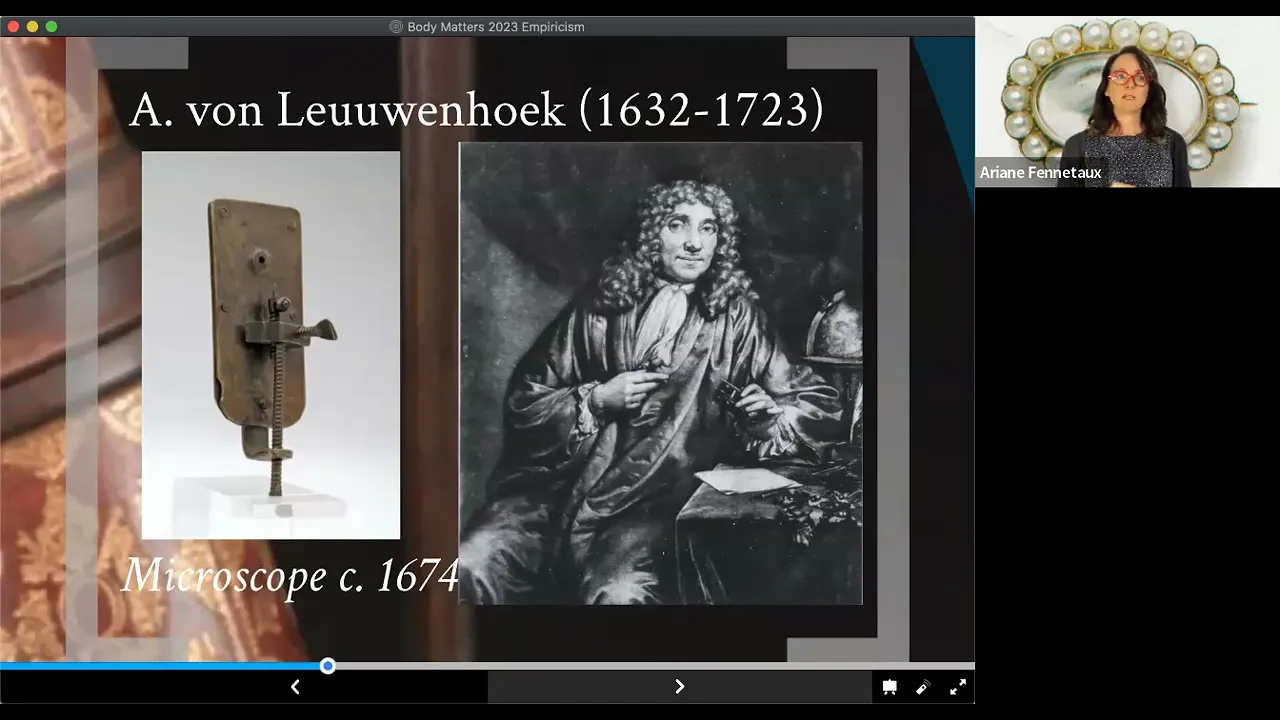
Now Antony Luven Hook, sorry for the name, he is a Dutch man. You see his date. So um he is really a 17th century and early 18th century man who devised a microscope of which you see um an example here which enabled him to um increase vision to magnify by can of 250 times.
So it it looks quite basic, but it was actually already um quite an efficient microscope. Of course, it's um uh compared to what we can achieve today, it's a very small magnification, but for a first um attempt, it wasn't bad. Um so this is Anthony Vanluven Hook in Holland in the Netherlands.
And what I want to draw your attention to um here is different things. As you may have noticed, I started with um John Lock who wrote his text in 1690. And then I told you about the Royal Society which was founded in 1660, so 30 years before.
And then I told you about Francis Bacon who kind of pre-existed the Royal Society. What I'm pointing at um what I'm drawing your attention to is that um is to be wary of any cause and effect link that too easy you know links that um are sometimes created in a way too easily between different um events and potential consequences that these events had. So um lock Francis Bacon the Royal Society of course the dates don't quite match um they often predate one another but they all belong to the same uh movement um but they express the same movement um I don't understand what it's asking me to do thing.
I don't know whether it's going to Okay. No, maybe that's okay. Hope that's okay.
Um and um my computer asked me to reconnect to Zoom for some reason. Um so, um they're part of the same movement and but it's not one creating the other or one being the cause of the other. So although Loach is seen as the father of empiricism, in a way empiricism wasn't born really with Loach.
He captured it in philosophical terms, but there were other expressions of empiricism before. And another um um expression of that is I've just told you that Anthony Luvenhook had invented the microscope. Um and he was a Dutch man at the end of the 17th century.
But there was an English man about 10 years before Louven Hook's invention who uh published a book called Micrographia or micro microraphia published in 1665. and he was Robert Hook, an Englishman, a member of the um Royal Society, who published a book um in which you have these plates of magnified details of here a a flea on the left hand side or the head of a fly on the right hand side. And he did this using his own um homemade microscope.
And you see here different designs. There are microscopes too. Um they're not the same as um Anton van Luven Hook's microscopes, but they also they try to achieve the same thing.
So what I'm drawing your attention to here is the question of invention. That is um historians of science these days really question the idea that inventions were invented. that the idea that there is a scientist who um he's in his lab and suddenly has a Eureka moment and he invented this or invented that.
Often you find that inventions were invented simultaneously in different countries approximately around the same time. uh because what happens is that people because they re they belong to the same generation, they learn the same things and then they live in more or less the same culture, one in Holland, the other one in England, but in a way they embibe um uh the spirit of the time and naturally they are motivated driven by the same questions. So if somebody is thinking, oh, wouldn't it be a good idea to have an instrument to try and see very small things, chances are somebody else somewhere else is having exactly the same idea.
Um, and indeed this is all belonging to that same movement of empiricism because if you want to look closer, if you want to look at the details, it means that you don't devalue observation, you value observation. And you want to augment your capacities at uh for for being a better observer for being able to observe things that you cannot see with a naked eye. Um, and in order to complicate things further, I've just said that, you know, new science was best based on observation and that um, which seems to indicate that observation leads necessary to truth.
So I'm going to develop an example here um where two kinds of observations led to two conflicting visions of a question related to the body. Um so Anthony Vanluven Hook the guy who invented the supposedly invented the microscope what did he observe? Um what what do what does a guy observe is if he's given a a capacity to observe very small things he decided to observe sperm.
Um so he took human sperm he took animal sperm and then he discovered he made the first observation of spermatzora. Um, and so he's the first man to have kind of seen flanks with my microscope sperm. So he saw these things that were moving with a tail and a sort of head.
Um and this kind of seemed to confirm a theory that existed about generation. That is about how are bodies formed? How are babies made?
Not in terms of the um um men and women having sex, but in terms of how does the body of the baby actually form. And there were two theories about that that conflicted. One theory is called preformationism and it's the idea that organisms um that is bodies are preformed and only grow in size.
And uh the observation of the spermatzoi seemed to um reinforce this idea because um what um Anthony Vanluven Hook seem to identify in um in sperm um the the little sperm that seem to be alive or that are alive um were then related to this idea of reformationism. them with the idea that inside the head of the spermia, what you had really was a very very very small man, a man which you can see in this later description that kind of lived all huddled in the head of the sperm. And what happened um um during gestation is that sperm was going into the woman's womb.
The woman is supposed to just nurture, feed this little man who is only going to grow in size. So he's already has a leg, a head, a heart, he's got everything but in very very small format and he only grows in size. And in a way, this theory about generation um was seemingly reinforced by an observation that is yet associated with progress with the advance the advent of new science and yet obviously it's a theory that we know to be wrong today.
Um so the other theory that preformationism was opposed to was the theory of epigenesis. And according to this theory, organisms um that is bodies arise from unformed matter which gradually organizes. Um the forefather of the theory was Aristotal.
So this was not a new theory by any description. This was really old. Aristotal in the antiquity had written a book called on the generation of animals.
Um but this was given new uh um validity uh by another observation not through a microscope that was made by a philos um philosopher and scientists often they're the same more a scientist probably William Harvey he was a doctor actually um a 17th century English man uh who wrote a book on the generation of animals which was based on observation of chicken and eggs, chicken development. So what William Harvey did, he used observation just like Louven Hook had used observation with his microscope. He opened eggs um chicken eggs at different times in the gestation of the eggs and he saw that initially just have egg yolk um and then then that gradually this egg yolk transforms into a little chick.
So you can see how the same principle of observation in a way is not a guarantee of truth obviously and that um it's not because in a way the two uh theories were born or revived or given new strength during the scientific revolution that they didn't that one um one over the other. They were both um uh coexistent. They existed at the same time.
They're competed. Obviously, they're not very um they they cannot really reconcile either you believe in preo preformationism or you believe in epigenesis. Um but you um the example um I wanted to give you is that there's no neat succession of history about these things.
That is it's not like because you have a scientific revolution that suddenly all the old errors are brushed aside and that truth prevails. It's not because you have instruments that are supposedly invented that you come to better improve truth. Sometimes these improved instruments can also reinforce old mistakes.
Um and um I wanted to stress the fact that theories and paradigms so paradigm you've got to imagine a paradigm like a pair of glasses which through which you see the world. Um and then sometimes so it's a little bit like a theory but it's it's it's it's more generic. It's really the way the categories through which you you see the world.
um and uh paradigms sometimes overlap rather than um change from one to the other. I give you another example of this and that's um about the humoric uh paradigm or the humoric theory which was a dominant way ever since the antiquity of understanding the body. I don't know whether you've heard of humors.
Humors are four fluids that the ancients and in particular this doctor galen believed um um dictated the workings of the body. So in the body we are supposed to have four fluids blood, yellow bile, black bile and fleg. And these um humorus, these liquids are related to different to the four elements.
They are related to different sensations. Um they're also related and correlated to different organs. So it's the liver that creates blood.
It's the gallbladder that creates a bile, the spleen that creates black bile, and the brain and the lungs that create flame. And they're also related to four temperaments. So characteristics of people depending on which humor prevails in their body is dominant in their body.
So somebody with a lot of blood is going to be seen as sanguine having a sanguine character. Somebody dominated by yellow bile is going to be caleric. Somebody with a lot of black bile is going to be seen as melancholy and somebody with a lot of fleg is going to be flegmatic.
There's also other correlations with different planets. Um this was really a whole system of thinking this humoric uh theory or this the model of the galenic medicine. Um and this although it had existed ever since uh the antiquity carried on and it carried on um explaining also understanding of diseases that is um because you had these four fluids.
There was a particular balance between these four fluids that dominated in your body. And if you were ill, if you were sick, it was probably because this balance was broken. This there was an imbalance between the four fluids in your body.
And this is why a lot of treatments rested on either vomiting, um, producing diarrhea or bloodletting, listening. Um and these were techniques used to restore um the balance between your different tumors if somebody was out of sorts, if somebody was ill. Um so this model really dominated medical practices up until the 18th century and during this the 18th century they were really still part of the treatments, part of the understanding of of the body and of its working.
um in parallel or overlapping with this galenic understanding of um humoral uh medicine um in the wake of this scientific revolution, you had a new paradigm that in a way superimposed with a galenic understanding of the body and this is what I call the circulatory paradigm. model. This was achieved or come to through observation, the observation of William Harvey, the same William Harvey um I mentioned before who at the beginning of the 17th century uh in a book called Mu Cardis de Muer um evidenced showed the existence of blood circulation.
So he showed that blood circulated all through the body was pumped through the body by the workings of the heart. Um and so this inaugurated in a way a new set of glasses through which to see the world although these glasses were compatible with the humors. So it's not like oh suddenly oh no it's not humors it's not balance it's not the question of balance it's also it's still that it's still the humorus and their balance that say whether you're healthy or not healthy but it's also maybe another element it's how well your humorus can circulate is circulation fluid for instance or is circulation blocked so this kind of provided other frames of vision, other paradigms through which to see health, not just about the balance of the fluids, but about how well they circulated.
But you can see that one doesn't contradict the other. You can still place value on balance, but place a new importance as well on circulation. And this is exactly what happened in the 18th century when the circulatory paradigm became more and more important.
And you can see that in medical treatises and medical discourse where there's a lot of stress being put on circulation and free circulation. So you see with these examples that uh paradigms or theories often instead of superseding one another combine, overlap and coexist. um this kind of um liquid understanding of the body with the fluids, the humorus and then the circulation um at the end of the 18th century was gradually replaced.
But again, it's not a a sudden replacement. It's not a Eureka moment that changes everything and becomes accepted by all. Um but it's a a new understanding of the body.
um was inaugurated after the um work that was done in particular by Italian scientists nerves and here I'm referring to an Italian scientist called Luigi Galvani who circa 1780 did the experiment that um maybe you did in class the thing with the dead frog and you kind of put electric current on the legs and you can see that the legs contract. And in a way, this inaugurated another paradigm, a sort of electric understanding of the body where what focused people's attention was not so much the fluids, but the nerves. And this is something that you see more and more in text towards the end of the 18th century.
And again, it's not because Luigi Galvani found that then people were interested in nerves. people become interest became interested in nerves at the same time as Galvani just as um Loach didn't invent empiricism he was an empiricist just as Robert Hook was except um their empiricism in a way didn't express in similar terms one was a philosopher and the other one was a scientist so what I want to stress and this is going to be the last um thing I say is that in all these questions about the body and in particular about medical theories but not just medical theories um there are no neat successions. There are no neat sort of story that you can tell where one thing leads to another where one thing is the cause of another.
Um and you have to see these um stories in what historians call that is instead of looking at small chunks of history which kind of neatly follow one another. This is the cause and this is the consequence you have a much messier story in a way where you don't really know what is the cause of what what really predated what. Um and uh changes are incremental and they happen over long centuries.
So the revol the scientific scientific revolution cannot really be dated in much more precisely than the 17th century. And you you saw examples that I gave from the beginning of the 18th cent the beginning of the 17th century from the late 17th century and to some extent um it carried on into the 18th century with for instance this example of the Italian um scientist who does the experiments who experiments with frog legs. uh so you really have to look at it through and not to really understand shifts that are always gradual and never simple.
So this was the podcast. The question I want you to answer is I want you to give a brief um summary of what I explained about preformationism and um and epigenesis and um same I'll create I'm going to create a little box where you can enter your answer directly. So I stop sharing uh and I'll say goodbye and see you next week.
Bye.