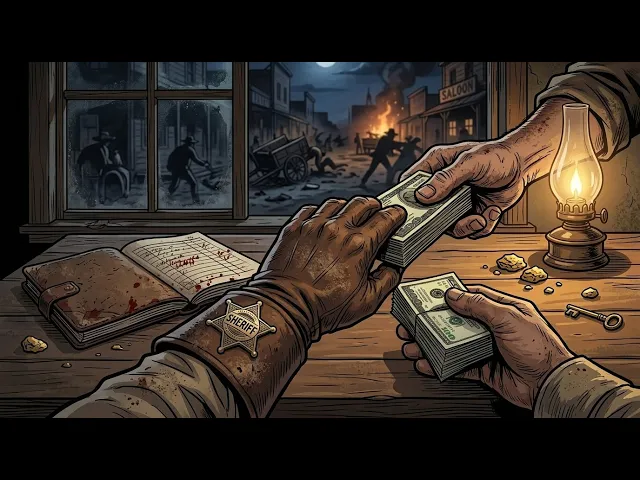
You're a lawman in a dying frontier town, pinning on a badge that used to mean something. The salary is $40 a month, barely enough to keep your horse fed and your boots patched. Meanwhile, the railroad tycoons are pulling in [music] more cash in a single afternoon than you'll see in your entire lifetime.
Your wife needs medicine. Your kids need shoes. And the bank just sent another letter about your overdue mortgage.
[music] The American dream feels like a cruel joke told by men in silk top hats. But today, everything changes. A stranger rides [music] into town.
Not just any stranger. This one's got a price on his head that could solve every problem you've ever had. $15,000.
[music] Dead or alive. You've seen wanted posters before, but this number makes your hands shake. That's enough money to buy a ranch, send your kids to [music] a real school back east, maybe even retire before this job gets you killed.
You study his face on the poster, memorizing every detail. This is your golden ticket, and you're not about to let it slip away. The outlaw sets up camp just outside town, which means he's planning something.
You could arrest him right [music] now, do everything by the book, split the reward with the federal marshals who'd swoop in to claim jurisdiction. Or you could get creative. That 15,000 could be all yours if you play this smart.
You tell yourself it's just one compromise. One bend in the rules. After that, you'll go back to being the honest lawman your daddy raised you to be.
You spend three days watching him. He's careful. This one doesn't drink in the saloon.
Doesn't gamble. Just sits [music] in his camp cleaning his pistols and watching the horizon. On the fourth night, you make your move.
You don't go alone. That'd be suicide. You bring your deputy, a kid named Tucker, who's dumb as a post, but loyal as a hound.
You tell him there's $100 in it if he keeps his mouth shut about what happens next. The ambush is textbook. You wait until the outlaw's asleep, then rush the camp with rifles drawn.
He reaches for his gun, which gives you all the legal justification you need. Tucker fires first, hitting him in the shoulder. The outlaw goes down hard, cursing and bleeding.
You could end it right there. One shot, claim self-defense, collect the [music] reward, but something stops you. Maybe it's the way he looks at you like he knows exactly what you're thinking.
Or maybe it's the calculation running through your head that a live prisoner is worth just as much as a dead one. and keeping him alive gives you options. You drag him back to town [music] and throw him in your two cell jail house.
Word spreads fast. By morning, half the territory knows you've captured the [music] infamous outlaw. A federal marshall sends a telegram saying he'll arrive in 5 days to transport the [music] prisoner.
5 days. That's your window. You sit in your office staring at the wanted poster, [music] doing the math.
The reward money will be sent to you first since you made the arrest. [music] There's maybe a 12-hour gap between when you receive the payment and when the marshall arrives to take custody. 12 hours where anything could happen.
[music] Where a prisoner could say, "Attempt an escape. " Where a sheriff might be forced to use lethal force. [music] Where the only witness would be your deputy who's already proven he'll do whatever you tell him for a slice of the pie.
Your conscience puts up a fight, but it's a weak one. You think about your daughter's [music] cough that won't go away. The way your son's feet are bursting out of his only pair of boots, your wife's face when she tries to pretend [music] the watered down soup is enough for dinner.
Every lawman in the West faces this choice eventually. The difference is most of them don't have the stones to do what needs doing. But there's a problem.
The outlaw isn't some dumb ranch hand who robbed a stage coach on impulse. He's been evading capture for 3 years, which means he's smart. On the second night, he calls you over to his cell.
His shoulder wound is festering, but his eyes are sharp as broken [music] glass. He tells you he knows what you're planning. Says he can see it written all over your face.
Then he makes you an offer that flips the entire game board. He's got $70,000 buried 3 miles outside of town. Money from a bank job in Denver that nobody ever recovered.
He'll tell you exactly where it is. You dig it up, split it 50/50, and let him walk. $35,000, more than double the reward.
And you don't have to kill [music] anyone to get it. All you have to do is leave the cell door unlocked one night and look the other way. You walk back to your desk with your head spinning.
The smart play [music] is obvious. Take the buried money, let him disappear, and you're set for life. But what if he's lying?
What if there's no money and you're just letting a killer walk free? Or worse, what if he plans to put a bullet in your back the second you dig up the cash? The clock is ticking.
You've got 3 days before the marshall arrives. You decide to test him. That night, you walk back to his cell and tell him you want proof the money exists.
He smiles like he was expecting this and describes the exact location down to the last detail. 3 mi northeast, past the old Miller ranch, there's a dried up creek bed with a lightning struck cottonwood. 50 paces due west from that tree buried 4 ft down in a leather satchel wrapped in [music] oil cloth.
He even tells you the denominations, mostly 20s and 50s, some hundreds, all from the Denver Mint, dated 1891. The specificity is either the mark of truth or the most elaborate con you've ever heard. You saddle up before dawn, telling your deputy you're doing a perimeter check.
The ride out is tense. Every shadow looks like an ambush waiting to happen. But you find the creek bed exactly where he said.
The cottonwood is there. Split down the middle by God's own fury. You pace out 50 steps west and start digging.
Your shovel hits something solid at four feet. Your heart hammers as you pull out a leather satchel [music] exactly as described. You unwrap the oil cloth with shaking hands.
It's real. $70,000 in cash [music] just sitting there in the dirt like a miracle. You've never seen this much money in your entire life.
For a moment, you just stare at it, feeling the weight of possibilities. Your family could eat [music] real food. Your kids could go to a proper school back east.
You could buy land, start fresh somewhere. Nobody knows your name. [music] Then reality kicks you in the teeth.
If you take this money and let him walk, you're not a law man anymore. You're just another crooked sheriff [music] in a territory full of them. But if you take the money and still collect the reward by killing him, you get everything.
The moral high ground is nice, but it doesn't feed your children. You ride back to town with the satchel hidden in your bed roll, [music] your mind spinning through scenarios. That night, you can't sleep.
Your wife notices you're distant, asks if something's [music] wrong. You tell her everything's fine, which is the biggest lie you've ever told her. [music] She knows you well enough not to push, but the look in her eyes says she knows you're carrying something heavy.
Day three arrives. The outlaw is getting nervous. He keeps asking if you found it, if you're going to honor the deal.
You don't answer, just watch him sweat. The truth is, you still haven't decided. Part of you wants to believe you're better than this.
That same part is getting quieter by the hour. Then something happens that makes the decision for you. A telegram arrives from the territorial governor's office.
There's been a clerical error. The reward has been reduced [music] to $8,000 due to budget constraints. $8,000.
Barely enough to get through winter, let alone change your life. The federal government just cut your moral dilemma's value by 75%. That night, you walk to the cell with a bottle of whiskey.
The outlaw sees your face and knows immediately what the answer is. You unlock the door, hand him the bottle, and tell him to drink up. He asks if this means you're letting him go.
You tell him you're still deciding. What you don't tell him is that you've already made up your mind. You're taking the money and killing him.
The only question now is how to make it look legitimate. He drinks and you drink with him. He starts talking, probably figuring if these are his last hours, he might as well spend them human.
He tells you about his daughter. says she'd be about your girl's age now if she'd lived past the fever. Says that's why he started robbing banks, trying to pay for medicine that never came in time.
You don't want to hear this. You don't want him to be a person with reasons and grief. You want him to be a monster, so [music] this is easier.
But he keeps talking. He tells you the worst part isn't the running or the violence. It's knowing his daughter died, thinking her daddy was a good man, never knowing what he'd become.
He says at least she's buried proper with a real headstone. Says he paid for it with [music] money from his first robbery. And it's the only thing he's ever done that he doesn't regret.
[music] The whiskey bottle empties. He's drunk enough now that he probably wouldn't put up much of a fight. You could do it right here.
Claim he tried to escape and nobody would question it. Your hand moves to your gun. He sees it and doesn't flinch.
just looks at you with tired eyes and says [music] something that stops you cold. He tells you that whatever you decide tonight, you'll be living with it [music] until the day you die. Says he knows because he's been living with his choices for years.
And they don't get lighter, they get heavier. Every single day, they get heavier. You leave the cell without a word, locking it behind you.
You've got 2 days until the marshall arrives. Two days to decide [music] if you're the kind of man who can pull that trigger. The money's already buried under your floorboards.
That choice is made. Now comes the hard part. Morning breaks cold and gray.
You haven't slept. The outlaw's words loop in your head like a broken music box. The same three notes over and over.
Whatever you decide, you'll live with it. They get heavier every single day. You make coffee that tastes like dirt and watch the sun struggle through the clouds.
Your daughter will be awake soon, asking about breakfast, asking about the man in the shed. Kids have a way of sensing when something's wrong, even when you're wearing your best poker face. The money under the floorboards feels like it's radiating heat.
$8,000. You keep doing the math. That's food for a year, maybe two if you're careful.
That's your daughter in a real school instead of learning letters from a woman who can barely read herself. That's medicine when the winter cough comes. That's also a man's life.
You walk to the shed. The outlaw's awake, sober now, looking worse for the hangover. He doesn't ask about your decision, doesn't beg, just watches you with those eyes that have seen too much.
You tell him the marshall arrives tomorrow at noon. He nods slowly, understanding the timeline, understanding what you're really saying. You've got 24 hours to make your peace with whatever happens next.
He asks if he can write a letter. You almost say no, then catch yourself. What's one letter going to hurt?
You bring him paper and a pencil worn down to a stub. He writes for an hour, his hand moving careful and slow like a man who doesn't write often. When he's done, he folds it three times and asks you to make sure it gets to his sister in Santa Fe.
You take the letter. The address is written in that same careful hand. You notice his fingers are inkstained.
[music] And for some reason, that detail hits you harder than anything else. This man who robs banks and shoots lawmen has [music] inkstained fingers from writing a letter to family he'll probably never see again. That afternoon, a writer comes through.
Not the marshall, just a drifter looking for work. You send him away, but he mentions something before he goes. Says there's talk in town about a big reward.
Says half the territory knows the ghost of Gilabend is locked up in your shed. Says there's already three bounty hunters on their way, hoping to claim the [music] prize if something happens to you before the marshall arrives. The situation just got more [music] complicated.
If bounty hunters show up, this whole thing could turn into a blood bath. Your daughter's in the house. Your daughter, who deserves better than growing up in a place where violence is currency and morality is negotiable.
You check your rifle. Make sure it's loaded. [music] Then you do something you can't quite explain.
You unlock the cell and tell the outlaw to come outside. [music] He hesitates, probably thinking, "This is it. You're taking him out back.
" But you just point to the water pump and [music] tell him to clean up. He washes his face and hands while you watch the horizon. You're not sure what you're doing anymore.
The plan was simple. Wait for the marshall. Collect the money.
Move on. But simple plans have a way of rotting when you let them sit too long. Your daughter comes out, sees the outlaw at the pump, and asks if he's leaving.
You tell her soon. She asks if he's a bad man. You open your mouth to say yes, but the word gets stuck [music] somewhere between your brain and your tongue.
The outlaw answers for you. Tells her he's done bad things, but he's trying to be better. She asks if people can do that.
Just decide to be better. He looks at you when he answers. Says he hopes so.
Otherwise, there's not much point to any of it. That night, you sit on your porch with the rifle across your lap. The outlaw is back in his cell.
The letter to his sister is in your pocket. The money's still under the floorboards. The marshall will be here in 12 hours.
You think about your daughter's question. Can people just decide to be better? You think about the outlaw's daughter buried under a real headstone paid for with stolen money.
You think about your own daughter who might not get that headstone if you can't pay for medicine when she needs it. You think about the weight of choices, how they don't get lighter, how they follow you like shadows that grow longer as the sun sets. Midnight comes and goes.
3 hours until dawn, 9 hours until the marshall, you've made your decision. You know exactly what you're going to do when that federal lawman rides up to your property. You just hope you can live with it.
But then again, the outlaw was right about one thing. Whatever you decide, you'll be carrying it for the rest of your days. Might as well pick the weight you can bear.
The stars are bright and cold and completely indifferent to the choices men make in sheds at the edge of civilization. The sun comes up on decision day. You walk to the shed one last time before the marshall arrives.
The outlaws standing at the small window watching the same sunrise you just [music] watched from your porch. You unlock the cell and tell him to step outside. He does slowly waiting for the bullet that might come.
Instead, [music] you hand him his gun belt. Empty, but his. You tell him the marshall's coming in 6 [music] hours.
You tell him there's a horse tied up behind the old Miller place, the one near that lightning struck Cottonwood. You tell him he's got a 30inut head start before you fire a shot in the air and start tracking [music] him. He stares at you like you've lost your mind.
Maybe you have. He asks about the money under your floorboards. You tell him it's staying right where it is.
Consider it [music] payment for the letter you're going to mail to Santa Fe. He doesn't move for a long moment. Then he extends his hand.
You shake it. He walks away without [music] looking back. And you watch until he disappears into the scrub brush.
You'll tell the marshall he overpowered you. Took your gun. Escaped [music] in the night.
It's thin but it'll hold. You won't get the 8,000. You won't get anything [music] except the knowledge that for once, just this once, you chose the weight you could actually carry.