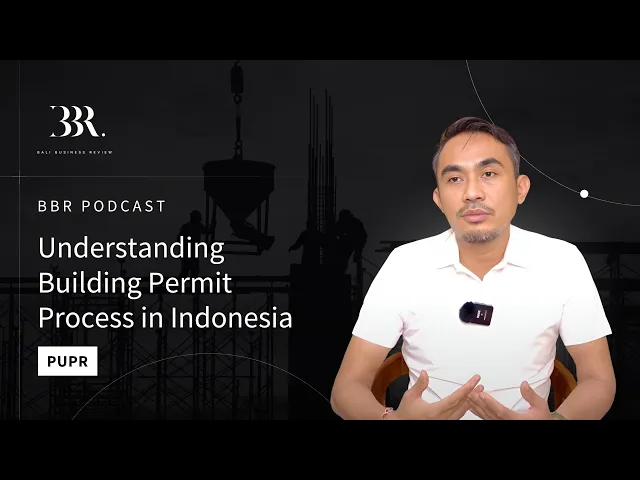
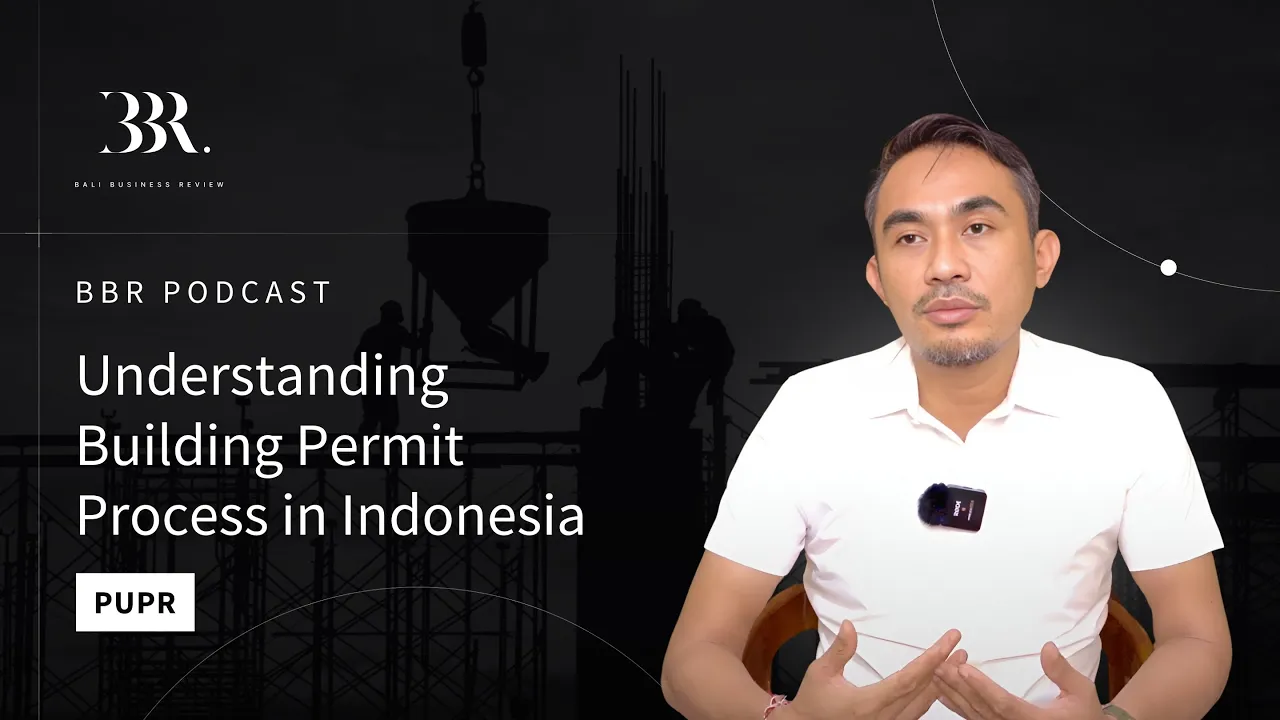
Hello, my name is Agus Sumardita. I happen to work at the Ministry of Public Works and Public Housing of Republic of Indonesia (PUPR) in Badung. where we are currently in charge of the management of the system, SIMBG system, Building Management Information System.
Where the system is used to process or manage applications for Building Approval or PBG and Certificate of Functioning or SLF. There is a lot of stuff handled by the Ministry of Public Works The permits like PBG and SLF, we just started handling it in 2021. Apart from being related to permits, the PUPR Office also has a lot of other responsibilities.
Programs related to the building arrangement, Environmental protection, spatial planning program, construction services, road construction and infrastructure There are many things that we handle. But yeah, the processes we handle which we are directly involved with people are the permit approval processes, PBG and SLF. Villa, by the Indonesian dictionary definition, is a type of business.
Every building that is used for business, according to provisions, laws and regulations, related to business permit and licensing, indeed every type of business must have requirements. The basic requirement for business licensing Firstly, KKPR spatial planning approval, (inaudible) space utilization. The system is also submitted through OSS.
The second is environmental documents or environmental approval, and the third is PBG or SLF for the building. Those are the basic requirements for all permits including one of them is the villa's function. There are more documents to be prepared, aside from the three that has been mentioned Those are technical provisions in addition to administrative provisions.
Relating to regulatory provisions, particularly to building regulations before the construction process is carried out, There has to be a submission of a building permit. That has to be done first before the construction process is carried out That is requested first before the business actor carries out the construction process. Then, during the construction, our (inaudible) will assign a team of inspectors to check the suitability of the PBG permits issued with the construction implementation.
Everything will be checked. After the building is completed, the applicant will have to apply for SLF, Certificate of Functioning so that the building can operate. Now, there is also a provision in the regulation that before the building starts to operate, there is another process of processing documents at OSS for its operational permit.
At this stage, the officers will request for PBG and SLF permits. For business owners, they need a space to do business. They will need a place or area.
Well, it is better before making an investment, leasing land or collaborating with the landowner, to first check the spatial suitability. The zoning, whether it is allowed to build activities that they will carry out, whether villas, hotels, or so on, please verify. In Badung, there is already a system that facilitates public information on spatial information, which is called BATARA: Badung Tata Ruang.
It can be accessed on the web, or via the application in Google Play Store . So that later before making an investment, you can find out whether the type of activity to be carried out is legal on the land you want to rent out. If the lease process has been complete it, you can submit your request of permit the next day.
You may submit an application to administer your business permit including the application for PBG and SLF. The points are, firstly make sure of the location and administration procedure for land tenure. Actually, it is almost the same, in terms of systems and provisions for business functions.
There is not much difference in the types of documents that has to be submitted. What must be prepared is almost the same. The only difference will be related to the type of activity, the document of activity type.
Well, the type of document will also differ. If it's a villa, the area is not too big compared to A resort or a hotel, that has a larger area. The difference will be the type of environmental document.
For example, If an area has one to 5 thousand square meters of building area, the document may be a SPPL, a statement letter to fulfill environmental requirements. If it is 5 thousand to 10 thousand square meters, The document will be a UKL-UPL. And lastly, if it is above 10 thousand square meters, the document is definitely an AMDAL.
That's probably the things that will differ. But in terms of technical provisions and others, the document requirements are not too different. Sometimes the requirements for especially identity or general data Let's say a local resident, Balinese, or Badung resident and to those people who resides outside Bali province, it will be the same.
Their data, their identity, KTP can be used. Now, what distinguishes the applications submitted by foreigners or Foreign-Owned Companies (PMA). The PMAs must attach a KITAS.
Those PT PMA or foreign companies must also attach their company deed. The Business Identification Number must also be attached. That's actually all the differences in relation to identification between locals or foreigners.
It's always better for business people or those who are planning to do so, let's say there is a third-party that will help and this party will help with your applications, PBG or SLF applications through the system. We recommend that the SIMBG account is shared amongst agencies, consultants, or business owners. So later, whoever it is, applicant or consultants they can crosscheck informations later.
Because the application status is there. The application history is there. The position of the file will be visible on the system.
So we can be updated about the progress, rather than waiting on informations from the uploader. Now, how do we know, after uploading, that there is something missing or incomplete from the file, or it is complete. You will be able to see that from the system or there will be a notification from us.
We at SIMBG secretariat management, will check the application. Whether the documents are complete or not. Suppose the PBG or SLF application is complete, we will give a notification letter.
The notification letter states that the documents are complete and will proceed to the consultation stage like that. And that letter is electronically signed. But if the documents are incomplete, we will also provide a notification letter that says- "This is what must be completed, what are the documents.
" Well, that's what we will convey to the applicant through a notification letter. If there is a discrepancy, or there are incorrect documents or maybe the data submitted is wrong, the information is inaccurate, we have had experiences. Suppose we authorize the permit and pass this application, but then there are inaccuracies during inspections or monitoring, firstly we will be returning the documents.
Secondly, there was a case where the PBG and SLF permits was revoked by us. Because there is a discrepancies between the document and what's happening on site, so we revoked the PBG. Sure, as long as it has been re-submitted with the correct data or submission.
At the time of submission in the system, the applicant will tick a box as a signature which says that the data submitted by the applicant is correct and true. That is an independent statement through the system. So if the data is not correct, the consequences are on the applicant.
The big challenge of space issues is actually that almost all regions is facing the same thing. Because there are economic, social, cultural factors, the needs of the community are also different. The second is also related to development.
The development is quite rapid, especially in the Badung Regency area, the development of investment is also quite high. The community's need for space to do activities or businesses is also quite high. The economic potential is high, the tourism movement is good.
Now that is indeed one of the challenges. Because with the existing provisions, zoning regulations, all places or areas have been designated for the space suitability data. The types of activities that will be carried out in one place have been regulated based on the RTRW and RDTR regulations.
So the desire is, the goal is, to control development. so that there is no uncontrollable development like that. This is actually a challenge.
Because there are productive zones such as horticulture, plantations. Maybe it has good potential in terms of view, good tourism potential. But then we have to maintain the place so that it remains sustainable as a place for plantations or horticulture.
That's what is sometimes a challenge to maintain. Because that is considered to have great potential, prospects for development to be used as tourist accommodation. However, according to the regulations, we are still not allowed to (build) in certain places, or in certain sub-districts, it is not allowed.
That is a challenge to spatial control because of such socio-cultural economic needs. For the PUPR office, because we also have a lot of fields, each field handles different types of activities, all are actually prioritized. We have government projects that must be implemented.
We also have social assistance that we carry out by/and friends like that. So we don't do that. Prioritizing one after another, no, all of them are prioritized.
Because it is our duty and obligation to carry out tasks evenly with the same level of responsibility. Maybe the first one in South Kuta, North Kuta if I'm not mistaken, in 2021. Related to regulations on zoning provisions, the detailed spatial plan is the latest.
Then Mengwi sub-district if I'm not mistaken, 2022 yes, that's the newest too. Abiansemal Petang in 2023 if I'm not mistaken, that's the latest. It's the most up-to-date provision on the spatial zoning.
So that's the benchmark for the RDTR year in each sub-district. So after that, no- there is no new one. Because it is indeed not a short time to review a RTRW or RDTR like that.
At least, if I'm not mistaken, the RDTR is 5 years old. But also to make changes is not as easy. Because the changes will require an in-depth and long study.
It will definitely affect the zoning arrangement. For example, in Mengwi sub-district perhaps. In the coastal Semagi area, which used to be horticulture.
It has now become either residential or tourism area so that there are more types of activities that can be carried out in that place. Types of business activities, accommodation, tourism, the selling value will automatically be impacted due to its high economic potential and those lands that are developing rapidly are in Kuta, North Kuta and coastal areas like Mengwi. Maybe up to coastal district of Tabanan, that is currently developing.
BATARA is actually an innovation from our leadership and colleagues in the department of spatial planning. Spatial planning, spatial planning team. BATARA is actually an informative system for the community related to land use, zoning in Badung regency.
So that the public can access or be informed with the designation or zoning in an area. Or let's say there is an applicant or an investor that wants to invest. Yes, you can also check out BATARA.
With the information in BATARA you will find out, the types of businesses that are allowed and not allowed. Second, you can find out the intensity of building regulations, what is the intensity of the spatial arrangement. So that this can be a guide for the planning team.
Before implementing a building, in that area, what are the zoning provisions? What is the KDB, how big is the boundary, it can be checked through the site. This is an innovation made by our colleagues.
While this is indeed quite successful and this is a mainstay in PUPR. And it also makes it easier for us, our teams handling PBG and SLF. While it's still only in Badung Regency because the one who developed it was an initiative from the leadership and friends in spatial planning.
That is indeed the Badung area. But also, this will already be a pilot by the ministry. Maybe it can be adopted by other colleagues in other regions or other districts.
Indeed, there are also those who are interested to replicate the BATARA system in their districts. If we collaborate, we call it as a discussion, and we do it a lot deliver programs or socialization. In addition to PUPR, we also often collaborate with the DPMPTSP Investment Office to socialize business licensing activities.
Conduct socialization on OSS, conduct socialization on SIMBG, related to PBG and SLF. Also conducted socialization on environmental documents or requirements. Because also invited are colleagues from the Environmental Agency.
Other collaborations carried out by local governments are also with practitioners, academics, including experts, consultants. Well, there is also collaboration or sharing sessions on the implementation of building in their respective regions, especially in Badung Regency like that. Yes, maybe we from the PUPR PUPR representing the leadership and ranks.
We hope that investors or business people - this is indeed a very high interest, trying to do business in Badung Regency. In terms of providing services, we try to be as humane as possible. So, don't be afraid to invest or make requests.
We will not make it difficult, instead, we will make it easier. Well, from business people, it is always better that all provisions are fulfilled. The legality aspect, the provisions are followed.
So there will be no discussion on "Why is it so complicated? ", As long as all the requirements are met, nothing is complicated. Everything has to start from the initial identification that should be done by the prospective applicants, of the location, what kind of business they will run.
Well, because that is heavily related to zoning. Do you already have a legal business entity? Do you comply with the regulations?
Do you have enough personnel? Those are your responsibility, what needs to be done. Inventory management, reviews too.
Actually, we can see that with the high number of applications, it means that the level of investment or business investment is quite high in the Bandung Regency area. So far, the investment climate is still great. As long as all legal requirements are met, I don't think there will be any obstacles or difficulties in managing the permits of the company like that.