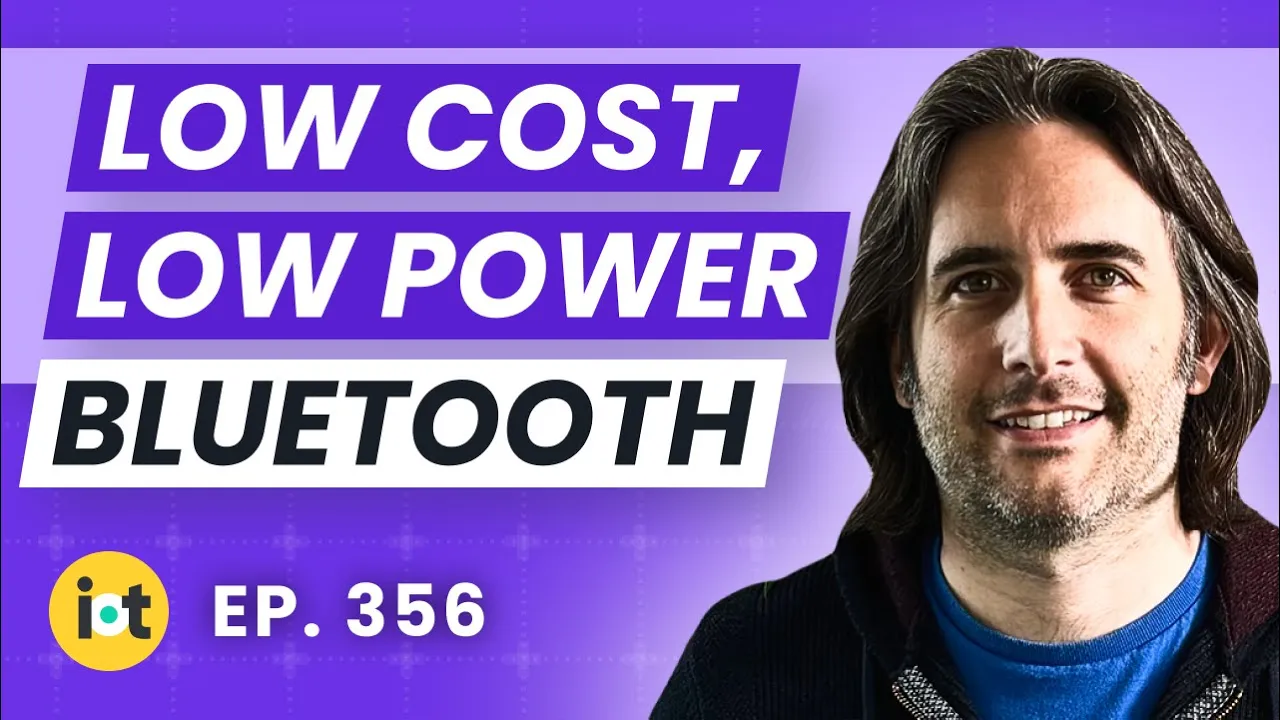
[Music] welcome Simon to the out podcast thanks for being here this week hey no worries nice to be talking to you Ryan yeah it's great to have you um before we get into it I'd love it if you give a quick introduction about yourself and the company to our audience oh sure yeah so um Simon Ford based in um Cambridge in the UK been in the iot um business a long time I guess um working at arm originally through cortex a cortex M micr controller platforms It software and things like that and now uh working
at bleen where we're building to low energy based iot connectivity we've talked about in the past a while ago but we haven't covered it kind of recently and where where things are today I'd love it if maybe we could start with having you just give a quick introduction to what Bluetooth low energy is compared to just Bluetooth in general how people think about it and then kind of where it stands now versus maybe where it was you know 12 months ago yeah you're exactly right so Bluetooth is this amazingly wellknown brand um it's been around
for years um but a project sort of around uh you know Nokia and Erikson and people like that in the early days of mobile phones called wbr um developed into something called Bluetooth low energy and actually became part of the standard um and as the name reflects it was much more focused on really low cost low energy devices but I guess what's interesting about Bluetooth low energy in particular is it it kind of got a free ride on on uh phones and laptops and things like that by being very um low cost to implement into
what was EX existing Bluetooth silicon so they're actually quite different Technologies but very cheap to add into the designs that already there so by that um fact it actually uh you know is one of the fastest growing Wireless standards ever the adop you know the rate of adoption of that technology um was amazing um and as you say I think most people will perhaps know it um for sort of personal peripherals things like keyboards mice um things like that um but I guess what's interesting well certainly to us um and to people are looking to
apply in industry in sort of I guess non-consumer applications is because it it got that free ride and because of the economies of scale it achieved it's actually just an amazing technology if you can apply it to some some different use cases more recently I mean there's been some really interesting additions to um the standard it's it's developed um a lot over the years I mean it's just it's you know we always think of it as like hiding in plain sight it's one of those standards that just keeps on chugging away and getting better and
better um got some really interesting um features around audio broadcasting um added to it recently in aast other things that can uh for things like Direction finding and distance measurements this growth in um consumer that that made the economies what they are and made the global adoption what they are it is you know even just that basics of that technology being applied into these different applications I think is is kind of what's I mean certainly what's really exciting for us no absolutely it's been a really cool space to follow just you know I mean I've
been in iot space for eight years or so now and just watching connectivity Technologies you know mature and evolve and some go away some improve you know all that kind of good stuff it's been great I think you people having more options and more sophisticated Technologies to make some of these use cases plausible that were not before is is the best thing that could possibly happen for the industry um amongst other things obviously could you talk to us a little bit about some particular use cases that companies are using ble for when it comes to
being the choice for the iot connectivity piece of a solution as your highlighting Bluetooth being around and people recognize it for those consumer use cases so sort of you know pairing a a health tracker to your phone or something like that what's really interesting is Bluetooth has got some quite impressive and and unique features so uh things like being able to advertise um so actually if you look at if you looked around you and you scanned around you there's there's probably 50 100 Bluetooth devices all advertising their existence and actually a technology like that um
perhaps originally got the interest of people like Apple and Google for marketing purposes so you walk into a shop and it it discovers you're there and you know it gives you a promotion for your Starbucks or something like that um and that's again how technology like that got adopted into all these different operating systems um but then you know then industry caught on and went well hang on let you know let's let's not track the user let's track an object let's make the thing that has the Bluetooth device the thing that's moving not the thing
that's static um yeah so so one sort of killer application for Bluetooth Lear enery um in this space is is um has been asset tracking and and um yeah the fact that these devices at incredibly low power can advertise their existence and you know that be detected by a phone or a dedicated piece of Hardware or something like that kind of kind of really took off quite quite quietly I I don't think until things like air tags came around maybe tile or something like that people knew it in the consumer space but yeah there's billions
of these devices being used to understand where things are um and then yeah as you say what what are the use cases from that well you know knowing where something is is is all well and good but actually often what you're looking to do is understand um not just where it is but what it's doing or what it's been doing um and that's kind of where it gets exciting for us is where you know this sort of this Beacon technology starts maturing Beyond I guess you know what got popularized as a marketing use case into
um really being um well requiring like secure data transfer and and and things like that so so objects or products can start communicating back to base about um you know through a supply chain when when did something go out of condition or if it's a product how is it being used when is it being used um or or or then getting on to obviously managing a device being able to update it and improve the firmware but but or when you can you know hit a very very low cost yeah I've heard about it in like
in the from an indoor asset tracking standpoint within hospitals and medical kind of situations we trying to figure out if it's going to be a good option to use for tracking medical devices and and different kinds of things within hospital setting um you know Ultra wideband is something people use but the cost associated with that wasn't always something easy to digest so I I've heard companies working with Bluetooth really trying to figure out how they can efficiently do indoor asset tracking which is kind of like has always been a big thing a big challenge for
for people in iot especially on the Enterprise side for sure and I think what's um sort of exciting to us is knowing where something is is part of the problem but actually knowing what it's doing is is really where it gets quite interesting and um yeah you you're exactly right that there there's a load of technologies that have um have been explored recently Ultra wide band being one but other things added to the Bluetooth standard like angle of arrival angle of departure and channel sounding for better positioning um it's a really interesting area and I
think there's a there's some really uh good companies working on that sort of the localization problem what's exciting to us is where people are starting to think well actually if I knew what what my products in the field were doing or if I knew how my environments were behaving I could make better decisions or I could you know I could improve the system right yeah location is sort of like the Baseline if you know where your um product is I think that's very exciting but then you start to have an Insight which to be honest
the SAS guys have had for the last 10 years right any SAS company now wouldn't be um wouldn't be where they were if they didn't understand how their product was being used used or being able to deploy improvements to their product um as they needed to so I think I think the embedded industry is just going to follow what about on the opposite side of that what are some of the challenges that companies have had using blle for iot connectivity for these Solutions great question yeah so yeah the the obvious benefits right people are looking
for low cost or they're looking for low power or it to be small or just the ubiquity the technology right is everywhere this is the reasons why they're trying to apply it right and um but then where where you get stuck is things like actually the fundamental architecture right so as a technologist you wouldn't necessarily build an IO connectivity architecture in the way the Bluetooth low energy is designed it's it's designed as that cable replacement concept right it's you pair a device and it's like you plugged it in you know it's like you plugged your
keyboard into your um computer it's just it was Wireless and and that that whole concept is great for peripherals but if you think of iot connectivity like cellular Technologies or Laura Technologies or anything like that it's generally about a device anywhere wherever it happens to be being able to talk home um so that sort of pairing concept doesn't quite the device kind of wants to be in charge it doesn't want to be a slave to a computer or something like that it's the thing that wants to communicate um so yeah that what you find is
um the technologist wouldn't necessarily design it like this but the pragmatist wants to use Bluetooth because of all the the the benefits um so yeah you you find companies effectively having to work around the the core architecture and build you know a different security transport that is more appropriate or trying to work around how how would you avoid pairing so that a device could you know migrate between hotspots or or something like that um so there's those sorts of things um and I guess um there's there's some range considerations as well so I guess when
most people think of Bluetooth they think 5 m or something like that it's your headphones reality is it's you know as long as the antenna's designed well and things like that you know 50 100 meters is fine and we've we've got people experimenting up to a kilometer and things like that but realistically it is a relatively short- ranged radio and that's when you start to if you look over at cellular what what sort of what sort of Technologies and inspiration do you take from there well it's things like Mobility to be able to roam you
know you can roam between hotpots or you can um a device as it's moving through a supply chain might want to talk um you to a different back end by access points and things like that so it's kind of all these sort of architectural things um that to be honest you know they're not rocket science but they are quite complicated um you need someone who knows security you need someone who knows topology and all those sorts of things so yeah I mean yeah in the my time at arm I spent a lot of time with
a lot of companies building building things when they were building with Bluetooth in this sort of area you know that's the teams they were ski up to to build those sort of things and you can only see that so many times before getting frustrated and think oh you know might going to fix this let me ask you we've covered some pretty high level like really the basics I think are super important here when when we're talking about B how does it also play into other trends that we're seeing with AI at the edge we've talked
about ML on here things that we listed ahead of time were energy um scavaging and then miniaturization like how are those Trends or how are I guess BL playing a role in those Trends yeah the three trends that you're talking about there you know that that's going to evolve over the next 5 10 years AI on the edge is an interesting one you know so there's a lot a lot of devices that they want to do sensing they want to understand something about their domain maybe they got quite high bandwidth inputs and obviously sending data
over radios is expensive so you often want to distill that down to something that's really quite high level Concepts right you know that's how you get efficiency in the system and you know thanks to you know companies like arm and and all the Silicon guys actually doing processing in a tiny Wireless device now is incredibly efficient so if you can do Edge processing to reduce the amount of data you send that's amazing but at the same time you actually need to be collecting data to be able to train your models you need to be able
to push new models down to the edge to um you know update as you find anomalies and things like that so Bluetooth is kind of uniquely placed there I think um in the sense that it can be really low cost um low bandwidth low power as a radio standard so when you're sending the information that you want you know the the high level data um it can be incredibly efficient that but then you can also ramp it up to actually be you know a decent bandwidth to push a new model down or to to get
the training data from the field rather than just from the lab and actually when you look at a lot of low power radios often they don't have that bandwidth that they're disposable um so has to be a lot of lab testing stuff like that so I think yeah and and the combo of sort of Bluetooth and quite powerful micros I mean there's tens of silicon vendors making them now so as a designer um it's a great combo yeah when you come to miniaturization and energy Scavenging again I think Bluetooth is is quite uniquely placed here
when you're dealing with energy Scavenging you're really looking to reduce power you know it is maturing as a technology now I mean it's real it's it's not widespread I wouldn't say yet but it is real if you if you go and look at what people are doing with energy Scavenging they're generally using Bluetooth low energy why is that well because it meets the Power profile why are you energy Scavenging well you're probably trying to get cost down as well you're trying to avoid having batteries you're trying to avoid sending someone out to replace batteries and
actually you know there isn't really any cheaper mainstream radios than Bluetooth so you can see it kind of that whole miniaturization whether it's printed batteries um you know flexible Electronics um things like that and the energy scavenger I think yeah is going to really play I mean it's certainly something we're betting on it's it's not the market now um it's it's a latent Market it's it's emerging it's you know it's getting real but it's not widespread but yeah I guess what's exciting for us is you know as as the you know the use of Bluetooth
in these sort of iot connective use cases grows you've got this new wave kind of yeah battery free or Fabric or embedded um you know technology it's just like it's almost just smuggled in the corner of a product or you know medical device or something like that it's really it's quite impressive what's going on and you can kind of get to seeing what's going to happen in the next five 10 years yeah if we look at the next 12 18 24 months anything kind of that you you're really excited for in this space or people
should be kind of paying attention to well I think there's two things yeah like like you say that um there's there's what I was talking about this sort of five years out thing I think a lot of that technology is going to start to feel very real um so people are going to contemplate you know perhaps products that they couldn't have imagined um before so that that's really interesting but that that's still quite you know science I suppose I guess what's interesting for us shorter term is we're just seeing more and more people becoming quite
pragmatic about iot and you know the use cases that they're they're understood um but it's not about the science anymore so you know yes there was A Rush of radio Technologies yes there's a rush of um all these different things but you know a lot of the companies we talk to at the moment they're they're pretty pragmatic about stuff and they're thinking not just technically they're thinking about economics they're thinking about cost of deployment they're thinking about um you know the reality of taking something to Market um Distributing it through a supply chain and all
those sorts of things and um you that's quite exciting because um you know this industry behind the scenes is growing crazily even if it's not so visible um but it's nice to see that it's it's just going to keep keep on that trajectory and that's why certainly building this business I I feel like it's an amazing time to be doing it actually yeah a lot of the research has been done a lot of the use cases have been you know somewhat proved out and and now it's um about making them more practical for people especially
on the Enterprise side like thinking at an affordable cost the ROI is more clear it's easier to deploy all the stuff that just makes you get to scale more you know more easy or make it easier right so and the spillover of um sort of consumer expectations into the industrial side is very exciting for us because actually cost of deployment become is a barrier a lot of projects have we we saw failed because yes the conceptually the product was great but when it came to deploy it it was um you know hit barriers of complexity
and training and these sorts of things but if you can sort of consumerized the product even though it's not for a consumer Market you can really change the cost structure and I think um that combined with the cost of Hardware continuing to go down means a lot of services Services businesses which are really what a lot of iot businesses are are not going to have that upfront you know Hardware cost or deployment cost that is the barrier to them giving value to their customers properly becoming a service model and a service industry is is really
exciting prospect I think so um where can our audience learn more about the company what you have going on follow up with questions any of that kind of stuff I also saw that you all are hiring too that's correct yeah yeah so yeah the company's called blein um we have a website b.net and and you can obviously reach out to us there or um follow us on LinkedIn and things like that or set up a call if you want to um chat with us we'll actually be over at embedded World um in Austin in October
so that would be great and yeah we are we are hiring we're still a small team but we're hiring super Guru uh people so if you think you're one of those people reach out but also working with a whole range of sort of design Partners design consultancies that are looking to build products with their customers you know it's it's great to talk to them we're a product company we love working with design consultancies that are in there solving the depths of of a customer's problem so if you fit into that category it' be um amazing
to talk to you here well Simon thank you so much for the time really appreciate it um excited to get this out to our audience and if um you know we can help out in any way in the future let us know hopefully we can find some time to to talk further maybe later this year into next year about kind of the state of the BL space and what you have going on over there yeah yeah exactly that that would be amazing thanks for your time Ryan that was brilliant