[Music] welcome everyone my name is Dan head again I am the chair of the Advisory Committee forestry which is the economic self-sufficiency sufficiency research Policy Institute and this evening I have the honor of introducing David Newmark who is a distinguished professor of economics and director of the economic self-sufficiency Policy Research Institute at UCI he's Previously held positions at the Federal Reserve Board University of Pennsylvania Michigan State University and the Public Policy Institute California and is currently a visiting scholar at the Federal Reserve Bank of San Francisco in their senior research fellow at the workers compensation
Research Institute he has made significant research contributions in numerous areas of labor economics that intersect with important pop public policy issues his early work On wage equation decomposition led to efforts to better tie these major and methods generally models of discrimination and his recent method methodological contribution on audit and correspondence studies is being rapidly adopted in new and ongoing studies didn't have to tell you what that is because I don't I don't quite know but one of the things that he's also known for one of the topics tonight is he's one of the original contributors
to the Minimum wage research and helping to pioneer use of state-level minimum wage variations to estimate minimum wage effects he's also a leading scholar on economics of aging age discrimination having authored numerous studies information of age discrimination labor markets and tests of alternative models of the age earnings profile his current research agenda as as as part of the activities director of Esprit concerns a long long runs of effects of alternative Anti-poverty policies on what we're broadly defining as economic self-sufficiency so that's earnings income poverty public assistance receipts and that's really what Esprit is looking at
is how do we have the most efficient execution of those things from a public policy perspective and tonight with his deep background in the minimum wage the topic is using the minimum wages to fight inequality and poverty hey do you want the following program to Make changes to this computer I think we'll say no there we go okay good thanks Dan thanks for coming my notes are here good so I'm going to run through what I've spent or wasted 30 years of my life on depending on your perspective in about an hour a broad overview
of the question of minimum wages and the use of minimum wages in fighting inequality and poverty and I'll go for the last an hour we'll take we'll take questions and we'll go From there I noticed I thought I had caught all the things in my slides I wanted to change but there's there's a couple UK references you'll see because I actually gave this in the Parliament building a few months ago not to Parliament just in the Parliament building so I had to talk a little about the UK and those of you who've been to the
lecture series in the past I will I will sort of because this is a good pedagogy as a teacher bring You back to things you heard in some of those talks because there's actually quite a few times with what we do what I'm talking about here okay so first of all this is a big topic now anyone who follows the news and this goes back I think probably really started before the last presidential campaign knows that we've kind of made this shift in the u.s. to a very high wage high minimum wage environment the federal
minimum wage has not changed since 2009 it's Still seven and a quarter but the federal minimum wage is increasingly irrelevant twenty-nine states and I probably off one or two because this changes like every two weeks but when I last wrote these slides and checked them a few months ago 29 states have minimum wages above the federal minimum wage ranging I think the highest is DC which is not really a state I realize but we'll call it a state at 12:50 cities have joined the parade Seattle and which Is a major city in SeaTac which isn't
have $15 minimum wages New York State and California are going up to 15 dollars over the next few years there are you know referenda and I was talking to a reporter today there's a minimum wage ballot in Arkansas this is no longer just you know liberal New England and West Coast states right there are minimum wages going at the Arkansas is talking $11 so across the country including in the south and and And some of the so-called red states we're seeing movement towards higher and higher minimum wages so I want to kind of talk about
what that means and why why why it's happening whether the policy tool is addressing the underlying motivations for it and issues like that so first of all what's driving the policy change why are we doing this why are we having this debate why is the fight for 15 movement seem to be gaining so much traction why did Bernie Sanders Endorse the $15 minimum wage then the Democratic Party in its platform endorsed the $15 minimum wage well inequality has been going up this is this is a depiction of the that graph you can you can see
the vertical axis starts it around at the left-hand side around to this is the ratio of the median wage to the tenth percent type of the wage distribution you rank everyone in order lowest wage the highest wage just working people the person at the Tenth percentile is a pretty low wage earner the person the median is right in the middle so there's the ratio of wages for of actually earnings for full-time workers to get around kind of hours variation between the median and sort of a low earner and you can see it's risen a lot
a lot of that rise was in the 1970s and 1980s and to some extent the 1990s and and then it's been it's been somewhat flat but this is a lot of what drives this this this this outcry on Some part are the parts of some for a higher minimum wage that that the low wage workers have really not done very well relative to others now if all boats were rising right so if real wages were rising at the bottom and rising even more at the median we might not be quite as concerned unless we just
cared about fairness but at the bottom real wages have not been rising exactly how much they've been falling or whether they've been roughly stagnant depends on how you Define all kinds of technical shoes but it's pretty clear that at the bottom we have not seen increases in the sort of what you what you can buy with an hour of work is this kind of the best way to think about it at the same time this graph is a little I have it's it stops a few years too early but the yellow line is the poverty
rate that's the percentage of individuals I'm doing here who are poor and then the orange line is G is is real per capita GDP Right the sort of value of the output of the economy you can see the Great Recession there where the orange line dips down of course but in general what you see with this graph and if I made it longer would look pretty similar is that of course GDP per capita keeps going up right the country gets richer and richer and richer at least on a per person basis and the poverty rate
is pretty stagnant I mean we had decline in poverty with the war on poverty in the 1960s but not not a lot and it's kind of interesting when you think about this because in the u.s. we use an absolute poverty measure right some countries define poverty as the twenty-fifth percentile of the family income distribution and then the poverty rate never changes because there's always 25% of the people below the 25th percentile we have an absolute measure it's kind of a weird measure it's meant to be sort of a proxy of the resources for basic needs
Of healthy living food shelter clothing and the like was invented in the 1960s it's actually three times the food budget of a low-income family which is sort of a historical anomaly but the point is its absolute so if a country gets richer and there's no change in inequality the poverty should continually fall right and eventually there should be almost no one at the poverty line except of course people who don't work so the Faculty of A growing economy and and fairly stagnant poverty suggests that maybe something is wrong now obviously this is a reflection of
the rise in inequality but anyway I think people looking at the persistence of poverty have said well we should use the minimum wage to address that problem now why have low wage workers fallen behind usually five factors are cited for why we saw that kind of stagnation at the bottom or declines one is weaker Sector private sector unions unions boost wages we know that 15% or so is a probably a good estimate private sector unionization has gone from over a third of the workforce in the 1940s and 50s to less than 7% now so private
secretary unions aren't really a thing in many in most of the private sector and most of the economy public sector unions are big but that that's sort of a different issue the second factor people talk about International trade globalization what international trade does of course is increases it has a lot of benefits economists think but but you know if you have if you have scarce resources scarce talent or ability or resources that work with those that other countries are complementary with you do better but if you're if you're a very low skilled worker the result
of trade is you're competing with more of those people from other parts of the world You know you think about Apple right creating an iPhone right then people who invent this stuff who design this stuff have all this you know all the sort of manufacture cost manufacturing capacity to now work with and those people as well as the company as a whole and anyone who owns their stock of course are doing better but if you're the kind of person who does the jobs that put that puts iPhones together you probably face face more competition so
that's the Second factor immigration is often cited obviously it's a controversial topic if you ask economists well it does as it often does it depends who you ask you heard from George Bohr house here a few years ago who's 10 tends to be one of the one of the hawkish voices in immigration finding that immigrants immigration does push down wages of low-skilled workers others say there's no detectable impact I think I think if you ask the people on The suicides of the debate is there a common ground they would probably say in terms of wages
if it's bad for anyone it's only bad for very low-skilled workers and that is what we're talking about here so there probably is is something to that technological change economists think has moved in the direction of of offering more higher earnings for high-skilled workers who are complementary with computer technology and alike and has made it Tougher for low-skilled workers because it tends to replace the kinds of things they do so those are those are for the factors and the fifth that people talk about and it's of course the focus of what I'm talking about today
is is the lower real minimum wage right the federal minimum wage I told you is 725 it's been there since since 2009 this is a depiction of how some people describe it it's it's the rich guy at the bottom who I think Isn't the same guy from the Monopoly board of our not mistaken says it's still not the bare minimum yet and and the point is that this graph is trying to make is that the real minimum wage has declined whatever wage floor aside from these other things trade immigration whatever you think of the evidence
on those the real min of the wage floor provided by the minimum wage has declined in real value what are the actual data look like well there's what The actual data look like this is this is the real minimum wage in 2017 dollars and you see a couple things here that are apparent first of all you see the sawtooth pattern kind of declines then ratchets up why does that happen well that's what the federal government raised the minimum wage right it jumps ahead in the intervening periods it declines when there's high inflation back on the
left side of the graph and the federal federal government doesn't Raise the minimum wage it declines a lot for obvious reasons but you can also see that in the last in sort of the second part of the graph since around I wish I could read the years on here since around 1990 there's some there's some fluctuations but the real value has been has been fairly persistent you know despite despite these changes but for sure when people say the minimum wage isn't what it was worth in the 1970s this is what they're talking about and As
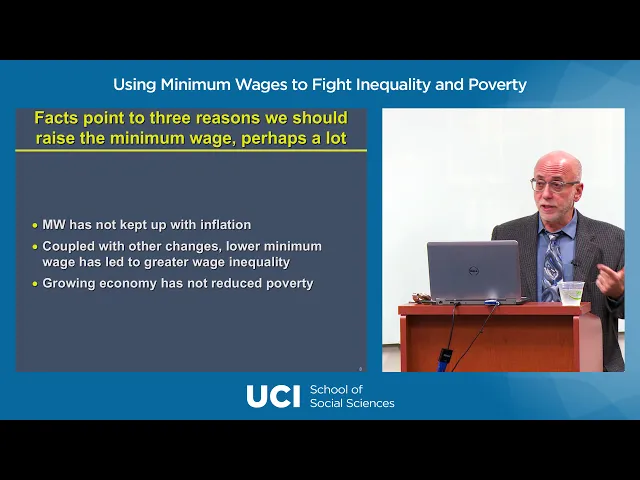
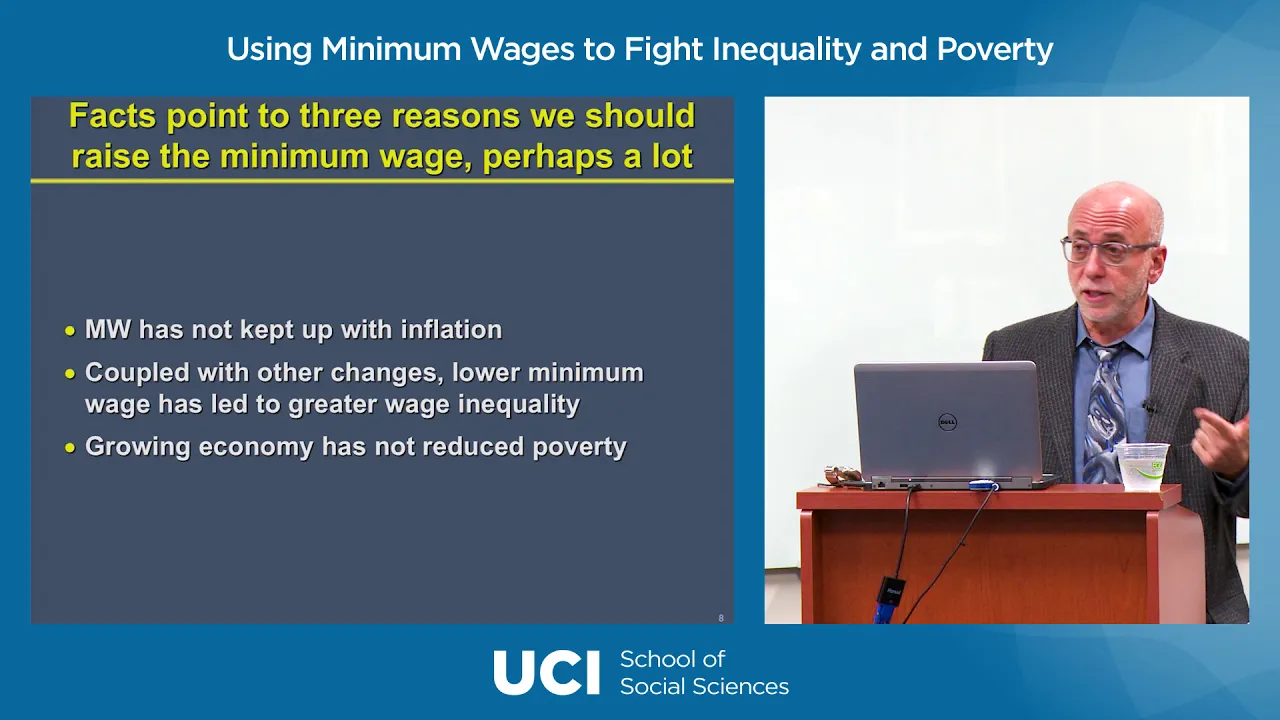
an empirical fact that's certainly true so if you take these facts they point to three reasons I think right why we should or some people think we should raise the minimum wage one hasn't kept up with inflation or real wages other other wages to coupled with other changes no one thinks it's the only thing but coupled with the other changes I mentioned it's the decline in the low in the minimum wage has led to more inequality and the third is that the Growing economy has not sort of delivered the goods at the bottom right poverty
has remained roughly the same despite a lot of a lot of increase in average income in the country those are the facts so then we get to okay why raise the minimum wage and I would say there are there are five contentions that come out of the minimum wage debate or the advocates out but I kind of cite here some of what the fight for 15 folks talk about this is What I gleaned from from what they say one a low minimum wage is immoral they often cite FDR and I think this is a direct
quote no business which depends for existence on paying less than living wages to its workers has any right to continue in this country that's that's the moral argument the second is kind of referring to what I told you before the real minimum wage has declined to the assertion that the real minimum wage shouldn't decline right the fact that The the simple argument that it has declined in real terms is meant to are imply that therefore we should raise it the third is that a higher minimum wage will counter the rise in inequality that's certainly what
people think how and this is the fourth and fifth points a higher minimum wage will help low wage workers and a higher minimum wage will reduce poverty so on what I really want to do in this lecture is is that was all background so far is kind of go through All these five contentions and evaluate what we know about them I'm not gonna say much about the first three because the first we don't have a lot to do with evidence and the last to do so let me just say a few things about some of
these early content some of these the the first arguments this is the you know the depiction of the immorality of of minimum wages with a low minima and record level profits that we often hear about I think as economists we are I Think well we are I was gonna say appropriately or not I'm not sure depends we ask but we tend to be cautions of those kind of statements we draw this distinction which we teach our students off in the first day of class at least I do between normative and positive statements you know the
first is the distribution of income should be more equal may be true may not be true it's it's clearly a normative statement the Second statement we should raise the minimum wage to reduce inequality and poverty is a bit of a hybrid but it rests on upon what we call a positive conclusion and that is that the minimum wage will in fact reduce inequality in poverty whether we should do it or not is of course a normative question but there's an empirical assertion underlying this that it whipped or to really one is that raise the minimum
wage We'll reduce inequality in poverty and the second harder to answer but equally important is it's the best way to do it right because because both of those are important I think it's economists as a labor economist who studies this topic you know your view on the first bullet relative to my view is equally valid I have no particular expertise on what the distribution of income should look like I just have my own preferences as might You the second is something that empirical researchers wrestle with all the time in particular the part that says you
know implies that a higher minimum wage will reduce inequality and poverty but I think it's important as you and as you read debate about this topic to realize the difference between or between statements like aloma and wages unfair to a hybrid and wages the right policy to get the desired distribution of income you often lose The separation between those two things in the debate and people often try to argue the second by pushing the first really hard which is maybe because it resonates more with people but they're two very different things I have my students
always write policy essays in my in my undergraduate labor class and I always tell them you can tell me your opinion preferably at the end of the essay but tell me when you're telling me your opinion so that I know That you know the difference and some of them do and some of them don't but it is important ok so that's kind of the first thing you know moral or not I don't know but it's all I can say is it's important to separate that from from what the evidence has to say does a declining
minimum wage real minimum wage per se on its own imply that we should raise it so this is a quote from well I didn't put a date on it but you'll figure it out since it was first established in 1938 The minimum wage was eroded substantially over several prolonged periods because because of inflation the proposal to raise the minimum wage by a dollar 75 by the end of 2015 would restore the real value of the minimum wage to what it was in 1981 so this was the argument made quite frequently under the obama administration that
first was talking about $10 but i guess in this statement was actually talking about $9 even Aggressive but the argument is sort of have you read it it simply the real minute weight has declined therefore we should raise it well it's actually more complicated that because the minimum wage isn't the only policy we use to try to provide a floor for income it's one but the minimum wage law says of course is you cannot pay a worker less than this amount per hour so it doesn't it doesn't determine the income floor because you gotta have
a job and you got To have hours but obviously it has something to do with it but we also something called the EITC are there an income tax credit which I won't define now but I'll get back to it later but all you need to know for now is it's a policy that subsidizes income for families with low income so what I show you here the yellow line is the exact same minimum wage line I showed you from before the real decline certainly from the early part of the Sample to the late the orange line
is what I'm doing here is i'm sorry the old line looks the same but i've rescaled it into what you would make at the minimum wage if you work full-time 2080 hours a year okay the orange line is what you would make including the EITC for a family of one adult two children which is the families that are most directly targeted by the EITC so think think poor female-headed households or low-income female-headed households so the EITC you Can see by the orange line sort of separating from the yellow line has become a very generous way
by which we subsidize family incomes and make sure families don't have low incomes and in a sense the real value of the the income fool the tool we now use to maintain an income floor has actually gotten more generous right so I look at this graph I actually wrote this for a New York Times whatever that economics blog with an X I don't know why a couple years ago to Make the point that you know we sort of we have a minute we had a minimum wage we still have them in a wage but then
we sort of invented this thing called the EITC in the 1970s and it's gotten more and more generous in lots of countries have copied it and and most economists and most policy makers apparently think it's a better tool a better tool to provide a minimum level of income for families and if in fact that's right it's theirs You know the fact that we've let the other one wither a bit to become less important in real terms may be a perfectly sensible thing to do so it doesn't make sense to talk about the declining real min
and wait in isolation without taking account of the other things we do to provide an income floor and in fact we've gotten more generous on that score so the third contention that I'm gonna of the ones I'm gonna go through quickly Was that a minimum wage will counter the rise in inequality so here's the same graph I showed you before remember this is the ratio of median to 10th percentile earnings okay this is actually the same graph except that changed the scale so the 2 is now way down at the bottom now you might wonder
why did I do this anyone know why I did that well so I could trade what happen at the top and on the same graph okay That's the 90/10 differential so that's that's the ratio between people the 90th percentile over people the 10th percentile now the 90th percentile is certainly upper middle class but not the super-rich right not even close perhaps not even the rich the point is that a lot of the action in terms of inequality has come at the top some of you were here for a manual sizes lecture a couple a couple
years ago who talked a Lot about that and if I showed you this graph for the 99th percentile versus the 10th or the 99.9 percent tile versus the 10th which is which science can do because he has tax returns it would go through the ceiling right it just gets it's more you know that what's happened at the top is where the real extreme growth and inequality is which is interesting in the context of minimum wages because minimum wage isn't gonna do anything at the top of the weight Distribution nothing direct anyways we're not know no
first-order effects so the rise in inequality that most people are talking about has nothing to do with the low end and nothing do with minimum wages it might help with about I'm just saying it won't but when people talk about the overall rise in inequality in America it's not something that's really amenable to fixing or even making making much of a detectable dent in it at all With the minimum wage because it's it's a tool it's much more an upper tail problem than a lower tail now that has to happen to some extent because income
can go up and definitely in a cannoli fall to zero so you get some sense you're always gonna get bunching at the bottom at the top but it's worth seeing what these facts look like okay so those are kind of the three the three sort of contentions I talked about before I don't know if a minimun Wage is immoral or not I don't have any quality as immoral or not and you shouldn't perhaps care what I think about that but understand when people making a moral argument second is it may not do that much for
inequality because it's not really it's not really going on there the action and the third is that all the real min wage has declined that's not the whole story because we now actually have another very generous program that those of us Who pay taxes which everyone in this room pays for to ensure that families have a you know whatever we have deemed a minimally acceptable standard of living so now I want to turn to the two sort of key assertions that the research really gets that so the first is a higher minimum wage will help
low wage workers first step and the second is a higher minimum wage will reduce poverty now why do I I'm not going to pretend that all economists agree on the answers To these questions there's probably more agreement on the second than the first I think but I think almost every Kannamma stood agree that if a higher minimum wage doesn't help low wage workers they never iron minimum wage doesn't reduce poverty it's not the right poverty tool it's very hard to make an argument for a minimum wage absent those two one one or both of these
things being true I used to imagine if I could convince Ted Kennedy that my my results were right he Would give it up but then he died okay so how does it mean wage effect low wage workers raise the minimum wage to a million dollars everyone will be Bill Gates which is often how's the debate sometimes reads what are we Khanna must have to say about that well economic theory tells us that when things become more expensive in most cases there are exceptions we use less of them we've seen this for gasoline those remember the
2008 election when Gasoline prices spiked and we had a huge growth in Prius sales and all these kinds of things we tax cigarettes and the evidence says for those who are sensitive young people the ones they actually wanted to scourge from smoking they actually respond to those taxes and smoke less reversing it we subsidize things we want people to do which of course is making it cheaper so they consume more of it and green technology is one example of That so clearly at first order when you think about the minimum wage you got to worry
about this or if I make low-skilled labor more expensive firms may find ways to use less of it it seems it seems a natural thing to worry about what economists always call an unintended consequence which were always fond of pointing out we want a $15 minimum wage and the guy behind the counter says you want layoffs with that I couldn't leave there were this many Minimum wage cartoons actually and when I really went looking for that kind of amazing I think a lot of them are the same person Labor's a little more complicated than just
gasoline prices or something like that so here's sort of three weeks of labor demand Theory boil down to one lecture what what happens in the labor market what do we think happens in the standard model at least well min wage goes up it makes low-skilled labor more Expensive right relative to other kinds of labor firms then economize on the use of low-skilled labor and switch to using other inputs might be capital might be high school you know substituting three three low skilled workers for two high skilled workers but one way and other they substitute away
from low skilled labor and towards other inputs that necessarily raises their costs because otherwise they would have used that combination of inputs before if it Actually wasn't more expensive that's going to raise prices assuming consumers are sensitive to price it's gonna reduce demand so you have two channels by which low-skilled labor low-skilled workers might suffer the consequences one is that first substitution away from them towards higher skilled workers or machines and and the second is and that's we called the substitution effect the second is if prices of sort of the things that men And wage
workers produce go up there's a scale effect firms just will spill to sell less of that stuff and they'll lose they'll use fewer low-wage workers because of that high wage workers Sam big ewis right they might use more than we might use less of them depending on which those two of which of those two effects is bigger but that's basically the the neoclassical theory of of labor demand which is the basis of the prediction that a higher minimum wage Will reduce employment of the least skilled workers and what I mean by that can't always see
this very well in the data but it's the people whose wages would have been pushed up by the minimum wage okay is the theory right so this is the big debate and it's been going on forever not forever in our book my book would bill washer we actually talk about papers written on this topic before 1920 in Australia and places like that where they first raise minimum wages so this Is my view of the evidence but I'll I think I will give you a balanced view fairly balanced anyways so there used to be what we
call time series studies we used to not have the data we have now so we would observe overtime the employment rate of teenagers let's say or 16 to 24 year-olds a low-skilled group we would observe what happens in a wage overtime and we would observe other things overtime like the growth of the economy or the unemployment rate for higher Skilled people whatever it might be in those studies pretty uniformly not surprisingly because it was the same data used in each study just with another couple years of data said that the minimum wage elasticity was about
minus point one two minus point two what is that number it's a useful number understand because reporters cited all the time because that's the way we all tend to summarize our evidence so so the elasticity is the percent change in Employment divided by the percent change in the minimum wage I'll talk later about whether that's actually a sensible measure that's about minus point one two minus point two so if I raise the minimum wage by 10 percent these estimates say employment of not not total employment of low-skilled workers they some some subset of affected workers
will fall by one to two percent there are it's a little tricky because when you do studies that really zoom in And the people whose wages were directly pushed up or would have been because they used to get paid below the minimum you get some much bigger elasticity Jake Victor talked about the Seattle minimum wage here a while back his us sisters are closer to - employee licenses are close to minus one and I'll talk a bit about why there's that ambiguity the problem is though that those time series studies are not entirely convincing we
have what we call An empirical work evaluating the effects of policies the problem of the counter factor well we're always trying thinking we're trying to do here the policy changes somewhere right in the old date and the old older data just at the national level because there were no state minimum wages and we see after the policy changes what teen employment is and how much had changed but we don't know is what would have happened if the Middle-aged are not going up because we don't have an observation on the economy without that having happened okay
so in the time series data all you can do is sort of get that out of a statistical model a good example of that is we had this big fiscal stimulus the ARA but in response to the Great Recession we then observed what happened to the aggregate economy after that and people arguing about whether or not it had an impact faced the same problem because what Would have happened had we not done it we have no observation on that all we can do is sort of build a counterfactual in that case often very based very
much on models with minimum wages we sort of started to get better evidence and this is actually how I how I got into this this this literature actually funny story when I and my first day of graduate labor economics in 1984 I think it was a professor came in and it was sort of the lecture was you know what uh What do people study labor economics do right what are you getting into and at that time there was a couple years after there had been this massive project run by the Department of Labor to Commission
a ton of papers on minimum wages and pretty much every labor economist you've ever heard of probably 10 years older than me has a paper in that book it was like for those of you who know what this means the New York City phone books it was there was like five was my volumes Actually this this thing and he said whatever you do don't study minimum wages right we know everything there was to know and then I was at the Fed my first job was at the Fed and the Fed we used to I was
a labor economist there were four of us among like 200 economists but every day this is sort of wasn't that pre-internet but pretty very sophisticated internet we'd get this report from called the the daily labor report which was any change any Reporting of you know government the government statistic came out or any kind of change in any law in any state and we started to see in the late 80s that a bunch of states started raising minimum wages and we we and some other people at the same time had the idea this might be a
more useful way to study the effects of minimum wages than these time series studies why because now I can think about two states kind of maybe hit by the same business cycle because They're in the same country or maybe in the same region minimum wage goes up in one and not the other and now I have something that is arguably a closer to an observable counterfactual I can I can approximate with the state where the minimum I didn't go up what would have happened in the state where did go up and then and then estimate
the difference and that's a method we use in increasingly sophisticated terms you know all over The place in economics I have this this line about the UK here which is relevant cuz most other countries just have national minimum wages right Canada has regional in wages they have 11 provinces there are some regional 'men wages in a few other places most countries are only of national minimum ages so they're still kind of stuck with this difficulty of estimating minimum wage effects but the u.s. we have this what I call this this great economics Laboratory and it's
not just Roux for minimum wage that's true for all kinds of policies right states can do whatever they want subject to some constraints you can't have a minimum wage lower than the federal minimum wage for the workers covered by the federal minimum wage which now originally wasn't that many people now is effectively everybody but you can always go higher but just like a lot of laws states can't you know can't get out of the federal law but they can Have they can have stronger stronger laws in some cases if they want to so what you
see here is that when I talked about before that we started to have this growth in statement wages down to the left there's virtually no states with a higher minimum wage Connecticut had a constitutional provision that it's midden wage had to be 1/2 percent higher than the federal minimum wage which I always thought was a little odd but somebody thought they were making a Point I think Alaska was always a little higher but probably not as important there but then you could see it just takes off with some spikes and the spike down is when
the federal minimum a chose up and of course it catches up to some state so it looks like there's fewer states with a higher minimum but the trend is up that's the number that's the percentage difference so some of these differences are pretty big and and and Getting even bigger so for labor economists that's a godsend at least if not for low-wage workers what does the evidence say so so I've done a bunch of papers on this as of other people in 2007 my co-author from the Fed from that original collaboration and I thought we'd
write a brief review of what these studies said not realizing we were going to find about 120 studies in English let alone the ones we couldn't read in other Languages and it end up being about 150 page paper but it went through all the evidence since kind of the early 90s when you first had the the statement and wages you could work there what is sometimes called the the so-called new minimum wage research so we reviewed these studies about two thirds of them to find negative effects we make our own assessment as to which ones
are most credible other people can disagree but When we do that about 85% of them find negative effects and when the study zoomed in more sort of more accurately as best we could tell and lower skilled workers maybe because they had prior wage information maybe because of the skill definitions they use high school dropouts whatever it might be the net via the negative effects were bigger right which is kind of what you'd expect if minimum wages reduce employment of least skilled workers there's the famous New Jersey Pennsylvania study by David Cardin Alan Krueger which I
don't like to talk about that much because it's kind of old but it comes up all the time they actually found it often gets cited as evidence the minimum wages don't reduce employment this study actually showed a huge positive effect of minimum wages unemployment which they the authors sort of tried to not emphasize in the paper remember I said the US this it was - point one two - point two They're kind of 0.8 so you raise the minimum wage by 10% employment at fast food restaurants goes up by around 8% which is it's puzzling
we did some subsequent work on that and show that they just it was a very mundane problem of data collection they surveyed restaurants it's kind of this is a good lesson for graduate students who ever do your own survey they surveyed restaurants and they they they say we want to talk to manager or assistant Manager and they did us nine months apart before and after one state raised its minimum wage and the other one didn't and the survey question was that this is a quote how many people work in your store right which you could
imagine the response would be anything from oh let me see there's five people here - I just did payroll and I'm on the New Jersey Turnpike so we're open 24 hours a day and 80 people work in my store there's 80 people on the payroll and the Reason you know it's problem is because you come back these stores nine months later and you have employment swings of sometimes 20 30 40 employees and we've been in fast-food restaurants right the kind of always staffed by roughly the same number of people except you know for some shift
variation so it was clear something weird was going on so we got actually the payroll from the employers they send us their ADP things on those oh the computer Paper we used to have you know with a with the holes down the side and and doesn't seem to be the right answer for that paper there's a whole bunch of other studies that have come out in the last starting 2010 and and continuing to today and they're probably one tomorrow when I open my email which argue that it you can't just use the state approach just
having saying states where the minimum wage didn't go up give you an idea of what the minimum wage would have Done elsewhere is not enough they say you've got to use geographically really close areas across counties across the border states that border each other states in the same census region wherever it might be it is the case that when you do that when you use that approach you tend not to find employment effect disemployment effects of minimum wages you tend to find estimates near zero there's this curious thing which i'm not gonna tell you what
these tables Say and you probably can't read them but i'm actually to flip through just flip to the second one and just make the point well so these are the studies that use the close controls approach right cross border counties wherever might be and with the one exception in the darker color down below they tend to always find no effects and then there's a bunch of other recent studies which are dealing with the same empirical problem that that earlier that other literature Addresses which is that maybe minimum wages are chosen in a so in relation
to economic conditions that can make the kind of state comparisons invalid so these other approaches do a lot of different things to try to deal with that problem and they tend all fine negative effects so there's kind of three or four new approaches that find negative effects one that doesn't it's kind of a technical issue as to what's going on I have some recent work which Tries to argue why I think these are more valid but there's definitely open question literature as to why these different approaches give different estimates in fact he's not here it
was Kyle's now I was early advancement exam today where student actually was doing some technical econometric questions to try to try to resolve these differences between these different approaches so it's a pretty active area of research so how do i how would i summarize that the Conclusion is contested right but that doesn't mean we don't know the answer that's kind of my that's kind of my take on this right some earlier papers and some recent papers don't find negative effects of the middle-aged unemployment it's a minority of studies for sure it hinges on restrictions on
the data and on the approach that I don't think can be supported and there's some evidence against them I think there's a continued flow of studies that that find negative Effects with a lot of different research designs so that's that sort of my take you have you have to pick and choose your own evidence what I want to caution you against though when you as a sort of trying to be an intelligent consumer of what you read about this stuff is when someone says there's no evidence that minimum wage or dis employment that's simply not
true right if they want to say oh sorry here's a quote from Paul Krugman a couple years ago in the New York Times and about 15 years ago he said the best minimum wage was was zero now says there's no evidence that raising the minimum wage cost jobs at least when the starting point is as low weight as it is in modern America that's simply not true right there is evidence if you wanted to say I believe these studies and not those studies we can argue but you will see that assertion made frequently in the
debate that just MIT we know minimum wages don't reduce Employment and why does it happen exactly I don't know this is a highly highly politicized debate and there are researchers in this debate probably on both sides I think the pro side is a little more guilty of this who adhere to a position and read evidence very selectively in my view so anyways that's that's my take on that so there's a second line of defense though which is well okay minimum wages reduce employment a little bit and some Of these folks take that position but the
USOC is so low right that workers must be helped so here's the pair's the basic argument they're making let's suppose we take a knee less the see of - point to remember that's the percent change in low skilled employment divided by the percent change in the minimum wage so now you sort of do this calculation we raise them in wage by 10 percent let's say two percent of load of low-wage workers lose their jobs 98 Percent of them the ones who didn't lose their jobs get a raise right sounds like a lot more winners than
losers and the average income of low-wage workers goes up and their I do they're just that their gains plus the losses 98 percent times the 10 percent raise 2 percent times 100 percent loss if you lose your job simplification and so so that 10 percent increase the minimum wage raises the income of low-wage workers by almost 8% okay Another way of saying that is that the elasticity of income with respect to the minimum wage is a lot smaller than negative one an absolute value right it's income is not very easy you know it doesn't decline
much whether the minimum wage goes up that's a really bad calculation as it turns out this could this is not a great graph I apologize but let me let me give you a different example to make the point and those who you want to stare at the graph can stare At the graph slide if I said what happens to the demand for apples when I raise the price of McIntosh apples the answer might be not very much right because there's a lot of different kinds of apples right whereas we ask what happens the price the
Macintosh apples when you raise the price what happens to the price what happens in the quantity of Macintosh apples sold when you raise the price of Macintosh apples it may fall a lot and That's one of the problems with a minimum wage of litterature so most studies are doing things like looking at teenagers right why teenagers because they were I'll talk about this later there are a huge share of minimum-wage workers but they're not all at the minimum wage in fact many teenagers aren't above the minimum wage so we raise them in and wage by
10 percent we seem in employment of teenagers fall by 2 percent but we really care about is The employment decline among those who would have gotten the minimum wage increase that was a teenager making $20 an hour already I'm not the one who's losing my job right the war is the one who's making minimum wage was so you want to actually kind of compare the the minimum wage increase for those who get it to the employment loss among those who get it and this this figure is a way of illustrating that that essentially when you
when you do it that way you can Easily show that even in u.s. - see - point two can imply that income actually doesn't change or even Falls for the lowest wage workers okay and there are actually two studies that show that one is that the Seattle study I mentioned by Jake Victor that he talked about and Jeff Clements at UCSD is a paper where he he very cleverly focuses on very low wage workers based on what they were earning prior to the minimum wage and you look what happened to their Employment when the mini
wage went up and that Alessa see is actually close to minus one which means essentially it's a wash right some are helped some are hurt but there's no average change in income other aside which is different from what you what you conclude from this so this notion that the Estes is pretty small you know so workers must gain isn't really isn't really legitimate and and recent studies and they're only recent ones that really try to dig into That by trying to isolate much better just the affected workers find that the employment losses lead to roughly
offsetting effects on income so that an average income of affected workers I think first first blush is unaffected by minimum wages so doesn't mean way to upload workers that's what we're starting with I got a raise I got a wage my boss fired me to pay for their raise and the answer is yes um right but there's cost right There are winners and losers from a higher minimum wage I think I think that's what most of the evidence says and you really can't get around it which doesn't tell you what to do well should we
raise it or not it just tells you it's more complicated then this is just good for everybody okay I should say a couple words before ground under the poverty question about what a $15 minimum wage might mean alright so the federal men wages that is Seven and a quarter a couple cities are at fifteen a couple are getting close and a couple states are getting close to that at a slower rate California is we'll get there in a while in New York a little bit later I guess you know what is that what's it gonna
do and the right answer is I have no idea because we don't have data on minimum wage increases anywhere near this big right we couldn't I can tell you what passed increases have done with you know fifty Cents seventy five cents with the seattleman and wage maybe a dollar two but if you want to tell me what's happening Mississippi here we go from the federal minimum wage where you know which is what mines are seven and a quarter to fifteen I don't know but I do know one thing that it's gonna affect a lot of
workers I did a calculation for California which is of course has high wage areas and low wage areas but even some of the inland counties a fifteen Dollar minimum wage when I sort of I did the calculation kind of you know inflating the year it would get there inflating current wages up to that level you get forty forty five percent of workers are affected by the minimum wage where's the federal minimum wage hits something like five to ten percent of workers so it's a huge increase in the share of workers or who are affected and
that isn't that raises a number of concerns first of all when you raise Them in when that many workers are covered in raised minimum wage companies have a lot of ways to respond aside from laying off work right you can let the you know but the bathrooms get a little dirtier there's a study by a couple Harvard Business School economists who show that Yelp ratings of restaurants declined when the minim weight goes up suggesting that they're somehow reducing their service and some clothes as well you know you Can cut benefits a little bit those are
beautiful exceeding the Amazon story have seen map cutting benefits but cutting other components that pay you can do a little substitution towards other kind of workers or capital or whatever it might be but obviously as you as you raise it more and it affects more and more workers your hands are tied more in terms of what you can do there aren't that many ways to get around a doubling of them in a wage for 40 percent of your workforce the second is and I'll come back to this later the targeting the extent to which minimum
wages go to poor workers that is workers in poor families declines the higher the minimum wage goes up the third is in all of this discussion I never see people talking about what's gonna happen in the high school dropout so what's gonna happen to the minorities what's gonna happen to the lowest wage workers in the economy when this happens cuz if Anyone's gonna get gonna get hurt it's gonna be them and the fourth concern is that most of these minimum wage proposes that indeed some of the cities and states that have raised the minimum wage
recently now index them to inflation we saw before the federal minimum aid is not indexed which is why it quite plummets when there's some inflation indexation kind of makes sense if you're gonna have them in a wage why not preserve its real value but it does mean That from the firm's perspective the minimum wage increase is much more permanent right if the minimum wage goes up sort of one shot in an environment a little inflation companies might say well no big deal it'll get inflated away over time we don't need to make big adjustments we're
not gonna sort of change our physical capital to deal with this if your minute weight goes up and now it's indexed now you've had a permanent relative increase in the cost Of low-wage labor and that can have much more lasting effect so I worry about a 50 dollar minimum wage although I don't really know it will happen so this is sort of turning the tables a little bit I'm convinced men and wages reduce employment but that doesn't mean the minimum wage isn't a good idea right it just says the minimum wage cost some people some
jobs I would challenge you to come up with a government regulation a couple of one or two that isn't gonna Cost somebody jobs somewhere right if we ever deal with climate change oil refinery workers are not going to be happy right they're gonna lose their jobs it's the it's the job of policymakers to make sort of the tough call right there are some there are some games there are some losses is it worth it what are we gonna do so I think what you want to ask is not just as their job loss from the
minimum wage and this is sort of the the California business lobby hellas has their top ten job killers I think every year and they always say you know minimum wage there is some point we know that therefore it's it's a terrible idea but they never say what are the benefits right so what are the potential benefits at least well Ted Kennedy quoted in extra very good biography of him I said the minimum wage was one of the first and is still one of the best anti-poverty programs we have Obama Somewhat later nobody works full-time should
have to live in poverty that's a slightly more subtle point but but clearly the minimum wage is viewed as a way to reduce poverty and if you follow the current debate that's what comes up again and again and again so I would argue that's a reasonable way to evaluate them in a way does it actually reduce poverty if there is some reduction in poverty what's the magnitude and then we sort of face this Trade-off right maybe there's some job loss or maybe reduce we reduce the number of poor families and that's a good thing so
this little table shows you information on the distribution of the benefits of the minimum wage so the left-hand column is has income the needs that's the ratio of a family's income to the poverty line that's we call income to need so if it's one your your income is exactly equal to the poverty line and the poverty line does depend on how many Kids are in your family people in your family and then 1 1 1 2 1 and 1/4 1/4 1 and 1/2 I go up to 3 or above so what this what this graphs
where this chart says is that it shows that if you I what I do here is I choose a definition of low-wage workers we think about a minimum wage increase I forget exactly what increased I was doing here but I think was the $10.00 Obama minimum wage proposal 85% of benefits would go to poor families right families below the Poverty line that looks like tremendous tart terrific targeting of the minimum wage to poor families the only problem is that from 1939 okay and if you expand that it changes dramatically so look compare that left-hand column
where 85% of the benefits went to poor families so the right-hand column 2000 12:12 percent of the benefits go to poor families okay look at that pod that in yellow here why does so few of the benefits of a Higher minimum wage go to poor families well there's a few reasons but the principal reason is that if you look at families leaving out the retirement age population household heads 18 to 64 more than half of poor families have zero workers right now why is that different in that in 2012 and in 1939 well because you
don't starve to death right if you don't have income in 2012 right we have government benefits we have we have protections for people so it didn't Really used to be possible to live without working of course this is awesome is something to have a bit of wage right pricing those people out of the labor market and then if you look at highlight the number of the bottom 40% of the benefits and this is a very simple calculation which I haven't explained but basically I'm doing here is you raise the minimum wage top everyone up to
it if they're below it and and there's no behavioral responses There's no job loss or anything like that here just in the FCO there's increase in the wage bill and then you assign it to the workers based on the profit the income level of their family and you say what share goes to which part of the income distribution forty percent of the benefits go to families three times the poverty line which is which is about median income okay so what that means I think it roughly forty percent of the benefits we can quibble About the
numbers but roughly forty percent of the benefits go to roughly the top half of the family income distribution which is a pretty stunning number I think this is my when I had an op-ed in the Wall Street Journal this is the cartoon they drew I had no say in the cartoon Obama was throwing money $10 was ten ten minimum wages and it's yeah they have none of it going to poor families because it's the Wall Street Journal that's not quite accurate some Of it goes to poor families but the point is a lot of it
goes to two non poor families why does it happen some people hear me say that say well how is that possible right how can you raise wages for low-wage workers and most of it doesn't go to poor families well the reason is simply that being a low-wage worker and being in a poor family are simply not the same thing they're related right I tell you someone's a low-wage worker They're more likely to be in a low-income family than a high income family but they're very weakly related and the reason the weakly related is one one
reason I told you already is that a lot of poor families have zero workers right the other reason is and this also explains why those numbers change as you move across that chart is there's a lot more secondary and tertiary workers a lot of teams work teenagers are about 25% of workers near the federal minimum And people age 1624 around 50% and those people aren't particularly poor you should never use an anecdote for evidence but I will I live in San Francisco and my daughter was in high school when San Frisco first raised the minimum
wage I think in oh six or seven or somewhere around there and she had a job working in a little gymnastics school out of the Sunset District and she came home and she said I'm so excited the raise in the minimum wage And I said I said no II I bet I make three times what your employer makes right and she was getting the higher minimum wage and the point is that you have a lot of teenagers who have after-school jobs and like who are not in poor families there's no reason in the world we
want to redistribute income towards them in fact we might want to do the opposite we want to not work and work harder in school I would predict it in California as the minimum wage climbs To fifteen you can have a lot of upper middle-class kids taking jobs after school that's real money probably displacing some of the kids have already dropped out of high school and really need those jobs but we will see those calculations like I showed you as simple as they maybe suggest that to get a dollar to a minimum wage family you've got
to raise the wage bill from the minute for the minimum wage wage bill by around five dollars right which Is a very inefficient Trant tax or tax and transfer scheme if you want to call that those are all stimulations what does the research show there's a big literature on this too not nearly as big as the employment literature most of it shows no net effect of minimum wages on poverty again kind of a wash the estimates are probably in the direction of reducing poverty almost impossible to find a statistically significant effect though in a lot
of different studies so The implication is like with earnings and workers when we look at families there are winners and they're losers some poor families gain some poor near poor families lose and then in fact is hard to find any anything except to wash this is my affects the incidence of price increases probably disadvantages the poor our last lecture was Kevin Murphy in the spring Kevin and I were to panel the American Enterprise Institute a long time ago And Kevin's those of you were there he's great speaker and we were talking in a way just
he said I don't forget this he said he forgot it I asked him if you remembered but he he doesn't but he walked into the panel and Kevin's a very casual guy and he says you know I was just eating lunch at the Kentucky Fried Chicken and I didn't know on which side of the counter people were poor right point being the people who tend to consume the product of minimum wage Workers tend to be low-income workers right they consume more fast food more cheap products fewer yotz yotz are pretty sure not build by minimum
wage workers pretty sure Tesla's are not built by minimum-wage workers so the price increases are probably somewhat regressive we don't have great information on that but it's probably true to some extent what about the argument which you've heard lately and this actually came up With the the whatever Bernie Sanders bill with a cute acronym was about about Amazon the Beezus act I figure what it stands for I know the claim that we are sort of we're subsidizing you know we're subsidizing employers by paying for these social programs let's instead make companies pay higher wages and
then we'll spend less on these programs right so important sort of shift the responsibility to them well you actually don't see that in the data that a recent Pretty comprehensive study of Medicaid free reduced-price lunch public housing TANF that's welfare snap that we saw food stamps and WIC which is a family for a program for you know for babies shows that when the middle age goes up you don't get reduction in spending on those programs and again it's proud because you've got some people who earn a little more money and therefore consume somewhat less from
those government programs some people lose Their jobs and and and take more from those government programs and there's kind of a wash the only program that falls is snap so food stamp spending declines when the minimum wage goes up which some people have jumped on and say aha see but but food stamps are fine program food stamps require work are searching for work since 1990 citizens welfare reform right so if it's harder to find a job you actually might lose your food stamp benefits right so so Food stamps Halling does not necessarily mean that people
are earning more than therefore don't need it as much anymore it's a tricky program it's the only one it's the only one that works that way where you can actually get more benefits from well the EITC doesn't that's not in here you can get more benefits from the program I work and more okay so last section my lecture quickly is it as Hopeless as it seems because so far that's been pretty hopeless and a little discouraging and it's important because as we saw changes in the economy have disadvantaged less skilled workers it's a lot worse
to be a less a low skilled worker now in certainly in relative terms and almost surely in absolute terms as well than it was twenty or thirty years ago so so we have the central challenge is there something we can do to increase incomes of Low-skilled workers or more importantly low-income families without discouraging work that's the dilemma we face and we've been talk about the minimum wage and the problem with the minimum wage is it certainly helps some workers but it does reduce hiring we could the alternative is we can provide income support we do
that through the welfare system not so much anymore those of you who are off its lecture there's a lot of talk about universal basic income right Sort of an income guarantee for everybody possibly phasing out possibly not Jesse Rothstein gave a lecture about that you know those programs always sort of put us in the classical public finance sort of dilemma as long as we're not willing along we're on it you know we as a society in all rich societies do they say there's gonna be some minimum standard of living we want to guarantee we want
to get those benefits of the People who need them but some people change the behavior because of those programs and how many and how much and and to what extent we discourage and work pretty clear evidence that welfare discourage work on some part of the population which doesn't mean it's a bad program it just means we have to realize that's part of the problem and universal basic income probably even more we don't know I would say not none of that to say those are not good programs they and and Obviously some of the people who
get those benefits wouldn't be working anyways and we need to take care of those people but I would say certainly in this current political environment if we can do anything and the answer may be we can't but if we can do anything probably likely to get buy-in from from both sides on programs that at least have the promise of encouraging work of so raising incomes for low-income Families while encouraging work at the same time and the Earned Income Tax Credit does that now what does the Earned Income Tax Credit do if you don't work it
pays nothing so Bob Moffat was here who used this this ironic phrase I'm not sure was trying to be ironic they'll work based safety net now the safety net is usually a phrase for how we take care of people who can't make any money right and the point is we now have a system which for the most part Not entirely but for the most part pays benefits to people props up your income but you got to work to get it not really we're we're a lot stingy ER to people who don't work at all and
a lot more generous with people who work but have low incomes and that's where the Earned Income Tax Credit does if you don't make any if you don't work at all you get nothing from it but if you work it subsidizes your earnings and a very generous percentage up to 40 it with Three kids up to forty five percent of your income up to somewhere in the high seventeen eighteen thousand dollars in theory more people should work in response and they do that's this is one of the clearest findings and labor economics that that certainly
single mothers with kids because their mothers have a strong employment response to the EITC the other brilliant thing I think about the EITC is it's based on family income right it doesn't have this Problem that the minimum wage does that it goes to low-wage workers it explicitly goes to low-income families because it's done through the tax system they know how much families are making right I mean it's also simple to administer because of that so the idea is very effective and finally we know we know from the research two things one not magic at all
if you take account of the EITC payment it reduces poverty that's not surprising if we get people For money we can reduce poverty right nothing magic there the sort of magic pixie does part of the EITC though is that the evidence says and and multiple papers that when you rate when you make the edge to see more generous more families earn their way out of poverty before you even count the EITC check so you're creating work incentive program that even before you get the benefit reduces poverty increases the fraction of people who earn the way
out of Poverty and that's a pretty strong selling point what's a better policy well I tell you a couple things about this this depends on some extent on if you think the government has any and redistribution right but as long as you take the view that yeah it's our responsibility to guarantee some some some level of income income at the bottom how do we compare these two policies the minimum wage in my view doesn't target the poor well that that's Actually fact we know that it almost surely doesn't Reedus treat money from the rich right
I mean I'm not sure who pays the minimum wage I'm actually doing a project now with his with tax date on Israel because we can actually see every worker in every firm as well as the owners tax return which is really cool so I get some evidence on this question for another country we don't really know this in the US but I'm pretty sure it's the people who owned the laundromats who Are paying for the minimum wage not the people who work for goldman sachs and the people work from goldman sachs are making a lot
more money the EITC or anything else we do through you know through taxing and spending we can target the poor much more effectively the ICC does that very well it's financed by taxes right so we can at least engage in the kind of if we're gonna redistribute we probably on those who can pay the most to pay for it and And the ICC does that universal basic income has that same advantage relative to a minimum wage which is why it may be a better policy in the minimum wage more likely to discourage work I think
although there's some there's there's some evidence emerging on it which which you know raises some questions about whether the extent to which that's true and we don't really know so what are the lessons the minimum wage has some negative consequences which is not a Statement that it's a bad policy that I'm against it just that has some negative consequences hard to find net benefits for low income families alternative policy the ITC seems to work better encouraging work and raising income for low income families some of the work I'm doing with SB that's kind of work
in progress with Brittany she's here and other folks are not here looks at tries to get at the longer term effects of these policies and the idea Is if the minimum wage shuts young people out of the labor market it may it may diminish skill formation because I don't they don't gain labor market experience where's the EITC encourages work people may gain skills and have earnings growth over time when we find have one paper that finds quite strong evidence that the long-term effects of the ITC for women are to raise earnings pretty dramatically which is
sort of a kind of a multiplier effect of the Policy so where do I finish well it's complicated um you can see the three people here 12 bucks for a crappy little hamburger that's the price effect look on the bright side now I'm getting $15 an hour and the third guy got laid off so I think that's the most important lesson it's complicated I don't mean to argue there's only one position one can take but if except if you think it's not complicated that's the wrong position there's winners and losers has not just Winners as
the advocates would have us believe there's not just losers as some of the critics of minimum wages would have us believe research can help us kind of figure out who the winners and losers are and how much they gain and lose that's what empirical research is all about and then policymakers have to decide if enough of the gains are going to those they want to help to offset the losses for others Mike my current take on this is I Haven't been convinced of the benefits outweigh the costs that's that's my own view but but at
least I hope this gives you some appreciation of the issues and what the trade-offs are you have to think about and how you want to evaluate what people are saying and what you're reading when you hear as you will more about minimum wages thanks Thanks we have a few minutes for questions one last day for first question because I've Got a few of these have been a couple of lectures it's warm I never see anybody debating there are some tax credit all the things I read this if anyone talking about that as as a negative
oh this is so if I showed you the graph on stay T I TC s it would look like the Fed like the minimum is a lot of states is now about 25 states that supplement the federal EITC and some pretty generously California has the most generous California late to the game mm I want to say 2016 they actually have an 80 percent subsidy to the federal minimum wage they almost double what the federal government pays you they did in a really crazy way they did eighty percent up to your first about seven thousand dollars
and then be actually always phases out because they don't do make a lot to get it so usually the federal phase-out is kind of slow so people up in the forty forty thousand dollar range are still getting a little Bit California face it out at the eighty percent rate so the budget constraint went like that and like that and I I testified in the legislature but a representative who was trying to change that and I asked her why and she said my constituents are telling me they can't get anybody to work more than part time
which is exactly what you'd expect from this kind of budget constraint it's because I'd made a huge kink but no states are doing this for sure It hasn't come up at the federal level I be the federal level the one thing that has come up Obama pushed this pretty hard was the way the ICC is structured is you get essentially nothing that quite true a little bit of you have no kids one kid it's a thirty four percent subsidy to its forty and three it's forty five there's been talk about increasing it substantially for people
without kids and the reason we don't do That is because we kind of focus anti-poverty policy on kids because in this country some people still think adults a response from being poor but no one thinks a five-year-old decided to be bored which is a reasonable a reasonable point of view obviously but the counter-argument is you look at low marriage rates at all and very low in disadvantaged communities and having a more generous AITC for people without kids many more men would then tap into That because they didn't have to have the kids in the household
if they're not married would become sort of more attractive marriage partners less interested in crime and that so that's the one the big dimension where we're at the federal level they talk about it because we have the legislature I think the other side what I think the other big factor is politicians want to do something about inequality because People are pissed you don't have to raise taxes to raise the minimum wage it still cost something but you don't have to raise taxes and the ITC I mean a man you know probably in a Republican in
the in the federal government cannot do anything that entails raising taxes right almost by rule now so it's very hard to get behind it right the current culture till grover norquist yes but it's also true the immigrant workers overseas and of course the Remittances can actually do much more for people there so one of the narratives i've been grappling with this you know the minimum wage is actually maybe not doing a lot to my party here a protected you in a lotta fact probably overseas so i guess the big picture question had us in your
world on the minimum wage is there a kind of implicit or explicit explicit commitment to nationalism or this being framed as a purely look like oh you know national Benefit for insiders is you know I find that so much if any of people who are supporting the fight for 50 are immigrants but I'm trying to reconcile you do they raise the issue of remittances and you're in in your experience do they raise the issue or maybe it's fine that people often try to avoid it as you put yeah reality is that you know it existed
a bit of a way just doing any of that work it is overseas whereas greater Purchasing power so I was just you know it's a fair point I don't I have no idea what the numbers would actually add up to and I don't know what I'm not you know I mean there's a lot of I'm not a development economist there's a lot of research on remittances in other countries I don't know that we collect any you know we have any data to get a handle on this but what you're saying is true I mean certainly
immigrants are you know I mean they're they're not their Minority the workforce but as you say $100 right in Guatemala is worth a lot more than hundred dollars here it's an interesting question you know there are I mean I think there are some datasets where they sort of do these surveys of at least in the US and Mexico like people who are connected or who go back and forth where you could in principle possibly even knowing what state the the person here is working and actually do the same kind of research design and Potentially learn
something about that but I think you're right when you said is our nationals respected we're not explicitly obviously we don't really talk about it that way but yeah the benefits I mean the sort of benefits and well and costs I'm sort of trying implicitly to add up here our US workers and that happens by the way at the local level to I I mean DC when they talked about their minimum wage I was commissioned by the Chamber of Commerce Into studying one of things I pointed out was DC being so tiny right meant that a
lot of the workers didn't even live in DC right and and if the people who are living in DC are gonna pay more of the cost and the benefits ignore people outside of DC that might not be as attractive a policy now that's a narrow perspective but that is one policymakers take greater vocational tents to give them the skills where more people could Reasonably create the value to you know not need assistance on what is a fair $15 an hour job is there any like Studies on more vocational high schools yeah there's I mean there's
there's there's a huge literature it's probably bigger than wage literature on what training generally yeah because you're right I mean you know what you're saying is if we're a skill I mean I I don't have the slide in my talk anymore but I used to have a slide that said you know The Holy Grail is raising skills so we don't need this anymore but we don't know how to do that but we've run you know we've run training programs Trump to his credit and he's gotten some some praise from Democrats on this at least has
talked so far about trying to beef up vocational training Clinton had a big school to work initiative that Bush Bush to killed so these are and some of these I wouldn't say we have anything that's gonna kind of raise you from 7 to 16 but I think there's some evidence that that that more vocational training is probably good for somebody I am I take I did used to do some work on school to work and my take on it was we sort of gone to a an educational system with all the testing that is very
much focused on those going to college and if that's not right for you and and you know 40 percent population doesn't go to college it's really not serving you very well right there's jobs you can get out there You skilled jobs you know putting solar panels down they're gonna pay you a lot more than working at McDonald's and we're not anybody got to train people how to do those things well you could argue it people do right right yeah right so so you hear that argument so I don't think the only people I hear I
do hear some minimum wage advocates from the Economic Policy Institute which is a big Union funded Center in DC that's a very good economists they try to make That argument but whenever I've been in a position to debate them and you call them out on that they back off from that very quickly and the reason is simply so is the money doesn't come from nowhere right it's coming from somewhere now the possible reason it could have a slight positive effect is in the short term is because the lower-income people tend to spend a higher share
of their income that higher income people marginal Printing to consume is higher so in the short term you might get a boost to consumption from doing that of course in the long term you might have less investment which is not a good thing so I don't think that are I mean you see people make that argument but I think that that one is considered so weak and made so and even made so seldom by at least the fairly serious advocates that I think you know it could be on my slide but that's that's why it
isn't But what the outside I think of near Lincoln Tax Credit is folks will we realize that benefit once a year you have to they're calling taxes is there some way yes outside the box and how you might be able to spread that right so so so here's an interesting fact it's kind of unbelievable and you definitely believe because your perspective so it used to be until a some number of years ago not that many that you had a choice you could take your minimum your your EIT with every paycheck or you could just wait
till the end of the tax year at most two percent of people chose the first option right so 98 percent of people wanted that lump sum at the end of the air any condoms are really puzzled about this right because it's it's like people who who are glad when they could attack Mike on my account used to apologize to me when when I had to pay tax at the end of the year and I said that's great because otherwise I Would have given the government a tax free loan you know for part of the year
so Jenny Romo choose at universal Washington where her I think it was a dissertation did this great study where they sat in a lot of these that like EF Hutton some of these tax companies provide low income tax services free tax services to the poor probably hoping that when they're not poor they'll start paying for it but or just maybe they're just be nice but they said in on these Sort of consults where people were doing their tax returns if you're low income it takes like a half hour right it's simple and they were interviewing
about why they chose this option you know they could see you know you're getting you're getting your VIP see you hadn't claimed it during the year there are a couple reasons so one of the reasons might be it's a little bit uncertain you might you know we have most of us have jobs that aren't gonna enter in the year we Don't really worry about that if your employment is kind of variable and unpredictable you might end up having to pay the government back some money depending on what happens you might not like that if you
don't have much money the bank but the bigger issue and this is what most of them said was they you they need for saving mekin in this and when you're poor they're low in important that porcelain when you're very low income You still need big checks once in a while your car dies you got to spend 2,000 bucks for used car or you're changing apartments and you need first month's lent rent last month's rent major security deposit these folks don't have to three thousand bucks in the bank and they used their EITC for that so
they are a new refrigerator whatever might be so even though in that sounds like a disadvantage when people had the option They didn't want it and so if you took it the federal government just said we can't do that anymore because it wasn't worth it wasn't it was sort of a lot having the administrative structure for that option when only you know a couple percent were using it thanks there one of them it's gotten pretty late okay so I'm gonna let her one go thank you so much for coming out and supporting this freeze it's
great to see everyone David thank you so much [Applause] [Music]