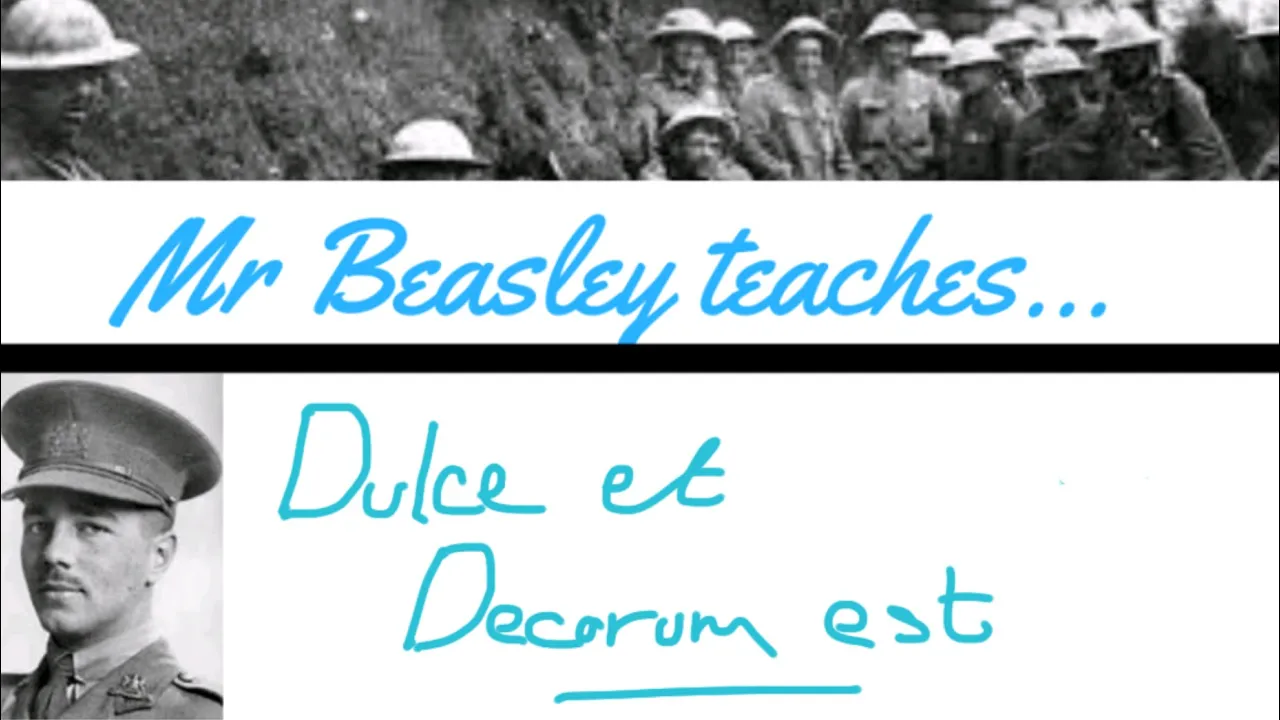
hello there my name is mr. Beasley and in this video we're gonna be having a look at Wilfred Owen his most famous poem Dolch yet the coram esthe the poem is written in 1917 when Wilfred Owen was in Craig Lockhart Hospital having been diagnosed with shell shock and while at the hospital Owen met another very famous poet Siegfried Sassoon who played a very important role in encouraging Owens poetry and editing his early drafts the central image in this poem is of a soldier suffering from the effects of chlorine gas which was one of several chemical
weapons used during the First World War to immobilize or kill soldiers the poem is written in the first person and much of it is in the present tense so the terrible realism of this event is enhanced not only by recognizing that Owen is describing something that he will have seen firsthand but also by Owen inviting and in some sense insisting that the reader watch alongside him don't you at decorum s his part of a Latin phrase don't yet decorum esta pro patria mori which literally means it is sweet and fitting to die for your country
and the purpose of this poem is to state with absolute passion and uncertainty not only how wrong this sentiment is but more importantly how long it is for those back in England to be using slogans like this as a way of persuading more young men to go out and fight the poem begins with an image of a group of soldiers leaving the frontline trenches and walking slowly and wearily towards a place of safety and rest Owen creates a sense of the terrible state of the soldiers by describing them as been double suggesting they can barely
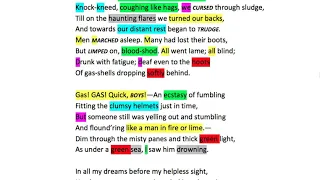
hold themselves up and this is followed by a series of images of how the soldiers who would have been young fit men before going to war have been prematurely aged similarly like old beggars under sacks is followed by another coughing like hags which combine to create a picture of men we were in a pretty wretched State ill poorly equipped and barely recognizable as human being and between these two similes is the alliterative knock-kneed which further adds to the image of deformity and mimics the sound of bones striking against each other as the soldiers struggle to
hold themselves up and the condition of the soldiers is further compounded by the terrible conditions they're experiencing underfoot in a letter to his mother Owen once described craters filled with waste high water and mud men he said had been known to drown in them here the sludge is thick enough to cause the men to curse and swear and deep enough to suck the boots from the soldiers feet so that the men are further injured blood-shod by marching barefoot it was a recurring theme in Owens poetry that the men who fought in the war were treated
as little better than animals you can see an example of this in anthem for doomed youth which opens with the line what passing bells for those who died as cattle and here the verb shod refers to shoes specifically when talking about horses and so the phrase blood-shod combines Owens view of the way that the soldiers are treated and become dehumanized by war while at the same time creating an image of the soldiers wearing shoes of blood understandably then the men are exhausted some either literally or metaphorically are marching asleep they are lame which means they
can hardly walk blind deaf and metaphorically drunk with fatigue which creates an image of the men's stumbling along as if they are intoxicated it's like the soldiers whole sensory experiences shutting down they've experienced so much horror and exhaustion that in this state the only thing they can do is stumble away from the frontline in the hope of finding relief their senses are impaired so much that they are even deaf to the hoots of tired outstripped five-nines that dropped behind it's worth mentioning that this line is edited by some online versions of the poem I'm not
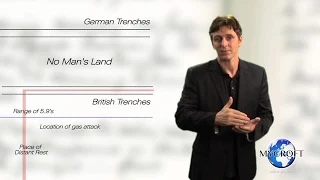
sure why because it isn't complicated five-nines refers to the 5.9 inch diameter measurement of the shells used to carry gas but anyway the men are far enough away from the fighting to be right on the limit of the enemy cannons range so that even the shells fired at them have become tired but they reach them nonetheless and these shells contain chlorine gas now before moving on I'm just gonna make a couple of points about the structure of this poem now you can work out a poems rhyme scheme by looking at the lines which rhyme and
coding them like this so you can see an a b a b c d c d pattern emerging and this continues throughout the poem all of the lines have roughly ten syllables and many of them are written in iambic pentameter which means that it's every other syllable that is stressed so moving on there's a dramatic increase in pace in the next part of the poem as we are alerted to the gas attack at the same time as the soldiers in the poem by the direct speech which begins the second stanza the panicked tone of this
is indicated by the repetition gas gas quick boys the soldiers then scramble to find and fit their gas masks but these box respirators were awkward and difficult to fit correctly an ecstasy of fumbling describes the frenzied clumsy movements of the soldiers trying to protect themselves from the effects of the gas which most of them manage to do just in time however one of the group is not so lucky and what is described in the rest of this middle part of the poem is the soldier suffering from the effects of the gas you'll notice that Owen
employs a sequence of present tense verbs which have the effect of bringing the action right before our eyes as Owen insists that we observe the man's agony at the same time as the poet we've got the verb yelling to indicate his fear and terror followed by stumbling and then floundering which describe his panicked uncoordinated movements as the effects of the gas start to take hold his movements Owen tells us a similar to those of a man on fire the reference to lime which I've indicated here is particularly unsettling as well as reducing the smell lime
was poured over dead bodies especially those buried in mass graves as a disinfectant and to aid the process of decomposition so lime suggests the dissolving effects of ingesting chlorine gas while also pointing towards the soldier's death we're then taken inside the gas mask of Wilfred Owen and we look through the eyepiece as he would have done and see the soldiers suffering firsthand and the scene takes on the dimensions of a nightmare there's an eerie thick green light as the chlorine gas hangs heavily in the air slowly dispersing around them and there is so much of
it that Owen compares what he sees firstly using a simile as under a green sea and then by the metaphorical I saw him drowning which continues the image the effect is horrifying to imagine once ingested the chlorine gas would have started to dissolve the tissues in the lungs making it difficult to breathe a sensation very similar to drowning and the word drowning is repeated at the end of the next sequence of present tense verbs as Owen recalls him plunging at him desperate for oxygen to plunge suggests the rapid violent but uncoordinated movement of the man
while also of course continuing the comparison with him being underwater choking is straightforward enough for us to understand in this context but guttering is worth explaining in a bit more detail because it describes the behavior of a candle that's about to go out the flaring dance of a low burning flame consuming the last remnants of its fuel before finally becoming extinguished works as an effective comparison - what is happening to the soldier desperately gasping for breath and about to expire the man's suffering is so terrible that the image of it becomes imprinted on Owen's mind
enhanced by his own feelings of helplessness and the poet narrator tells us the memory comes back to him in all his dreams the final part of this poem serves two purposes firstly it describes what happens to the injured soldier next and secondly it directly addresses the reader in a visceral angry tone in order to convey his message and as I've said before the imagined audience for this poem is the people back home in England specifically those who might use war propaganda to encourage young men like Owen to go out to France and fight for their
country and in the final part of the poem Owens intention in describing these horrific events becomes clear the section begins with the conditional connective if and we can see that he started addressing the audience directly with the pronoun you Owen is challenging the reader here to consider what it would be like if they too had this terrible image of what happened to the injured soldier next coming back to them in their dreams the adjective smothering which is used to describe what these dreams would be like is another word suggestive both of fires being snuffed out
and the act of depriving another person of air and so Owen is sort of saying to his reader back home that if like him they had these dreams they would be so horrendous that they would almost experience the same feelings of drowning as the injured man so I said that this section describes what happens to the soldier next and we can see that he was picked up and flung onto the back of a wagon the verb flung sounds careless and disrespectful the suffering of the soldier and that's sort of the point there's been so much
death than violence experienced by these men that the victim of the gas attack becomes just another body there's no dignity or honor involved in this man's sacrifice it's also effective I think at conveying the lifeless state of the soldier being lumped in a rough and uncontrolled way into the back of a wagon Owen describes himself pacing behind this wagon with the remaining soldiers and watching the white eyes writhing in the victims face which is another vivid image of the soldiers pain his eyes rolling around in his head while the rest of his features have a
hanging lifeless quality to them and remember that Owen is showing this to his audience and talking directly to the men and women back home he might encourage soldiers to go and fight and he's saying if you had seen this and then if you had heard this as he goes on to describe at every jolt the Blood come gargling from the froth-corrupted lungs he wants them to see and hear the soldiers distress as graphically as possible and so he paints a picture of the wagon bumping over the uneven ground adding to the man's agony as the
dissolving lungs turned tissue to poisonous froth that gargles in the man's throat as he tries to breathe the simile which I've highlighted here compares his face to a devil's sick of sin which seems to suggest a sickness with the evil of war a sickness so great that even a devil would have grown tired of it there's alliteration in this line too sick of sin and where we get this s noise being repeated it's called sibilants and it makes the simile sound even more bitter and angry as the consonants are his stout Owen uses another pair
of similes here to describe the sight of the man's blood as it gargles out of his mouth obscene can have a range of meanings from simply hideous or dreadful to something gross or indecent and so this simile implies that just like cancer the man's blood is a sight that should never have been seen on one level the second simile bitter as the cud works in the same way as several other of Owens images in that it connect the soldiers to animals cud is the half digested food that some animals regurgitate in order to break it
down the cud contains fatty acids which help the animal to digest and it's this acidic burning going on in the mouth of an animal that Owen is referring to here comparing it to the poisonous burning froth coming from the soldiers mouth the further impact of this is the vile incurable sores referred to in the next line and the fact that the adjective innocent is used at the end of this sequence of images has two important effects firstly it reminds us again if the soldiers youth these would have been fit young men going out to fight
I mean in 1914 the minimum legal age to fight overseas was 19 but most people didn't have birth certificates and so it was easy to lie about your age and it's estimated about two hundred and fifty thousand underage soldiers signed up to fight carried along on a wave of patriotism and propaganda and it's the second of these that Owen is really taking aim at in this poem the adjective innocent contrasts with those whom Owen points the finger of guilt and responsibility towards at the final part of the poem and as I've said before these are
the people back home in England who are encouraging young men to go out and die for their country he addresses them as my friend but he's being ironic here the tone is bitter angry as he tells them if you had seen what I have just described then you would not with such enthusiasm be telling children that it's sweet and right to die for your country many of these children would have lived pretty dreary lives and would probably have loved being told that they could find excitement and glory on the battlefields of France but this was
a lie an old lie because originally this latin phrase was penned by an italian poet called horace who was born in the year 60 five BC and wrote a series of patriotic ODEs and dulce decorum esthe is far from a patriotic poem and so the title itself is an ironic comment on the sort of jingoistic language being used to support the war effort there is nothing sweet or fitting in this soldier's death it is brutal nasty painful and pointless one of the millions sacrificed on the fields of France I know in himself would add to
this number he was shot and killed trying to cross a canal one week before the air war ended in the armistice was signed on the 4th of November 1918 he was just 25 years old