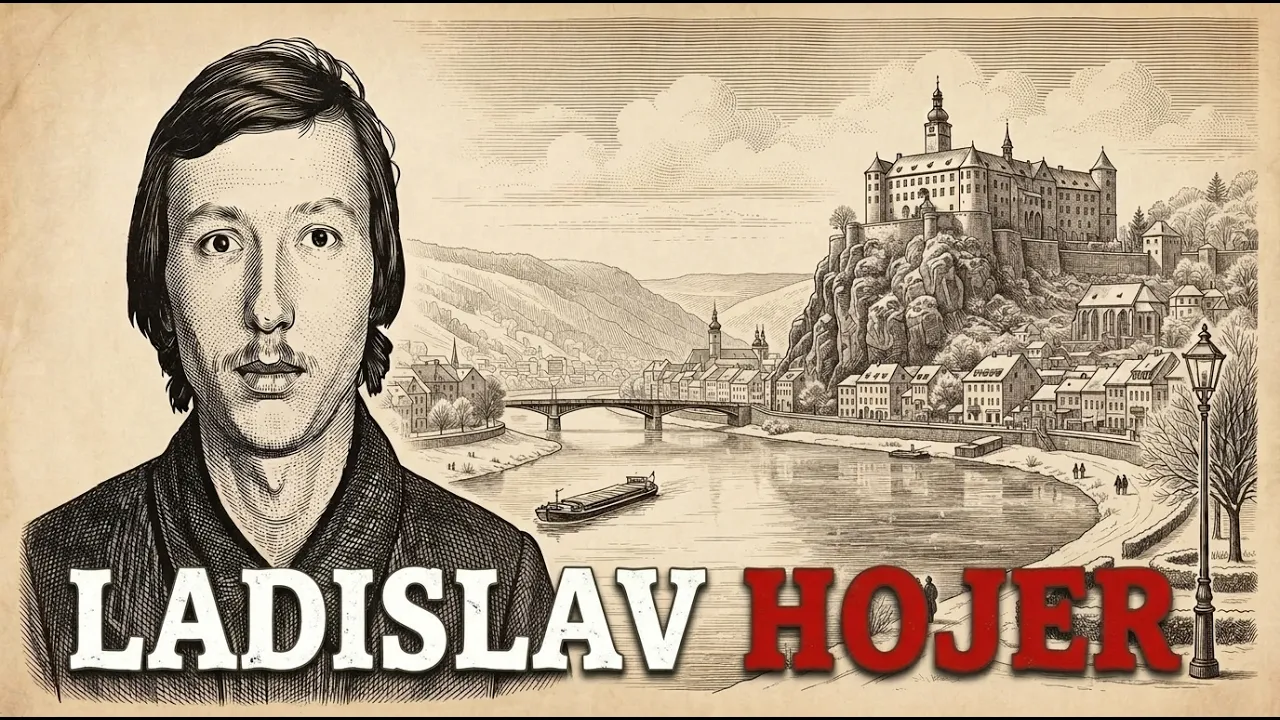
And tonight we are going behind the iron curtain to Czechoslovakia to the gray tower blocks and rattling tram lines and soot streaked railway stations of a country frozen in the long winter of what the communist party called normalization. the two decades of political repression, cultural stagnation, and enforced conformity that followed the Soviet invasion of 1968 and the crushing of the Prague Spring, a country where the state controlled the newspapers, the television, the courts, the police, the prisons, and the truth, and where, accordingly there were no serial killers. Not officially.
Serial murder was a phenomenon of the decadent west, a symptom of capitalist alienation and bourgeoa depravity. In the worker's paradise, such things did not happen. Except they did.
Between December 1978 and October 1981, a 20-year-old glass blower named Ladislav Hoyer murdered five women across Czechoslovakia in Dchin on a night train between Prague and the Bohemian border at a reservoir in Slovakia in the streets of Berno and within 300 m of his own flat in the Moto district of Prague. He strangled them, he raped them, some of them dead. He cut one of them apart with a scissor blade and ate her.
He committed at least 18 rapes beyond the murders. He was arrested on the 11th of February 1982. He confessed exclusively in writing because he was too ashamed of certain acts to say them aloud.
On the 7th of August 1986, Ladislav Hoyer was hanged at Punk Prison in Prague. He was 28 years old. He was the last criminal executed in Czechoslovakia before the abolition of the death penalty.
One of his victims has never been identified. She is still waiting for her name. Ladislav Hoyer was born on the 15th of March 1958 in Czechoslovakia.
He was the elder of two sons. His brother was named Yaruslav. The family lived in Motol, a residential district on the western edge of Prague, dominated by the enormous Moto University Hospital complex and by the rows of Panelak tower blocks that the communist regime had erected across the country's cities in the 1960s and 1970s.
These were the standardisssue housing units of normalization era Czechoslovakia. Pre-fabricated concrete apartment buildings identical in design from Bratislava to Carlo Vivari stacked 8 or 12 stories high containing hundreds of small flats with thin walls and shared stairwells surrounded by patches of compacted earth that the planners called green spaces and the residents called mud. The flats were allocated by the state.
The rent was nominal. The heating was communal. The silence in those long corridors was absolute.
Hoer's father died of cancer when the boy was small. His mother remarried, but she too was ill. She died of cancer shortly after the second marriage.
The stepfather, young, inexperienced, overwhelmed by the sudden responsibility of two boys who were not his own, made a decision. He moved away. He left.
Ladislav and Jaruslav were alone in the flat in Mottl. Two boys, the elder barely into his teens, abandoned in a concrete tower block in a country where the social services existed on paper, but where in practice a fatherless child in a panel was invisible. There were no relatives who stepped in.
There were no teachers who intervened. There were no neighbors who took notice or if they did they said nothing because in normalization era Czechoslovakia saying something meant involving the authorities and involving the authorities meant risk. The boys survived.
Ladislav completed a special school a designation that in the Czechoslovak educational system indicated a pupil assessed as below average in cognitive ability. His IQ was later measured at 88, placing him in the low normal range, not intellectually disabled, but slow, limited in abstraction, concrete in his thinking, and profoundly disadvantaged in any social situation that required nuance, empathy, or the reading of unspoken signals. He was trained as a glazier and eventually found work in a glass-b blowing workshop.
He had no friends, none. The only social contact in his life beyond the minimal interactions of the workplace was the clientele of his local pub star. Older men, the permanent fixtures of the Czechoslovak neighborhood hospital, men who sat in the same seats every evening and drank the same cheap beer and talked the same circular talk about nothing.
And these men, these drunks, these self-appointed mentors of a lonely, fatherless teenager who did not know how to speak to women and who had never been taught how to be a man, gave him advice. Their advice delivered with the blunt authority of the bar stool philosopher was this. Take them by force.
Take them by force. Whether they meant it literally, whether they were genuinely counseling a socially stunted young man to commit rape, or whether it was the careless bravado of drunk men talking tough, we cannot know. What we can know is that Ladis Lav Hoyer took them at their word.
He had no other frame of reference. He had no father. He had no mother.
He had no teacher, no mentor, no friend, no girlfriend, no model of human intimacy that did not involve coercion. The drunks at the hospital were all he had. He tried.
He tried to find a woman through legitimate means. He answered a newspaper lonely hearts advertisement, the insert new rubrica, the personal ads section that was one of the few sanctioned channels of romantic introduction in communist Czechoslovakia, where there were no dating agencies and no nightclub culture and where the party frowned on anything that smelled of westernstyle casual sexuality. The advertisement presumably described an eligible man seeking a companion.
a woman responded. She arrived at the meeting well-dressed, expecting, as the advertisement had promised, a financially secure, presentable middle-aged man. She found Lattis Lav Hoyer, squat, powerfully built with a face that repelled her on site.
He was not middle-aged. He was not presentable. He was a 20-something glass blower with an IQ of 88 and a vocabulary that did not extend to pleasantries.
The woman recoiled. She did not attempt to hide her disgust. She reproached him for wasting her time, for misrepresenting himself, for being what he was, and left within minutes.
There was another occasion at a party, one of the few social gatherings in Hoyer's barren life. A young woman approached him and offered him sex in the next room. This should have been the moment of connection, the breakthrough.
Instead, it was a catastrophe. The woman's forwardness, her directness, her sexual agency panicked him. He did not know what to do with a woman who wanted him.
He had been taught only about force. Consent terrified him. He threw her so hard that she smashed through a glass door and then he fled from the apartment.
Later he learned that the girl who apparently had a reputation had told his acquaintances about his failure. The humiliation was total. The one woman in his life who had wanted him and he had responded with violence and cowardice.
After that something closed inside Lislav Hoyer. His psychiatrists would later record that he told them he spent his evenings alone in the flat in Mottle, imagining scenes in which a helpless woman begged him for mercy. Not scenes of sex, scenes of power, scenes in which he was in control and the woman was not.
The fantasy was not about desire. It was about domination. the one form of human connection that a man with an IQ of 88, no parents, no friends, and no social skills could imagine achieving.
He was always, his psychiatrists noted, vulgar and contemptuous about women in conversation, but passive, tongue-tied, and uncertain in their actual presence. The contempt was armor. The passivity was the truth.
On the 1st of December 1978, Ladislav Hoyer, 20 years old, boarded a bus and traveled north from Prague to the city of Jetin. Jetchin sits on the Elb River in northern Bohemia near the border with East Germany in a deep valley where the river cuts through the sandstone cliffs of the Bohemian Switzerland region. It was and is an industrial town, a riverport, a railway junction.
Hojer had passed through it before on a bus heading toward Germany, and something about the city had lodged in his mind. He wanted to go back. He explained his reason later in his confession with a sentence that is almost unbearable in its simplicity.
He wanted to see the beauty of my country, but also to look for some women. He went to the cinema. He watched a film.
When he came out, it was dark and the streets along the Elbe embankment were quiet. He spotted a 29-year-old woman named Ava R walking alone along the riverbank. He followed her.
She did not know she was being followed. The distance between the point where Hojer attacked her and the nearest inhabited house was 35 m. 35 m, the length of a swimming pool.
Close enough to hear a scream. If anyone had been listening, he knocked her down. He dragged her into the bushes.
He strangled her to death. And then over the body, he committed his first act of necrilia. Before leaving, he stuffed a stinging nettle into her genitalia.
A gesture of contempt, of defilement that went beyond anything that could be explained by sexual compulsion alone. It was punitive. It was his answer to every woman who had ever recoiled from him.
Eva R had, it later emerged, left her husband that evening to visit the cinema, intending afterward to meet a lover at the spot where she was killed. The lover forgot about the rendevous and did not appear. Suspicion fell on both the husband and the lover.
During the investigation, other lovers were discovered. Eventually, a man who had nothing to do with the crime confessed to the murder. Apparently, for attention, a phenomenon that would recur in almost every one of Hoyer's cases.
The real killer was already gone. Back on the bus to Prague, invisible as he would remain for three more years. 14 months later, Hojer killed again.
This time the setting was a train. By February 1980, Hojer was serving his compulsory military service. The two years of Zachlansku that every able-bodied Czechoslovak male was required to complete.
On the 9th of February, he boarded the night train R770 from Prague to Jetin, the same northern city, the same river, the same dark pool. In the carriage, he noticed a young woman. Her name was Ivona S.
She was 25 years old, a medical student. She had just said good night to her husband, a military officer who was traveling on a later train. She was alone.
Hojer watched her. He watched as she walked to the toilet cubicle at the end of the carriage. He waited.
When she emerged, he was behind her. He followed her into the cubicle, locked the door, and strangled her with her own scarf. The cubicle was tiny, barely large enough for one person, let alone a corpse.
He could not leave the body there. It would be discovered within minutes. He masturbated briefly over the dead woman, then opened the window of the cubicle and threw Ivona's body from the moving train into the night.
He calmly disembarked at Nadlim, a city partway along the route, waited 2 hours at the station, and caught another train back to Prague. A witness at spotted a soldier who seemed to be in a hurry, but the description was vague. The other 46 passengers on the train were identified and eliminated from the inquiry.
The unidentified soldier became the prime suspect. But Hoer's absence from barracks on the night of the murder was never recorded. In the bureaucratic fog of Czechoslovak military service, a single soldier slipping out for a night and returning before morning went unnoticed.
He had an alibi by default. Ivona's body was found around 8:00 the next morning by the GSD Chesca Sloveni, the state railway cleaning service, lying beside the tracks in the dark countryside between Prague and I. The case triggered a cascade of tragedy that illustrates with terrible clarity the collateral damage that a serial killer inflicts beyond his immediate victims.
A railroad worker, a man who had nothing to do with the crime, fell under suspicion. The pressure of the investigation, the weight of accusation, the scrutiny of the police in a society where police scrutiny could destroy a life, it was too much. The railroad worker committed suicide in his flat.
When they found his body, the walls were covered with newspaper clippings about the case, and there was an English language medical textbook on the table. Though the man did not speak English, he had told colleagues he hoped the authorities would close the investigation. He was a man drowning in proximity to a crime he did not commit, and the current pulled him under.
Then another man died. A distant relative of Ivona's, emotionally shattered by her death, collapsed at her funeral, and subsequently killed himself. two more dead.
Neither killed by Hoer's hands, but killed by the ripples of what his hands had done. In August 1980, during a military holiday, Hojer traveled east far east across the entire breadth of Czechoslovakia from Prague to Koshitza in eastern Slovakia. He told people he was going to visit a friend.
The Rouian reservoir sits southwest of Koshitza, a large V-shaped artificial lake created by the damning of the Hornod River in the deep winding valley of the Bjanovsk Hills. In good weather, it was a sought-after recreation site. Families picnicked on the shores.
Swimmers cooled themselves in the green water. Fishermen cast lines from the rocky banks. In bad weather, it was deserted.
The weather was bad. Hojer found a solitary woman standing on the shore watching the water in the rain. She was alone.
There was no one else in sight. He did not speak to her. He did not call out.
Unlike his other attacks where he had at least attempted a few words of conversation before the violence began. This time he simply walked up behind her, knocked her down, and strangled her. During the attack, he ejaculated prematurely and lost interest in the sexual act.
He tied the body with wire he found nearby, weighted it with a stone, and sank it in the reservoir. Then he left. The body was not discovered until the 11th of October, 1981, more than a year later, when workers at the reservoir spotted something in the water.
By then, decomposition had done its work. The head and wrists had separated from the body. Identification was nearly impossible.
Forensic investigators examined the clothing and found a label, Triola, a Czechoslovak textile brand. They determined that the woman was a Czechoslovak national aged between 25 and 35. She had never undergone surgery.
She had no major healed injuries that would appear in medical records. There was, in short, nothing distinctive about her body, nothing that could be matched to a missing person report, nothing that could give her back her name. Despite extensive investigation by the Slovak police, the woman was never identified.
She has no name. She has no grave with a stone. She has no family that knows where she is.
She is a gap in the record. A woman who went to watch the water on a rainy day and never came home and whose absence in the vast anonymous machinery of the Czechoslovak state was never accounted for. She is still waiting.
The fourth murder was the most depraved act in the criminal history of Czechoslovakia. On the 30th of January 1981, Hoer arrived by train in Bernau, the second largest city in the country, the capital of Moravia. At 5:00 in the morning, he wandered the city all day.
He had no plan. He had no appointment. He simply walked the gray streets, sat in pubs, watched people, waited for something to happen.
At approximately 3:00 the following morning, 22 hours after his arrival, he was standing at a tram stop when he saw an 18-year-old woman. Her name was Ivana M. She was returning home from a visit to the local zoo, or rather from an evening that had begun at the zoo and ended somewhere in the Berno nightife because it was 3:00 in the morning and the zoo had closed many hours before.
Hoer tried to speak to her. Ivana ran. He shoved her to the ground.
He dragged her into a park between apartment blocks, a space enclosed on all sides by the concrete facades of panel tower blocks. Hundreds of sleeping families stacked in their small flats behind thin walls. He tried to rape her at knife point.
When the rape failed, when his body did not cooperate, as it so often did not, he stabbed her 39 times. Then he strangled her. And then in that park in the middle of a city surrounded by tower blocks full of sleeping people, he took a scissor blade and sliced off both of Ivana's breasts and her genitalia.
He placed them in a plastic shopping bag. He caught the train home to Prague. Back in his flat in Motol, he arranged the severed breasts on the kitchen table.
He penetrated the excise genitalia with his penis. Then he stored the remains in his refrigerator. After approximately 1 week, he boiled them in salted water.
He attempted to eat them with mustard and horseradish. He later told investigators in the flat affectless language that characterized all his confessions. The dish did not taste good.
The flesh, he said, was devilish, a word that, in the Czech original, carries connotations of toughness and unpleasantness rather than any supernatural meaning. He flushed the remains down the toilet. Ivana M had suffered 39 stab wounds.
Her wallet, jewelry, and watch had been stolen. The first suspects inevitably were members of the large Greek community in Berno with whom Ivana had socialized. A Jordanian student, hearing of the crime, confessed to the murder and then attempted suicide.
Under interrogation, he explained that he had made the false confession in order to divert attention from his academic failures and thereby protect his family's reputation. He had never met Ivana. He had never been near the park.
He simply wanted to be someone, even if that someone was a murderer. The pattern was now established. Every one of Hoer's crimes attracted a false confessor, a man who, for reasons of his own, claimed credit for what Hoer had done.
It is a phenomenon well documented in criminology. Sensational crimes attract false confessions the way Kerrion attracts flies. But in the context of communist Czechoslovakia, where crime was supposed not to exist and where the police were under intense political pressure to close cases quickly, each false confession consumed weeks or months of investigative effort and sent the inquiry spiraling in the wrong direction.
His fifth and final proven murder came on the 3rd of October 1981 and it was the one that scared him because it happened practically on his doorstep. At 10:00 in the evening near the bridge over the Motoski Potok, the motel stream in Prague 5, barely 300 m from his own flat, Hoyer began wandering. He wandered for an hour restless hunting.
Then he encountered a woman walking home alone. Her name was Anna Shash. She was 51 years old.
She was returning from an evening concert. She was well-dressed and attractive. And in the dark, Hoyer mistook her for someone younger.
He approached her. The conversation lasted four sentences. Then he slit her coat, her skirt, and her underwear with a knife.
He pressed the blade to her throat. He pulled her stockings over her head so she could not see his face, and he raped her. Then he strangled her.
He threw her overcoat over her face so that as he later explained with a logic that was both chilling and oddly methodical, nobody except the killer and the investigators would know the cause of death. Anna's dying scream was heard by multiple witnesses in the surrounding buildings, but nobody connected it with a crime. Nobody called the police.
Nobody went downstairs to look in the landscape of the panel where screams, arguments, drunken fights, and domestic violence were background noise absorbed by the concrete walls and the culture of non-involvement. A woman's scream in the night was simply one more sound. Her body was discovered by a random passer by who had gone into the bushes to relieve himself.
Hojer walked home 300 m. He went to work at the glass blowing workshop the next morning. But this killing rattled him, the proximity to his flat, the scream that had been heard, the body found so close to his daily route.
For the first time, he was afraid, and his fear expressed itself in the most paradoxical way imaginable. He told people what he had done. He went to his local pub, the hospital where the drunks sat, the same men who had taught him to take women by force.
and he admitted to the murder. He told them he had killed a woman near the bridge over the Matulski Potok. He described details.
He repeated the confession on multiple occasions. Nobody took him seriously. Nobody called the police.
The drunks at the hospital heard a man they considered a harmless oddball, a strange, thick, socially inept glass blower claiming to have committed a murder. and they assumed he was lying or fantasizing or drunk. They laughed at him or they ignored him or they told him to shut up and have another beer.
Lattis Lav Hoyer had confessed to murder in a public place to multiple witnesses and nobody believed him. The ordinariness of his appearance, the very thing that made women recoil, the very thing that made him invisible, was also the thing that made his confession invisible. He did not look like a killer.
He looked like nothing. He looked like the kind of man you do not see. His arrest on the 11th of February 1982 came through a chain of events so improbable that it reads like the plot of a detective novel which in a sense it eventually became.
A mentally ill patient in a psychiatric institution confessed to the murder of Anna Shei. This was not in itself unusual. As we have seen, Hoer's crimes attracted false confessors.
But this particular false confessor knew things that he should not have known. He provided unpublished details about the crime scene. Details that had been withheld from the press, details that only the killer or someone who had been at the scene could know.
The police were puzzled. The patient had been securely behind bars in his institution at the time of the murder. He could not possibly have committed it, but he knew how Anna had been killed.
He knew the precise configuration of the body, the positioning of the overcoat, the details of the wounds, how under interrogation, the patient explained, a friend had taken him to the scene of the crime and described the killing to him. The friend had shown him exactly where the body had lain, exactly how the woman had been attacked, exactly how she had died. That friend was Ladislav Hoyer.
The police came for him on the 11th of February at his flat in Moto. They found particles of cloth from his trousers that matched fibers found at the crime scene. They found his blood type matching saliva and sperm samples secured from the body.
They found the knife he had used to cut Anna's clothing. Hojer was arrested and then in the cells confronted with the evidence he began to write. He confessed exclusively in writing.
This detail is significant and it tells us something essential about Lattislav Hoer's psychological makeup. He could speak. He was not mute.
He was not a phasic. But he could not bring himself to say certain things aloud. The acts he had committed, the necrilia, the mutilation, the cannibalism, were so far beyond the boundaries of what even his stunted moral framework could accommodate that he could not form the words in his mouth.
He could write them. He could set them down on paper, in his clumsy, semi literate hand, in the blunt vocabulary of a man with an IQ of 88, but he could not say them to another human being's face. He admitted to five murders.
He admitted to 18 rapes. He admitted to an attempted murder, a young woman drunk at a tram stop whom he had dragged into a park, stripped and sexually assaulted. The girl had survived only because she had the presence of mind to persuade him to continue at her home where she said no one would disturb them and then asked him to dress her because she could not walk naked on the street.
Once dressed, she pushed him away and ran, screaming until a policeman leaned out of an apartment window and shouted at Hoer to leave her alone. The wouldbe killer mocked the wounded girl and fled. Criminologists who studied the case believe Hoer committed at least two additional murders that he never confessed to.
But the authorities, anxious that further interrogation might lead Hoer to make false confessions, to claim credit for crimes he had not committed, muddying cases that had already been closed, pushed to end the investigation. The case was shut down. Whatever else Ladislav Hoyer had done, it would remain in the dark.
He also at one point withdrew his entire confession. Then he reinstated it. The vacasillation was characteristic.
A man who wanted to be known and a man who wanted to disappear, alternating inside the same body. The lead investigator assigned to the Hoer case was Detective Yi Marovich. Marovich was born on the 16th of November 1942 in the village of Boleradita in southern Moravia.
He joined the Czechoslovak police in 1964 and was assigned to the criminal investigation department of Prague in 1977. Over the following two decades, he would become the most celebrated homicide detective in Czech history, the head of the Prague Morparta, the murder squad, with a 100% clearance rate sustained over six consecutive years. During his career, he caught seven murderers who received capital punishment.
He died of cancer on the 20th of October 2022, aged 79. But his most extraordinary case, the one that defined his career and his legacy was Lattislav Hoyer. Over the two years of the investigation, Marovich developed a relationship with Hoyer that both men described in terms that were by any normal standard astonishing.
Hoyer, fatherless since early childhood, abandoned by his stepfather, raised by nobody, mentored by drunks, latched onto the detective with desperate, almost canine affection. In Marovich's presence, Hoyer was cheerful, cooperative, talkative, and eager to please. He became, in Marovich's words, a different person.
The flateyed monoselabic killer who had strangled five women and eaten one of them was transformed in the interview room into something resembling a son trying to impress his father. Marovich recognized what was happening. He was an experienced investigator who had spent years studying the psychology of violent criminals.
His friend and informant, Vladimir Techverk, a sadistic murderer he had caught in 1979, had taught him more about the minds of deviants than any textbook, and the two had maintained a friendship that lasted decades. Marovich understood that Hoyer's attachment was genuine, that it was not manipulation, not strategy, but the authentic emotional response of a profoundly damaged man who had finally found someone who paid attention to him, who spoke to him as a human being, who asked him questions and listened to the answers. Marovich once tried to invite Hoyer to his home for a Sunday lunch.
His colleagues vetoed the idea flatly, emphatically, and with considerable alarm. The notion of the Prague Morde Parta's lead investigator sitting down to roast pork and dumplings with a man who had boiled a woman's breasts in salted water was understandably too much for the department to countenance. But the bond was real and it served the investigation.
Hojer confessed because Marovich asked him to. He cooperated because Marovich was kind to him. He led the investigators to crime scenes, identified victims, described his methods, and filled in gaps in the evidence.
All because a middle-aged detective from Boleradiche treated him like a person. A signature element of Marovich's investigative method was the crime scene reconstruction, the reconstruct. This was standard Czechoslovak police procedure.
The accused was taken to the scene of the crime and asked to physically demonstrate step by step what he had done. The reconstructions were filmed and photographed. They were used as evidence in court and they required live actors to play the roles of the victims.
In the Hoer reconstructions, women initially played the victims. This was a mistake. Hojer became so deeply absorbed in reenacting his attacks, so immersed in the physical memory of the violence that he lost self-control.
The detectives watching him saw the transformation happen in real time. The cooperative, almost friendly prisoner was gone, and in his place was the killer. His hands reaching for the actress's throat, his body tensing with the same predatory energy that had driven him to strangle five women.
The women had to be pulled away. The actors were replaced with mannequins. At several outdoor reconstructions, local citizens who recognized Hoer or who had heard that the killer was being brought to their neighborhood tried to storm the police cordon.
They wanted to lynch him. Mobs formed. Officers had to physically hold the crowd back while Hoer stood in the middle of the scene, blinking in confusion.
He genuinely could not understand their anger. He did not comprehend why people he had never met would want to hurt him. The psychiatrist noted this reaction as clear evidence of his total inability to grasp the gravity of his crimes.
He understood that he had killed women. He understood that killing was against the law, but the emotional weight of what he had done, the grief, the rage, the violated sense of communal safety was invisible to him. He existed in a moral vacuum.
The concept of empathy was simply absent from his psychological architecture, like a room that had never been built. Hoer's sense of humor was pitch black, and the things he said during the investigation have a quality that is simultaneously appalling and pathetic. The utterances of a man who had no idea how to be human, and who filled the silence with a kind of grotesque clowning.
During a car transfer between prisons, he pointed at two female hitchhikers on the roadside and said to the detectives escorting him, "If they stopped the car, he would sniff and kill the women so that the detectives could have a quick case. " He laughed at his own joke. The detectives did not.
His signature phrase, his motto which he repeated with evident satisfaction was gades mistomi in English. When my tail stands, my brain stops. It was his entire theory of himself compressed into eight words.
When sexual arousal overtook him, rational thoughts ceased. He was not excusing himself. He was not pleading diminished responsibility.
He was simply describing in the most primitive vocabulary available to him what happened inside his body when the compulsion struck. His descriptions of his murders were rendered in the same blunt concrete language. I took her oxygen.
I caught her by the mouth. She remained in my hands. I did not care what she looked like drunk, especially that she had a good skeleton.
The phrases read like a foreign language. the language of a man who experienced human beings as objects, as bodies, as collections of parts, a skeleton, a mouth, oxygen to be taken away. The psychiatrists who examined him, specialists in forensic psychiatry, psychology, and clinical psychology, produced their report with clinical precision.
Diagnosis. A primitive psychopath. An amoral anabolic personality with schizoid features and aggressive tendencies.
Criminal behavior committed in uninterrupted consciousness. Capable of hindering and correcting his repeated actions. Attitude toward murders indicative of insensitivity and brutality.
The absence of at least additional sympathy, conscience, or regret. Their conclusions were devastating. No mental disorder had been detected.
He was not psychotic, not delusional, not out of touch with reality in any clinically defined sense. Resocialization, even through lifelong imprisonment, was not possible. Protective treatment in a closed psychiatric institution was not proposed.
Not even castration could guarantee that he would not attack again. He was in the judgment of the Czechoslovak psychiatric establishment irreparable. Lattis Lav Hoyer was sentenced to death.
He did not believe it. Throughout the trial, throughout the sentencing, throughout the appeals process, he maintained a cheerful conviction that the sentence would not actually be carried out. In part, this was denial, the refusal of a man who cannot comprehend abstraction to accept the reality of his own death.
until the moment arrives. But in part, it was something else. Something that the investigators and the prison staff observed with a mixture of pity and unease.
Hoer enjoyed prison. He said so. He told the guards, the doctors, the investigators.
Prison, he said, was the first time in his life that anyone had been interested in him. In the flat in Motol, he had been invisible. a strange lonely man in a tower block surrounded by people who did not see him.
In prison, he was the center of attention. Psychiatrists examined him. Detectives questioned him.
Guards brought him meals. Marovich visited him. People spoke to him, listened to him, wrote down what he said.
For a man who had spent his entire life in a vacuum of human indifference, the condemned cell was paradoxically the most connected he had ever been. The observation is heartbreaking in the truest sense of the word. It breaks something in you to read it.
A man who was so profoundly starved of human contact that a death sentence felt like acceptance. a man for whom the attention of his executioners was preferable to the invisibility of his freedom. Marovich, who did not agree with the death penalty, attempted to drag out the investigation as long as possible.
Many of his colleagues interpreted this not as thoroughess, but as what it almost certainly was, a last quiet effort to prolong Ladislav Hoyer's life. The detective who had caught the killer was trying to save him. Not because he forgave what Hojer had done, but because the bond between them had become real, and because Marovich understood, with the insight of a man who had spent decades inside the minds of murderers, that Hojer was as much a product of what had been done to him as of what he had done to others.
The effort failed. The sentence stood. Pancrock's prison stands in the southern suburbs of Prague on a 14 hectare site on the Nusla plane that was once well outside the city limits and is now firmly within them.
It was built in 1889 to replace the older Saint Weslas prison which had been condemned for its appalling conditions. In the century since its construction, Pankro had accumulated a history that read like a catalog of the worst that central Europe had inflicted on itself. During the Nazi occupation, a Gestapo prison had been established on the site.
A guillotine was installed in a white tiled room in the basement. 1,176 people were guillotined or hanged there between 1939 and 1945, including in the final frenzied months of the occupation, hundreds who were executed within minutes of their sentencing. After the communist takeover in 1948, the prison services were in heavy demand once more.
The show trials of the early 1950s, the hanging of the Democratic politician Milada Horakova in 1950, the execution of Communist Party general secretary Rudolph Slansky in 1952 took place at Pankratz. The courtroom where the sentences were pronounced was connected to the prison by an underground corridor. Justice in communist Czechoslovakia was a conveyor belt.
By the 1960s, open air executions had been abolished, and a purpose-built execution cell had been constructed in the basement of the prison. The device was simple and efficient. A noose attached to the wall with a remotely operated trap door in the floor.
The condemned stood on the trapoor. The noose was placed around his neck. A lever was pulled, the floor opened, the drop killed him, or it did not, and the executioner waited.
It was in this cell that Ladislav Hoyer died on the 7th of August 1986 at the age of 28. Ladislav Hoyer was led from his cell to the execution chamber in the basement of Pankratch prison. He was terrified.
The calm, cooperative prisoner who had chatted with Marovich, who had joked about sniffing and killing hitchhikers, who had enjoyed the novelty of human attention. That man was gone. In his place was a 28-year-old who was about to die and who understood it finally with the full animal clarity of a body that knows what is coming.
The execution was delayed twice. Hojer became physically ill with fear. According to Czech sources, he lost control of his bowels.
The prison staff had to wait to clean him to compose him to bring him back to a state in which the procedure could continue. It is a detail that the official record would prefer to omit the indignity of the condemned, the mess of death. But it happened and it tells us the final truth about Lattis Lav Hoyer.
That in the end, stripped of everything, his fantasies of power, his contempt for women, his motto about his brain stopping, he was a frightened man in soiled trousers, begging with his body for a life that his body had forfeited. He was hanged. He was the last criminal executed in Czechoslovakia before the death penalty was abolished.
3 years later, the Velvet Revolution swept the communist regime from power. The new president, Vatzlav Havl, a playwright, a dissident, a man who had himself been imprisoned at Punkrt, pushed the abolition of capital punishment through parliament in May 1990. The noose in the basement was retired.
The trap door was sealed. The last man to fall through it was a glass blower from Motel who had never been loved. Yiji Marovich continued his career.
He became the head of the Prague murder squad, achieved his legendary clearance rate, caught the teenage serial killer Yiji Straka in 1985, and retired in 1999. In retirement, he wrote two books about his cases. He never forgot Hojer.
In interviews given decades later, he spoke of the killer with a complexity of emotion, pity, horror, affection, sorrow that was entirely at odds with the blunt certainties of the Czechoslovak criminal justice system in which both men had operated. He died on the 20th of October 2022 of cancer, aged 79. In 2024, Czech television aired Mata Marovich Hoyer, the Marovich Method, Hoyer, a six-part dramatic series chronicling the investigation and the extraordinary bond between the detective and the killer.
The series produced by TV Nova premiered on the 4th of April 2024 and was followed by a continuation Mata Marovich Straa released in 2026 dramatizing Marovich's pursuit of the Spartacad Killer. Hoyer was portrayed by the actor Peter Ulik Marovich by Peter Lyenichka. Marovich himself had collaborated with the filmmakers before his death.
The unidentified woman from the Ruine Reservoir has never been named. The Triola label on her clothing confirmed she was Czechoslovak. Her age was estimated at 25 to 35.
She had no surgical scars, no healed fractures, nothing that could be matched to medical records. Somewhere in the former Czechoslovakia, in the Czech Republic or in Slovakia, in a city or a village, in a panel or a farmhouse, there may be a family that has spent more than four decades wondering what happened to a woman who went away one day and never came back. Or there may not.
She may have been as alone as Hoer himself, a woman with no one to miss her, no one to file a report, no one to notice the absence. She remains in the water, in the record, in the silence. The principal source for the life and crimes of Latislav Hoyer is the Czech language criminal record and the investigative files maintained by the Prague police, portions of which have been published in the Czech press and in the books of Yiji Marovich himself.
Lovets Praku Vi Shokoval Republicuh Ghost Hunter Murders that shocked the Republic co-authored with Victorin Schulz and published by EPO in 2008 and Criminalista Legenda Price Mortar Deianum Nastopia The Criminalist Legend of the Prague Murder Squad on the Trail of Deviants co-authored with Petra Shamal and published by Epica in 2015. The Wikipedia articles on Ladislav Hoyer and Yiji Marovich sourced primarily from Czech language journalism doic akalia kzed gzed blesque IDNA cz provide the most accessible English language summaries the history of capital punishment in czechoslovakia is documented in otakar lishkas trusteem vikon chesco slovenu vet devatans at d98 zd Published by the Office for the Documentation and Investigation of the Crimes of Communism in 2006. The Pancra Prison Memorial and Museum is accessible by appointment.
The television series Mata Marovich Hoyer produced by TV Nova aired in the Czech Republic in 2024 and is available on streaming platforms in several European territories. That is all for this episode. Thank you for listening.
We will be back.