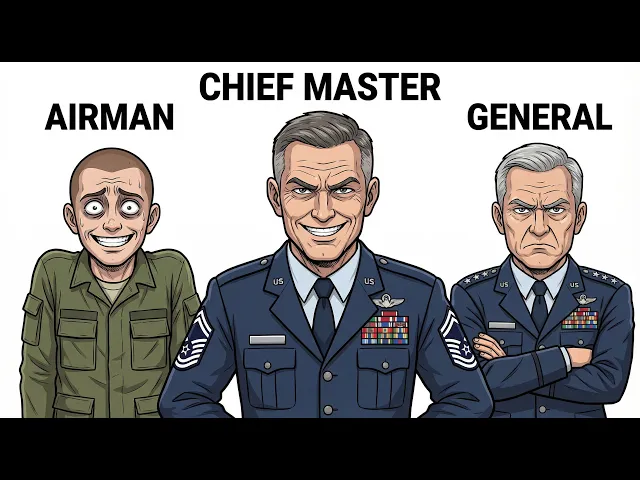
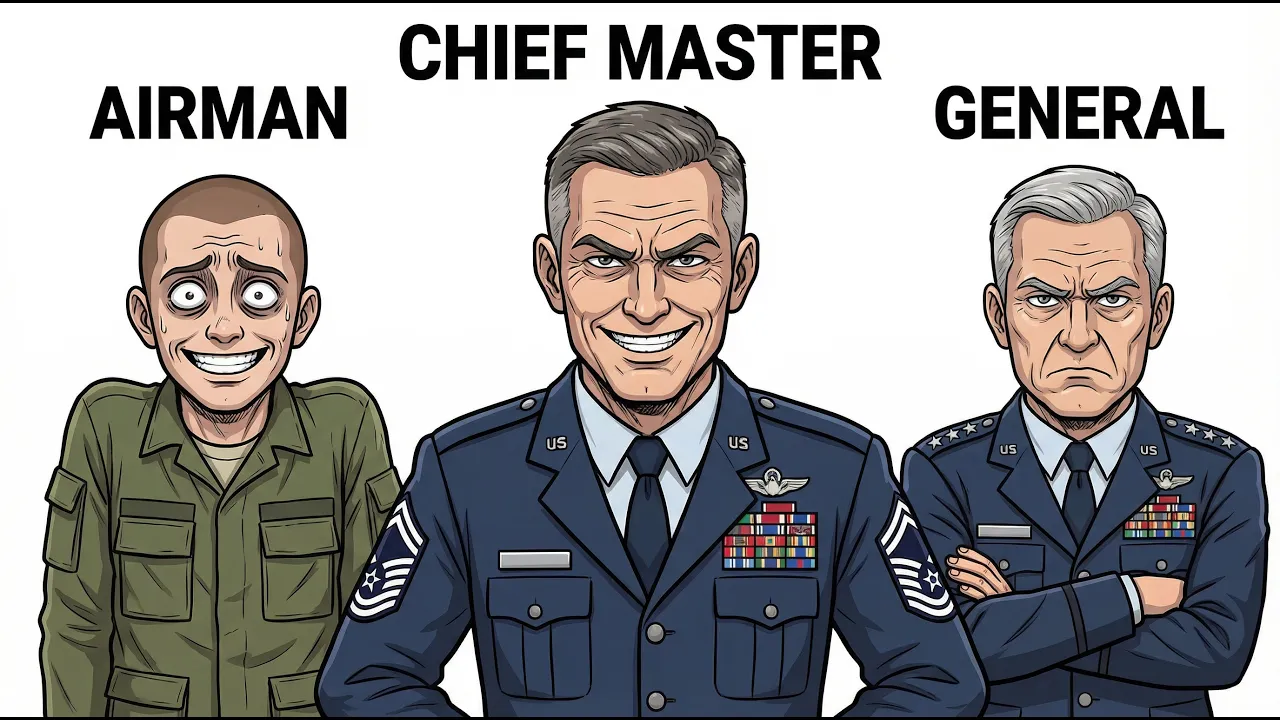
Airman Basic E1. You don't have a rank yet. Not really.
You have a uniform, a shaved head, and a bunk in a bay with 59 other people who are just as lost as you are. You are an airman basic. The bottom rung of the United States Air Force.
And right now, basic military training at Lackland Air Force Base in San Antonio, Texas, is doing everything in its power to find out if you belong here. It is 0430. The lights come on without warning.
A military training instructor, your MTI, is already standing in the middle of the floor. And he is not happy. He was never happy.
You have learned this much. You have 8 and 1/2 minutes to dress, make your bed with hospital corners sharp enough to cut glass, and fall into formation outside. You've done this 14 days in a row.
You still haven't done it fast enough. She BMT is 8. 5 weeks long.
That number sounds manageable until you're inside it. The Air Force doesn't train you to kill things first. It trains you to function under pressure, under sleep deprivation, under constant evaluation.
You march, you run, you study the airman's creed until you can recite it blind. You learn drill, weapons qualification on the M18 pistol, and how to respond to a chemical attack. You learn what it means to be part of something that doesn't care about your excuses.
Week four is when something shifts, not for everyone at the same time, but you feel it. The chaos starts to have shape. The shouting starts to make sense.
You stop waking up confused and start waking up ready. That's what they were waiting for. You graduate on a Friday morning on Lackland's Finston Parade Field.
Your family is in the stands and you march past them in perfect formation and you don't look over because you've been told not to and because you are no longer the person who needed to. You are air ammon basic no more. But you remember what it felt like to be nothing yet.
You'll carry that. Airman first class E3. You've been in for about a year.
You made Airman, then Airman first class, and those promotions came automatically, which means you didn't earn them so much as survive long enough to receive them. That changes now. You are stationed at Rammstein Air Base in Germany.
It is February. The air outside is the kind of cold that feels deliberate. You are an aircraft maintainer, a crew chief, and you own an F-16 Fighting Falcon the way a rancher owns land.
Technically, it belongs to the Air Force. Or but try telling that to your hands at 0200 when you're the one with your arm inside the engine bay trying to diagnose a hydraulic pressure drop before the pilot's 0530 brief. The jet doesn't care what time it is.
The mission doesn't care either. An airman first class is where the Air Force separates the ones who showed up from the ones who decided to be here. You are no longer just completing tasks.
You're starting to own them. Your staff sergeant watches, but less. Your technical sergeant signs off on your work, but the work is yours.
When that jet lifts off the runway at first light and clears the airfield fence with 27,000 lb of thrust, you are the last person who touched it. That weight is real, and you don't put it down. You study for your fivelevel career development course on the weekends.
It's correspondent study, thick volumes of technical knowledge about aircraft systems, maintenance procedures, and air force doctrine. Nobody makes you do it on Saturday morning. You do it because the gap between where you are and where you want to be is filled with exactly this kind of unglamorous work.
You will not be an airman first class forever, but you will never forget what it taught you. That competence is built in the dark, one hydraulic line at a time. Staff Sergeant E5.
You tested for Staff Sergeant twice. The first time you missed the cutoff by two points. You remember the exact number because you replayed it for 3 months.
The second time you didn't miss. Promotion in the Air Force in listed ranks from E5 upward is competitive. Your score on the weighted airman promotion system, your score is a composite of your job knowledge test, your enlisted performance reports, your decorations, and your time in service.
You studied, you performed, and eventually the math worked in your favor. You are a staff sergeant now. You have people.
Two airmen report to you directly. And what happens to them, their careers, their performance, their understanding of this job is your responsibility in a way that nothing before this prepared you for. You are stationed at Nellis Air Force Base in Nevada, home of the Air Force Warfare Center, where some of the most advanced aerial combat training in the world happens daily overhead.
Your airmen are good. One of them, a young A1C named Torres, has the instincts but not yet the discipline. Well, you have had that conversation three times now.
Not a counseling session. A conversation. You've learned the difference.
You do it at the workbench side by side where it doesn't feel like an office because the lesson lands better when it doesn't feel like a lesson. You run the section when your tech sergeant is at a commander's call. You brief the flight chief without notes.
You write your airmen's EPRs with the care of someone who knows that six lines of text can define the next 3 years of another person's life. You get one shot to describe what Torres actually is versus what his record says on paper. You choose words carefully.
Leadership at this level is not loud. It is consistent. It is showing up the same way on a bad day that you do on a good one.
Your airmen are watching all of it, even when they don't seem like they are. I especially then before we go further, if you've made it this far, comment what you want next. Hit that like button right now and subscribe so you don't miss what's coming next.
We upload every single day. Technical Sergeant E6. The Air Force calls the technical sergeant the backbone of the enlisted force.
That's not a slogan. It's a structural reality. You are the connective tissue between the senior NCOs who set direction and the airmen who execute it.
You translate intent into action and you do it in both directions simultaneously up and down the chain without losing anything in the translation. You are currently deployed to Al- Uade air base in Qatar, the largest US military installation in the Middle East. The heat is something you've stopped remarking on.
It is 114° at noon and the flight line doesn't pause for it. You are a loadmaster on a C17 Globe Master 3 responsible for the safe loading, securing, and delivery of everything from ammunition pallets to armored vehicles to humanitarian aid. The weight and balance calculations you run before every mission are not estimations.
They are exact. An error doesn't ground a flight. An error puts a $200 million aircraft and its crew into the ground.
Your crew trust you completely. You have earned that over seven deployments and 11 years of service. Last Tuesday, you caught a cargo strap that had been incorrectly rated for the load.
It was a small thing that was not a small thing. Nobody made an announcement. You fixed it, logged it, briefed the team, and moved on.
That's how it works at your level. The heroics are quiet. You mentor.
You counsel. Uh you sit with airmen who are struggling with things that have nothing to do with aircraft. Marriages under strain from deployment cycles, finances unraveling at home, the quiet grind of being gone more than their present.
You're not a therapist, but you are often the first person they trust enough to talk to, and you take that seriously because you remember who played that role for you. Technical sergeant is where the Air Force's institutional knowledge lives in your hands, in your decisions, in the example, you set every single shift. Master Sergeant E7, you have been in the Air Force for 16 years.
You have deployed to six countries. You have held a secret clearance for a decade and a top secret/ci clearance for 4 years. You have lost a colleague, attended two military funerals in 18 months.
And you have kept going. Sure, because that's what the people around you needed from you. And because stopping was never a real option.
You are a master sergeant. The promotion rate to E7 Air Forcewide hovers around 15%. That means roughly eight out of every nine technical sergeants who test do not make it.
You made it. Not on the first try. You are currently assigned to the first special operations wing at Herbert Field in Florida supporting special operations aviation missions.
You don't fly the aircraft. You make sure everything that makes the aircraft possible is functional, documented, and ready before the crew ever walks to the jet. Supply chains, maintenance, scheduling, crossf functional coordination between units.
The invisible scaffolding that holds the visible mission up. Your flight chief position means you run a section of 43 airmen and NCOs. You know their names.
You know their family situations. You know which one is quietly studying on weekends to get ahead and which one hasn't been sleeping well since they returned from their last rotation. This is not surveillance.
This is leadership. It looks like coffee at 0700. Informal and without agenda.
It looks like a hard conversation that you initiate before the problem becomes a crisis. You are also preparing for the senior NCO enlisted professional military education course. It's a significant commitment.
Weeks away from your section, weeks of strategic leadership curriculum. You don't love leaving your team. You go anyway because the Air Force is investing in the leader you're becoming, not just the one you are.
Master Sergeant is the rank where the Air Force stops measuring how well you do your job and starts measuring how well the people around you do theirs. Chief Master Sergeant E9. There is no higher enlisted rank in the United States Air Force.
Chief Master Sergeant E9. Approximately 1% of the enlisted force reaches this grade. In an organization of hundreds of thousands, that number is not a statistic.
It is a statement about what this rank requires and what it costs to get here. You did not plan to become a chief. Nobody who becomes one does, at least not honestly.
You plan to be good at the job in front of you. 26 years of being good at the job in front of you eventually produced this. The board convened.
Your record spoke for you in a room you weren't allowed to enter. A they pinned five chevrons and a star on your sleeve and nothing about your actual day changed except everything. You are the command chief master sergeant of the 86th Airlift Wing at Rammstein Air Base in Germany.
The same installation where you first arrived as a young crew chief 23 years ago. You walked the same flight line last week that you once worked on as an E3 with cold hands and something to prove. The flight line hasn't changed much.
You have. Your job now is not maintenance. It is not logistics.
It is not any specific technical function. Your job is people. Every enlisted airman on this installation, more than 5,000 of them, falls within your purview.
You are their most senior advocate. When something is wrong in the force, morale, policy, I a commander's decision that looks right on paper but feels wrong on the ground. Your voice is the voice that says it out loud to the people with the authority to change it.
You don't carry a wrench anymore. You carry the weight of every conversation you've had with every airman who was struggling. Every NCO who needed direction, every young staff sergeant who reminded you of yourself at that age and needed someone to tell them they were going to be fine.
You attend the wing commander staff meeting. You sit at the table. You speak when it matters and you choose silence when it matters more.
Generals consult you not because of your rank, because of your understanding of what the Air Force actually is beneath the briefings and the doctrine. The human machinery that makes all of it move. The newest Airman basic who landed at Rammstein last week has no idea who you are yet.
They will. And when they figure it out, what you want them to see is not the rank. You want them to see the standard.
The standard that says this organization will ask everything of you and if you give it this is what you can become. Second left tenant 01. You graduated from the United States Air Force Academy in Colorado Springs on a Thursday in late May.
The superintendent spoke. The common dance spoke. Someone threw their cover into the blue Colorado sky and then everyone did because that's what you do.
And then it was over and you were a commissioned officer in the United States Air Force. You have been a second lieutenant for 11 weeks. You know this because you are counting, not out of eagerness, out of self-preservation.
You are at undergraduate pilot training at Columbus Air Force Base in Mississippi. And up is the most demanding academic and flight training pipeline in the American military. Roughly half the people who begin it do not finish it.
You fly the T6A Texan 2. It is a turborop aircraft with tandem seating and enough performance to expose every gap in your coordination, your spatial awareness, and your decision-m that you didn't know you had. Your instructor pilot, Captain Reyes, is 29 years old and has approximately 8,000 hours more flight time than you.
She does not yell. She also does not let anything slide. These two facts held in combination are the most educational experience of your life.
The day is structured to an extreme. Ground school in the morning, aerodynamics, meteorology, aircraft systems, emergency procedures. You know the boldface emergency procedures for engine failure, uncontrolled fire and loss of communications cold.
They are called boldface because in the actual checklist they are printed in bold. They are not for referencing. They are for knowing instantly under conditions that don't allow for page turning.
You fly in the afternoon. You debrief for an hour after every sorty with an exactness that civilian aviation would find unusual. Every deviation from the profile is noted, analyzed, and corrected before the next flight.
There is no hiding from a debrief. There is only learning from it. You are not a pilot yet.
You are becoming one. The difference is not semantic. It is the difference between the person who got into this aircraft 3 months ago and the person who will climb out of it eventually with wings on their chest and the knowledge that they were tested at the hardest thing they'd ever attempted.
And they did not stop. Lieutenant Colonel05, you command. That is the word the Air Force uses and it is the right one.
As a Lieutenant Colonel, you are in command of a squadron roughly 300 to 500 personnel depending on the unit. You are responsible for their training, their readiness, their welfare, and their conduct. All of it.
All the time. You command the 9inth Airlift Squadron at Dover Air Force Base in Delaware, home of the Air Force's largest airlifter, the C5M Super Galaxy. Dova is also home to the Charles C.
Carson Center for Morttery Affairs. The port of entry for fallen American service members returning from overseas. It is the quietest part of the base.
The weight of it reaches everything else. Or you have been a pilot for 17 years. You have over 3,800 flight hours, multiple combat deployments, and two squadron level staff tours that taught you more about how organizations fail than any leadership course ever did.
You know how decisions made in a conference room three levels above the flight line ripple down and land on the youngest airman in the most inconvenient way possible. You have been that airman. You don't forget it.
Your day rarely belongs to you. Commander calls, readiness reviews, officer performance reports, meetings with the group commander, meetings with the mission support squadron, a phone call at 17:30 about a maintenance issue that could ground two aircraft for a deployment that leaves in 36 hours. You solve it, not because you have the answer immediately, but because you have the right people around you and you've learned how to let them do what they're trained to do.
You have started saying less in meetings not because you have less to say because you've learned that a room full of good people with a commander who fills every silence produces a room full of people who stop thinking. You ask questions. You listen to the answers.
You make the call. Your operations officer, Major Castillo, is going to be excellent. You knew it 6 months ago and you're watching it happen now.
One difficult situation at a time. Part of your job is creating the conditions for that. Part of your job is getting out of the way.
Squadron command is the best job in the Air Force. Every Lieutenant Colonel who has done it will tell you that. They'll also tell you it's the hardest.
And both of those things are true in exactly the same measure. General 010. You have four stars.
They were placed on your shoulders by the Secretary of the Air Force and the Chairman of the Joint Chiefs at a ceremony that you remember less clearly than you expected to. What you remember is your spouse's face in the front row. 29 years of deployments and separations and phone calls that ended too soon and they were still there.
You are a four-star general. There are fewer than a dozen Air Force generals of this grade on active duty at any given time. UK command air combat command headquartered at Langley Air Force Base in Virginia.
ACC is responsible for providing combat ready forces to combatant commanders across the globe. Every fighter wing, every bomber, every reconnaissance asset are every cyber warfare unit that falls under the air force's combat mission. Roughly 100,000 personnel, hundreds of aircraft.
a budget that is classified in its most sensitive elements and enormous in its public ones. Your day begins before most people's alarms. You have already read the overnight intelligence summary, the operational status report, and three flagged items from your command chief before your first scheduled meeting.
You do not manage time. You allocate it with the same precision you once applied to a flight plan. Every hour is a resource.
Every conversation is an investment. You sit on the Air Force Council. You advise the chief of staff.
You testify before the Senate Armed Services Committee when required, which is more often than you would prefer. And you do it without notes because you cannot afford the appearance of being less prepared than the senators questioning you. You represent not just your command, but the 330,000 men and women of the Air Force who will never be in that hearing room.
The decisions that cross your desk do not have clean answers. Budget trade-offs between readiness and modernization. Personnel policies that affect retention across the entire force.
Operational risk assessments for missions where the margin between success and catastrophe is narrow and the consequences of failure are measured in lives, not line items. You still go to the flight line when you can, not for the optics of it because you started there. Because the crew chief checking the landing gear of an F-35 at 0430 in the cold is the reason everything else exists as and you never want to forget it.
You walk over, you ask about the jet. They answer surprised that you know what questions to ask. You always did.
Four stars do not change who you are. They clarify what you are responsible for. And the weight of it, the full unddeminished weight of it, you carry every single day.
Not as a burden, as a privilege. The Air Force was built by people who believed that what they were building mattered. It still does.
And somewhere on a flight line right now, an airman basic who graduated from Lackland 3 weeks ago is learning that for the first time. They don't know yet where it leads. You do.
And it leads here.