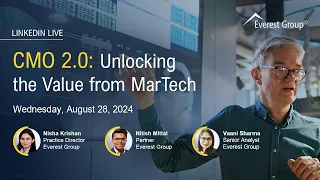
I would now like to introduce today's presenters Michael Jansen chief research officer guides the practices research agenda and architecture by leveraging his extensive experience to identify and unlock emerging trends Sarah Burnett executive vice president and distinguished analysts sets up and leads Everest groups service optimization technologies research program which focuses on intelligent process automation and optimization using technologies such as artificial intelligence and robotics process automation a bar deep bode practice director is also a part of the service optimization technologies research program and leads research related to robotic process automation intelligent automation and process mining and with
that I'd like to turn things over to Michael take it away Michael all right Thank You Lucy and I'm Michael Jansen and I'm calling in from just north of Dallas and we got a great topic today dealing with my colleagues across the globe here as we look into the sections we're gonna cover we're gonna talk a little a little bit about the marketplace and Sara and I are gonna have a brief chat about that and then we're going to get into our pinnacle study which is really focused on the intelligent automation so it's something we've
been working on for a little while and we have some great results and want to show you what those look like so let's take it away from there so Sara I wanted to start out with a conversation around just just define what we're talking about there are there's a lot of components to RP a and intelligent automation can you give us the lowdown on how you see it and and how folks should be thinking about it so Michael and hello ladies and gentlemen we've tried to encapsulate what we mean by intelligent automation on this slide
as you can see here it's a number of different components that contribute to intelligent automation this is really Everest groups description of what it is so the core components are those that on the left side of this slide these include intelligent document processing IDP you'll hear our to talk about IDP unattended robotic process automation which is RPA to automation you may have heard the term RDA or attended RPA and intelligent virtual agents those are really the core parts of intelligent automation but they do draw upon the technologies that are also shown on this slide on
the right side of of it for example you know something like an intelligent virtual agent might call on two cognitive services that are provided by a larger platform the same with intelligent document processing so we've put in those core parts of AI itself like cognitive services NLP ml and so on increasingly we are seeing business process management and in particular workflow and orchestration come into play as enterprises try and pass parts of processors back and forth between machines and humans and back and from machine to machine and so on so it's being able to control
the flow of a complicated process then at the top there on the right we have analytics this of course itself comes in many different guises there is analytics for operations operational data process data what's going on in the process and not to forget of course the value that the transactions that are being processed carry so the data that they carry the business intelligence side of it as well so it's really a very broad set of technologies that make up intelligent automation and actually I think this will grow this will expand over time as well so
having this defined what intelligent automation is let's look at how the market is evolving let's look at the evolution of automation here you'll see that we've created a hockey stick chart this is how we think the market is and where it'll head and it's more really in terms of advances in automation versus the business impact that organizations are able to achieve so we you know early on we had robotic desktop automation largely designed to help contact center agents that then evolved into what we now call robotic process automation where you know you were doing similar
kind of thing going through the user interface automating processes that way but weird robotic process automation the focus was very much on running things in the back in the data center and you know writing according to schedules and sometimes real-time as well you know polling robots polling particular queues for activities and being able to handle them straightaway as they came in and of course we're somewhere between our PA and intelligent automation that's how we've marked it and that's largely because adoption of solutions such as IDP and I VA haven't yet got to the you know
to the sort of level where we expect organizations will achieve huge business outcomes and of course achieve scale in terms of automation as well so Michael I hope that answers your initial question anyway yes yes it does and into the next slide we're gonna get into some of the numbers and I look at these these almost explosive growth rates here and I know you and I go back and forth with your team on you know is this real not real yes sure so we do we research this very in very great detail because there's a
lot of hype in the market and there are other estimates that are much bigger than ours so this is the conservative estimate really because we are looking at license sales mostly but the market is really growing extremely fast overall I reckon it's about 3.8 billion so if we put these three markets together and the components here the biggest contributor to that size is our PA which is at around two billion and growing at about seventy seventy-five percent then we have the intelligent document processing market this is really growing on the back of people's familiarity with
our PA I believe because they are actually learning how to codify their processes and then how to apply other technologies that they've maybe never used before so that is also growing yes it's about a billion a billion and a half then we go on to the intelligent virtual agents market which is still relatively nascent it's I guess it's coming mostly through the consumer market because of all they home devices that everybody has we haven't got so good at using it in the enterprise yet using this technology but again that's growing significantly forty to forty three
percent I expect as time goes by we'll get better at it at understanding how we can use it in the enterprise I mean there's already the chatbot and the frontline of customer contact management that is the ideal place for this kind of technology to be used but I reckon there's a lot more that we could do with IV a so Sarah if you bring those those valuations you see how explosive the marketplace is let's talk about where the value is being created at and on the next slide what you're gonna see here is really kind
of our stack of different value components so at the very basic level you have cost savings and I you know there is always going to be an element of cost savings than any of these kind of digital to digital projects where people are looking to hey how can I take some money to the bottom line but the real value that we're seeing and hearing from clients in the in the actual implementations is more on the operating layer in the middle so getting more efficient improving the quality the overall experience from employees and how they do
their work and some of that and the way that work is managed that's where the bulk of the value is now now we did this study about a year just a little just over you almost two years ago it would have been and you know there's another component on the top which is really kind of focusing on the business impact and we saw very little of this we saw just a couple instances of this showing up here but we are increasingly seeing more opportunity and you'll see some of this and as we go through the
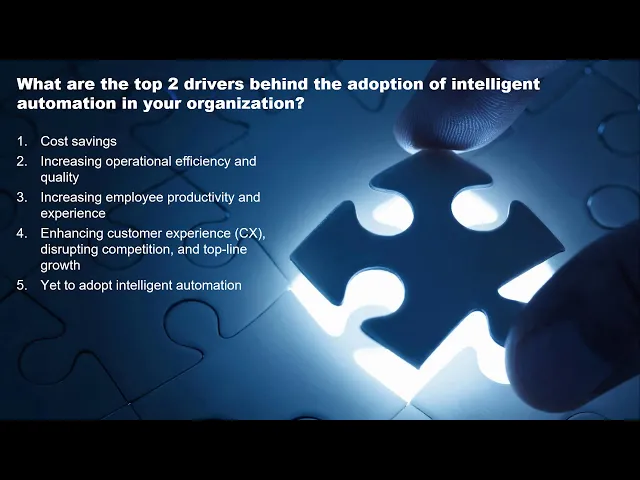
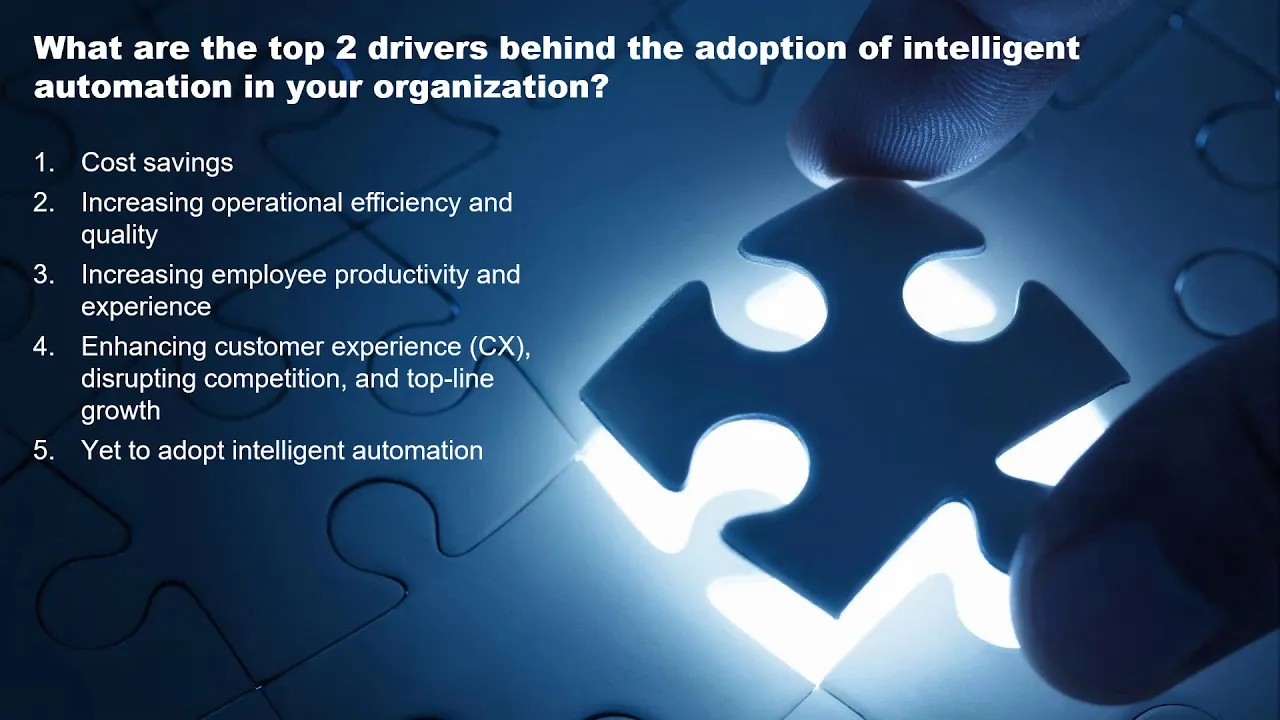
deck we're where clients are now focusing in how this can help their overall customer experience and also improve the the digital transformation agenda too so those are components we're looking forward to seeing more of but the real sweet spot right now is and that operational middle ground so let's do a quick poll here and we want to get your perspective on the drivers between your implementations and your organization's so we've given you five choices one is on cost savings one is around that operational efficiency one's around employee productivity the customer experience and one get-out-of-jail-free card
says yeah and I haven't done it yet so let's look at the results right now and oK we've got just about a third of the people voted okay I'm getting close to 50 okay now we just want to pass 50% and pretty much okay so Peter given another five seconds here all right let's close out the poll here and probably no surprise here that operational efficiency and quality is what you guys are saying as well so certainly a component of cost it's always going to be important but really focusing on that and you know you
know there's there's like an increasing number on that that top level that enhancing the customer experience disrupting competition and top-line so that's that's good to see that one growing as well so Sarah any thoughts on that one yes I think that that is sort of increasing shows the increasing maturity of the market I bet you if we do this next year there the enhancing customer experience and increasing employee productivity will be higher rated as well I think we started with cost savings being very important but it's actually expanding into other drivers now yeah which will
allow the industry to continue to grow as it values there than the industry will grow accordingly let's get into our study here and on the the next slide here what you're going to see is what we call a dot plot slide and on this is represent each dot represents somebody that participated in the study so these are all enterprise comparisons so there's no vendor or service providers in this mix this is all comparing consumers of services and so what we asked a number of questions around capability and you can see five different categories that amar
and I were going to talk about as we go through the deck but those things the scores are aggregated to create a x-axis and on the y-axis we see the outcomes so we're looking at those same things with categories in general our cost operational business impact we've aggregated all those scores and plot those out here now if you go back to your your basic statistics class back in college you could easily imagine a regression line that goes from the bottom left clusters all the dots go into the upper right and what you'll see there is
there's almost no dots in the upper left just there's a straggler that's kind of close up there and that's that's good for an analytical standpoint so what that basically says is if you're you have really basic capabilities you're not going to get the higher level of outcomes and you don't see any dots in the the bottom right either so what we're looking at there is you got folks that if they do it they put additional capabilities they do get proportional amounts of increased outcomes and the goal here in this analysis was to show you the
cause and effect relationship between things you can do to the expected business outcomes you're going to get and so we take all those those scores and then what we're going to do in a lot of this analysis is we're going to show you the comparison for those enterprises in the upper right we label them pinnacle enterprises and those are going to be compared to everybody else so what we under what we want to understand is what those organizations are doing differently and why they get the outcomes they do so okay Maura I'm gonna I'm gonna
you and I are going to go through this and we got our way we're going to present it is in three components the convictions provocations and controversies so the convictions are that we feel very strong amount we believe the data is absolute and there's really not a lot of controversy but we want to show this to you then we're gonna take it down to a series of provocations these are ideas that are what we where we think things are going and and what we see in the marketplace but there may be some interesting other views
that may come in fly here we label them as value creation ideas and then we have some at the very end we have some controversies and these things are I would refer to as emerging hypothesis these are things that Sarah and her team and an NMR and then the rest of the team there are going to be looking at over the next 12 to 24 months to see if those things come to come to pass so with that let's get into the data so the first five of those convictions here I'm not going to go
through them here we're going to take each one section by section and Mars gonna cover a lot of the content that goes behind that so on the first conviction we have enterprises maturity has complete maturity has increased difficulty over the past 18 months and so this is I would referencing we had done a study just about two years ago now and we're gonna compare the results and talk about what's changed so mark sure Michael hi everyone so if you look at this slide so we classify in the legend automation capabilities into five key dimensions and
the change if we compare how the maturity has evolved with the last eight months we see that change is evident across all these automation capability dimensions so in terms of the vision and strategy more enterprises are looking beyond our savings and operational efficiencies to focus on the strategic benefits such as period of some experience top-line growth and shorter time to market for driving diligent automation initiatives on an average the scale of intelligent automation deployments has become three times as large in a span of 18 months almost all enterprises now have an automation center of excellence
and the number of enterprises that have at once to a more mature hub-and-spoke automation center of excellence models almost doubled over the past 18 months and um software technology capability a significantly higher number of enterprises have deployed a I based automation technologies in addition to our appeal and those leveraging ancillary technologies such as the Stratus management or trans Orchestrator analytics and process mining technologies have also increased to more than double the last of not at least automation given a dimension that is current management so on that front we see director prices have been able to
achieve a greater success in upscaling and rescaling their employees due to higher focus and investments in establishing automation training programs and enabling higher employee engagement now I go to the next light what we see is that best-in-class or clinical enterprises are ahead of being other enterprises in terms of scale scope and speed of deployments pinnacle enterprises have over 250 automation use cases and productions is a huge number for an average and about 2.5 times the number of use cases deployed by other enterprises and they have achieved that by deploying automations and in two times faster
pace and by scaling the automation initiatives across a larger number of the dysfunctions within the organization Michael any thoughts on this no I think it's you know it's it's it's indicative what we've been hearing and seeing out there that we get a significant impact in in in the execution side so I think we'll continue to see this some organizations have struggled to to get the you know to keep keep the scale going but I think as we get more mature in our execution these numbers will just only go up yeah okay so the next one
we're going to talk about is the the operational impact so that was something that was the number one on the Quick Poll there we want to show you some of those those those actual numbers that we found from the participants yeah so when we look at this chart we see good news and great news which Michael often talk about when he talks about this light and oil average other enterprises have been able to realize almost of people's an improvement do the intelligent automation of every automation scenario over a wide range of operational metrics such as
reducing cycle time improving a strong productivity and improving prosperity and this is quite a significant improvement in itself and hence good news and the great news is what miracle enterprises have been able to achieve and as we can clearly see they're further ahead with over sixty five percent improvement on average over these operational metrics yeah and I think it's all today yeah I think it's really important on tone you look at that and we talk about good news and great news I love that line on this kind of care kind of research and those are
not insignificant I mean those are dramatic improvements this is now like well a few people figured this out it's largely that that most organizations are able to see this kind of improvement and you know yes or some few people that are doing it better but there's nobody really doing reporting in you know absolute failures or things like that in this and I'm sure there's some projects that don't go quite before what they want to but on a whole we're seeing really good news here so if we moved to the next conversation and Ammar you mentioned
earlier the hub-and-spoke co e i remember what we did did this survey you know just over two years or just about two years ago we talked about you know did you have a co e for automation and now the question is that's not the question any more questions move beyond that yes absolutely and if you look at the next slide I will see that almost all pinnacle enterprises have a hub-and-spoke coa model as compared to on into in about 25 percent of other enterprises and the question has really beyond automation Co e having or not
having automation serious because almost all enterprises are pinnacle enterprises or other enterprises participated in this research so they had a dedicated automation ceiling so if it's really about what is the maturity level of the automation Co is that the enterprise's have and we clearly see that Phenix enterprises are ahead with a more mature hub-and-spoke CEO a model and series of pinnacle enterprises also have a better governance and distribution of roles and responsibilities while the pinnacle enterprises are also ahead in terms of having a robust collaboration between idea operations teams the difference between them and other
enterprises as we can see is not much and this with leaf is a result of increased awareness among enterprises on the importance of ensuring collaboration between ID and operations pinnacle enterprises are ahead and better or define the roles and responsibilities of the automation Co as you can see in the chart below and and this is across the automation lifecycle and then we look at the next slide we see that it's naturally extend to more advanced resourcing and talent management practices all the clinical Enterprise is said that they share and pool resources as compared to a
less than 50 percent of other enterprises and with a hub-and-spoke the only model they're also much ahead of others in terms of following an inclusive approach to automation with organization wide employee engagement and well structure official training programs and this clearly helps with better change management and achieving enterprise scale yeah these are these are some of the differentiated best practices we've seen between the the pinnacle group and the rest of the folks I mean I encourage that anybody that's in you know that's looking at automation is considered these kinds of things to show you a
few more as we go through here but you know big differences and the execution here okay so I'm gonna bring this back to Sarah here to talk a little bit about the overall ecosystem and you know you had a slide at the very beginning we kind of explained here the components let's talk about that in the context of the actual data we saw yes sure well I think this slide really encapsulates the findings very well so first of all the adoption of AI in addition to our PA has increased significantly you know more than four
times adoption of are there capabilities such as process orchestrators and BPM components within you know in conjunction with our peer has also gone up significantly so we talked about organizations wanting to get more out of intelligent automation and investing in a broad set of technologies they're investing in analytics in chatbots versus mining and so on many enterprises have said to me that they've automated a few processes but they don't really know what to do next and that's where this kind of interest in process mining process discovery comes into play they are finding that you know
the data the information that they need in order to identify what to automate next so you they can also optimize their processes which is such an important part of automation at all together so for end-to-end automation you know they don't they don't need robotics alone they need other capabilities intelligent document processing and so on so really it just confirms that we are in the age of intelligent automation yeah Sarah when I look at this slide and you see something where the just in a less than two year period here we go from 17 to 84%
into the you know adoption of AI you know that's that's a huge jump and it's not a few percentage points it's it's a it's a wholesale change and I think that's really coming from - to that angles really is the demand side and the supply side you want to talk a little bit I mean that kind of goes back to your initial conversation how discussed all kind of coming together yes absolutely so the technologies are advancing all the time for example let's take or talk about IV a the intelligent virtual agents they're able to actually
offer more so what we're seeing is the ability to understand some nuances some utterance says more intense the technology vendors are actually pre training some of the IV a for specific capabilities with some awareness of the context within which they're expected to operate so technology is advancing and it's making it easier for it really to be adopted by enterprises well and the vendors themselves are changing - right so you know they're no longer just doing you know one one-trick ponies they're now becoming multidimensional and being able to deliver that whole suite that a whole suite
of think you were talking about and they do it in context of the customer's industry absolutely we're seeing the mergers and acquisitions in this space as you know the vendors try and cover more so initially they were trying some of the RPA vendors we're trying to basically make RPA that was the glue that held everything together but actually the the model is changing and sort of there's almost although there is integration between packages they're not necessarily all coupled together you know it's a bit of a decoupling going on in the market for the want of
a better word but yes absolutely they are expanding into other areas and we will see a lot more of that given what's going on with Microsoft as well with Microsoft flow announcements so it's a very interesting dynamic market at the moment so mark take us a little deeper into some of the technology aspects yeah sure so if you look at the next slide so what we feel that pinnacle enterprises are often in the hunt for experimenting with innovative disruptive technologies and consequently they're ahead and adopting more sophisticated intelligent automation technology is and also leveraging them
effectively for better outcomes for example while other enterprises are not leveraging or leveraging process planning for basic process discovery pinnacle enterprises are looking to leverage them for a profit of optimization there are also much ahead of other consulting solutions integration with advanced the IML LLP kind of capabilities so I mean just relating back to the point that migrants are talking about in terms of maturity in terms of both demand and supply all right fantastic so let's go on to the final conviction here and let's talk about the the robots are coming and they're gonna replace
all the humans and talk to us about what that reality looks like yeah absolutely so what most of the enterprises do not really see insulation automation as a means to reduce headcount right and we found that on average less than 20% of the employees who were impacted due to intelligent automation we're laid off that means more than 80 Bulls and we're really redeployed being skilled or upscale to do high-value work and report the media around massive job losses due to automation are highly exaggerated as we see it when we look at the data actual data
from the enterprise as well actually adopted intelligent automation and and some of these media reports around massive job losses are actually leading to negative sentiments and distractions on the contrary we find that intelligent automation is helping enterprises enhance employees and engagements as well as offer better a better career path and incentives to their employees investing in talent upscaling or if refueling is also becoming unnecessary for enterprises to address the talent needs of the future so if we look at the next slide yeah Ammar before we before we go to the next slide I want to
add there's a lot of questions here and I want to pick up one or two along the way in this relate to the conversation around hub and spokes and you know what's what's the activity do you see in a spokesperson to the hub do you have any ideas on that teach me give us real quick yeah absolutely so of what we feel that the hubs of this kind of a hub and spoke center of excellence models I focused on filtering the use cases and setting their governance rules based on these the all these folks are
the word so these folks what are as basically setup within individual business units or individual geographies which have their own set of specific requirements and they've kind of tweaked some of those governance central hub based on some specific regulatory orthography specific requirements that aren't there or certain limitations that are clear but it's really about collaboration between the house who can accept those principles those governance rules in terms of how the automation use cases are identified and really empower all the spokes with the tools and technologies and the better of best practices to go about identifying
the use cases and delivering automation and these posts really are are the ones who are looking at specific business unit requirements or geography requirements and collaborating effectively with the hub to implement those automation use cases so it's really about bringing collaboration between the hub's which also comprises of IT and business or operation teams working closely with each other and the spokes again pull up consisting of business folks when in those business units or geographies and collaborating with their local IT teams to kind of really implement those best set of best practices that are set by
are the central hub okay thank you and we've got several pages of questions here so keep them coming if we can't get to them along the way we'll try to get them at the end or we'll try to respond back after the the webinar so keep them coming and we'll do our best to answer those as we can all right Automation is no longer so we're moving into the provocations these are things that we're we're still thinking about there may be some controversy here in terms of uh you know where things are going so Marr
talked to us about the the simple rules based tasks and where we're where we think things are going from here and Sara you're gonna join us yeah so I mean if he if he just recall the slide which that I was talking about doing the initial part of the presentation where we see the market a maturing towards intelligent automation I mean moving beyond our RP and kind of going towards intelligent automation I think that's really ties to that with some more data from the study so what we see is that enterprises have started looking beyond
low-hanging fruits which are you know simple would say stop by our clinical enterprises are ahead and have found greater success in automating complex use cases that deliver higher business value pinnacle enterprises are also following an optimized first approach towards automation and what that really means is that they are really looking towards eliminating unnecessary steps from the processes or optimized the processor simplifying re-engineering them or even defining the future states of the processes before going about automating them and as you can see from the data that we have here any kind of process clearly ahead of
other enterprises in terms of calling this kind of automate or optimize first approach but if we if you look at the general market maturity or at an overall level we see that in general enterprises have started to look beyond low-hanging fruit simple rules based arts and I'm looking to optimize or make some changes to the business processes before going about automating them yes I think this is really significant this slide I think it shows that pinnacle enterprises that have achieved considerably more with automation than others have all really prepared well for automation they have made
significant efforts into understanding what they're doing how they're doing it and actually you know it makes a lot of sense to me as well because with process mining for example finding that organizations have hundreds you know hundreds of versions of the same process the way that people do the processes are quite different to each other even when organizations think they have standardize so which version of the process are you going to be automating which is the best one these are the sort of questions that you need to ask and that's why you need to find
out how a process is being conducted being undertaken what is happening and actually is there some way that you could do better for example with robots you can do 24/7 you know you don't have to wait for working as during the day you can do 24/7 operations is it possible to change things so that you get more done during quieter working hours in the you know during the night when that all other times when it's quieter for the enterprise so it's really important to have a review and understand what it is that you're actually automating
all right so let's move on to our next provocation and this one's this one always gets uh gets gets interesting responses because there's always well is this real in terms of savings and you know you know you Michael you talked a little bit earlier about you know the operational excellence of a Mario needs some slides on that but provocation number two is really about show me the money and what's really possible what a client's really reporting in terms of their actual savings and their breakeven points and their return on you know return on investments what
are we really seeing there yeah so I mean it's really great to see the kind of return on investment that enterprises have reported that they're achieving from their intelligent automation programs and this is certainly higher than what they were achieving less than two years ago that there are same deployments so the net of it is that by implementing more AI and other digital limbers as part of their automation initiatives in addition to our PA certainly the pork savings and return on investment has improved now if you look at how pinnacle enterprises compared to other enterprises
there again significantly ahead and achieving one almost 1.5 X the return on investment from their intelligent automation initiatives and hey uh do we lose I think we lost tomorrow there okay all right let me just jump in here so so those savings are real what I wanted to do is actually the next one that I was going to cover that so I'm just going to go ahead and take it from there so I um tomorrow we got you back here yeah I'm sorry for the new function um we were just saying that if you go
back to a previous slide so they're not only able to achieve greater return on investment but they also break event faster then comes in the prices average in about foot box and just coming back to the level of cost savings and the use cases it's a bit provocated to see that vinegar enterprises have been able to achieve an average 60% savings from other intelligent automation initiatives over you know pre automation scenario alright great so don't let's move on to the last conversation we have here and and that's really the one that I look at and
saying you know how what's the the overall potential for this in terms of the business impact so we've talked about cost savings we talked about the operational improvements but can we really go beyond that and is this really gonna make a difference at the c-suite and so on the next slide what we've done here is really start to pull forward some of those conversations and and so let me let me start us off here and in just the way we've got that set up yours these are the things that people were we asked to to
stack rank in terms of it improvement and so are you seeing improving employee experience improving customer experience top-line growth new business models and reducing time to market so that's the order that they that people responded but what's important here is in the last version of the study we did just just about two years ago there was literally almost nobody responding to any of these things in this context okay so they were getting the operational pre once they were getting some cost savings but they weren't seeing much strategic impact and so what we're seeing now is
the pinnacle enterprises are starting to report on more of those case studies and Sarah you had some case studies that you wanted to talk about here that that really kind of Illustrated what what the potential is yes certainly so I think in terms of employee experience you know we we are at the beginnings of enabling employees to do more automation for themselves so we're seeing that the BIA at the beginning of that journey and of course the kind of examples that we are seeing you know there's an example of a lady who had a five-hour
process that she had to do fairly frequently and he took something like 300 clicks and her organization actually ran a program where they trained there as their staff to automate their own processes and she did this and she's now able to run it in a matter of a few minutes so obviously freeing up her time and it was a very tedious process by all accounts as well but this whole idea of having chat BOTS for example doing some of this sort of first line of support for staff as well when it comes to IT for
example or HR inquiries it's all about speeding up improving employee's experience the in terms of day to day work you know being able to help agents for example know what's the best answer to give provide guidance and policy as a call is going on for example in a contact center or even for employees actually identifying you know where the expertise might lie in as something that is possible through collaboration Suites and so on combined with these kinds of intelligent solutions I think is really important improving customer experience of course has led to a lot of
this development where because of this sort of contact center agents origins of RDA and so on it's always been top of the mind but we are getting some phenomenal results now we're hearing some amazing things like banks that have managed to reduce their customer onboarding from two weeks to a matter of you know 10 15 minutes of 15 days to 15 minutes we're also hearing about things like adverse media searchers being significantly reduced in the time that they take there's one example of a bank in North America that has reduced false positives by ninety five
percent and is making savings of about fifteen million what that translates is fast their onboarding of customers again so I hope these sort of illustrate the kind of things that organizations can do no I think they do a great job in it and you have it you have more depth on those conversations if you want to reach out to us later we can certainly help you with some of those more those more positive examples of how customers are taking this to the next level so all right let's wrap up on the the data part and
we'll move into Q&A here in just a second but let's let's let's take the kind of to the next looking forward conversation so what are the controversies that we're looking at here and and Sarah do you want to start off with the first one in terms of how this markets kind of going to evolve yeah there's a lot terms of you know just a few years ago we were looking at you know five to ten vendors in this space and what was that just like three years ago four years ago something like that yeah yeah
the numbers were mm-hmm oh I think overall there are around 60 70 vendors you know we we we are tracking a good proportion of those but the thing is that there's a lot of some there is some mergers and acquisition activity going on you know we know about for example at P an acquiring judoka not long ago and the RP a vendors also no longer want to be one-trick ponies so they are expanding either through developing their own additional capability is such as you know blue prism developing its intelligent document processing capabilities and then we
have some of them acquiring companies like uipath acquired process gold and so on so there's a lot of activity going on and of course the bigger companies were now starting to take note si P some time ago made an acquisition in this space Microsoft has just made a series of announcements as well so it's actually changing so it is evolving it's changing and I think the capability our PA will be here to stay because it's it's a kid it's something that every organization can use but it is evolving quite fast okay yeah I think that's
something you you and your team are constantly updating the information you provide to clients and I know it's a it's an it it's no longer about just incrementally changing things you're constantly having to change the landscape and actually show new landscapes of the vendor community still yeah so the second one here would tomorrow I'm gonna ask you this one would it make sense to deploy a robot for every employee I know you're I know we've talked about that will a benefit hurt the automation journey this is an interesting one because what we're seeing is enterprises
when at least some of them have started experimenting with this vision of robot for a real boy and what we see is that this is more like a effect that they have put in terms of the investments that we have made in this duration and we are hoping to get benefit or experience enjoy productivity and those benefits coming in force of time not necessarily a short of bead so that's what that's why I can't come Sunday one of the themes that we are really investigating on the we believe that in the in the next 12
to 18 months period we will will get more information around what kind of benefits enterprise have been able to realize from their investments in this direction now it could very well benefit them in terms of improve employee engagement productivity and possibly the culture that kind of feeling braces innovation or it could also Hardy journey and it turns off this investments non appearing the kind of fruits that we had in mind when we made the investment ok great and you know but the last one we have here and up I'll start this one let you guys
chime in on this a robot sure and reduce the need for off outsourcing and offshoring so I think there is going to be an impact on the overall service provider services organization whether it be through a shared services or through an outside provider I think there will be an impact here so we don't see like a wholesale hey the robots are coming and they're gonna take over everybody's job but they will have an impact in some of the very transactional workforces and if some of those things happen to be offshore or outsource those may be
the ones that we see the most impact toward the actual overall human human robot equation if you will are that the the software wouldn't live there so I think robots showing is something we're gonna pay a bunch of attention to as we go forward here and I don't know if it's that will the enterprise's prefer to work with an automation platform provider versus a traditional providers went out to sea but they're certainly going to be a kind of a tug of war there and Sarah I don't know if you if you you see that tug
of war right now or not yes the guess is definitely to some extent absolutely yes I think what we'll see is that robot shoring will chip away at some of the market but the service providers will also do their own thing in that they will develop more automation capabilities they will offer more automated services and so yes that will just continue in that in that way so we'll continue to look at that as a team not only with Sarah's team but also across the the rest of our research organization so all right so that concludes
the the actual presentation we want to open up to questions and I've got a whole bunch of them lined up here I'm gonna I'm gonna take a few Sarah if you want to grab a few certainly take a tip your choices on there I'm gonna the first one I'm going to do is how do you think cope in nineteen will impact the automation journey of various enterprises and so the good news is we actually have I'm gonna sound like we're promoting promoting a future webinar here which I am in a Peter can put the link
to that in the in the chat there we actually are going to be talking about that probably in about a 10 day period I think it's the 24th is we have that webinar set up for and there's a link there you can register for that we want to we want to talk about the the impact of what we're seeing here beyond the hand sanitizer moment so I think we all know we should be using hand sanitizer and some of the basics there but we want to get beyond that what does that mean for organization so
hopefully you can join us there to answer your question directly in this context I think it will drive more people to automation as we look for hey how do we you know find those areas that we don't have to be so labor-intensive there will be some once we get past the panic part of the the cycle there will be opportunities for people to look at and say hey we need to have more redundancy we need to have more documentation of our processes and that automatically leads to to a level of potential opportunities here for the
automation dialog that there's one I can take Michael which is the improvement in operation metrics of pinnacle enterprise in respect to others is it due to the higher number of implementations only no that definitely hell helps because you know the more use the more benefits you can achieve because you learn and you improve the way that you implement as well as of course multiply the benefits but it's the whole approach that pinnacle enterprises are taking this kind of you know where they have reviewed their processes they have visualized what they might look like in future
they have optimized their processes before automating them the way that they've gone about working with the rest of the enterprise bringing people on board helping them understand the benefits ace the whole approach towards adopting automation and implementing it on a large scale that is helping with that there's another question here what kind of work is done in process mining Marcel you want to talk to so we see three broad level use cases are being targeted using process mining technologies the first use case is a long process discolor or are discovering the process models of the
of the various business processes in the organization and the way some of these processes of mining technology is volunteers is heavily focused on leveraging he logs from the IT systems so it's really about leveraging those laws to discover the business processes and with any process Lorenz the second use cases around process conformance and that is a more to do with how the actual business processes the Discworld processes and align to are the the ideal a business process as defined by the organization and if there are gaps where those gaps are and this kind of naturally
extends to the cold case of process mining which is providing crosses intelligence and analytics around what are in which those gaps could be overcome or just providing more information around the gaps or automation opportunities or optimization opportunities how the processes are being run in X Y the geography versus other geography and identifying why it is taking more time and something that in some other geography has compared to you know let's say us and kind of getting to the bottom of it or root cause analysis around those gaps or just providing a lot more analytics and
insights around how it can be done in a better way and this is where we see law of process mining technology vendors investing heavily in terms of providing more interesting and useful insights to the businesses and the way they are doing it is also by leveraging artificial intelligence to do more predictive and prescriptive analytics fantastic all right so let's wrap up right now and what I want to do is point to an offer that we we have here and this is for enterprises those that are that are buyers of services and you know I've got
a number of questions here and then in the that you've already submitted and we'll certainly try to try to answer those but if you've got a question you want to set up a briefing with with Sara or tomorrow or any of the the analysts on their team's happy to get that set up you can reach out to us in three ways one is there's a link in the the chat room right now you can click on that and they'll take you to a landing page to make that request you can email Sarah or Maura myself
on the emails on the next slide here or you can at the end there will be a post webinar survey you can click the box there and that'll also trigger a response to us to reach out to you so happy to do so wanted to thank you for your attendance today and this is an exciting topic I am sure we will be doing this study again in your later this year or early next year and I can't wait to see the results and see how we've improved but don't don't wait till then if you have
questions please please reach out to us and we'd be happy to help thank you to Michael Cera and amar and thank you everyone for attending today's webinar again you will receive a follow-up email within one to two business days with a link to download the presentation slides along with accessing B on-demand playback of today's live session on behalf of Everest group and our presenters thank you for joining us today and have a great rest of your day