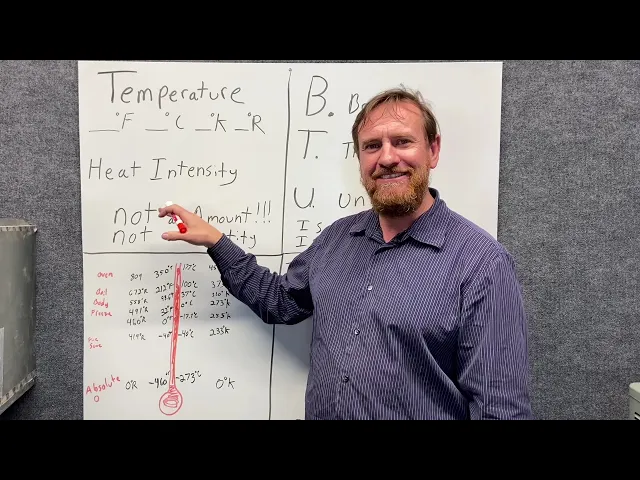
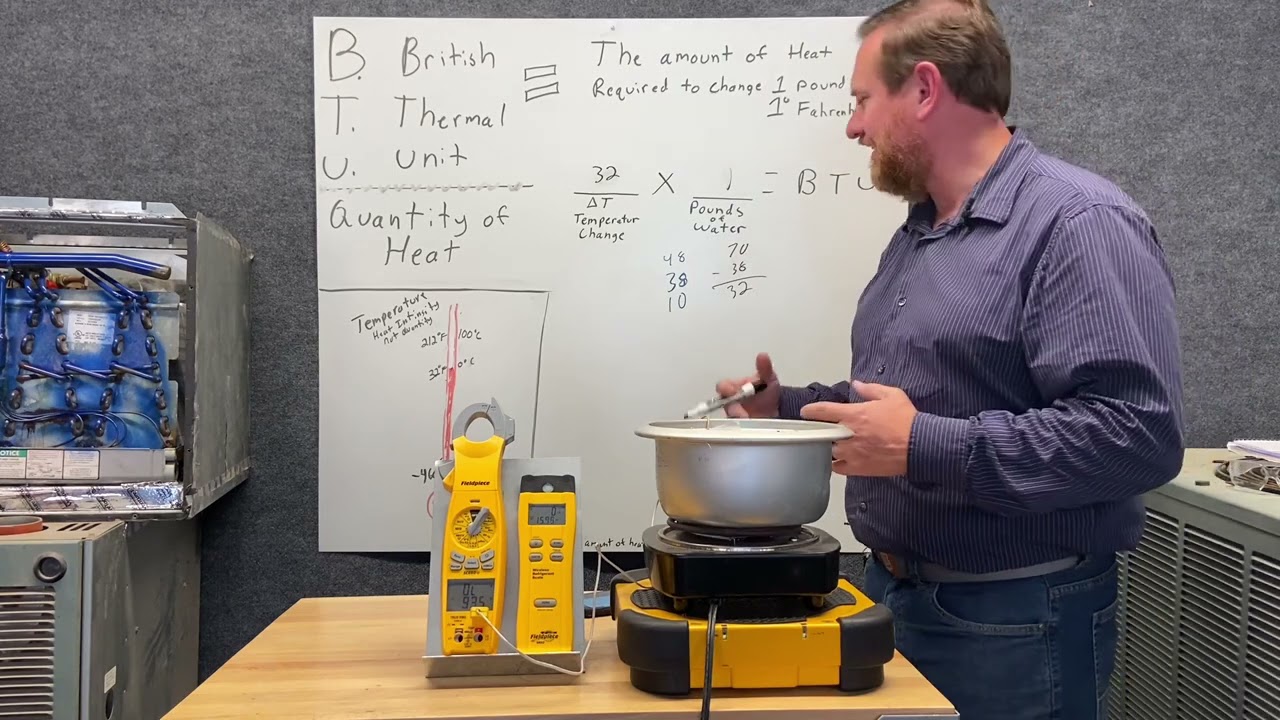
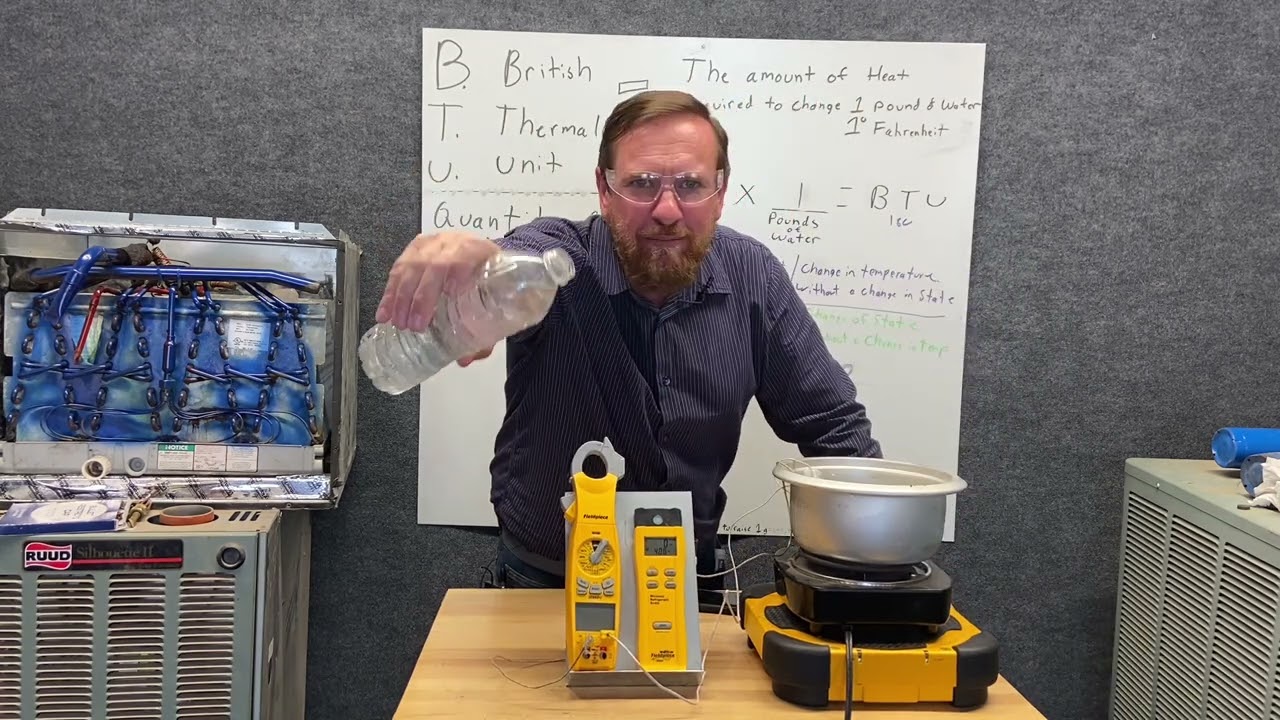
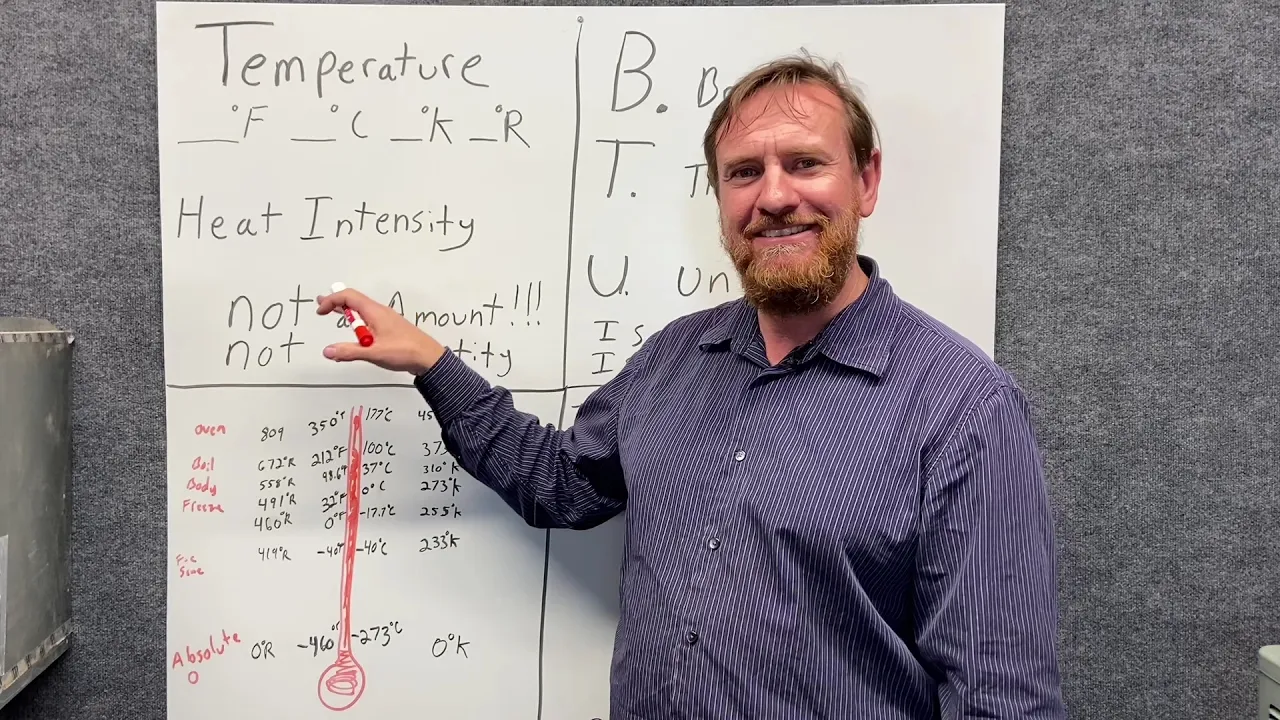
when we talk about heat most people think in temperature or fahrenheit but temperature isn't an actual measurement of heat it's heat intensity it's not an amount of heat and it's not a quantity of heat like gets a lot of people a little confused so let's give you a little demonstration let's say that we have two containers and you gotta bear with me pretend that this is full i'm weak i can't hold a full jug with one hand i have this at 70 degrees and this was full at 70 degrees there would be more heat energy in this both at the same temperature now that may be confusing to you let's think about it this way let's say that this is in a metal container and we put it on the stove and on the same stove in another burner same size burner we put this cup and a metal container on the stove which would heat to the next temperature faster if i want to say raise it to 71 degrees would this raise the 700 degrees first or would this raise the 71 degrees first putting the same amount of heat into it well obviously this is going to heat up first because it's a lower quantity so even though we got both of these at the same temperature it's going to take more energy to raise the temperature of this because there's going to be more heat energy in this so we've got to be thinking about quantity so temperature when you talk about 70 degrees or 80 degrees whatever temperature it is that's something that has meaning to you as meaning to me we grew up with a temperature it has some relevance so that's why we use temperature a lot but it doesn't tell us a quantity now let's look at another thing let's talk about a thermometer so if we have a thermometer in it the old thermometers we had mercury and mercury we talked about mercury rising well really what it has to do is also energy as the heat energy or the intensity adds to this thermometer the temperature goes up the molecules in this liquid start to move faster and they start moving faster they start spreading apart and they spread apart it expands in short you put heat on most things they expand we add heat to mercury the mercury expands out of the bulb and pushes up higher on the thermometer in this case right now it's a little above 60 degrees fahrenheit on this thermometer now now that we understand that concept let's apply this a little bit more and go a little more in depth we're going to have our thermometer right here and let's say that we're at the very lowest points ludicrous always asks how low can you go absolute zero that's how low you can go absolute zero on any one of our scales right here absolute zero is zero degrees rankin minus 460 degrees fahrenheit minus 273 degrees celsius and 0 degrees kelvin that's all the exact same numbers those numbers have a different number but it's all the same points that's the same thing we talked before about energy and atoms and molecules and everything's in motion all the time well at absolute zero everything stops it looks like this board's solid but it's really moving right now there's energy in it what's cool is most gases will actually turn to a solid at this point there's no energy at all absolute zero that's only been found on one place on earth and that's my ex-wife's heart above that everything else is heat so we're going to do is add heat energy and see what happens the next point i put on here if we add heat energy and the mercury starts to rise is actually negative 40 degrees fahrenheit negative 40 degrees fahrenheit is the same as negative 40 degrees celsius it's the only point that i know of that fahrenheit and celsius are the exact same number so it's kind of cool a little trivia question somebody may ask you but that number also means 419 degrees rankin also 233 degrees kelvin same exact number so let's add a little bit more heat energy let's raise it up to zero degrees fahrenheit a lot of people can imagine the weather in some places unfortunately gets to zero degrees fahrenheit but there's still 460 degrees of heat available the rankin scale is an absolute scale similar to fahrenheit and at 460 degrees rankin is the same thing at zero degrees fahrenheit it also means negative 217. 7 degrees celsius and 255 degrees kelvin but if we add even more heat energy and the mercury rise a little bit higher we get to 32 now this is a more important number 32 degrees fahrenheit is when water starts to freeze change state from a liquid to a solid or from a solid to liquid depending if you're adding heat or taking heat away 32 degrees fahrenheit is also zero degrees celsius so if you're in the other part of the world everybody knows that water freezes at zero degrees celsius in america they always know that water freezes at 32 degrees fahrenheit that is the exact same number now we can convert that to rankin which i don't know that anybody uses ranking anymore honestly but ranking would be 491 degrees rankin and kelvin which is the scientific absolute scale is 273 degrees kelvin if we continue to add heat the next number i've put in the list is our body heat temperature and fahrenheit it's 98. 6 degrees fahrenheit and in celsius it's 37 degrees celsius i've kind of rounded some numbers but 37 degrees celsius is our body temperature now this is important because anything warmer than my body temperature heat is going to be coming into my body so i'm going to feel significantly warm anything lower than my body temperature heat can actually leave my body so i'll start to be cooling off now there's some differences in that depends what you eat your body's always creating more heat energy and it also depends on how fast you can transfer heat we're going to talk about more about that later but now let's continue to raise our heat energy level up our intensity level up and we get to 212 degrees fahrenheit water is going to start boiling at 212.
it's going to start changing state at 212. we're going to talk about that number later so keep in mind 32 fahrenheit and 212 fahrenheit is the same zero degrees celsius and 100 degrees celsius are very important numbers at 100 degrees celsius and 200 degrees fahrenheit water is boiling it's a very important we're going to come back to that later now if we wanted to put that in rankin that's 672 degrees ranking and that same exact boiling temperature is 373 degrees kelvin now put one more number on here i've put up here the typical oven temperature 350 degrees fahrenheit and 177 degrees celsius that would be 809 degrees rankine and 450 degrees kelvin now this number can go on and on and on and up we get the number of the temperature that water will actually steam will turn into a different substance we get the temperature of stars there's all kinds of numbers that go up and up and up through the scale i'm just wanting you to realize that all these different numbers are the same point for example in the u.