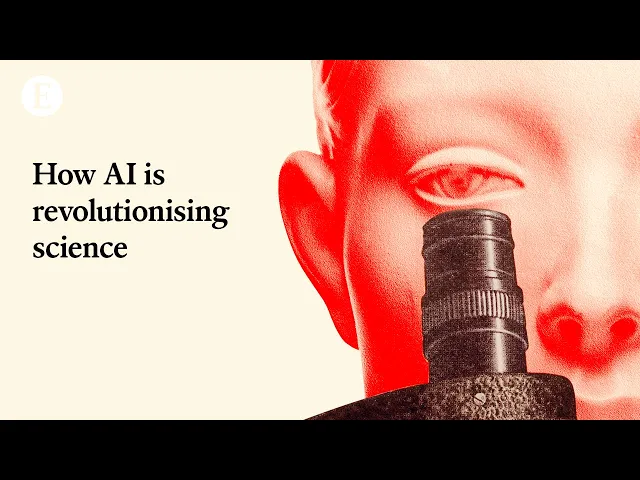
Is this the scientist of the future? AI is driving a transformation across all fields of science Researchers have used AI to translate brain scans into text promising to change how it’s done and turbocharge research We are at the start of a really important journey It could help to tackle some of the world’s most complex problems It’s hoped artificial intelligence will lead to breakthrough drug discoveries Despite challenges and anxieties You’re really delving into the unknown Remember those early days when people were criticising? could AI prompt a new golden age of scientific discovery? This is Bear Bear
is my Siberian husky Ten years old now, but I can’t walk him anymore He’s too strong Come here Bear In 2022 Andy Davies, a former soldier in the British Army, was referred to hospital after suffering a persistent cough for several years His doctor diagnosed him with idiopathic pulmonary fibrosis, or IPF, a lung condition in which the lungs become scarred and breathing becomes increasingly difficult Thank you I should have like, seven-and-a-half litre capacity lungs I’m down to about 4.6 litres, so I look fine, but I’m not fine My lungs are getting smaller, the scarring is progressing
and they will in time, slowly suffocate me There’s nothing they can do for me bar the hope of a double lung transplant Ever since Andy has been trying to raise awareness about IPF and what it’s like to live with the condition This is going to be my bedroom We’re going to have a shower in here Hopefully I’m not going to need it just yet but getting up and down the stairs is getting more and more difficult With no cure available, the outlook for people with IPF often feels bleak Half of patients die within five years
of diagnosis My mental health hit absolute rock bottom I started planning my funeral I started picking my funeral songs I started doing all the things that I didn’t want other people to worry about doing I could have an exacerbation tomorrow, the scarring could progress, and I could end up on full-time oxygen sat in the chair and that is the long and short of it And that happens It happens all the time to people with this awful disease Fortunately, all may not be lost for those suffering from IPF Today there’s hope from a technology that’s disrupting
the world generative AI These algorithms are now being used to develop new drugs for diseases that are right now incurable Alex Zhavoronkov runs a startup called Insilico Medicine, which in 2020 used AI to find a new treatment for idiopathic pulmonary fibrosis We utilise generative AI to identify targets for proteins that are implicated in age-related diseases and fibrotic diseases Insilico has created several AI pharmaceutical platforms One identifies the proteins in the body that might be targeted to influence the course of a disease Another can design potential new drug molecules Instead of searching for a needle in
the haystack we can generate perfect needles with the desired properties Insilico’s IPF drug is now in phase two clinical trials, which means it’s currently being tested on patients with the condition It took just 18 months and only cost $3m to develop That’s a fraction of the time and money normally spent Using AI in the pre-clinical stage of drug development could bring a time and cost saving of 25-50% AI is also turbocharging aspects of biological research that have traditionally taken human scientists years A type of AI known as deep learning is powering Google DeepMind’s AlphaFold This
is an algorithm that can predict the shape of a protein from its amino acid sequence It’s not perfect Sometimes the shapes it predicts are wrong But AlphaFold has built up a database of more than 200m proteins and has been used by more than 2m researchers according to Google DeepMind The efficiencies of cost and time on offer through AI have attracted Big Pharma, particularly in China, where investment in AI drug discovery topped $1.26bn in 2021 Drug discovery is open to many more players that are willing to bet a significant amount of capital So this democratisation, I
think, will lead to many more new therapeutics AI has been part of the scientific toolkit since the 1960s Now here’s a man playing draughts and his opponent a multi-million dollar computer For many decades it was limited to fields like mathematics or particle physics But in recent years the use of AI across all fields of science has exploded Lots of graduates in engineering, in sciences are familiar with AI techniques and it’s easier and easier to use them This change has empowered different kinds of AI to accelerate research in numerous fields of science At the University of
Cambridge Emily Shuckburgh is a professor of mathematics who specialises in using AI to improve climate science The advances in our scientific understanding are currently not just incremental, which often they are, but really leaps and bounds because of AI because it is enabling us to look at the problem in a different way Super-resolution AI models can enhance low-res electron microscope images, transforming images from this to this, while a method called literature-based discovery uses AI to search through millions of research papers to find patterns and connections and then suggests new hypotheses for scientists to investigate It can
even matchmake collaborators from different fields And as well as new drug molecules AI algorithms are helping to search for new materials for batteries and solar panels, improve weather prediction and transform our understanding of the mysteries of animal communication Here at the University of Tel Aviv Adi Rachum and her colleagues are using AI in their very own bat lab Welcome to my colony These Egyptian fruit bats are recorded 24/7 to try and understand how they communicate with each other As you can see the colony was designed to mimic a cave as much as possible So the
noises that they were making is because they were rearranging This is part of what we’re trying to learn using the communication, using the vocalisation The team uses an AI algorithm to link the calls with different behaviour patterns So I’m watching a movie and I want to see what the bats are doing when they emit specific sounds AI helps the scientists to understand much more about what these individual sounds might mean In this case I can see they’re fighting but the fighting is over food It’s not just a random fight In the next movie we can
see that their communication is regarding mating They found that some aspects of bat communication are closer to human speech than previously thought The bats have their own dialects and the mother bats even use baby-talk, when communicating with their young Other scientists studying animal communication have used AI to spot regional accents among wolves and taken the first step towards decoding the sounds made by sperm whales However, some are sceptical about whether researchers in these fields will ever be able to record a representative range of sounds without introducing human bias into the data set It’s a potential
pitfall Adi is conscious of It is always going to be human interpretation when we’re talking about behaviour with animals But that’s why we have a lot of recordings to try to be as accurate as possible With all its promise to do good for science AI could also end up accelerating the bad Fraudulent research has been under the microscope recently Analysis suggests that AI fakery in scientific journals is on the rise Some researchers have even been caught out after accidentally copying and pasting the phrase “regenerate response” into their papers That’s the ChatGPT button you’d press to
make it rewrite its latest answer Other data detectives have spotted the telltale appearance of AI-generated gobbledygook in journals It’s the same tune and yet it’s different Big data is replaced by colossal information Random value is swapped for irregular esteem and artificial intelligence becomes counterfeit consciousness Experts have identified more than a thousand papers that seem to have identical, AI-produced images even though they were submitted by different labs The absolute central pillar of the scientific world is publishing, and in a sense it’s how the body of scientific understanding is built upon over time There’s obviously a role
that it plays in the way in which you’re judged as an individual scientist and consequently it’s also an area where there’s always concern as to whether or not there’s an opportunity for fraud to enter into that But like so many of the drawbacks we hear about AI, these are problems with us humans, not the machines Many scientists are optimistic and believe in the promise of a golden era of scientific discovery, one where AI not only turbocharges research but also transforms the scientific process itself This robot at the University of Liverpool in Britain may look a
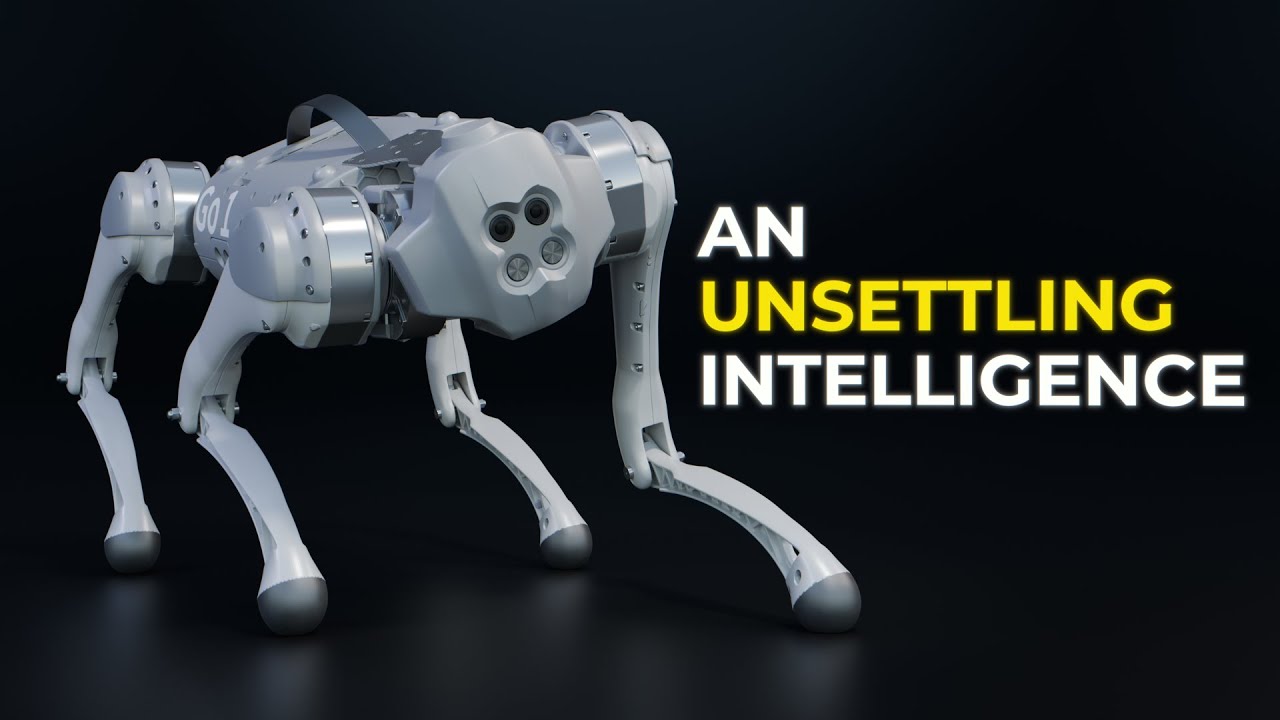
tad unassuming but it could be a glimpse into that future In 2020 Andy Cooper decided to introduce some machine-learning muscle into his chemistry lab We became aware of this rise of the use of mobile robots in other sectors such as automotive manufacture, warehouses and so on So we decided, well rather than automate the instruments, we’ll automate the chemist What he landed on was a roving robot, one that would navigate the lab by touch sensors and light-detection and ranging LIDAR Guided by AI this robot scientist uses the test results of one experiment to decide what to
do next The robot did something like 700 experiments in this eight-day campaign, and to reference that to a human chemist I’ve had PhD students previously working in the area of photo-catalysis and they wouldn’t have done that many photocatalytic experiments in a whole four-year PhD Last year, Andy’s team focused on giving the robot scientist more sophisticated AI to test for new materials for clean energy production Or as the team called it, putting a brain into the robot We’re now beginning to look at the use of large language models, ChatGPT and other models, to encode the space
or to describe the space That’s the first challenge The second challenge is to build in any kind of reasoning And now there’s a double act We have two mobile robots here This one is configured to do organic chemistry relevant to pharmaceuticals and the second one is configured to do catalysis research in the area of clean energy You can imagine this scenario in a large pharmaceutical lab where you have 50 fume cupboards, 20 different instruments We wanted to show that you could have a team of mobile robots that might be deployed in a much larger lab
Unlike their human counterparts robots can work 24/7 Well, at least until they need to recharge their batteries As a result, robot scientists or self-driving labs, like these, could ultimately make science more productive And they could also help with what’s known as the reproducibility crisis There isn’t much kudos in repeating work that’s already been done or publishing failures so human scientists tend to dodge doing this AI not only doesn’t suffer those hang-ups, but also promises an ability to think outside the box I think ultimately the core idea is to find chemistry that helps humanity I think
the sort of breakthrough moment, which I would say hasn’t quite happened yet, is when one of these systems finds something and people say that simply couldn’t realistically have been conceived by humans alone Lots of technologies through history have been hailed as the answer to the problems of humankind, and usually nothing lives up to such a billing In the 1850s the electric telegraph was expected to usher in world peace by bringing countries closer together, while pundits in the 1990s said the internet would reduce inequality by making a first-class education available online But there are stronger grounds
to believe that AI could indeed deliver something huge for scientific research A new golden age of discovery, perhaps Something like the one kickstarted by the scientific journal or the introduction of the laboratory However, for AI to truly realise its full potential scientists have to be willing and able to use it on a much broader scale You need to have the right data You need to have the right regulation You need to monetise it correctly AI technologies move so very fast but all these other aspects which require human intervention and human decision-making is something that needs
to be really prioritised Overcome these human obstacles and AI could change science and the world for the better We’re entering this beautiful space where AI and sciences can really create something novel and new Hello, I’m Alok Jha science and technology editor at The Economist If you’d like to read more about AI’s impact on science, then click on the link opposite And if you’d like to watch more of our Now&Next series, click on the other link Thanks for watching, and please don’t forget to subscribe!