in January of 1860 a German physicist named Gustav kirkov published a paper in which he coined a new term the black body defined as a perfect absorber and emitter of light along with this new theoretical term came a curve which represented its emission power as an unknown function of wavelength and temperature over the next few years many physicists would interpret this graph and derive new relationships from it in 1879 Austrian physicist Yosef Stefon looked at prior experiments done by Irish physicist John Tindle which measured infrared emission of light along with temperature of radiating Platinum filaments
Stefon noticed that as the temperature of the Platinum increased by 1. 1846 times from 798 de Kelvin to 1,473 De Kelvin the intensity of the radiation increased by 11 seven times which happened to be approximately 1.84 6 raised to the fourth power from this Stefon postulated this relationship in which the intensity of light from an emitter is proportional to the fourth power of its temperature 5 years later Stefan's doctoral student lewick boltzman published a derivation of his mentor's relationship and the two Share Credit for what is now known as the Stefon boltzman law despite this
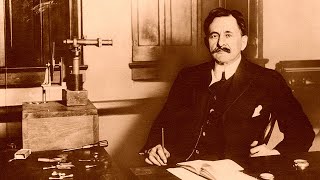
black body radiation was making very slow progress after 24 years the few things that were known was the Stefon boltzman law and that emissive power was some unknown function of wavelength and temperature almost another decade would pass before studies in black body radiation would make another significant leap and would be at the hands of another German physicist by the name of villum Van V's life did not start on a path to physics from an early age he seemed destined to be a farmer following in the footsteps of his father Carl however an economic crisis turned
him away from his life on the farm and towards academics he bounced around universities until finally settling at the University of Berlin here he worked in the lab of Hermon Von helmholtz who he got to spend a semester with despite intense family struggles and losing the family Farmland he received his doctor in 1886 with a thesis on defraction of light on metals and on the influence of materials on the color of refracted light after his Doctorate he remained at the lab of helmholtz after helmoltz moved elsewhere and it was here in 1893 when he made
his first significant contribution to black body curves the first relationship V discovered is known as V's scaling law and was obtained through a thought experiment in thermodynam Dynamics he considered an expanding chamber with light inside it this chamber is expanding in a way that is considered adiabatic which means that heat does not enter or leave the system using knowledge of adiabatic processes and of the doler effect along with Concepts such as the fundamental thermodynamic relation and the Stefon boltzman law he derived a relationship between the energy density of the light and the frequency and temperature
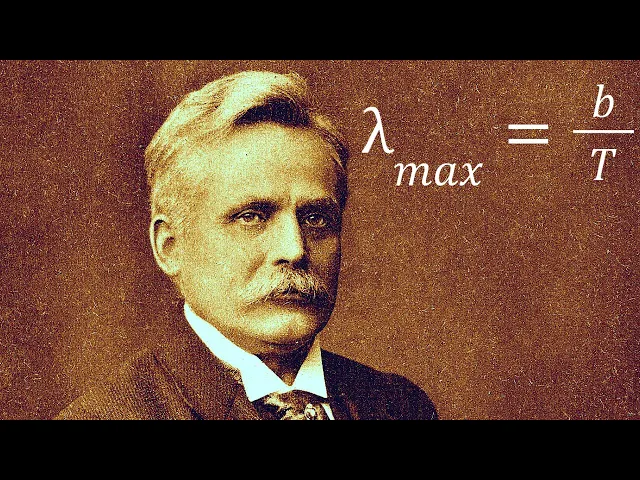
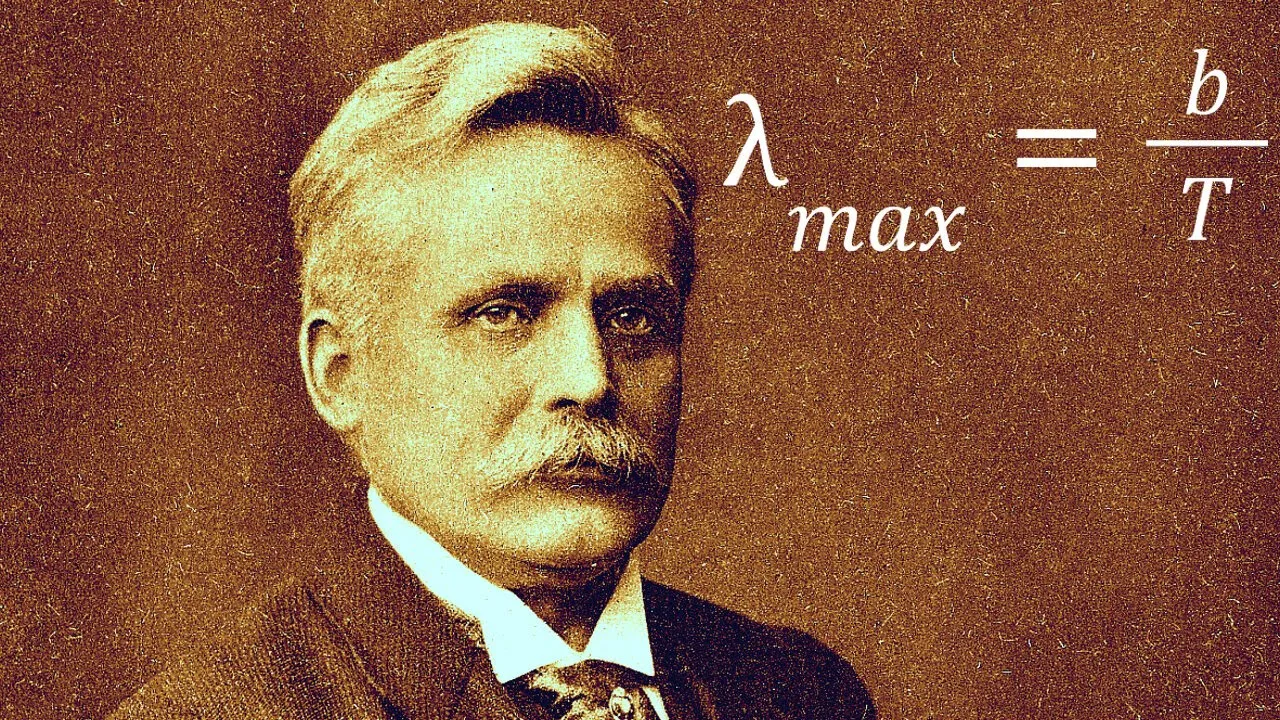
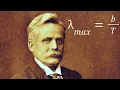
of the light this is V's scaling law and V used this to then derive a simplified form of cure covs function take its derivative with respect to wavelength and set it equal to zero to find the maximum wavelength for the energy density function the result of this was a differential equation that has only one physical solution which is what we know today as V's displacement law this law states that Peak wavelength for a black body is inversely proportional to the temperature of that black body and that if V's constant is known then any Peak wavelength
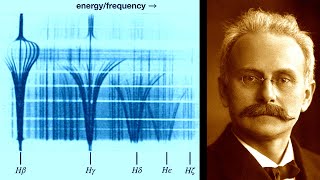
can be found for any temperature of any black body 3 years later in 1896 V published another paper attempting to model kovs energy density function in its entirety in what is now known as V's approximation he did come close to an accurate model but his function deviated from experimental data at larger wavelengths and higher temperatures as discovered in 1899 through more experiments on black body radiation the black body function wouldn't be accurately modeled until Max plunk dropped a bombshell on the physics world in 1900 by abandoning classical Theory and proposing energy as being distributed in
discrete packets Plank's equation along with matching the experimental data may have refuted and replaced V's approximation but it did however verify V's scaling law and V's displacement law V ended up being an integral part of the development of the black Body Curve and won the Nobel Prize in physics in 1911 for his contribution to the topic V's work after black body radiation lied in experiments with anode Rays where he developed the van filter a device utilizing perpendicular electric and magnetic fields to deflect particles depending on their speed in doing this he helped lay the foundations
of Mass spectrometry from studying anode Rays he also found positively charged particles in a similar manner to how Thompson discovered the electron but due to the fact that each particle had differing Mass to charge ratios the positively charged particles couldn't be given a specific label it wasn't until Rutherford's later experiments in 1919 that the proton would officially be discovered and coined V's work in anoid Ray further solidified his legacy in physics leaving his Mark in more than one field of study Venus remembered today not only as one who laid the foundations for a new scientific
technique but also as one who significantly Advanced our understanding of radiation and served as a stepping stone to the foundation of quantum theory if you enjoyed this video please consider liking and subscribing click here if you want to see more scientific progress made during this time period period thank you for watching and I will see you in the next video