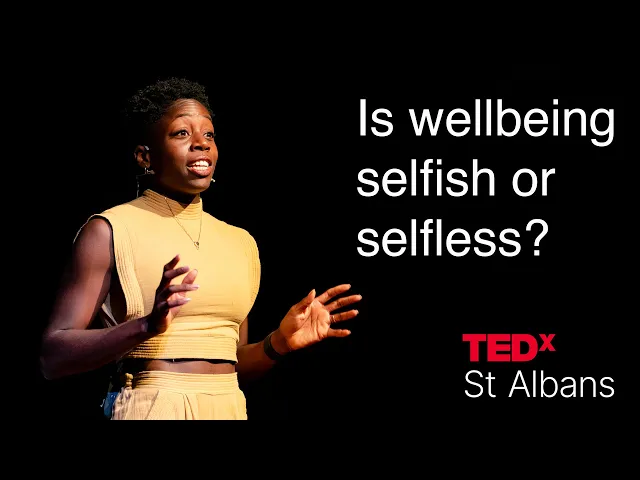
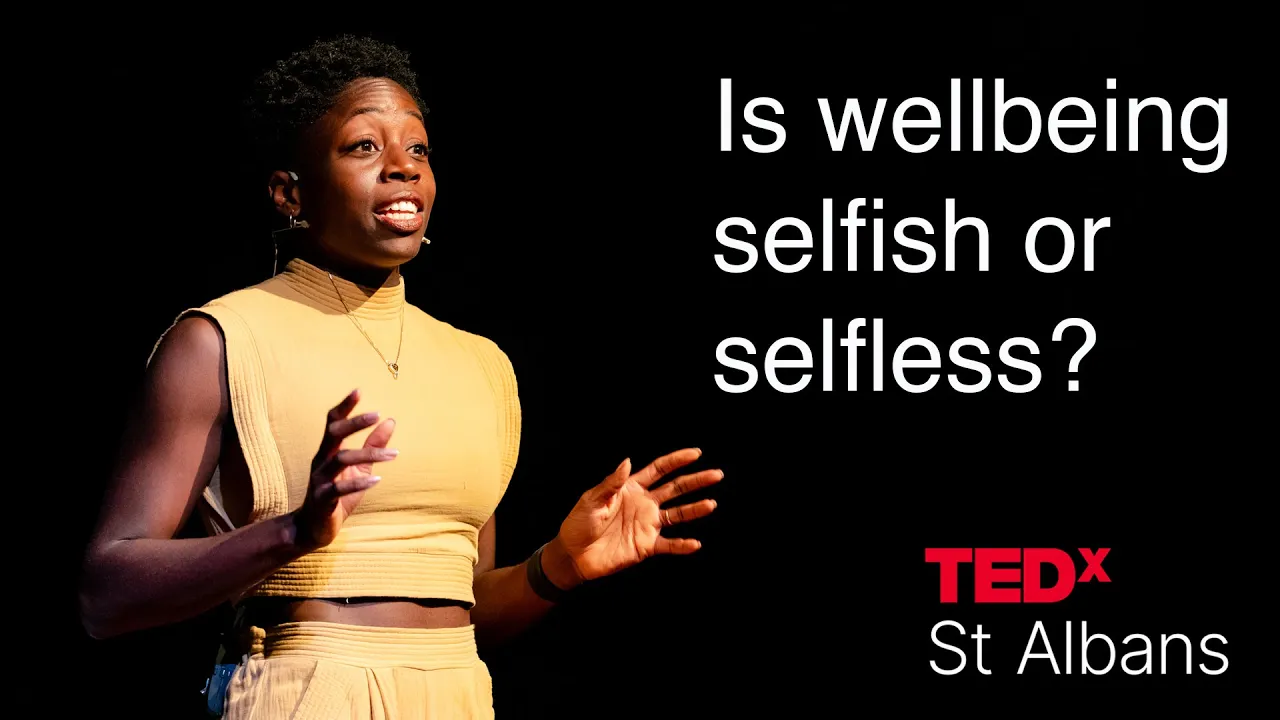
Transcriber: Flor Moreyra Reviewer: Walaa Mohammed I am a lot more selfish than I used to be, especially since the pandemic. But. Is that a bad thing?
I'm going to share with you today why it's not. I'm a national athlete and triple jumper, a business owner, and I'm very ambitious. When I asked people to describe me, one of their top three words is always driven.
How many of you have noticed? And I'd like those who can to raise their hand here. How many of you have noticed there has been a lot of talk about wellbeing over the past few years?
As you may have noticed, more businesses have integrated well-being into their strategies. And according to the Global Wellness Institute, wellness itself, which includes health, nutrition, fitness and sleep, is worth up to £2. 8 trillion worldwide.
So with all this talk of wellbeing, with all the self-help books and audio books, organisational strategies and focus on work-life balance. You'd expect we'd all be getting along just great, right? Wrong.
It is estimated that 1 in 6 adults still report what is termed as a common mental health disorder, such as anxiety, depression, or stress, and when considering black and black British women in the UK, this number rises to almost 1 in 3 experiencing these mental health challenges. Although I cannot and do not represent all women from the global ethnic majority, I can relate to the link between wellbeing and mental health. Personally, 2018 and 2019 were really challenging years for me.
I struggled a lot with my mental and physical health, including battling with anxiety, depression, panic attacks, hormonal issues, and also eventually being diagnosed with IBS. During these years, I spent months in and out of my GP surgery, and many more months were spent in therapy than I'd expected. I only really realize how bad my mental health was when HR said it’s important to get support before you can’t get out of bed in the morning.
What they didn't realize was we'd already gotten into a pattern at home where my partner would make my breakfast for me downstairs while I lay upstairs trying to force my body to get out of bed. The fact I'm standing on this stage today shows just how far I've come since then. In 2020, despite the ongoing pandemic, I overcame most physical and mental health challenges to have my breakthrough season as an athlete.
One of the best moments in my life was winning my first ever national medal in front of my partner and family, in the crowd, while my friends watched on TV. At the end of each championship, I stepped onto the runway for my final jump and asked the crowd to clap with me. I ran down the runway, took off at the board, and as soon as I landed, I knew I had jumped a personal best.
I had jumped over 13m for the first time, rose up to what was then 35 in the UK all time list, and won the silver medal, which was my first ever national medal in over 15 years competing in athletics. I then went on to extend my personal best. That summer, I won another silver medal of the outdoor British Championships, despite spending most of that year training on the grass near my house and in my garden during the pandemic.
So how did I go from struggling with my physical-mental health to standing on national podiums? I made a lot of changes towards the end of 2019. I changed my diet to get my IBS under control.
I resigned from my full time management job to work part time, which allowed me to focus more in athletics. I changed my coach and my training setup, and I gave myself permission to focus on my wellbeing and my health without guilt. But critically, before I did any of this, there was one major psychological shift that I made.
Critically, I reframed selfishness as selflessness. Reframing selfishness as selflessness means recognizing that putting yourself and your well-being first has a positive impact not only on you, but also on those around you. It means recognizing that breaking your own boundaries to please others in the short term hurts you.
The bigger picture is that when your long term health and well-being suffers, you are less able to give and the impact on others is larger than if you’d just prioritized your own well-being in the first place. As with all lessons, you can either learn them the easy way or the hard way. And as my season had gone so well in 2020, by the end of January 2021, I was one of the few athletes in the UK given elite access to train and compete during lockdown.
At the end of European Trials, I stepped onto the runway for my final jump and asked everyone to clap with me again. I ran down the runway, took off at the board, and as soon as I landed, I knew something was very wrong. I felt a strange heaviness in my foot.
At first I thought I had broken the takeoff board and that was still attached to my spikes. That wasn’t it. I hopped into the sandpit to avoid standing on it.
And soon I realized I could not walk at all. I was taken off the track in a wheelchair. Later on in A&E, I learned I completely ruptured my Achilles tendon.
My heel had essentially snapped in two. A few weeks later, an MRI showed I also had a talus bone bruise across the front of my foot, which is a precursor to a fracture. An Achilles tendon rupture is one of the worst injuries you can have as a sportsperson with a very long recovery time.
For many athletes, it is career ending. In total, I was on crutches for six months. I spent time being pushed in a wheelchair by my partner, who essentially became my carer.
And I suffered from horrendous fatigue for months. I was initially signed off work for six weeks. And then ended up phasing back into part time work for a further two months.
During this time, I felt guilty. For putting my needs and my well-being first. But I realized for the best chance of long term recovery, I had to again reframe selfishness as selflessness.
I said no to many events and tasks, setting boundaries so I could recover as quickly as possible and reduce how long other people were also impacted by my injury and mental fatigue. Because of this, this is an injury I was able to recover from and I am still competing today. I am just one person, and this is just one story of the impact of health and well-being on ourselves and others around us.
More broadly, a lot of sickness absence can be prevented through good wellbeing practices, including hygiene, cleanliness and ergonomics. Last year in the UK, almost half of all sickness absence was due to musculoskeletal disorders and common illnesses such as coughs and colds. Burnout, which is also being spoken about more, is preventable too, but research from Westwood Health shows that over half of workers are at risk of burnout.
That could be over half of this room. So then, with all this in mind, why don't people focus on their own wellbeing? Often, they focus on others’, or rather they focus on what they assume other people want them to focus on doing.
For example, many managers work long hours and weekends trying to support and take the pressure off their colleagues and team members. However, often this sends the message to others in the workplace that they should also be working harder and putting their work above all else. Many people stay in jobs and situations they don't even like because they think other people expect them to.
However, leaving these situations often inspires others to achieve more than they believe they could. Many people are afraid to say no because they don’t want to let others down socially or at work, despite being exhausted in that capacity. However, setting boundaries and taking time for yourself means that when you do engage with others, you can be more present and also do a better job.
Reframing selfishness as selflessness and looking after our well-being enables us to live a longer and healthier life, giving us the best possible chance to connect with each other, both by being physically and mentally well enough to actually connect with each oher. It is choosing to live. This is the ultimate act of selflessness.
I'm going to make a wild assumption here that most of us have a mobile phone that requires a charger. You can't make a call with no battery. I started off this talk by saying I'm more selfish than I used to be, and I am.
But I am also a more present and attentive partner and friend. I give more, including coaching others to look after their wellbeing. I'm as driven as ever and my mental health is as stable as it's ever been.
There is a lot we can't control in life, but what we can control is our approach to wellbeing. Ultimately, wellbeing is not selfish. It is the ultimate act of selflessness.
And reframing selfishness as selflessness is key to truly looking after both our own and our loved ones’ wellbeing. Thank you.