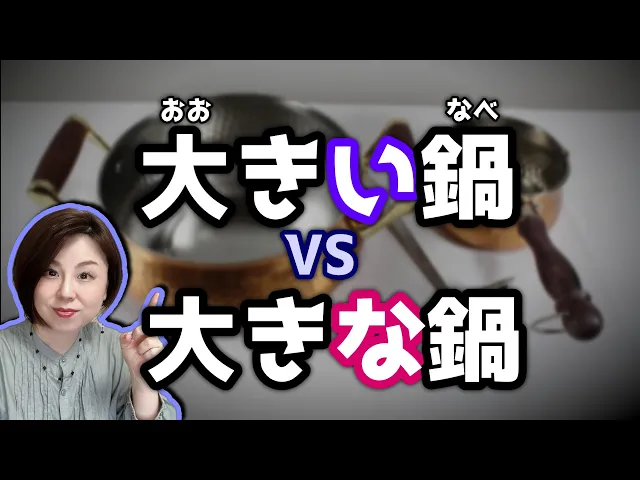
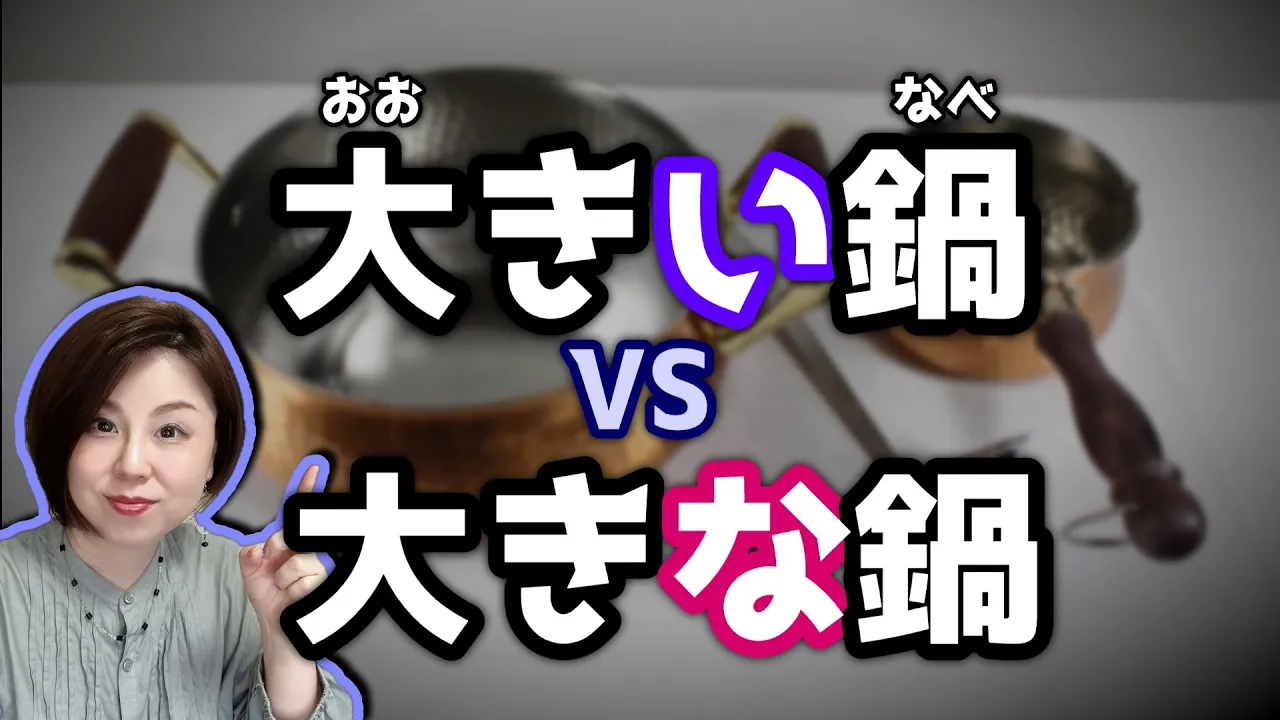
Welcome to Haru's Japanese Cafe! I am Haru, a Japanese who teaches Japanese in Taiwan. Today we are going to think about a question that viewers often ask: the difference between "大きい~" and "大きな~".
Do you think these two are the same? Or do you think it’s different? Today’s content is mainly aimed at people with intermediate or above Japanese proficiency.
Many Japanese people may answer "the two are almost the same. " But in fact, depending on the situation, we unconsciously use the two differently. After watching this video, you will understand which one is more appropriate to use under what circumstances.
In the second half, we will also discuss similar situations: such as "ちいさな", "やわらかな", "あたたかな" and so on. Please read to the end. First of all, what are the parts of speech of "おおきい" and "おおきな"?
These two parts of speech are completely different. "大きい" is what Japanese language education calls the so-called "い adjective". As we all know, when "い adjective" is followed by a noun, such as "big mango", it is directly connected to the noun.
So adding a 「の」 or 「な」 is wrong. So what is the part of speech of "おおきな"? The word "おおきな" contains "な", so it is often thought of as a "na adjective", but in fact it is not a "na adjective".
"Na adjectives" are generally called "adjective verbs" by Japanese people, such as "quiet + noun", "quiet park", etc. This "na adjective" can have many changes, but "おおきな" will not change, nor can it be followed by "だ" or "だった". So this is not an adjective, but a "joined word".
The word "joined word" may not be heard often. It does not have many changes like an adjective, and it is always followed by a noun. For example, I just said this: "大きい" is the so-called "い adjective" in Japanese language education.
"This" and "so-called" are both "conjoined words". These must be followed by nouns. So, why are there two situations: "い" and "な"?
First, I searched for "おおきいいえ" on Google, and 94,600 search results appeared. This gives the impression that this word is used quite frequently. Then I searched for "おおきないえ", and 588,000 search results appeared.
This is about 6 times the size of 「い」. It can be seen that although 「い」 is very commonly used, 「な」 is more commonly used. This means that if you are hesitating between using 「い」 or 「な」, you might as well use 「な」 first, and it may not be wrong.
Next question. You're watching a cooking show. The assistant asked the teacher: "Teacher, do you want to use a big pot?
Or a small pot? " What would you say? Of course, I just explained that "な" is more common than "い", so many people may think it is "な".
In fact, this is not wrong, but in this case, many people will still use "い" at this time. Why? Because of these two pots, one is obviously large and the other is obviously small.
Maybe the diameter of the big pot is 30 centimeters, and the diameter of the small pot is 18 centimeters. When the size is clearly divisible numerically, "い" is more commonly used . But what do you say when you see a huge pot that you have never seen before?
"Wow! What a big pot! " In this case, there are more opportunities to use "na".
Of course, personal habits and regions will also differ, so there is nothing wrong with saying "い". But this time, because you were surprised by the size, you used 「な」 more often in more subjective and emotional situations. Next question.
I think the government bears a great responsibility for this protest. How about this? It is correct to use 「な」.
I just said that "い" is objective and is mostly used for visible physical things. What about the word "responsibility"? Not so much physical as invisible abstract words.
When such an abstract word comes next, it is more natural to use 「な」. Besides the word "responsibility", what other words can you think of? For example, "major problems", "major misunderstandings", "major differences", "major successes" and other words would normally be added with "な".
So, what about this situation? There is a big wall between country A and country B. If there is a real visible wall, "い" may be used, but if the wall does not refer to a physical wall but an invisible obstacle, then "な" should be used.
Also, "大きい口" refers to a really big mouth, but "大口" means "exaggerating" or "bragging". 「な」 is often used in this idiom. Also, for example, "big face" may really refer to a big face, but using "な" means that you do bad things but don't care and don't feel guilty at all.
Also, have you ever heard of this term? It means "overly well-intentioned" or "offensive. " Please remember.
So, consider the next situation. You ask someone you meet for the first time: "How old is your child? " The other person replies.
The older one is 8 years old and the younger one is 5 years old. Most people use 「い」. Why do you think?
The hint lies in the type of noun that follows. This "ほう" is called a "formal noun". In other words, instead of using the word "child", it is better to use "the older one" and "the younger one", that is, use the word "ほう".
Such formal nouns usually do not have much meaning in themselves, but are words used to replace other words. In this case, use 「い」 instead of 「な」. So, what about this situation?
You go to a department store and buy a pot. What would you ask the store clerk? Excuse me, how much does this big one cost?
This is also 「の」. This 「の」 is also a formal noun. Therefore, the clerk may answer: 10,000 yen for the large one and 8,000 yen for the small one.
Please remember that it is more natural to use 「い」 in front of these formal nouns. This is similar to the time-related "とき" and "ころ", both of which use "い" to express "when I was a child". On the contrary, I personally have never heard of using 「な」.
Everyone is starting to realize it, right? This table only mentions "大きい" and "大きな", but this almost applies to "小さい" and "小さな" as well. Moreover, whether these words appear in spoken language or written language, their trends will also be different.
For example, how about saying this in spoken language? It’s so quiet that you can’t hear it! Sing louder!
In general conversations, a certain number of people will probably use "小さい" and "大きい". In this way, there are probably quite a few people using 「い」. Of course, some people may say "ちいさな" or "おおきな", but in ordinary conversations, "い" is still used quite often.
According to the survey, Japanese people use "大きい" in 60% of their spoken speech and "小さい" in 80% of their speeches. However, in written language, such as newspapers or novels, "大きな" is more commonly used than "大きい", and "小さな" is much more frequent than "小さい". Indeed, in poetry or lyrics, "大きな" and "小さな" are really common.
For example, what about this song? The big and tall ancient clock is grandpa’s clock♪ This is also "na". So, have you heard this song?
A little love and longing is conveyed, a little island is by your side ♪ This also uses "na". In this way, using "な" will be more cordial and warm than using "い". Instead of saying "小さい爱", it is better to say "小さな爱", which can better convey the feeling of being small, cute, precious and positive.
In fact, this also applies to the difference between "あたたかい" and "あたたかな", as well as the difference between "soft" and "soft", and "おかしい" and "おかしな". For example, although "warm light" sounds gentle enough, if "na" is used, it will give people a very gentle feeling. In addition, the word "soft performance" sounds very soft, but if "na" is used, it will appear gentler.
In addition, there is also the word "weird" that can be used as "adjective" and "conjoined word", but these two need a little attention. Originally this word had two meanings, do you know what they are? One has a negative meaning of "abnormal" or "suspicious".
Another meaning is "interesting," or "making people laugh. " What about, for example, the following sentence? The man was taking drugs and was considered strange by those around him.
This can be 「い」 or 「な」, No matter which one is used, it has negative meanings such as "abnormal", "suspicious", etc. Although I just said that using 「な」 can make people feel friendly, in this context, even using 「な」 can have a somewhat contemptuous or negative connotation. Of course, using 「い」 will have a stronger negative meaning.
So, what about the next sentence? This is the story about "Anpanman" and his happy companions. In this case, we want to use 「な」.
It just means "interesting and pleasant friends", so we can affectionately call them "pleasant companions". Finally, let’s think of an example sentence like this. "Clothes that are oversized", "dogs with small ears".
In these examples, either 「い」 or 「な」 can be used, but judging from the trend, 「い」 is more commonly used. "Large-sized clothes" or "small-eared dogs" are more commonly used. That is, these words are preceded by "size" or "ear".
If "大" or "小" is preceded by a word that serves as a subject, it will usually become "い", so it's helpful to remember this. However, this may vary depending on personal habits or region. Got it?
I also share some subtle but important differences that are not found in Japanese textbooks. If you don’t want to miss it, it is recommended to subscribe to this channel. Then, let's meet again at Haru's Japanese Cafe!
I'm Haru.