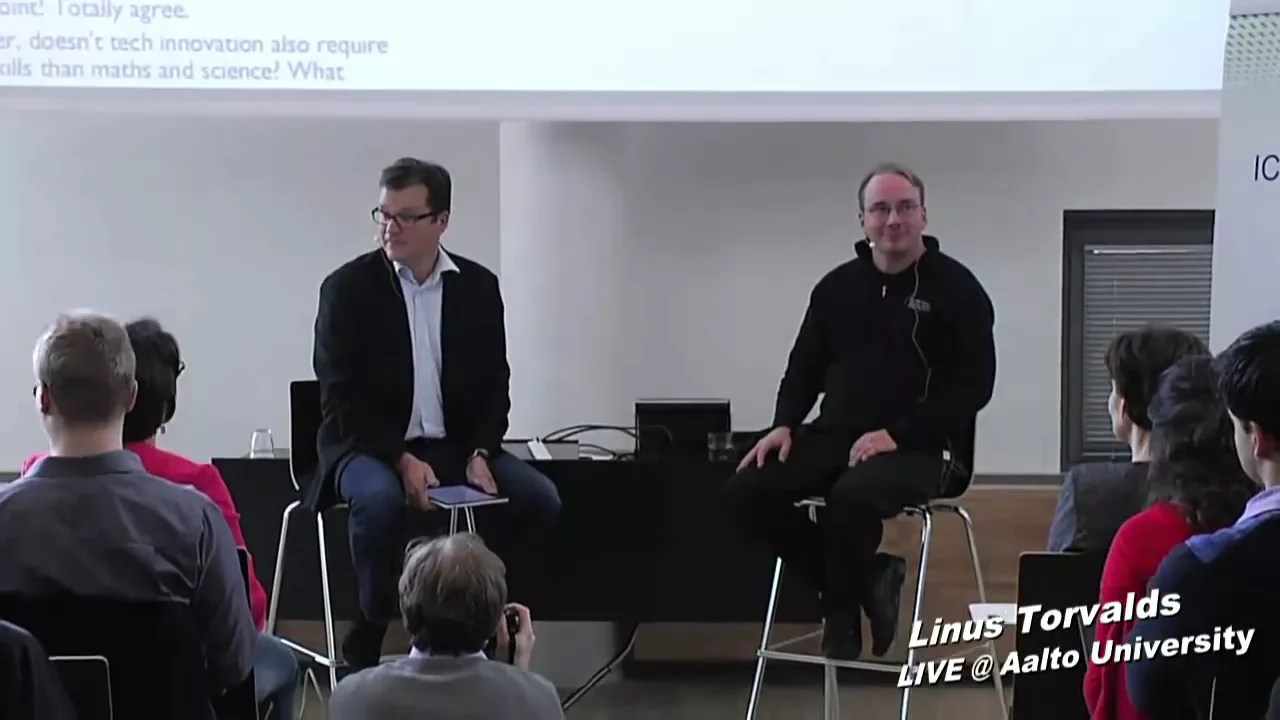
First of all uh it's a great great pleasure to have you back at Alta University um and uh and it wasn't that long ago since you were here last time it was I guess early summer just a quick question Who was here in June okay okay so there's new blood in this audience good yeah well actually I have another question how many here are all the students okay excellent because that was One of Linus's requests that that we we he he really wants to talk to all the students so I'm glad you are here um
now if I Now go to YouTube and and and actually search for Al the university so your recording actually comes up fairly high up at the top uh so just uh you know to pre-warn you this no fingers this time yeah okay so so so this is also recorded it's streamed live so uh you know let's uh let's hope or keep our fingers crossed that uh it's going to be Uh equally fun and you know exciting U uh event so so that's that's one thing then then couple of other uh things like let's say we
are in the open Innovation house so some house rules and uh and maybe also Innovations so um we would like you to participate there are several ways in which you can participate and one of them is something called screen. which is a startup from uh from uh actually people who are working in this building from Helsinki Institute for information technology so through screen iio everybody here can participate uh we have the web address screen. io/ Linus so if you have anything that runs a browser so just you know take it use it um and um
um right now you could log in there is kind of a uh first question uh up there if you do so uh uh please uh you know guys put it up um so that's one thing so we have um um various different ways for you to get engaged uh screen I is one Then we also uh reserved a hashtag so uh if anybody is tweeting so please use uh lenus EIT as the hashtag for this event um then a third thing is that we have another kind of innovation from the Alta University students so uh
this is something uh that's called a catchbox and uh now whenever anybody here wants to uh ask a question the what we will do is to throw you the mic um and so this is a microphone um and don't worry it's not you know it's Pretty soft so uh so no injuries so far um but anyway so this is the the the mic that we are going to be passing around and uh you can pass it back to us uh I guess we will have all all lenus uh and uh and and and we will
uh well I guess there are no questions so far so we will throw it to you when you have questions um but anyway so that's that's another little piece of technology that has been developed by a startup here at Alta University uh that we will use Today um but I guess one of the nice things about being a moderator is that I have an advantage I can ask you questions first uh and uh well one of the things that strikes me and and I kind of remember reading a book called just for fun about 10
years ago which was about you and how you sort of um you know started to do what you did and and and kind of what the motivation is behind so now 10 year 10 years has gone you know and uh can you tell a little Bit about first of all what do you currently do for Linux and and also what keeps you going what keeps you motivated so these days what I do in Linux is I read email and I answer email and I apply patches but more often I do just merge uh code from
others I haven't written code myself in a few years I mean I still write code but the the kind of code I write is is simple fixes for stupid mistakes others make uh so most of the time my my actual code Contributions tend to be one lers or two liners and what I really do is just merge code from the thousands of actual developers and try to make it easy to get code into the kernel by being approachable and being available pretty much every day uh so that people don't have to wait for for me
as a technical lead and that's how we I mean on average over last year I did the statistics um every day we average about 170 uh change sets we have 13 merges Most well a lot of them are doing done by me every single day on average over the last year uh 15,000 lines changed uh to put that in perspective when I started and made the first Linux kernel release the whole Kel was 10,000 lines of code now we do 15,000 lines of changes every single single day and as a result the Cel is slightly
bigger we're about 16 million lines of code in 40,000 files so I kind of act as a manager but as a technical manager for the whole Project and and do very little coding anymore uh the coding I do I tend to do on other projects smaller pet projects of mine and and on the Kernel I'm I'm this boring manager person there was another oh what what keep you motivated in doing or is is it those pet projects then or no the pet projects are kind of fun but they are side projects uh what keeps me
motivated is I used to start out as a pure programmer and actually writing the code Myself and that is still fun and I still do it on on the smaller projects but it turns out that even though I'm a geek I actually really enjoy the social interaction I enjoy cursing at people when they make mistakes I like I like the back and forth I like the arguments I it really motivates me to be part of a very vocal Community we have we have a lot of Engineers with a lot of ego and uh and it's
really exciting to Just participate in that so uh we do have technical discussions and not all of them are cursing uh but uh that kind of does has ADD spice to your life so it's still it's the communities the people who are it is the communities it's the communication yes great okay um maybe now we could show the kind of results of the warm-up thing it was about which is your favorite platform so oh okay well that's a big surprise I'm sure it's slight self- Selection work here well anyway uh there's a lot of uh
fans around that's good um on the other hand um and this was kind of my U uh second question but U and I would perhaps not have put it exactly like this but since it came up uh uh from the audience so uh let's move straight there so I mean we are now in Finland and of course you know Linux as an operating system is in the middle of a very very interesting technology battle between different mobile PL oh This is the Nokia question and this is the Nokia question exactly exactly and I would not
have put it it like this uh somebody from the audience put put it it like this um but anyway I guess the question is bro broader than you know what is Nokia and Microsoft doing I guess from my side uh the the the question would have been that well how important do you see the role of operating system system and why do you think that Linux really now has all the Ingredients oh I'm assume that you you think that so that that that the Linux based systems will be the ones that will win the mobile
battle Yeah so I really I'm not going to answer the noia question there is no upside for me I'm like whatever don't even ask me good uh it has been very interesting to see Linux on cell phones uh for a few reasons one has been a purely technical side which is the um low power capabilities have often been driven by The cell phone people uh so over the last few years one of the things we've had to battle in the kernel have been power management and that has been largely I mean it has somewhat been
driven by laptops but the cell phones have been a huge part of it uh the other part that I really enjoy about how popular Linux has been in cell phones thanks to mainly Android is just that it's also shown that Linux is actually very capable of being This uh Rich user interface that normal people interact with it used I mean before Android uh there had been uh people trying to do Linux on cell phones more or less successfully mostly less uh but people used to feel that hey user interfaces and actual like consumer products was
not something Linux was necessarily famous for and and Android changed that I think perception wise it has been very important and and made a lot of companies aware that even if you Don't use Android and a lot of people are using Android I think it has made Linux more acceptable in certain areas as a a consumer interface and and that's interesting I think it's a very important area yeah yeah I agree um okay so now I think it's time for a first question from the audience so who wants to start and uh lenos can throw
the catch box wow no come on um Please there thank you I'm from mathematics so question to begin about mathematics do you have something that you should have read while you were studying for the students what what youest they should read and what is something that you found out later that this is very useful I don't know so when I was so I was at Helsinki University and uh for the first years I actually did more math Than computer science at hson University and I'm not aware of directly having you any of the math I
I mean get uh but uh I actually took a lot of very theoretical courses I mean set theory Algebra 2 I mean things that were about Concepts and not so much about numerical stuff and uh having never maybe used those things directly I think the model of thinking is actually really important and for example the other project that is not nearly as well known as Linux but the Other projects I've been involved with uh git um I think having a mathematical mind and a model of thinking and uh and sets and and doing these kind
of thing is very important for a programmer just uh even if you don't use the math directly uh I really enjoyed math in fact uh the reason I did computer science as my major in at the University was that I felt that it was more likely that I could get a job as a computer science Major than as a math major but uh but math was actually my main interest and uh I think it's a useful skill to have so all the people who clapped because you hate math you're wrong right great uh next question
okay not not with the catch box right now wow you're much worse than the Helsinki University students well that that's not good that's not good um there's a question there now Yeah back there uh close enough and keep it close to your mouth because that's better yeah yeah I like to ask you how feel about that so I have three daughters and the eldest one is just about to turn 16 and so far none of them has have shown any interest whatsoever in programming uh it's sad but there you have it they are much more
interested in Facebook and and things like that I suspect none of them will be Engineers I did try to kind of encourage them but my problem is I'm a really bad teacher I get upset and frustrated if you don't immediately understand what I'm trying to tell you uh that probably scares my kids away more than it actually makes them want to learn programming so so at some point I just realized I'd better just stop even trying okay any more questions now um Here zra good throw hey I have [Music] questions opinionin build what mental discipline
is programming most like I really don't know I would assume it's it's more like architecture or building a bridge or really engineering not so much The Sciences in general uh but it's hard for me to really even say and uh I'd much rather answer your second question because I I can answer that one uh the most important thing you should keep in mind when building something new is to not think you're going to change the world and not overdesign and not make it something huge and big and completely different from what has gone before uh
It's it's nice to think that somebody has one great big idea and will apply that idea to make the world a better place and that's not how the world actually works uh every I mean I've been involved in many projects uh but all of them have started from very pedestrian routes trying to solve a particular problem I had and uh some of them never got any further but the successful ones when I had solved my problem somebody else came Around and said hey that almost solves my problem too and uh and they grew from the
fact that uh it they started small but the roots and the the basics were good enough that they could grow but don't try to aim for the Moon I mean I don't I did not start Linux thinking I would take over the world but we're almost there now right well that's one I I actually had one here and uh and and I would like to Um um well open source to you is it mainly the way to get good programs or do you think that open source as such as an idea has you know broader
value so to me personally the big advantage of Open Source is it's so much more fun and so much more interesting to work together with other people uh and be able to work together with anybody I mean I've done close Source programming I worked for a a company that did Software and I did proprietary software too and I really enjoyed that that as well but uh just doing it in an open community and allowing anybody to be involved really when it works it is so much fun it's the whole social interaction the whole different viewpoints
the fact that inside a company usually you have a vision of where you go and that's boring it's much more interesting to have a project like Linux where you don't have a vision it's Like everybody has their own vision and sure there's some overlap but there's a lot of non-overlap too one of the strengths of Linux I think has been the fact that you have the people who do cell phones but you also have the people who do supercomputers and and trying to balance this out has been a great joy so to me from a
personal standpoint it's just that the development is much more interesting in open source there are lots of other advantages I think that From a conception standpoint the scientific method is really important and the way to make real progress on complicated issues is to have lots of people work together and being able to build on each other's work uh I quote Newton my my favorite quote is if I have seen further it has been by standing on the shoulders of giants and he was talking about physics and science but I think the same is absolutely true
in technology too that most real Technological innovation is not about this great new idea it's about taking incremental improvements on top of existing technology and just over years and over decades you turn what used to be a really clunky car into what we have today and uh and again open source is kind of the scientific model for computer science uh and I I think that's important then there's the whole free software standpoint which Just thinks that open source is important for moral reasons and I find that to be an intriguing and interesting standpoint even though
I tend to uh disagree with uh with it but it's it's interesting how there are so many different people doing open source for so many different reasons both Technical and personal and and I think that's actually real strength great I think there was a question there Yeah EV in what way so I actually have to say that most of the individual Parts evolve pretty slowly sometimes excruciatingly so that you'd like to make much faster progress and what happens is that you just make small incremental improvements to any particular part and the explosive growth of Linux
is actually not being that any particular area of of the kernel tends to develop very quickly it's being Because there's 8,000 different people and they're working in different parts of the kernel and that's how when you look at any small detail things can take years to mature but then when you look at the whole it turns out that over a single week a lot of things change so you have both slow progress but then Global fast progress at at another level I was hugely for example uh frustrated with all the power management work we did
it took us years And uh and it's actually fairly common when you have something that crosses boundaries you power management especially for cell phones but it was true in in laptops too you have you have to have a scheduler you have to have the the io is very important for power management all the drivers and we support thousands of different Hardware they all have to get the power management right the PCI layer has to get it right there's a lot of different Components and and it took a long time and it was very frustrating um
so sometimes you have these really slow things and and then people say oh but you develop things so fast it's true in in one sense we're good in other sense we're no faster than anybody else so actually it looks like that we hear the catchbox here quite well but the the people in the Stream don't so uh whenever you get a question lenos can You just repeat it repeat it but yeah next one here question I would like to ask Google question touchid already which is dominated by Google open SCE operating system but good has
commercial interests um do you think there's room for a big scale uh Initiative for not for profit um organization to run an a mobile OS probably Linux based uh other than Android so the question was if I think There's space for not for profit uh space operating system like Android but not Android um I have to say it's really hard to develop a whole distribution I mean it's it's a ton of work and one of even though I absolutely love the whole Grassroots effort of Open Source and we've had a most of the Kel work
has been done by like individuals that are just excited about the technology the fact that we've had companies Involved has been very important because it turns out especially making a product I don't know what it is but you almost need the kind of direction that a company has and I think that's been one of the successes of of Linux has been how Linux was one of the First open- Source projects that was very open to commercial use of the open source uh code and I think it's very hard to do something like Android without the
backing of a company and without the Focus of somebody who has a particular goal in mind and I I I I do think that commercialism even though some people think it's crass and bad it does help Drive Direction a lot I'm not saying it's impossible to have a kind of community different uh Android alternative I'm just saying it's hard thanks before we go there and there so uh uh one from U uh the stream so um what do you think about the kind of Upcoming open Hardware movement um and then it's link to uh Linux
so I don't know about upcoming people have been trying to do open hardware for the longest time there's been many projects trying to do open hardware and um open Hardware is hard because software anybody can be involved and all you need is a computer and a development environment and you don't have any other costs open Hardware sure you can do the design that Way let's say if you're creating a new CPU or a new graphics chip or something but in the end somebody needs to actually create the piece of hard itself and aside from 3D
printing which is obviously coming in a big way uh that's still very much not something that you can do as an individual or even as a medium-sized company um what I find more interesting is not necessarily open Hardware but really cheap Hardware so all these projects Were I mean if you count something like Raspberry Pi as open Hardware then I do find those interesting because I think when Hardware is really cheap and really widely available that kind of changes some of the economics of things but uh but open Harbor in the sense that it was
openly designed seems to still be uh some way off right okay then back um that's going to be a hard throw though Hi I'm from NRC um I would like please to explain us your methodology you follow when you uh merge code from others from the step when you check the code of others I actually have a hard time here can can you keep it a little bit Clos to your mouth because we have hard time here yes um if you can please share with us your methodology you follow when you merge code from other
Developers so your methodology when you uh do Actually the the code mergers and you know how do you you manage all that uh I'm a huge believer in not micromanaging others and trusting people so most of the code I accept I accept not because I look at each piece of code because quite frankly there's no way I could do that I mean go back to the 15,000 lines change every day if I even try tried to actually watch the code itself I would go crazy um what happens is over the years I've created a network
Of people I trust it's kind of the way people work in general you have close friends and you know how they work and after a while you watch the code they generate or the the code they accept and you just say hey I trust that person he's the expert in his sub area uh to a degree where I'm in many cases I have a very good overview of the colonel itself but in many sub areas I am by no means the expert on that area so the people I trust are often better than me for
that Code so I would be stupid to then try to micromanage them and try to look at the code and uh and overly getting involved in in checking what they did that would just waste my time it would waste their time too um that said and this is why I'm known as being not very nice and being I'm cursing a lot of people is I only I don't ever get involved when things go smoothly Right when somebody has made a mistake and accepted code they really shouldn't have accepted that's when I have to step in
and people start mailing me and saying hey you broke the colonel and the last release doesn't work at all and and then I start cursing at people and saying what the hell I trusted you you you clearly should not have done this to me and uh so so quite often I get involved later on and look at this code and say Christ This is ugly horrible code how could you ever accept this um and and that's that's the kind of involvement I often have which is mostly negative um which can be I mean somewhat not
good at times I mean people really do I mean some people really think I'm a grumpy old man and I I realize that if you only see my flames and my curses and not the private discussions where when things go well You think I hate everybody and some days that's almost true right but I mean I still check code from people I don't trust but I do have a the closest 10 15 developers when they send me code I say I trust you I'm not going to waste both of our Times by trying to second
guess your decision thanks great well there was a previous screen iio question on your management style and I think we covered that pretty well here as well uh anyway Next question here at the front um half I think you need to pass nice one yeah I was actually having a question about Hardware vendors and uh how do they affect the development of the Linux kernel and uh what are their responsibilities if they want to uh have good support for Linux so there's so many different Hardware vendors and some are great and some are not so
great and at this talk maybe I should concentrate On the good ones right uh because there are Hardware vendors who do a really good job I mean the the best example is probably Intel that is a big Hardware vendor they don't do just CPUs they do networking to both wired and wireless uh they do a lot of different things and they have been very active in not just sending us drivers and documentation but several of the main maintainers of the colonel actually work for Intel so uh Intel basically said hey You're maintaining this sub area
let us pay you to maintain it for us and and that's an example of a hardware vendor who has done pretty much everything right it took them some time I mean when I moved to the Silicon Valley I actually maybe the first year I gave a talk at Intel and at that point Intel Engineers were not allowed to participate in the Linux kernel mailing list discussions using an intel.com email address that was a hard rule inside of Intel saying No you must never ever tell anybody that you work for Intel because if you do something
bad we don't want our name B merged by your actions right but over the years they have become one of the best if not the best hardware vendors there's a whole spectrum of really bad vendors that I won't name again to um what's often most painful is Hardware vendors who realize that Linux is actually important to their their Particular piece of hardware and they put Engineers to work in writing a driver for let's say a network card and they write this driver completely internally without talking to anybody else around it and then they send that
driver to us and in particular Greg who's the maintainer of the driver tree and most of those drivers are horrible they're really nasty even if they work the code quality is so bad that nobody can actually read it and it Was all done within theur Comm the company that does the hardware so nobody else has any documentation for it you have bad code maybe it works maybe it doesn't if something breaks nobody can help fix it so that's the kind of situation where clearly clearly the hardware company tried to do the right thing but because
they never interacted with the community at all except here take this driver it ends up being really painful for everybody and then we have People like Greg who is he's a saint I don't understand how he because he works with a lot of these companies who who are actually nice and pleasant people and try to convince these Hardware companies to please we realize you're trying your best but this sucks and and it can take years to get the kind of back and forth real Community interaction going things are getting better I mean they are getting
so much better it used to be that we had almost No support for any hardware company uh and these days uh a lot of Hardware companies often can give us drivers even before they even release the hardware so things are much nicer now but it's it's been a teaching experience on both sides great now uh again from online so um this is more about uh desktop uh distributions and and windows managers and uh and you know state of gnome and so forth so uh you know first of the question was that where do you think
That desktop Linux is and about the current distribu U how it's going and then they also you know there was explicit question that which uh which what do you use yourself so clearly the question was meant because I'm fairly well known for not liking some of the things that the desktop people have been doing I have to say things are so much better now than they were one year ago uh I am actually back to using gnome 3 and I Don't like some of the things they did uh but they have been fixing issues it
has been getting less painful they have extensions now that are still much too hard to find uh but with extensions you can make your desktop look almost as good as it used to look two years ago uh but there is a certain amount of frustration in that very sentence that I think the desktop which was getting fairly good on Linux regressed for a few years and that Was very frustrating since the desktop has always been the part I personally use I personally care most about and was the original uh Target for Linux we've been very
successful in cell phones and servers and pretty much everywhere else but the desktop is clearly a very hard nut to crack and and for a while it got harder rather than better okay uh well I'll I'll take one more from here and then continue so uh so going back to mobile uh Linux of Course it's not only the story of Android and there are all kinds of other things going on of course uh we have memories of uh myo Amigo uh and then uh people are asking now about Yola have you followed uh that company
Migo Resurrection company I haven't really followed it I'm I mean I'm hopeful that they will be successful and there will be a plan B and maybe Yola is going to be able to do that plan B it's been interesting I mean uh Android clearly is Very dominant in that space um but there are companies working Migo and working tyan uh the Asia in particular and Korea uh has noticed that they used to be just Hardware manufacturers and and partly thanks to Linux some of these companies that used to create hardware for software that other people
wrote uh have now been able to say hey we can actually control our own destiny and write our Own software on top of Linux and they are getting very involved too and and uh and I think that's been one of the nice things about open source how it allows all these different parts of the ecosystem to to realize that hey I can actually be involved d uh so I was in Korea two weeks ago and and uh talked to Samsung and LG people and they seem to be very interested also and they want to they
are a bit nervous about Android because they're not Google right they Want to they want to also maybe do their own uh operating system just because they want to be in control right yeah so so there's many of these going on and maybe Yola will convince noia to rethink their stance well we have perhaps some Nokia people in the audience as well sailfish is by the way the name of the distribution that Y is working on so but it is Migo based it's Migo but they just renamed their own version um okay next Question uh
where's the catch box there you have it go ahead yeah um I'd like to ask a question um is gr security coming to the um this the first question or the second is how are you prioritizing between security fixes and fixes for more usability and the third one is you just mentioned that the desktop system is so important for you yourself um do you think you will accept like colonal patches like uh PF sources which Actually make like I owe much more fluently working with so these are my questions that's uh three different questions uh
gr security and uh security patches a lot of gr security has actually made it into the kernel uh the lot that has made it into the kernel is the San part uh security people are sometimes a bit black and white and by that I mean crazy uh security people think that the every problem is either a Security problem or not worth thinking about and that is is incorrect uh the most secure systems are systems that nobody wants to use because they're a pain in the ass and and a lot of security people seem to want
to drive their system in that direction because then it's really secure uh so my standpoint has been that I do not want to make a huge distinction between security patches and other patches uh this is Not just about security by the way uh a lot of people seem to think that performance problems are different from correctness problems and again I disagree performance problems are real problems exactly the same as correctness problems I do not want to distinguish performance Patches from patches that fix some correctness issue so and I don't want to distinguish that from security
things um a good system is a balanced system and Security is part of it but security is by no means more important than anything else security is important but it's not the question and a lot of security people are I mean they they're just they have blinders on and they're two onedimensional and the fact that I'm not sometimes irritates them I call security people bad names sometimes because some of those people really are uh expletive morons really I mean Sometimes they're very smart people but they're not thinking straight uh and gr security has had a
lot of good patches but they have had a few patches that basically say hey we can break compatibility because we want to make things more secure never mind that nobody wants to use the end result what was the second question wow uh you want to repeat um the other one was about um PF sources and the io scheduling that is like Working well for servers but has disadvantages on desktop systems we've had many situations where and this is kind of the same issue um where a certain particular Niche wants to create kernel patches that work
really well for that small area and even when that small area is the desktop uh it turns out I'm not willing to do that so for example some of the schedular Patches um some of them worked really well on two and four CPU machines and just did not scale at all past that point and if all you care about is to enforce CPU machines you're saying hey this code is working much better for me why don't you take it and I'm like saying I'm sorry but one of the points of Linux is you have to
be able to balance all these different areas and we generally have been able to do so so for example when we added support for S SMP And SGI was creating patches that to support their 4,000 CPU Monster Machines the initial patches were completely use unusable for anybody else they were these hacky things that made it work really well on their big machines but they were not something we could use on small machines and I basically told them I'm not taking that in order for you to merge your stuff back you must write them in such
a form where your patches work for everybody else too and they did And the thing about that is it actually made the end result much better it made it much better for us but it turns out it even made it better for the SGI people they cleaned up a lot of the assumptions they had done and some of the projects you mentioned seem to have again these blinders on where they're saying we only care about our small world and we don't care about the fact that we're making things wor worse for others and if you
have that kind of Approach then you shouldn't be surprised when I'm not interested in the patches you sent me so you people need to be able to balance things out and uh sometimes you can do that with tunables but uh I prefer code that just works and works well on small machines and on big machines and it is possible but it takes a lot more effort next here yeah well um there was the talk about like Android breaking the barrier Of Linux on like regular users so um what is your opinion on valve's work with
Nvidia and Intel improving the open source drivers with the goal of releasing the steam gaming platform in Linux so um is the year of the desktop Linux finally coming well if valve actually I mean and it's probably not an if it's a when when valve actually releases their client for Linux that's certainly going to help desktop Linux a lot because one area that a small but Very fairly vocal group of people care about his games and ly has not been very strong on games um I was not directly personally involved with the valve group but
I talked to Colonel develop developers who we and they were very impressed by the valve people and apparently it was Mutual they uh both sides actually really enjoyed working together with each other uh the Linux konel and not kernel also the openg G stack in user space people were Really happy to see real world cases of high performance graphics 3D graphics and being able to also look at the source code that valve used for their game engine and were able to say oh you don't actually care about being fast in this case you care about
being fast in that case and that helped the the openg GL and kernel side uh it turns out apparently the same was through the other way where where some of the valve people were really happy to work with The open source people because they could see oh that's why this is never going to be fast because you need to do all these crazy things so there was uh the people I talked to were actually very happy with the whole back and forth there and it does apparently mean that we'll have good gaming on lenux not
in the not too distant future right next uh you seem to be getting a lot of things done how do you go about beating Procrastination how do you avoid watching Cat videos all day oh I actually don't have that problem well I I do in certain areas um the reason I don't watch cat videos every day is because I don't find them to be as interesting as the technical emails I get uh so I don't have problem with with procrastination just because I actually think my work is really really interesting and when I wake up
in the Morning um my office is above our garage I have to walk up the stairs I have to I mean it's 50 m away not quite uh in order to not have to do that by the bed I have a tablet so when I wake up in the morning the first thing I usually do is I use the taet to just check what email is going on right just so that I don't even have to work to my office to see what's going on so that's one reason I don't have problem with Procrastination then
in other areas I'm not so good so one of the reasons I don't do slides and I don't do speaking is if I'm forced to give a talk I invariably procrastinate until 5 minutes before the talk and then I realize I have no time to make slides anymore because I just can't I can't force myself to be interested so it depends the way to avoid procrastination is to find something you love doing so much that you just won't put it Off that's good a little bit related well first of all there was an very early
question that do you like cats we have I've always had a well always I've had a cat most of my life and we still have enough another cat uh we also have a dog we have a snake we've had several Geral hamsters rabbit fish I really despise but we've had in our family we've had pretty much any animal you can think of we've had it at some point or other uh cats and dogs Are my favorite great but not videos I mean the whole point of having a pet is to the unconditional love in the
case of dogs and the I don't know what in the case of that cats well back to uh this question still sort of how much do you work during a day and then there was another one that have you actually ever played Angry Birds on a Linux machine I've played Angry Birds um Mainly I used to play Angry Birds when I was waiting to pick up the kids from gymnastics or something like that it's a great program for yeah you you have 50 minutes to kill because gymnastics is running late and then you play Angry
bursts on your cell phone uh what was the the first how much do you count the hours how many hours counts don't you just don't count the hours and I can actually do most of my work I can do even while traveling so as long as I Have Wi-Fi and my laptop uh I obviously can read email doing big painful merges is inconvenient while traveling just just because um it's just small keyboard bad internet connection not enough CPU power to compile the whole kernel like that uh so I try to avoid doing the merge window
while I travel although it actually happened last mer window but today for example when I got up um I try to spread it out over the Day uh so I did three or four merges this morning um when I get back well this evening I probably won't do merges uh but I may be able to do them at the airport tomorrow morning when when I leave in case I find free Wi-Fi at Helsinki airport so they have it they do have it they do have it good um well maybe going back to a little bit
more technical side of that answer is that there was a question on the growing complexity of Linux kernel uh so uh what's your view on it's a it's a huge problem uh especially certain areas are getting so complicated that we only have a few people who actually understand them yeah the VM is is at that point now that we have certain areas where there's like a handful of people who really know the code well enough to be able to judge patches the good news is when you're that core there not that many patches There it's
not the area where you have 100 patches a day it's you might have 100 patches over one release um so it's still manageable it is slightly more fragile than I'd like it to be uh but we're none of the areas are in the situation where it's so complicated that nobody dares touch it anymore I mean that we've been able to avoid that problem but some of the areas are esoteric enough that we only have a Few people who are competent in that area okay next question here yeah do you always wear those round shaped glasses
uh no that's an odd question I don't think I've ever gone that question before uh actually for 10 almost 10 years I wore no glasses at all I had Le um so I can actually see you guys even without the glasses uh before lasic my vision was so bad that I couldn't recognize my own kids in a swimming pool And that's kind of embarrassing if you start grabbing the wrong kid um so um I wear whatever glasses my wife picks out for me good um another let's say more family Rel related question so so why
aren't you writing the Tal's family Blogspot fi anymore I don't think it was ever blog Blogspot fi I don't know I tried the blogging thing I did it for uh maybe a couple of months And it got to the point where I just got self-conscious about writing what I was doing so now I'm for the last maybe year I've been using Google+ and if I see something really odd I might take a picture of it and post on Google+ or I could I've posted a few programming questions actually uh I've posted a few rants because
hey it's what I do um but I'm not actually all that interested in the whole blogging Thing uh another question before we go back uh there so uh this is a about failing uh and any examples of where you think you failed and you know or you would like to share with the audience of the learnings that you had from a failure on the technical side there's been many cases where I've made the wrong decision but that has usually not been a failure it's been okay I made the wrong decision as long as I'm ready
to Admit it and undo do it and do the right one who cares I mean we went down the wrong direction for a while uh we've had that happen um I'd like to be a nicer person certainly I'd like to curse less at people and be slightly more encouraging people to grow instead of telling them they're idiots uh I'm sorry I've tried it's not within me it's like I get frustrated at times and then I yeah uh I like the fact that we have we have different personalities in the kernel too we have a lot
of them are strong personalities where strong doesn't necessarily mean good but uh we have people who specialize in guiding new people through the process because they actually like doing that and I've never been that kind of person so that may be a failure it is there was a question back there um do you want to try to give it a where oh I'm not going to H that just try to catch it and good thr close enough all right so uh I thought I'd uh ask what's your uh view on systemd so we know that
it does many many nice things like isolation and a parallel startup of services but then there's also some criticism like it breaks the unix's philosophy of doing one thing nicely and and then programs interacting together so do you have any opinion on this one so I think system D is interes to repeat Okay my the question was my opinion about system D and uh and how some people feel it breaks the Unix philosophy and and it's just different um I don't know how many people care here systemd is kind of the replacement for the traditional
init model and it tries to take over a lot of other kind of process startup things in general um I actually like a lot of what system D does um my personal biggest issue with System D is the people involved seem to think that change is good for its own sake uh I've seen Leonard pottering for example talking about how something is bad because it's something that has been done for 30 years and old is by definition bad which makes no sense at all to me because I'm saying if it's been working for 30 years
it's clearly doing something right right this is my standpoint while some of the systemd People seem to be have the exact opposite which is saying if it's been working that way for 30 years it's about time we changed it and that that mentality to me makes me very nervous they seem seem to sometimes make changes for the sake of changes and worry less about what people are used to and trying to kind of that that's probably why system D has generated so much negative feedback because uh it takes people out of their comfort zones and
uh doesn't Feel bad about that at all and um at the same time I think a lot what it does is interesting so I'm I'm a bit nervous about the development model and the willingness to break things which I think is a huge mistake but I do think uh that it's showing a lot of Promise all right thank you there's a question back there and then here wow okay yeah hi um um just a Personal question how exactly did you feel when you won the Millennium technology pricee and if I could be so adventurous uh
what did you do with the money um so it's hard to explain how you feel when you win a prize I mean obviously it's a really great thing to get a price for anything H it's a recognition and the Millennium price was actually a lot of money uh so far what I've done with the money I've paid taxes on it right uh not a lot else we have Had uh um right now we don't have many plans one of the things the price money means is that I may not care horribly much about money but
not caring about money also means not liking to worry about money and uh I had money Set Side for the kids education which in the US is really expensive uh the million price means in particular that there's one less thing to worry about right and uh I'm hope Hopeful that the kids will come to Helsinki University or Alta University uh and we won't waste any money on an education and in this case I can what use the money on hookers and blow or something I don't know okay you should probably not that's that's gone that's
gone but uh but the point is right now it's it's there uh so that I don't have to worry about it not that I had to worry a lot about money before I Mean I'm doing okay good there thank you for being here lus and um I have two question one is a little broader and uh a little uh another one which is specific the one uh that I like to know about your personal feeling about the personal Computing in the future uh let's say in 5 10 years uh and do you agree with Steve
Jobs um which is said it will be trucks and cars that concept and my specific question is Regarding the unification of uh operating systems how important is it to have a unified operating system system between uh PC uh tablets and other form factors thank you okay so the question about technology in 5 to 10 years I don't actually really care um I think technology is interesting but I think technology is interesting mainly because it's this toy and it keeps changing and there's always something new so the thing I'm actually looking Forward in the 5 to
10 year time scale is uh we're reaching the limits of physics when it comes to to just uh shrinking processes and uh I actually think that's really going to be fun and interesting because it's going to have to I mean it's going to mean that the industry is going to have to change uh the people who are used to computers getting twice as fast or using half the power every 18 months are going To have to change how they work and that's going to cause the change in the whole industry and I think that's actually
exciting and and it's going to be really interesting um I don't think you're going to have cars versus trucks that you'll have small stuff and big stuff I I think you'll continue to see this continum and uh more of the ubiquitous stuff that it's just going to be computers everywhere and I actually do think that it's important to have a System that spans the whole ecosystem one of the things we've done surprisingly well and I didn't actually believe we'd do that is the fact that we can and Linux is the only konel who actually runs
from cell phones to supercomputers and it really is the same Source base everybody else has been doing like apple is obviously doing OSX on the bigger side and then iOS on the smaller side and they're not unified and uh We've and Microsoft did The same thing we've seen that there are huge benefits to have the same source code across the whole spectrum because it means that things that only used to matter in the mobile space used to be things like power management and we spent a lot of time on power management for Mobility it turns
out you go to any like server room in the world today that is getting built and power use is if not one number one It's number two on the list of things people care about and these kinds of things 5 10 years ago people weren't even thinking about it that much I mean some people were but it was not widely recognized and having a a common base means that you you get all these different inputs and if you're able to cover the whole Spectrum it's actually a really powerful technical tool to to be flexible so
that you can care about power on big computers we did P for Servers and supercomputers and on the desktop people were running single CPUs on cell phones people weren't even imagining ASP 10 15 years ago today you can't buy a cell phone with only one see well you can if you buy a Windows cell phone but uh any non- Windows cell phone will have two or four CPUs in it right modern um so it's like it's very common that you find these things that you think matter only for one area and it turns out no
they Don't they they actually matter across the whole Spectrum so I think it's been very useful for Linux to to have this broad base well I think that's an excellent answer from somebody who says that you don't care about the future of it um also well reminds me on you know all of these con actions of power management for example third of the the the uh web servers in the world run Linux and uh and the energy consumption of those Servers is astounding and uh I mean you can save a few are I mean not
building a couple of nuclear nuclear power plants just by doing a better I mean right now I mean I don't know what the situation is in Finland but I know that in the US when people build big server uh facilities they tend to build them close to for example power plants and especially around water plants where they can get cheap power year round um so it's it's interesting how important Power management has become for the server business yeah yeah exactly and that that is fairly recent I mean really it's in the last few years it's
become something that that is their sometimes number one concern I will actually throw one of mine in the middle here so so now okay uh 5 to 10 years what do you think will be the biggest thing for Linux I mean the the big new things that are behind the corner I don't think that way I really Don't uh I plan one or two release Cycles ahead so for Linux that means 3 to six months ahead um I do get access to early Hardware I also get access to people who tell me what their their
plans are two years down the line right I can't talk about those but I it it means that that when we make releases and look at code uh a lot of the carel developers do we kind of have a something of a window what will happen in the near future and say okay this Code makes sense or no this is a bad idea because two years from now if we do this we'll be doing the wrong thing um but I don't have a 5-year plan and in most of our Colonel work is really it's new
hardware and it's new usage cases so we're being driven by from outside by both Hardware companies and by companies who use Linux uh and it's been very interesting but it means that I this is I'm not a Visionary I don't like the word Visionary I don't plan Five years ahead I don't think it works uh we are reactionary we try to do the best thing we can with a fairly short time frame for the future plans good next question here oh yeah hi uh do Google Facebook and Samsung pay your insurance bills my insurance bills
well no uh but they do fairly directly actually pay my salary so the way I'm getting paid is I'm a employee of the Linux foundation and the Linux Foundation is a nonprofit group that gets paid by Google Intel Samsung and so on so they do pay my salary uh they do pay for example um it's not direct I guess it actually is a kind of insurance they also pay the Linux Foundation legal department so if somebody works sue me or Linux uh I don't have to worry about them suing me directly there's there's some legal
department that Will step in it doesn't happen really I mean why would you sue me you sue big companies that have lots of money um as a follow um what about your role as the lead of Linux development so what do you think um in the future how my role in Linux development it's actually being fairly stable for the last few years we've found a model that works really well we used to have a featur driven release model and we used to have a source control manage model Model that didn't really work very well and
there was a lot of problems with both of those uh We've over the years we've found what works and what doesn't and we have a both a release model and a management model that seems to be scaling really well so our the development the throughput of development has actually gone up so we have more patches coming in we have more changes coming in and we're keeping on Top of it and it really seems to work and who knows maybe there's some problem coming up in the next few years which means that we'll have to change
our model again and that's really really painful some of the most painful changes we've ever done in in the kernel have not been about technology it's been about how we do development uh but for now I don't see anything coming up we seem to be doing really Well there um the pro the thing is that I'm uh I've been using Linux for some time right now but you know I completely want to get rid of windows but that's not happening the reason is that for example I'm using a Samsung mobile phone and Samsung has their
own application called keys which is the mobile which is you for managing the mobile phone but I don't find an Linux equivalent for that you know for this is the problem I face So I have to go back to Windows to for example to update my phone or to save my contacts it's it has been a problem um my wife used to run an iPhone Christ that was painful for some of the same reasons you needed to run iTunes just to sync anything and she was so much happier when I finally just got her Android
phone and she noticed hey I can do everything on the web I don't need to do this whole synchronization part it has been painful when uh certain things Only come with drivers for Windows or applications to do what I really personally dislike is Hardware that comes with firware upgrades and the upgrade program is some stupid windows program I don't have windows in my house anywhere so I can't update the firmware on on the hardware I have and I'm just saying okay I need to stop buying that Hardware um to some degree Apple has actually helped
this situation because it turns out if you Make Windows only applications these days apple is big enough that it actually annoys people uh so now certain vendors make Windows and Mac versions but um other vendors have just said hey we'll do upgrading through the web uh so the fact that there's not that windows isn't 99% of the desktop Market anymore has actually helped to some degree uh has made it easier for for Linux to to be accepted to but yeah there are problem spots I I hope uh Those problems will be solved soon I hope
so again um from screen iio so um you started Linux when you were a student at University of hinki and and and I guess the question was that uh do you think um that's the right time to start a big new project like Linux or would it be better to do it on your free time when you uh you know you are you know graduated from University you might have your job but then you kind of allocate your other resources to uh Something like what you did was this the right time to start I I
think it was uh I think um I had a lot of free time because it took me eight years to graduate from H University right I was not exactly studying hard uh I also think think that quite often you have to be slightly ignorant of what you're doing to do something that if you knew more you'd say that's just stupid that's too much Work I'll never get anything done when you're a student at the University you can just you hey your choice is between drinking beer or doing something fun with a computer I did both
and uh and it wasn't wasted time it helped me with my studies it was interesting and it would be much harder to do something like Linux when I have a real job and kids And uh and a real life so I I think at least in the case of Linux my University years were were absolutely the right time to start doing it yeah well there was an earlier question and I kind of guess answer that that well of course kind of the the university system is trying now to force the students to graduate in a
shorter amount of time in five years and so forth and uh what's your opinion on that Trend I understand why you'd think that wasting 10 years of your life drinking is not a good thing for society uh I have to say I really enjoyed hink University and the fact that I I only got a master's in 8 years of studying I was to me very successful uh I realized maybe most people don't do anything else productive at the same time so there's a push to make people More efficient I don't know enjoy it while you
can is my suggestion it's it's all good and it's not a bad time to start something big next hi would you like to talk a little about your pet projects or in more in general what other fields other than kernel development and git would you like to get into or are getting into so the question was about my pet projects and other things I do outside of the Kernel the kernel is my main work I mean the kernel is where I use really all my time even if I don't program it is it is what
I do day in and day out um I do have a few projects I've worked on on the side uh git was obviously something I did very actively five years ago these days I don't need to worry too much about git because git has a great maintainer so I can just say whatever unia H has been doing a great work at maintaining it for the last six plus Years uh so I don't get that involved in get anymore I occasionally send a patch just because I found something that it didn't do quite right for my
usage case um I another pet project I have is a program called subsurface I love scuba diving outside of if I go on a vacation I want to go on a vacation where there's warm water and colorful fish and corals and I can go underwater and scuba dive and it turns out there are no good scuba diving Applications that run under Linux so I wrote my own and uh and if there are any scuba divers in the audience uh my co-maintainer Durk hondel just released the 2.1 version of subsurface today or was it yesterday it
depends on which time zone you were in uh so I've had a few other projects that I work on uh but they've been toy projects compared to to the colonel well I guess it's uh now uh time for the last question and so time flies good Company uh and I am I'm actually taking it now from here so uh and this might be asking you know which one is your favorite child but I won't ask that so what piece of Linux are you most proud of so I have to I mean there's parts of the
colonel that I've been intimately involved with from a technical angle and I really like like the path name lookup I I think Linux does that better than anybody else but at the same time I Think in the big picture what's more important is we've had a great Colonel community and the fact that we've grown the community thousands of people involved and and I'll take some credit for that and that's the that's more important than the code itself is the fact that we have a very healthy and big development Community where uh there are heated discussions
at times but but I think people really do end up enjoying the colonel Community a Lot well I think that's a great way to end this discussion and uh I hope you all join me in just uh well giving a big Applause to [Applause]








![Learn Python - Full Course for Beginners [Tutorial]](https://img.youtube.com/vi/rfscVS0vtbw/mqdefault.jpg)