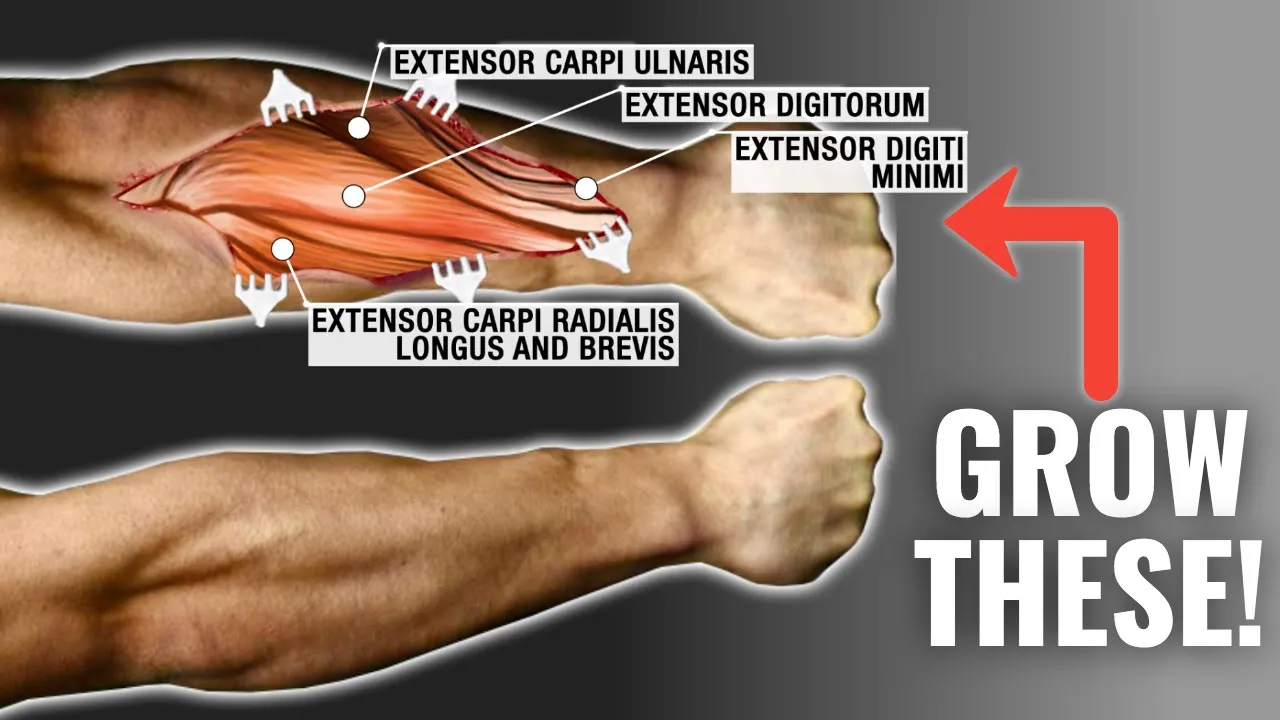
Thick, well-developed forearms are one of the most important features that you want to achieve. Not only because they dramatically improve the appearance of your arms, but also because they play a vital role in strengthening your grip to handle more weight. That being said though, when most people aim to strengthen and grow bigger forearms, they fail to realize just how many forearm muscles there really are and what they're responsible for doing.
Instead, they think that a few sets of wrist curls and wrist extensions is all that you need. And although these exercises can help, if you want to maximize your forearm gains, then you need to be incorporating movements that enable you to target all of the forearm muscles and their movement functions most effectively. In this video, I'll show you exactly how to best do that with three easy tips so that you can finally see the forearm growth that you're after and in the fastest way possible.
The first tip is very easy to implement, yet will instantly start to make a big improvement in your forearm development. And it's simply a matter of taking the existing bicep curls that you're currently doing in your routine and swapping them out for more forearm-focused curls instead. This is because traditional bicep curls obviously work the biceps to a much greater extent than the forearms, but by making a few tweaks to your curls, we'll be able to shift more of the emphasis and growth to two of your forearm muscles, the brachioradialis and the pronator teres, which is important because growing these two muscles will make a very visible difference in the overall size and appearance of your forearms, since they not only lay the most superficially in the forearm, meaning that they're closest to your skin and therefore most visible and noticeable when grown, but they're also some of the largest muscles of the forearm.
So, how can we best target these muscles when curling? Well, there's two things that we can do. The first thing we can do is simply change to a pronated grip instead of a supinated grip.
This is because as shown in EMG analyses like this one from the Journal of Neurophysiology, a pronated wrist position when curling elicits the greatest activation of both brachioradialis and the pronator teres muscles when compared to a neutral or supinated grip. Not only that though, but this position also elicits the least biceps activation as well, meaning that with this grip, you're able to most effectively shift tension away from the biceps and onto the forearm muscles instead. So, reverse curls are obviously a great option to enable you to do this and hammer curls would be the next best option, especially since they tend to be more friendly on the wrist.
But, there's another tweak that we can make to these exercises to make them even more effective for forearm growth. And it has to do with playing around with the strength curve of the exercise. Because we know based on biomechanical analyses of the elbow flexors that the brachioradialis, one of the biggest forearm muscles that I previously went through, contributes the most when it reaches higher degrees of elbow flexion.
So, roughly within the top half of a curl, for example. Whereas in contrast, within this range of motion is when the biceps contribute the least to the movement. Meaning that curls with a strength curve that elicits peak forces at the top half of the movement will develop the brachioradialis to a greater extent than the biceps.
Now, the easiest way to achieve this type of strength curve with the reverse curl, for example, is by applying a form of accommodating resistance during the movement, which can be accomplished by simply attaching a resistance band to the bar to resist you as you curl. Because with this in place, the top half of the movement will now be considerably harder than the bottom half and will as a result effectively emphasize the brachioradialis to a much greater degree, while also minimizing the involvement of the biceps. Next, to speed up your forearm growth even more, you want to incorporate some additional direct forearm work to your routine.
Because although many barbell and dumbbell movements involve an isometric contraction of the forearms and will indirectly help with their growth, we know based on research that dynamic contractions that take the forearms through their full range of motion are better for muscle growth. And in fact, studies that have analyzed the effect of adding in additional forearm exercises into existing training regimens have found that it significantly increases forearm size and strength to a much greater degree. So, what are the best forearm exercises that you should start including into your routine?
Well, we want to ensure that we're hitting all of the forearm muscles and their respective movement functions. So, first, we want to hit the flexors and extensors of the forearms, which as their name implies, simply act to flex and extend the wrist. So, to best work the flexors, you'll simply want to incorporate one wrist flexion exercise such as the behind-the-back barbell wrist curl.
And then to best work the extensors, you'll want to incorporate one wrist extension exercise such as standing barbell wrist extensions or seated dumbbell wrist extensions, for example. Now, although this alone will hit many of the forearm muscles, it's important that you don't just stop here like most people do. Because the forearms still have a lot more potential for growth, which we can capitalize on by incorporating some of the other movement functions of the forearm muscles beyond just flexion and extension.
And this is why next we'll want to move on to a forearm exercise that incorporates adduction and abduction of the wrist, which is going to emphasize seven of the forearm muscles shown here that are designed to perform this very movement function. And one great exercise to accomplish this are dynamic barbell suitcase holds. We simply hold the center of a barbell by your side and then slowly tip it forward and then back for roughly 10 reps each direction.
As you do so, the various forearm muscles responsible for adduction and abduction of the wrist will then be forced to work to balance the weight. And to progress this exercise, simply load it with more weight or aim for more reps. In addition, another great exercise is simply performing wrist adduction and abduction using cables.
Just hold the ball with no attachment, bring the cable down to your side, and then perform wrist adduction shown here, and then do the opposite with wrist abduction shown here, and increase the weight over time. And you can also even implement wrist adduction into your triceps exercises well, for example, by incorporating it at the very end of a rope pushdown just to easily get in a little more work for your forearms throughout the week. But, we don't just want to stop here, as we're still missing out on another important movement function that will emphasize four of the largest forearm muscles shown here, and it's pronation and supination of the forearm.
So, to most effectively work and grow these muscles, we'll want to incorporate one exercise that performs this movement function of active pronation and supination, which can be easily done by simply placing your forearm on a bench, holding the bottom of a light dumbbell, and then rotating the dumbbell from left and right for about 10 reps each side. And again, gradually progress with heavier weight as your strength improves. But, by performing a routine that incorporates these five different movement functions of your forearms, you'll now be able to effectively target all of the forearm muscles and therefore grow your forearms to a much greater degree than you would have otherwise.
Now, the last tip here has to do with how exactly you then go about adding your additional forearm exercises into your current regimen. And there's a variety of viable ways to do this. For instance, a 2017 paper compared the effect of adding in volume-matched additional forearm work with a low frequency of three times per week versus a higher frequency of five days per week.
As shown here, after the four weeks, both groups experienced roughly a 9% increase in grip strength as well as a similar significant increase in forearm size, simply meaning that you can choose whether you want to perform shorter, yet more frequent sessions dedicated to your forearms or longer, yet less frequent sessions. Both of which do have their pros and cons, and it does ultimately depend on your preferences, as well as the type of split that you're running in order to prevent any forearm soreness from interfering with your main lifts. So, if you're running a push-pull-legs split, for example, one good option could be to throw in two longer forearm sessions after each of your pull or your leg days, since they'll likely need a day or two to rest and we don't want the soreness to carry over to your next push or next pull workout, for example.
At the end of the day though, regardless of how you set it up, as long as you're incorporating tip one with the swaps, tip two with a forearm routine, and then tip three of implementing this into your workouts as best as you can, you'll be able to very quickly and noticeably speed up your forearm growth as well as your overall grip strength. So guys, I hope you're able to see that if you want to maximize and speed up growth in all of your muscles, not just your forearms, then it's important that you don't overlook crucial aspects of your program like your exercise selection, your training volume, and most importantly, your nutrition. Otherwise, you simply won't be building muscles fast as you could be.
And for step-by-step, science-based nutrition and workout plan that puts all of this together for you week by week so that you can build muscle and lean down as efficiently as possible with science, then simply head on over to buildwithscience. com to take the body type quiz to discover what program is best for you and your body. Anyways, guys, I hope you enjoyed this one.
Please don't forget to show your support by giving the video a like, leaving a comment down below as to what you'd like to see me cover next, subscribing to the channel, turning on notification for the channel as well, as this all really does help me out. Thank you so much, everyone, and I'll see you next time.