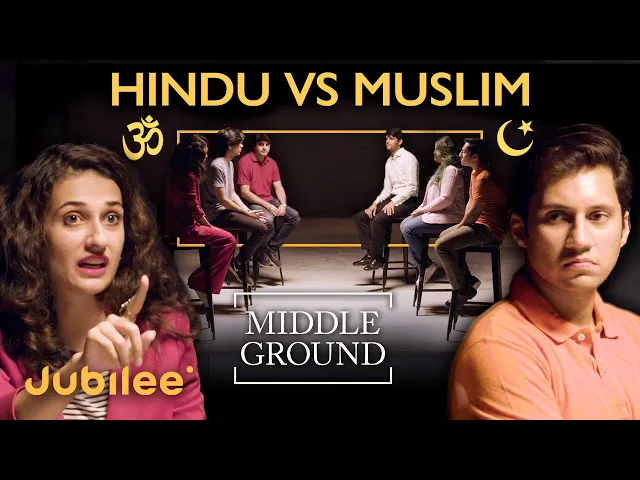
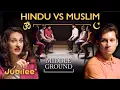
- They have destroyed that masjid and that is a wrong thing. - Yeah. - But do you know how many temples in Kashmir have they burnt?
350 temples. - Are we settling scores? - No.
- Exactly. - Hindus and Muslims are like the Montagues and Capulets of India. We've been waring for centuries.
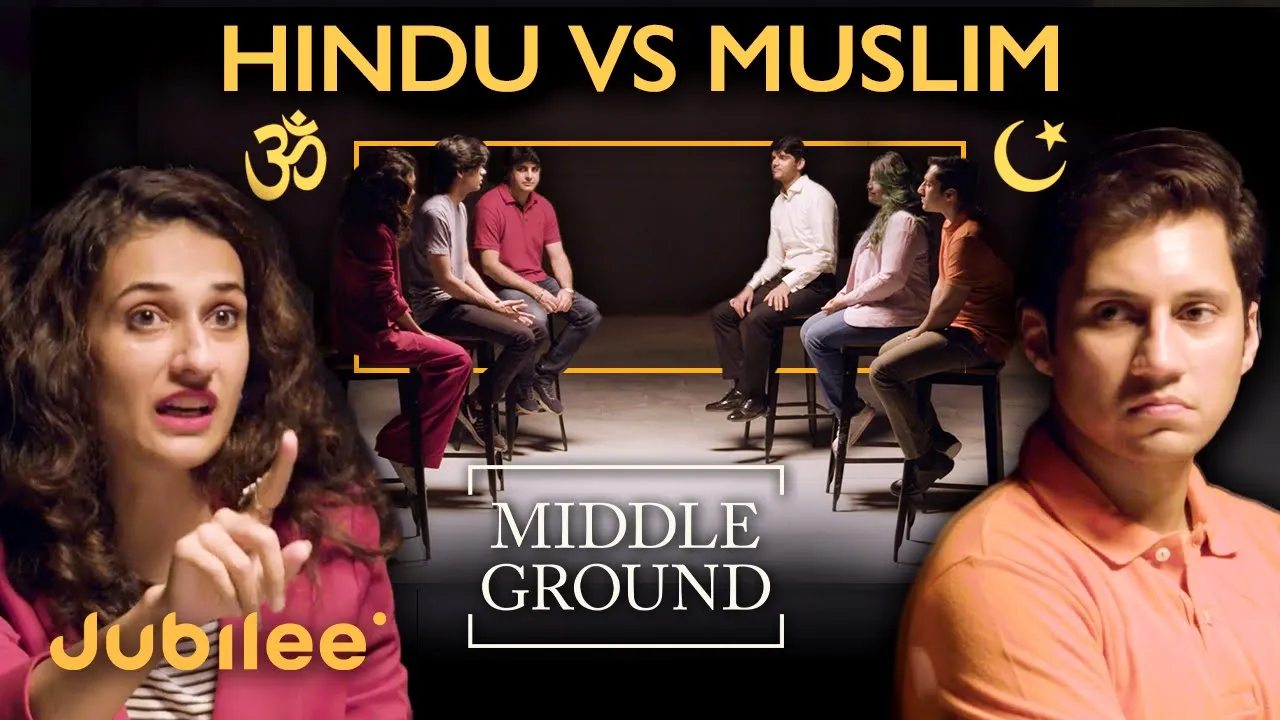
(upbeat music) - [Interviewer] Growing Up, I was taught to stay away from the other side. Can the agreers please step forward? - It wasn't said so strongly, (both chuckle) nothing really did.
There was generally a non-appreciation of me hanging out with Hindu friends. So there was not a clear thing that don't hang out with Hindus, but discouraging. Where are you going?
He's a Hindu. You don't even know how they would have coped. Why are you going to their birthday party or something?
Whereas if I have a Muslim friend, he was somewhat more welcome. - So yeah, in my family I think I have actually seen my parents neglect a lot of my Muslim friends and very sternly my mother specifically walk up to me and tell me that don't make Muslim friends or whenever there was a Muslim friend's birthday party she would tell me not to go there. So there was this very cold environment.
Like I would see my mother not treating them very well, not sitting with them or trying to even initiate a discussion. It really needs to be stopped. You can't let your kids grow in such a venomous environment that it ultimately takes a toll on them.
And when they grow up, they start just hating the other community to such an extent that they can't even engage in discussions with them. - [Interviewer] Can we have the disagreers come forward? (footsteps thudding) - My experience was quite the opposite.
In my house, actually my sister's best friend was Muslim and she used to live in our colony. And for every Diwali, it's like she didn't have anywhere to go or anything to do. So she used to spend Diwali with us.
So my family's been very accepting. - So for my parents, it was never a choice because most of my friends were Muslims only- - Same. - So there was no choice for them to stop me somewhere.
But yes, it was communicated (indistinct), never marry outside your. . .
- What I really enjoy whenever someone from a different religion would come to the house, then the level of curiosity that my parents would have. - Absolutely. (all chuckle) - And that's also something very bad about our society.
After 1000 years of coexistence, there is still curiosity. How dumb are we? - [All] Yeah.
- Like you still don't know about the other person. (suspense music) - I've been married to a Muslim boy by my own will and choice, of course, against my parents will. They still don't speak to my husband at all.
They have cordial relations with me, which I think I've over the time come to accept that it's okay if they don't want to talk to him, it's their decision at the end of the day and I need to respect it. - [Interviewer] Someone I know has died because of this conflict. (footstep thudding) - We being Kashmir Pandits, are treated as a minority community in Jammu and Kashmir.
And because of this religious extremism, my father was assassinated when I was at the age of 15 or 16. All house was coordinated by militants. And he was taken from that my place.
And he was assassinated. Because of this religious conflict, certain innocents are being targeted. And if the extremism and conflicts will go on, such things will happen.
(footsteps thudding) - I think a lot of us (chuckles), - Yeah. - Are just tongue-tied for now. But if I may, I think I just have had a lot of respect for you, like right now because I think it takes a lot to be a firsthand victim of a crime and then still not develop that hatred and let that hatred get so much to you that you start blaming an entire community for it.
Because at the end you have to realize that an individual or few individuals belonging to that community were actually responsible for it and not the entire community. So I think if we actually had people like you who were so practical and understanding, we wouldn't be in this situation we are in today. - No, that's actually very true.
I've spent a lot of time in Jammu and Kashmir. My father was in the army, we were posted there for a long time. I've seen a lot of terrorism and a lot of violence in front of me.
We didn't go to school for many months because of that so I've lost out big chunks of my childhood. Initially, when you'd introduce yourself and you said you were a Kashmir Pandit, I was immediately filled with fear because I've had a lot of negativity from people who tend to harbor hate against people with literally just my surname, for of course, things that have happened terrible in their lives. - [Pallavi] Yeah, absolutely.
- But to see somebody emerge from such a situation and then still come out the other side with the level of maturity that you are able to show right now, it's really incredible to see yeah. - What you have been through, given that despite that personal tragedy, you have managed to keep yourself just and fair, my salute to you. And if it matters, I doubt it does, but as a part of a Muslim community, I am terribly sorry for your loss.
- See, that's the problem. I mean, you can be sorry to him. Why do you have to take the blame for it?
- [Both] Exactly. - That is something that I don't understand. None of my business, not my problem.
Some people did it, I am the representative for myself. That doesn't make me absolute, in the sense to represent that entire culture. It's just a tiny facet.
- It does. - No. You know actually- - Why.
- When you start being apologetic for the entire community is actually when you start giving the other side the chance to blame the entire community. - Pallavi, made a point. So she said that if everybody was like him, we wouldn't be here at all.
But I wanna just take to the other side because to go what he has gone through, I believe the pain would be immense. And if that means that I lash out at society and the perpetrators, at whoever or whatever was responsible I believe that there is hope for understanding those kind of violent actions. - Oh, absolutely not.
I so disagree with that point of view. We'd be living in an uncivilized and lawless society if we actually start propagating thoughts like this, that being violent is okay at a point. Your aggression, your being upset at the situation, the immense pain that you have felt, I'm sure people are going to understand.
But saying that it's justified for me to be violent- - I'm not saying it's justified- - I think that's wrong. - If I understand what he's trying to say, is if he goes out because his family was subjected to violence and he killed somebody, what he's saying actually that killing somebody is bad, that is not a justification for killing. But probably what he's saying is that when it comes to punishing him, - Yeah.
- The history which existed. So that should serve as not a defense against his crime, but a mitigating circumstance. - [Pallavi] No, but then I have a question- - This guy understands me so well.
(Zarah laughs) - How's that gonna change anything? - [Pallavi] Exactly. - I think that's the middle ground.
- Then how does that make him different from the people who assassinated his father? How does that make him different then? - See, what Pallavi is saying is that- - Because he also went ahead and shot those people.
Those people shot his father. - Blaming an entire community is not an answer to that. - So where is the difference?
- We can justify by doing through individuals but blaming up complete community is not justified, so that is what Pallavi, and I also agree on that. Muslims and Hindus can bridge those gaps because there are some negative energies which will pull you in your way, but we need to be tolerant. We need to be very much patient about the actions which we are doing.
- [Interviewer] The government has created more divide between Hindus and Muslims. - Yeah. - Really?
Are you guys not coming forward? - So I think of course you have reports after reports. In fact there is a New York Times post that has clearly said and I quote, " that the data of hate crime in India gets released based on who the hater is.
" So when the government of India decides to release a data on hate crimes in India and it excludes lynchings of minorities and only puts forward certain facts where the majority is favored, crimes against majority. I think of course the government has a huge agenda to solve in pleasing the majority. - If there would have been a time angled to this problem that would have made it much more simpler for all of us because I feel post independence, all the governments in this country have actually done nothing good for the majority and for the minority.
On a way, social sense or economic indicators we are not counting in, the governments have definitely done, that's why we are where we are right now. - Make no mistake, government since 1950s wouldn't have done anything. I agree with you.
But 2014 onwards, we have a government who has an official policy to discriminate against Muslims. We have this Qurbani, the sacrifice of the animal and it takes place at our village. And we go to village and bring back the meat.
From last two years, we are not bringing back the meat because we believe traveling with the meat is very dangerous. They'll stop you and they'll lynch you saying that it's cow. So this government has multiplied hate and hate crimes exponentially.
It is not something which is just happening and they're hypothetic about it, this is their policy. And these are seasoned politicians making very absurd claims. That you should go to Pakistan and all, and you and I may think that they're buffoons and idiots but what they're doing actually is they're normalizing it.
- Yeah. - Unlike Congress and which this politician has said it very right, Congress may be corrupt. I agree with you, but this government has overtaken the institutions so completely.
The judiciary, the investigating agencies, - [Both] The media. - Yeah. - So I think- - All of that was already taken over on- - No.
- Not so much. - I think that's living incomplete denial. Governments before this must have done this.
What we are seeing now is a support towards all of this. - So basically you were- - They supported blatantly, it's happening, without any regret that they're violating the constitution. - So the problem is the degree here- - They're violating law.
There's open support for it. When did we see previous government supporting it? They at least had the knack and the shame to the go ahead and oppose it.
Even on the face open. Even though you know in your head there must have been some way had a hand in this but they never supported it openly. What we see now is open blatant, shameless support.
And it has led to such violent situation on the ground. Like he correctly said, people are being lynched for just carrying meat. - I don't think it's the government who did the lynchings and the people who did the lynchings they have been arrested.
And even our prime minister has said several times that it has denounced those acts. So I don't think it's the government who's not doing, it's a law and order issue in UP. And it should be looked at as that.
Secondly, I don't think the government is increasing the divide between Hindus and Muslims. I think the divide has always been there since the partition. Second of all, - No.
- Speaking to the Ram Mandir issue, there my stance is the Muslims have thousands of mosques all over the world, but Ram was born only at one place. So I personally believe, that the Ram Mandir should have been there and the the Supreme court has given Islamic society the right to build a mosque, right beside, and it would be like why would we ever want to take kardha away from you? It's like that.
That place is too special to us than it is to you. And just out of magnanimity, it would be magnanimous of the Muslims to just give that. But I'm not really emotional about that issue.
It could have gone either way and I would've been fine with it. - What you're saying is that the Muslims should have shown magnanimity, is what the general view would have been. And the Supreme court has gone by it, just because they're minority, they're weak, they're less in number, let them come forward and show magnanimity and to the majority why should we show magnanimity?
And let's not forget, that a mosque did exist at that place that was demolished. There is proper videographic evidence to show that people were on top of the tomb and they demolished that mosque. And then you say, give it to us, give the place to us because Ram was born here.
And let me get your facts right. - And no evidence of that. - There has been affidavit in the Supreme court by the government itself stating that there is no evidence whatsoever.
In fact, by the Archeological Society of India, also that there is no fact whatsoever to state and to confirm that Lord Ram was actually born at that place. So your basic foundation of why the judgment is good is flawed in itself. - So I just never wanted to go on this mandir-masjid kind of a thing, but I just want to clarify here, maybe anybody who has done on masjid they have destroyed that masjid and that is the wrong thing.
But do you know how many temples in Kashmir have they burnt, 350 temples? - Are we settling scores? - Exactly.
That doesn't justify. - So we should not, this is a wrong thing. - One wrong does not justify the other.
- This is a wrong thing, wrong statement to say- - But you're justifying it. No, so- - That intolerance has been to Muslims only. - I was at work and the entire debate about CAA and NRC was going on and working in news means that's a very big discussion topic.
If I was to ever voice an opinion the immediate rebuttal it's often said in jest, but that doesn't of course make it okay. Is, oh, why are you bothered? You can just go back to Pakistan.
Even though I have absolutely no affiliation but my identity is then brought into question. My loyalty towards my country is brought into question by these things. It goes back all the way to middle school as well.
- [Interviewer] Hindus and Muslims can coexist peacefully in India. - Really? - Oh my God.
(Pallavi chuckles) - Oh God, it's just me. - What is wrong with you people? Of course.
You are not born biggit. You were turned into one, by all these politicians and all the men who wants to keep their power to themselves and don't want to work. So they need things to divide people.
- I think we've been living fairly peaceful to be very honest. There have been some incidences, there is obviously been a spike, but look at us. We are having such a sound conversation and there has definitely been an increament in the number of interreligious marriages, more Muslim scholars being part of public institutions.
I'm a thorough optimist. I feel that the trajectory is definitely going uphill despite all the hiccups that we are facing at this point in time for political reasons. - No, I don't agree that it's going uphill.
I think it's getting worse as of now, since 2014 like Kabir said. But I think, yes, there's definitely a place to coexist because we have been doing that since, even before independence - A thousand years. - So we have coexisted for so long.
Also I think the situation on the ground, like we are all the privileged lot, so let's accept that. But even if you see very common people on the ground also, I don't think there is as much as divide as being portrayed by the media. And the only reason the media is portraying it is because the government to its own benefit wants to push this narrative that there is a Hindu-Muslim divide.
That Muslims have been the cause of your trouble. They were the one whose needs were always put forth. And despite being majority, you were always neglected.
So now we are going to look after you. So I think the media's just running that narrative full throttle since 2014. And it's just becoming venomous, like Kabir said fascism gets to you very, very slowly.
- I'm not very much comfortable when you are saying after 2014 it had happened. So I don't agree. - Sure, it's all open.
- I don't agree with you on that thing. Muslims and Hindus, if born in India can coexist very peacefully and only we need to leave our extremism. So whatever maybe that Hindu extremism or the Muslim extremism.
Extremism is the main issue, which should be left behind - You better defend yourselves. (Pallavi chuckles) - I think like you said, it's a very optimistic view. It's very idealistic.
I want it to happen. I don't know if that'll happen. You're right, we have existed together for a very long time.
We're barely existing together right now. When this is not a symbiotic relationship, we're not happy together, I personally blame it on the old guard. I think a lot of people have prejudice because of the experiences they've had.
And that's trickling down to younger generations, perhaps not to make it sound extremely dark, but if that generations die out and conversations like these continue, there could be change. But again, keeping our privilege in mind, these conversations are just how happening here. I am super afraid of having these conversations outside of this.
I am afraid of backlash. I am afraid of being othered. I am afraid of being told that, oh, you know, just go back to Pakistan where you belong then, you'll be comfortable there.
So I don't know if it's happening outside of these sort of- - It is. In every educated household- - Education is very limited though. Again- - It's not that limited.
Definitely, it's one of the points that we have to focus on. - I wanted to make the point out that why is encourageable optimism is not misplaced. Things are bad right now, of course.
And is there fight between Muslim and Hindus which weren't there earlier? Say Muslims came to India say 1000 AD. Were there wars before that?
- Of course, yes. - Were their Muslims, when there was Mahabharat? Was their discrimination before Muslims came?
There was a cast system. There is nothing particular about any one particular community. So Hindus and Muslims are not that, unique pair who can never be together.
Majority of us agree that they can live together. All of us want them to live. - Absolutely.
- Only difference would be like, you know how much? So I think we should be optimistic. I implore all of you.
We certainly can live together. - Oh, you just put our foot here. - I will, standing.
(indistinct) (all exclaiming) - Making coexist.