You know what's weird? We have this image in our heads of what a genius looks like. They're the person dominating every conversation, solving equations on a whiteboard, correcting everyone in the room with some obscure fact nobody asked for.
Basically, a walking encyclopedia with no social skills and a superiority complex. But here's the thing, that's almost never what high intelligence actually looks like. And psychology has known this for a while now.
The people with the highest IQ's often don't match the stereotype at all. In fact, if you met one at a party, you probably wouldn't even notice. Not because they're hiding it, but because real intelligence doesn't perform.
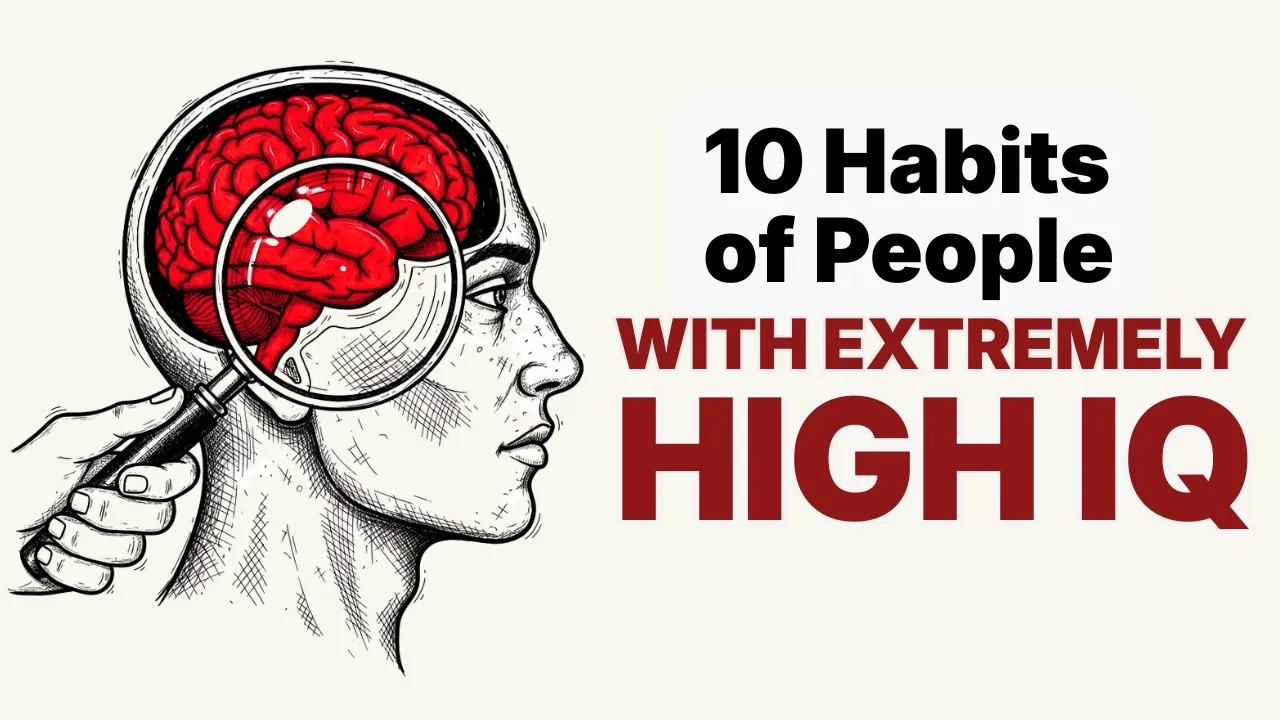
It processes. And the way it processes that shows up in habits most people completely misread. So, today we're getting into the psychology of people with extremely high IQs.
the actual behavioral patterns, what's happening in their brains, and why so much of it looks nothing like what you'd expect. Let's start with the one that surprises people the most. Highly intelligent people spend a lot of time alone.
And no, not in a sad, isolated, something's wrong kind of way. Their brains are just expensive to run. Cognitively speaking, a high IQ brain is processing more information per second than average, making more connections, running more simulations.
That takes energy. And social environments, even pleasant ones, are incredibly data heavy. Every face, every tone shift, every unspoken dynamic in the room, their brain is logging all of it.
So solitude isn't avoidance, it's maintenance. Researchers at the London School of Economics actually found something fascinating. People with higher intelligence reported less life satisfaction from frequent socializing than their peers.
Not because they hated people, but because their preffrontal cortex, the region responsible for deep thinking and planning, essentially needs quiet to do its best work. Constant social input interrupts that process. It's like trying to write a novel in the middle of a concert.
You can do it technically, but why would you? And this connects to something else that flies under the radar. People with very high IQs tend to observe far more than they speak.
In group conversations, they're often the quiet ones. not shy, not disengaged, just gathering. They're watching the room like a chess game, tracking who's performing, who actually means what they're saying, what the real power dynamics are beneath the small talk.
Their brains are running pattern recognition on social behavior in real time. Most people interpret that silence as disinterest or worse, arrogance. But internally, it's the opposite.
It's a brain that takes in so much data, it needs a moment before responding. And when they do respond, it tends to be precise, measured, sometimes unsettlingly accurate because they weren't just listening to the words. They were reading the entire room.
Now, here's one that genuinely catches people offguard. Highly intelligent individuals are often the first to say three words most people avoid like they're a disease. I don't know.
Sounds counterintuitive, right? If you're so smart, shouldn't you know more? But this is where it gets psychologically interesting.
There's a wellocumented phenomenon called the Dunning Krueger effect where people with limited understanding of a subject tend to dramatically overestimate their grasp of it. Meanwhile, experts in a field are often haunted by how much they still don't understand. High IQ individuals live in that second camp.
They've spent enough time thinking deeply to know that knowledge has edges. that certainty is often an illusion maintained by people who haven't looked closely enough. So when they say, "I don't know," it's not ignorance, it's precision.
They'd rather admit a gap than fill it with something halfbaked. And honestly, that takes more intellectual courage than most people realize. This brings us to something related.
People with extremely high IQs change their minds often and willingly. For most people, changing your position feels like losing. It feels like admitting you were wrong, which our egos interpret as a threat.
But a high IQ brain treats beliefs differently. Beliefs aren't identity. They're working models, temporary explanations that should be updated the moment better evidence shows up.
Psychologists link this to cognitive flexibility, the ability to shift between mental frameworks depending on new input. It's one of the strongest markers of advanced problem-solving ability, and it's exactly why intelligent people can seem inconsistent to others. Last week, they held one position.
This week, it's different. But that's not indecisiveness. That's a brain that values accuracy over comfort.
A brain that would rather be right eventually than feel right immediately. Here's something that sounds almost contradictory given everything I just said. These same people who process the world so carefully also tend to overthink the smallest things.
An off-hand comment from a colleague, a text message that was slightly shorter than usual, whether the cashier's tone meant something or nothing. Their analytical engine doesn't have an off switch. The same wiring that lets them solve complex problems is the same wiring that dissects a two sentence email for 45 minutes.
It's not anxiety necessarily, although it can look like it from the outside. It's a brain that treats every input as potentially meaningful. Every data point gets processed and sometimes the small ones take the longest because they're the most ambiguous.
There's no clear answer, no resolution, just a loop of possibility that the brain keeps circling because it hasn't found a satisfying pattern yet. And then almost paradoxically, these people often have a deeply developed sense of humor. Not just appreciation for comedy, but the ability to construct it.
And this makes perfect sense when you understand what humor actually requires. To be genuinely funny, your brain has to recognize a pattern, set up an expectation, and then break it in a way that's surprising but still logically connected. That's pattern disruption.
And it demands a level of cognitive processing most people underestimate. Studies published in intelligence research journals have found a clear link between higher IQ scores and more sophisticated humor comprehension. It's not that intelligent people laugh more.
It's that they're processing comedy on a deeper level, catching layers of irony or absurdity that others might miss entirely. And dark humor in particular tends to correlate with higher cognitive ability. Because finding something funny in the absurdity of suffering requires holding two opposing truths at once, that life is painful and ridiculous at the same time.
That takes a specific kind of mental agility. Let me tell you about another habit that most people misunderstand completely. Talking to yourself.
If you've ever caught someone muttering under their breath while working through a problem, resist the urge to judge. Psychologists call it self-directed speech, and it's actually a sign of highlevel cognitive processing. Studies show that verbalizing your thoughts out loud improves focus, strengthens working memory, and helps the brain organize complex information.
It's essentially your mind using language as a tool to manage itself. And people with high IQs do it more frequently because they're managing more complex thought patterns. They're not losing it.
They're thinking out loud because their inner workload demands it. Now, here's one that rarely gets discussed, but shows up consistently in the research. Night owls.
People with high IQs disproportionately report being most mentally active at night. Some evolutionary psychologists theorize this has to do with cognitive flexibility, the ability to deviate from ancestral norms, like a rigid sleepwake cycle tied to daylight. Essentially, a brain that's wired to adapt and explore is also a brain that drifts toward unconventional hours.
There's something about the stillness of late night that mirrors what these brains crave. Low stimulation, fewer interruptions, a world that's finally quiet enough to match their internal speed. It's not insomnia.
It's a brain that found its operating window. And maybe the most defining trait of all, the one that ties everything else together, is a relentless search for meaning. People with very high intelligence don't just think about what's happening.
They think about why it's happening. Why people make the choices they make. Why systems work the way they do.
Why certain patterns keep repeating in relationships, in society, in history. This isn't always some grand philosophical quest. Sometimes it's just a quiet restlessness, a feeling that there's something beneath the surface of everyday life that most people walk right past.
It's the brain that finishes a conversation and keeps processing it for three more hours. The one that reads between every line. The one that's never quite satisfied with simple answers because it knows from experience that simplicity usually means someone stopped looking too soon.
And here's where it all comes together. These habits, the solitude, the silence, the overthinking, the humor, the flexibility, the midnight thoughts, none of them look like what we've been taught intelligence is supposed to look like. They look like someone who's distracted, quiet, indecisive, maybe even strange.
But underneath all of it is a brain that's doing exactly what it was built to do. Processing the world at a depth most people never access. So if you recognize yourself in any of this, if you've ever been called too quiet or too intense or too in your head, maybe that's not something to fix.
Maybe that's a mind doing what it does best, just in ways the world hasn't learned to recognize yet. Because intelligence was never about having the loudest answer in the room. It was always about asking the question nobody else thought to ask and then sitting with it alone at 2:00 in the morning until something clicked.
If this resonated, hit subscribe. Let me know in the comments which part of the video hit home for you most. And if you want to go deeper, the next video breaks down a pattern most highly intelligent people don't even realize they carry, and it might explain more about you than anything you've heard before.
Click it. You'll see what I mean.


![LOTR Ambient Music – 24/7 Live Radio | Study, Relax, Sleep, Focus [NO ADS]](https://i.ytimg.com/vi/Y4u7D7xCvtw/mqdefault.jpg)